

Gen Z Doesn’t Need Another Points Wallet. Give Them Something Worth Joining.
A Gen Z loyalty program should offer clear, attainable value through useful savings, relevant experiences, access and recognition. Points can support that proposition, but customers should understand what membership gives them and how quickly they can benefit. Brands should segment by interests, budget and purchase behaviour, then measure repeat purchase and incremental contribution rather than enrolment alone.
Key takeaways
- Make the first meaningful benefit attainable within the customer’s normal buying pattern.
- Combine practical savings with optional experiences and access.
- Reward useful participation without confusing activity with loyalty.
- Make eligibility, expiry and redemption conditions clear before customers join.
- Measure whether membership changes purchasing behaviour profitably.
The problem begins with the invitation
“Join our loyalty program.”
It sounds like an offer. Too often, it feels like an assignment.
Create an account. Download an app. Complete a profile. Start collecting points. Reach a threshold. Find something available. Read the exclusions.
Somewhere inside that sequence, the customer is supposed to feel appreciated.
For a brand, the program may look impressive: registered members, points issued, campaign participation. For the customer, it may be another balance with no obvious use.
The better starting question is simple:
What becomes better in someone’s life because they joined?
Perhaps their next purchase becomes more affordable. Perhaps they get an enjoyable weekend plan, useful product advice or access to something they care about.
If the answer takes a presentation to explain, the proposition needs work.
What does the research actually tell us about Gen Z?
It is tempting to describe an entire generation with a convenient headline: they want experiences, they love communities, they dislike traditional loyalty.
Those statements are too broad to guide a serious program.
A student managing a monthly allowance and a working professional funding their own lifestyle may belong to the same generation. Their reward priorities can still be very different.
Deloitte’s 2026 global Gen Z and Millennial Survey reports that 55% of Gen Z respondents are delaying major life decisions because of their financial situation. This is global evidence about financial pressure, not an Indian loyalty-preference survey. It nevertheless provides a useful caution: brands should not dismiss practical savings while designing aspirational benefits.
Source: https://www.deloitte.com/global/en/issues/work/genz-millennial-survey.html
In India, the 2025 ET Snapchat Gen Z Index, developed with Kantar, evaluates brands across consideration, advocacy, brand love, trendsetting ability and excitement. That offers a broader lens for understanding brand relationships than transaction frequency alone. It does not prove that any particular reward will create loyalty.
Source: https://newsroom.snap.com/india-the-gen-z-playbook?lang=en-GB
The practical implication is to test a combination of financial usefulness and personal relevance.
“Gen Z” is the starting audience description. It should not be the final segmentation strategy.
Are points the problem?
Points work when their value is understandable, the earning pace is reasonable and redemption is useful.
They become frustrating when customers cannot answer three questions:
- What are my points worth?
- When can I use them?
- What will I actually receive?
Consider a hypothetical customer buying from a brand once every two months. If the first worthwhile reward requires twelve purchases, the program asks for two years of commitment before delivering meaningful value.
A frequent buyer might accept that structure. An occasional buyer may see little reason to participate.
The first reward should be designed around the customer’s realistic purchase frequency.
Brands can keep points while adding benefits that arrive sooner: a welcome privilege, a modest verified-purchase reward, a useful milestone benefit or access that does not require a large balance.
Sephora’s North American Beauty Insider program illustrates this broader architecture. Its 2026 birthday offering combines gift choices, tier-specific options and the alternative of choosing points, with different redemption conditions for stores and online purchases. This is an example of combining recognition, choice and points, not evidence that the same design will work for every Indian audience.
The lesson is to make membership tangible.
A practical framework: Useful, Enjoyable, Connected, Recognised
For brands designing a Gen Z program, this article proposes four benefit layers.
A program does not need all four at launch. Each selected layer should have a clear purpose.
| Benefit layer | Customer question | Possible benefit | Intended behaviour |
|---|---|---|---|
| Useful | Does this help my budget or solve a problem? | Cashback, a relevant voucher or product support | Qualified purchase and repeat purchase |
| Enjoyable | Does this give me something I would like to do? | A movie benefit or an eligible local experience | Benefit use and return engagement |
| Connected | Can I participate with someone else? | A shared activity or a qualified referral benefit | Genuine referrals and shared participation |
| Recognised | Does the brand remember my relationship with it? | A milestone benefit, early access or relevant recognition | Continued participation and retention |
The sequence matters.
A brand may want to launch with exclusive experiences because they make attractive creative. But if customers mainly want an attainable benefit on everyday purchases, practical usefulness deserves priority.
Likewise, repeated cashback may support purchases without giving customers any distinctive reason to remember the membership.
The design challenge is to choose the right combination for the audience and category.
What rewards should brands offer Gen Z customers?
Begin with the customer’s circumstances and the behaviour the brand wants to change.
| Audience situation | Benefit worth testing | Design consideration |
|---|---|---|
| Budget-conscious, frequent buyer | Small, usable savings or relevant vouchers | Keep thresholds attainable and redemption simple |
| Customer interested in outings | Movie, attraction or local activity benefits | Check location, availability and additional spending |
| Customer interested in a particular category | Early access, demonstrations or learning sessions | Make access useful rather than merely labelled “exclusive” |
| Customer who naturally recommends products | A benefit for a qualified referral | Reward a verified outcome, with clear limits |
| Occasional buyer | An immediate purchase-linked benefit | Avoid a long accumulation journey |
| Existing engaged member | Milestone recognition or a wider benefit choice | Use actual behaviour and stated preferences |
These are hypotheses to test, not universal generational preferences.
A short pilot can reveal whether customers choose practical rewards, entertainment, experiences or access. That evidence should guide the next version of the program.
Where experiences can add something points cannot
A points balance describes accumulated value. An experience can give that value a specific purpose.
A movie outing. A guided discovery of the customer’s own city. An attraction visit. An activity they have wanted to try.
For some customers, that makes the benefit easier to imagine and more enjoyable to use.
This is where an experience partner such as tripXOXO can fit naturally into loyalty design. Brands can explore activities and experiences as optional benefits, alongside vouchers or cashback, subject to the inventory, locations and commercial terms available for the program.
The important word is optional.
A customer who needs help with their next purchase should not have to choose an outing they cannot afford to complete.
Experience rewards also require careful evaluation. A benefit may involve travel, booking restrictions, a co-payment or spending on an accompanying person. A discount voucher must be described as a discount voucher. It should not be presented as a free experience.
An experience reward is valuable when the customer can realistically use it.
Three illustrative journeys for Indian brands
The following concepts are proposed campaign designs, not existing client programs or verified results.
1. FMCG: Make the next purchase worth returning for
A customer scans a unique pack code and verifies an eligible purchase. They receive a small, clearly explained benefit.
A subsequent verified purchase within an appropriate period unlocks a choice of rewards. Depending on the budget, that could include a relevant voucher or a contribution towards entertainment.
The commercial objective is repeat purchase within the category’s normal replenishment cycle.
Track the proportion making a second verified purchase, time between purchases, reward cost and duplicate claims. Avoid rewarding scans alone as evidence of sales.
2. Fashion or beauty: Give membership a useful identity
A customer joins after buying and voluntarily selects interests. Membership combines a purchase-linked benefit with relevant early access, product guidance or invitations.
A milestone can unlock a choice between practical value and an eligible outing or experience.
The commercial objective is to encourage a second purchase and make membership useful between transactions.
Do not make a positive review a condition of receiving a reward. If feedback is incentivised, request honest feedback and handle disclosure appropriately.
3. Electronics: Recognise the relationship after the sale
A young professional buys a device and completes product registration. They receive a clear welcome benefit, useful setup guidance and access to support information.
Later, a qualified referral or an eligible accessory purchase can unlock another benefit.
The commercial objective is product adoption, relevant accessory sales and genuine referrals.
For an infrequently purchased product, useful support and referral benefits may matter more than a conventional purchase-points ladder.
How can brands launch a program without overbuilding it?
Start with a pilot that can answer a commercial question.
- Choose one objective. For example, increase second purchases among eligible first-time buyers.
- Define the audience precisely. Include buying frequency, budget, interests and location.
- Test the proposition. Check whether customers understand the benefit and consider it attainable.
- Choose a small reward menu. Start with practical options and an experience option where appropriate.
- Define qualifying actions and controls. Specify verification, limits, returns handling and payout timing.
- Build the shortest workable journey. Use the channel customers can access comfortably. A microsite or WhatsApp journey may suit the pilot.
- Measure against a comparison. Where feasible, compare with a suitable control group over a relevant purchasing cycle.
- Improve the program using observed behaviour. Expand the benefits customers use and reconsider those that create friction.
The pilot period should follow the category. A grocery program and an electronics program cannot be judged on the same repeat-purchase timetable.
What should a Gen Z loyalty program measure?
Member growth tells you how many people accepted the invitation. It does not establish whether the program created loyalty.
A useful dashboard should include:
- Activation: Members completing their first qualifying action.
- Time to first usable benefit: How long customers wait for tangible value.
- Repeat purchase: Eligible customers buying again within a defined period.
- Benefit use: Redemption, booking completion and failed fulfilment.
- Referral quality: Referrals producing verified qualifying outcomes.
- Operational quality: Support contacts, payout delays and unresolved claims.
- Commercial value: Incremental contribution after program costs.
A practical evaluation formula is:
Net incremental contribution = incremental sales contribution − rewards − technology, operations and fulfilment costs − attributable fraud and return losses.
Incremental sales contribution means the contribution from sales attributable to the program. It is not the gross value of every purchase made by a member.
If incrementality cannot yet be established, report the observed results and that limitation clearly.
Questions brands should ask before launching
Do Gen Z customers dislike loyalty points?
There is no basis for treating that as a universal preference. Points can be useful when their value is clear and rewards are attainable. Test whether the earning and redemption structure suits the actual audience.
Are experiences better than cashback?
The better option depends on budget, interests, location and the qualifying behaviour. Offering a controlled choice can help brands learn which benefit customers value.
Should brands reward actions beyond purchases?
They can reward useful actions such as product registration, learning or qualified referrals. Each action should serve an objective, and its results should be measured separately from purchasing outcomes.
Does a Gen Z loyalty program need an app?
Only if the app provides enough recurring usefulness to justify installation. Brands can test membership through an accessible web or messaging journey before investing in a dedicated app.
How can brands build community?
Give members a worthwhile reason to participate together, such as learning, activities or shared interests. Measure participation and usefulness. A broadcast list alone does not demonstrate community.
How should brands personalise rewards?
Use stated interests and relevant purchase behaviour to offer useful choices. Explain why information is requested, keep collection proportionate and avoid assuming preferences from age alone.
Where RewardPort and tripXOXO fit
Delivering this kind of program requires more than selecting attractive rewards.
The brand needs rules for qualifying behaviour, verification, benefit delivery, customer support and measurement.
RewardPort’s role can span that connected journey: promotion and loyalty design, QR or invoice-led verification, gamification, referral mechanics, WhatsApp engagement, fulfilment and analytics.
tripXOXO can support the experience layer, giving brands another form of value to consider alongside merchandise, vouchers, movies or cashback. The final selection should follow the audience, budget and confirmed availability.
Together, the opportunity is to make membership useful enough to return to and enjoyable enough to remember.
Before launching, ask a small group of target customers one question:
“What would make this program worth joining, and what would make you use it again?”
Their answers will tell you more than a larger points multiplier.
For brands planning a Gen Z loyalty pilot, RewardPort can help map the qualifying behavior, verification journey and reward mix, including suitable tripXOXO experience options.
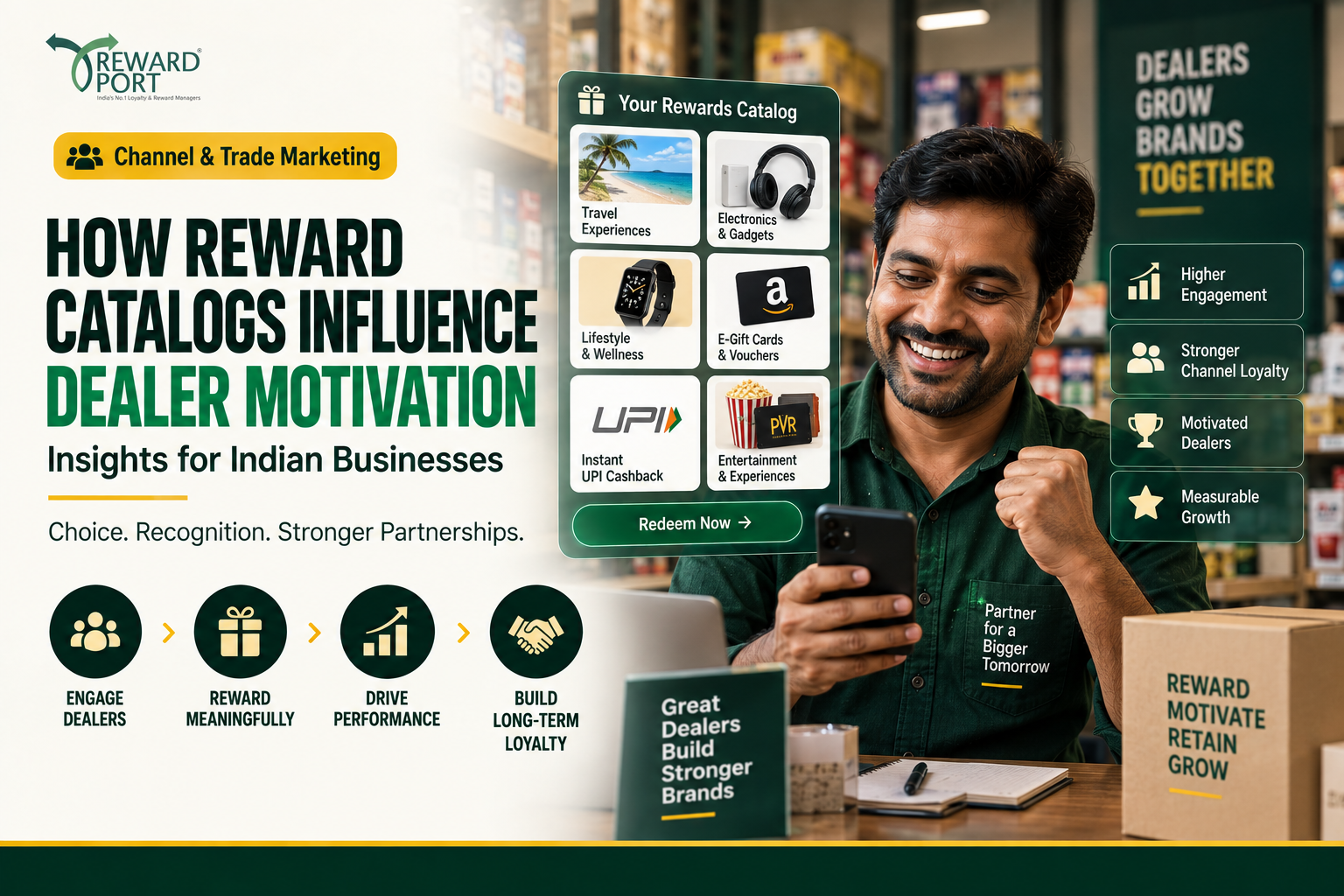
How Reward Catalogs Influence Dealer Motivation: Insights for Indian Businesses
In India’s dynamic trade ecosystem, motivating dealers is pivotal for brands aiming to enhance sales performance and channel engagement. Reward catalogs are becoming a strategic tool to inspire dealer motivation, offering tailored, relevant incentives that directly impact participation and loyalty. Understanding how reward catalogs influence dealer motivation helps businesses craft effective incentive programs driving measurable business outcomes in 2026 and beyond.
Market Context and Dealer Behaviour in India
Indian dealers today operate in a digitally empowered environment, with increased expectations for instant gratification, personalised rewards, and seamless user experiences. The proliferation of mobile internet and digital payments (especially UPI) has set new benchmarks. Dealers are more receptive to incentive programs that offer tangible, easily redeemable rewards that align with their personal and professional aspirations.
Emerging Trends in Reward Catalogs for 2026
The influence of reward catalogs on dealer motivation is shaped by several forward-looking trends:
- Hyper-Personalized and Dynamic Catalogs: AI-powered catalogs suggest rewards based on dealer preferences and sales history, increasing engagement and redemption rates significantly.
- Instant and Digital Rewards: Instant cashback through UPI, e-gift cards, and digital vouchers meet modern dealers’ demand for speedy rewards.
- Experiential Rewards: Travel, skill workshops, and exclusive experiences build emotional connection and long-term loyalty beyond financial incentives.
- Wellness and Lifestyle Incentives: Health check-ups, fitness subscriptions, and wellness apps reflect a growing priority on dealer well-being post-pandemic.
- Mobile-First User Experience: Mobile-responsive, intuitive platforms ensure easy redemption, driving higher participation rates.
- Gamification and Tiered Catalogs: Leaderboards, badges, and tiered rewards promote healthy competition and aspiration among dealers.
Implications for B2B and Channel Marketers
For Indian manufacturers, distributors, and brands, integrating these trends into dealer incentive programs offers clear benefits:
- Higher Participation & Redemption: Personalized and instant reward options motivate dealers to actively engage and redeem.
- Repeat Performance & Loyalty: Tiered and experiential rewards encourage repeat sales and long-term channel partner loyalty.
- Enhanced Channel Activation: Gamified elements and choice-based catalogs spur competitive sales efforts.
- Improved Dealer Satisfaction: Wellness and lifestyle incentives communicate care beyond just business, deepening dealer relationships.
RewardPort Perspective and Solutions
RewardPort leverages deep expertise in channel partner incentive programs, offering customisable digital reward catalogs aligned with evolving dealer preferences. Our platform supports multi-brand vouchers, instant UPI cashback, experiential travel rewards through AirPac and VacPac, and tiered loyalty tiers with gamified engagement. The seamless mobile-first experience and real-time campaign analytics ensure measurable ROI and continuous optimisation.
Verified RewardPort Case Study Insight
In a channel incentive program, RewardPort integrated tiered reward catalogs featuring movie tickets, digital vouchers, and travel incentives for a leading FMCG client. The program achieved higher dealer engagement and repeat purchase, demonstrating how a well-curated reward catalog boosts dealer motivation effectively.
Practical Recommendations for Implementation
- Use Data-Driven Personalization: Leverage dealer sales data to offer relevant, appealing rewards in catalogs.
- Incorporate Instant Digital Rewards: Facilitate rapid gratification via mobile-friendly platforms with UPI cashback and e-vouchers.
- Include Experiential Options: Add unique experiences that build emotional bonding and differentiate from competitors.
- Design Gamified and Tiered Systems: Reward incremental dealer performance with clear tiers and gamified elements.
- Ensure Seamless Mobile Access: Optimize reward catalog platforms for mobile-first usage to increase accessibility and ease of redemption.
Reward catalogs influence dealer motivation by offering personalised, instant, and experiential incentives that drive active participation and loyalty in India’s competitive trade channels. In 2026, leveraging these catalogs with a mobile-first, data-driven strategy aligned to dealer preferences is essential for brands and channel leaders aiming for robust sales growth and long-term channel engagement.

When AI Chooses What Consumers Buy, What Happens to Brand Loyalty?
For decades, brands competed for consumer attention.
They fought for:
- Search visibility
- Shelf presence
- Marketplace ranking
- Advertising recall
- Social media engagement
The consumer still made the final decision.
They compared options, read reviews, explored alternatives and selected a brand.
But commerce is entering a new phase.
Artificial intelligence is moving from helping consumers find products to helping them decide what to buy.
This shift changes the marketing challenge.
The question is no longer only:
“How do we get noticed?”
It becomes:
“How do we remain preferred when AI is helping someone choose?”
Brand loyalty does not become less important in this environment.
It becomes more valuable.
The brands that build strong direct relationships, understand consumer preferences and create meaningful reasons for customers to choose them will have a stronger advantage in AI-mediated commerce.
At RewardPort, we believe the next generation of loyalty will require what we call:
Loyalty Moat for Agentic Commerce
A framework designed to help brands build stronger consumer relationships before autonomous shopping becomes mainstream.
Key Takeaways
- AI is moving from search assistance towards decision assistance and transaction support.
- Brand visibility alone may not guarantee consideration when AI narrows choices for consumers.
- Loyalty programs must evolve beyond points accumulation towards stronger preference creation.
- First-party consumer relationships will become increasingly valuable.
- Promotions, rewards, warranties and post-purchase engagement can help brands build direct connections.
- Brands should start building a Loyalty Moat for Agentic Commerce.
AI Is Moving From Search to Decision
Traditional digital marketing focused on winning attention.
Brands competed to appear:
- Higher in search results
- More prominently on marketplaces
- More frequently in advertising
- More visibly on social platforms
The consumer then completed the evaluation process.
AI changes this journey.
Shopping assistants can increasingly help consumers:
- Discover products
- Compare options
- Understand features
- Evaluate alternatives
- Make purchase decisions
Research from NIQ highlights the growing role of AI in product discovery and purchase journeys.
Technology platforms are also building commerce infrastructure that allows AI systems to participate further in shopping journeys.
Google’s Universal Commerce Protocol is designed to support commerce interactions between AI agents and retailers, while Universal Cart enables consumers to manage products from multiple merchants within a connected shopping experience.
Source:
https://blog.google/products-and-platforms/products/shopping/google-shopping-cart/
Open Ai’ Agentic Commerce Protocol similarly focuses on enabling interactions between consumers, AI agents and merchants to support purchasing experiences.
Source:
https://openai.com/index/buy-it-in-chatgpt/
The infrastructure for AI-assisted commerce is already developing.
What Is Agentic Commerce?
Agentic commerce refers to a shopping model where AI performs part of the discovery, evaluation, recommendation or transaction process on behalf of consumers.
The level of AI involvement can vary.
Today, a consumer may ask:
“Which smartphone should I buy under ₹30,000?”
The AI compares options.
Tomorrow, the interaction could become:
“Choose the best option under ₹30,000 with good battery life and delivery before Saturday.”
The consumer defines the objective.
The AI helps execute the journey.
This creates a major shift for marketers.
The brand may no longer compete only for human attention.
It may also need to remain relevant within machine-assisted decision-making.
What Happens If Consumers Never See the Shelf?
Traditional buying behavior gives brands many opportunities to influence decisions.
A consumer walking through a store may notice:
- Packaging
- Promotions
- Brand familiarity
- Displays
- Recommendations
An online shopper may compare:
- Reviews
- Prices
- Features
- Offers
But an AI-assisted shopper may receive only a few recommendations.
Imagine a consumer asking:
“Recommend a protein snack for my child with low sugar under ₹50.”
Instead of comparing dozens of products, the consumer receives a shortlist.
The marketing challenge changes.
Brands must move from:
How do we appear?
to:
How do we remain preferred?
This affects categories including:
- Consumer electronics
- Appliances
- Beauty
- Packaged foods
- Travel
- Insurance
- Financial products
- Fashion
- Household products
Does AI Make Brands Less Important?
Not necessarily.
Trusted brands may become even more important.
AI systems require signals to understand what consumers value.
Those signals can include:
- Past purchases
- Loyalty membership
- Brand preference
- Reviews
- Product experience
- Consumer feedback
A consumer may tell an AI assistant:
“Choose my usual brand unless another option is significantly better.”
That preference becomes a powerful signal.
Google has already introduced identity-linked loyalty capabilities within its commerce ecosystem, allowing participating shopping experiences to recognise retailer-linked information such as loyalty benefits.
Source:
https://blog.google/products-and-platforms/products/shopping/ucp-updates/
The future of loyalty is not necessarily disappearing.
It is evolving into:
Portable consumer preference.
RewardPort’s Loyalty Moat for Agentic Commerce
Brands should begin thinking about loyalty as a connected system.
A strong loyalty moat consists of six layers:
1. Recognition
Does the brand know who the customer is?
Anonymous purchases create limited relationship value.
Recognition converts an unknown buyer into a known consumer.
Brands can build recognition through:
- QR registration
- Warranty activation
- Membership
- WhatsApp opt-in
- Purchase verification
- Cashback redemption
- Referral programs
- Contest participation
The objective is not only immediate sales.
It is creating a relationship foundation.
2. Permission
Can the brand continue the relationship?
Knowing a customer exists is different from having permission to engage.
Brands need clear value exchanges.
Consumers may provide permission in return for:
- Loyalty benefits
- Rewards
- Warranty support
- Personalized offers
- Product education
- Service updates
- Exclusive access
As AI-driven commerce grows, direct communication channels become increasingly valuable.
3. Preference
Why would a customer choose the brand again?
Many loyalty programs measure activity.
But activity does not always equal preference.
A customer collecting points may not necessarily prefer the brand.
True preference means:
“When I have a choice, I want this brand.”
Brands should understand signals such as:
- Repeat purchase
- Purchase frequency
- Reward choices
- Category preference
- Referrals
- Engagement behavior
- Response to offers
The goal is not only tracking transactions.
The goal is understanding preference.
4. Reward
What value changes behavior?
Rewards remain an important part of loyalty.
But the reward itself is not the strategy.
The strategy is understanding:
Which value is meaningful for which customer?
Different consumers may value different benefits.
Examples:
- Cashback for immediate value
- Entertainment benefits for engagement
- Travel experiences for aspiration
- Lifestyle rewards for premium audiences
- Practical vouchers for everyday needs
A reward catalogue supports loyalty.
It does not create loyalty by itself.
The behavior strategy comes first.
5. Direct Relationship
Can the brand maintain a connection without depending completely on intermediaries?
As AI shopping grows, brands may increasingly compete through platforms, marketplaces and AI agents.
The brands that maintain direct consumer relationships will have a stronger advantage.
That relationship can begin through:
Purchase → Verification → Benefit → Permission → Engagement
The transaction may happen through an intermediary.
The relationship can still belong to the brand.
6. Re-Engagement
How does the brand strengthen preference over time?
The future of loyalty is not sending discounts repeatedly.
It is creating relevant interactions.
Brands can:
- Recognize milestones
- Recommend relevant products
- Reward meaningful behavior
- Encourage referrals
- Reactivate inactive customers
- Personalize engagement
The objective:
Make consumer preference stronger over time.
Loyalty Benefits Will Need to Become AI-Readable
Today, loyalty programs are primarily designed for humans.
Consumers understand:
- Gold membership
- Reward points
- Cashback offers
- Exclusive benefits
- Free delivery
But as AI systems increasingly participate in shopping decisions, loyalty benefits may also need to become structured and understandable for machines.
Future AI shopping assistants may need to understand:
- Is the consumer a loyalty member?
- What benefits are available?
- Can rewards be applied?
- Does the customer have preferred status?
- Are there personalized offers available?
- Does buying directly create additional value?
Google’s commerce ecosystem already indicates movement towards identity-linked loyalty experiences where benefits can be recognized within shopping journeys.
Source:
https://blog.google/products-and-platforms/products/shopping/ucp-updates/
This creates a new opportunity.
Loyalty is no longer only about communicating benefits to customers.
It may also become about making those benefits visible to systems acting on behalf of customers.
Could AI Expose Weak Loyalty Programs?
AI-assisted commerce may create challenges for brands that rely only on discounts.
Consider a consumer instruction:
“Buy my usual coffee unless another equally rated option is 20% cheaper.”
An AI system can continuously compare:
- Price
- Reviews
- Availability
- Offers
- Alternatives
If price is the only reason a customer stays, AI may make switching easier.
This creates a risk for discount-led loyalty.
Strong loyalty requires deeper reasons to choose a brand.
These can include:
- Trust
- Familiarity
- Product experience
- Service quality
- Warranty
- Exclusive access
- Membership benefits
- Personal relevance
- Emotional connection
The future advantage will belong to brands that build preference, not only promotions.
AI Can Also Make Loyalty More Intelligent
The conversation around AI and loyalty should not only focus on disruption.
AI can also improve how brands understand and engage customers.
Future loyalty systems can potentially identify:
- What customers regularly purchase
- When they may need replenishment
- Which rewards they value
- Which incentives are unnecessary
- Which products are relevant next
- When a customer is becoming inactive
- Which intervention has worked previously
This can transform loyalty from:
Everyone receives the same offer
to:
Each customer receives the most relevant next action.
The objective is not simply increasing rewards.
It is improving relevance.
Why India Could Experience AI Commerce Differently
India’s consumer journey is already highly fragmented.
Customers move across:
- Physical stores
- Marketplaces
- Quick commerce
- Social platforms
- Messaging apps
- Brand websites
The future journey may not be:
Website → AI Assistant → Purchase
Instead, it may look like:
Creator → AI → Marketplace → Store → QR → WhatsApp → UPI → Loyalty → AI-assisted Repurchase
The winning brands may not be those with the highest number of channels.
They may be those that can recognize the same consumer across multiple interactions.
Meta and the Retailers Association of India highlighted the growing importance of omnichannel shopping behaviour in India, including online research before offline purchase and offline research before online purchase.
Google has also expanded AI-powered shopping experiences in India through Gemini and AI Mode.
What Should CMOs Do Now?
Brands do not need to wait for fully autonomous shopping.
They can begin preparing today.
1. Convert Anonymous Buyers Into Known Consumers
The first step is building recognition.
Brands should identify moments where consumers have a reason to connect directly.
Examples:
- Product registration
- Warranty activation
- QR engagement
- Cashback redemption
- Loyalty enrolment
- Customer support interaction
A known customer creates relationship possibilities.
2. Audit Loyalty Beyond Points
Brands should ask:
Does the program create genuine preference?
Or does it only distribute discounts?
A successful loyalty program should understand:
- Why customers return
- What benefits they value
- What behaviors indicate preference
3. Build First-Party Behavioral Signals
AI-powered engagement requires quality signals.
Brands should understand:
- Purchase frequency
- Reward preference
- Engagement behavior
- Product interest
- Repeat behavior
- Referral activity
Data should create better experiences, not just better reports.
4. Connect Promotions With Loyalty
A promotion should not end when the reward is delivered.
The customer journey can continue:
Purchase
↓
Verification
↓
Reward
↓
Permission
↓
Relationship
↓
Repeat Engagement
Consumer promotions can become entry points into deeper loyalty ecosystems.
5. Make Benefits More Portable
As commerce becomes more connected, customers will expect benefits to move with their identity.
Brands should think about:
- Membership recognition
- Reward availability
- Warranty access
- Consumer preferences
- Purchase history
The future of loyalty may depend on whether benefits can travel with the customer.
6. Measure Preference, Not Only Redemption
A high redemption rate tells brands:
“Customers liked receiving value.”
It does not necessarily mean:
“Customers became more loyal.”
Brands should measure:
- Repeat purchase
- Retention
- Preference signals
- Direct engagement
- Referral behavior
- Incremental behavior after incentives
How RewardPort Helps Brands Build Future-Ready Loyalty
RewardPort helps brands create consumer engagement ecosystems combining:
- Consumer promotions
- Loyalty programs
- Cashback campaigns
- QR-based engagement
- WhatsApp engagement journeys
- Digital reward fulfilment
- Personalized rewards
The objective is to help brands move from one-time transactions towards continuous relationships.
A typical journey can look like:
Consumer Purchase
↓
Verification & Identification
↓
Reward Experience
↓
Consumer Permission
↓
Personalized Engagement
↓
Repeat Purchase & Loyalty
As AI changes how consumers discover and buy products, owning the relationship becomes increasingly important.
Measuring Loyalty in an AI-Assisted Commerce World
Brands should move beyond traditional loyalty metrics.
Consumer Identity Metrics
- Known consumer rate
- Registration rate
- Opt-in percentage
- Profile completeness
Engagement Metrics
- Repeat purchase
- Purchase frequency
- Reward interaction
- Content participation
- Referral behavior
Reward Metrics
- Redemption rate
- Reward preference
- Cost per incremental action
- Reward effectiveness
Relationship Metrics
- Direct consumer engagement
- Retention after incentives
- Reactivation
- Category expansion
Operational Metrics
- Purchase verification success
- Fraud prevention
- Fulfilment performance
- Customer support experience
The objective is not simply measuring rewards.
It is measuring whether preference is becoming stronger.
The Future of Loyalty: From Points to Preference
For many years, loyalty was defined by:
Earn points → Collect points → Redeem points
That model still has value.
But the future will require more.
Brands will need to create systems where consumers:
- Are recognized
- Give permission
- Develop preference
- Receive relevant value
- Maintain direct relationships
- Continue engaging
This is the foundation of a stronger loyalty moat.
AI-assisted commerce will change how consumers discover, compare and purchase products.
But it will not eliminate brand loyalty.
It will redefine it.
The brands that succeed will not only be those that appear in AI recommendations.
They will be those that consumers already prefer.
Building that preference requires a stronger approach:
Loyalty Moat for Agentic Commerce
Recognition
Know the consumer.
Permission
Earn the right to continue the relationship.
Preference
Create reasons to choose the brand.
Reward
Deliver meaningful value.
Direct Relationship
Maintain connection beyond transactions.
Re-engagement
Strengthen loyalty over time.
The future of loyalty is not about having more points.
It is about building relationships strong enough to survive when AI starts making choices alongside consumers.
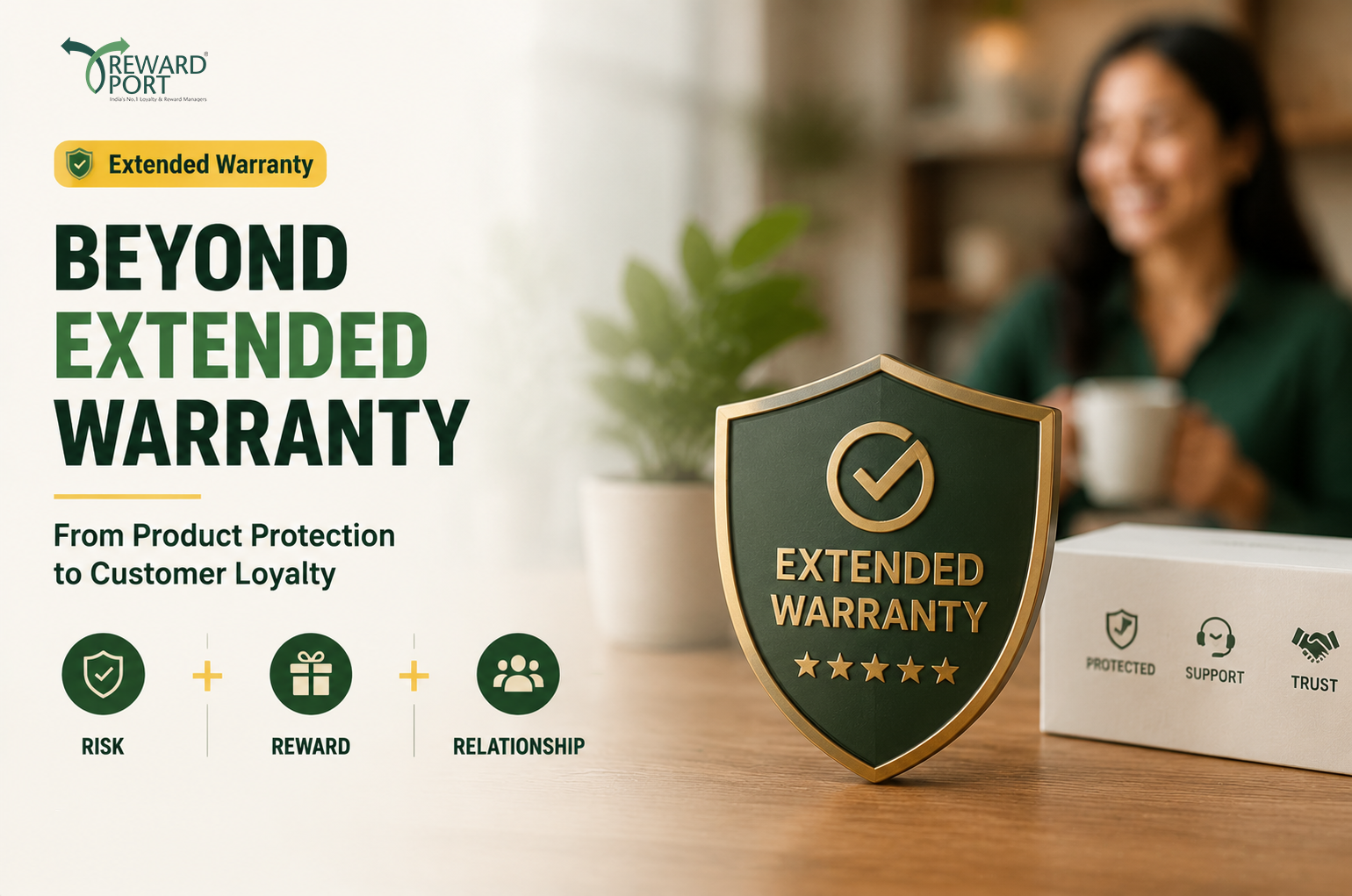
Can Extended Warranty Become Retail’s Next Loyalty Platform?
Extended warranty is changing.
What began as a relatively simple promise to cover repair risk is becoming broader, more flexible and more deeply connected to the ownership journey.
Samsung is expanding appliance protection into areas such as software support and scheduled maintenance. Godrej is using long-duration comprehensive warranty as a visible trust proposition. Apple has evolved device protection toward flexible, ongoing coverage models.
The next step may be even more important for retailers:
Can warranty evolve from a cost-of-failure product into a loyalty asset that creates value throughout ownership?
That means combining:
Risk + Reward + Relationship
The opportunity is to stop thinking about warranty purely as something customers use when a product fails and start exploring its potential as a post-purchase relationship layer.
Warranty Is Becoming a Marketing Proposition, Not Just a Service Promise
In April 2026, Godrej Appliances announced a five-year comprehensive warranty across a broad appliance portfolio and explicitly positioned the move around trust and loyalty.
That signals an important shift.
Warranty is no longer only something explained after a customer decides what to buy.
It can become part of the reason to buy.
When protection becomes visible at the consideration stage, it can communicate confidence, reassurance and commitment to the ownership experience.
Samsung Is Expanding What Protection Means
Samsung India expanded Samsung Care+ to cover more home appliances, including refrigerators, washing machines, air conditioners, microwaves and smart TVs.
Samsung also highlighted capabilities such as software-update and screen-malfunction protection, service tracking and scheduled-maintenance reminders.
The company also bundled a buy-one-year, get-two-years extended warranty offer around a refrigerator launch in April 2026.
The broader implication is important.
Warranty can simultaneously become:
Purchase Incentive → Service Promise → Ownership Experience → Marketing Differentiator
That takes protection beyond a back-end service function.
Apple Is Turning Protection Into a Relationship That Follows the Customer
Apple introduced AppleCare One in the US in July 2025, allowing customers to cover multiple devices under one monthly subscription and add or remove products as their ownership changes.
Apple subsequently expanded AppleCare+ coverage options in India, including monthly and annual plans and Theft and Loss protection for eligible iPhones.
The broader pattern is becoming clearer:
Protection is becoming more continuous, flexible, service-led and relationship-driven.
But there is still a fundamental challenge.
Most Warranty Programs Have One Structural Problem
They become most valuable when something goes wrong.
A customer pays for protection.
Then the customer, retailer and provider all hope it never needs to be used.
From a risk-management perspective, that makes sense.
From a loyalty perspective, however, it creates a missed opportunity.
The important question becomes:
What value could the customer receive while nothing is broken?
That is where warranty starts moving closer to loyalty.
From Risk to Risk + Reward + Relationship
A useful way to understand the evolution is through three stages.
Warranty 1.0: Risk
Something fails → Repair or replacement support according to the plan
Protection is the core value proposition.
Warranty 2.0: Risk + Service
Protection is supplemented with useful ownership support such as:
- Technical assistance
- Product guidance
- Service reminders
- Diagnostics
- Maintenance support
- Installation assistance
The relationship becomes more useful even before a major failure.
Warranty 3.0: Risk + Reward + Relationship
Now the ownership journey can potentially include positive value even when no claim occurs.
For example:
- Maintenance rewards
- Anniversary benefits
- Upgrade benefits
- Family benefits
- Assistance services
- Lifestyle privileges
- Referral recognition
- Trade-in benefits
- Next-purchase advantages
The warranty is no longer simply waiting for failure.
It becomes part of the customer’s ongoing relationship with the retailer or brand.
The Retailer Has an Advantage Individual Brands Do Not
Think about a typical household.
The television may come from Brand A.
The washing machine may come from Brand B.
The refrigerator may come from Brand C.
The air conditioner may come from Brand D.
But all four products could have been purchased from the same retailer.
That creates an interesting opportunity for consumer-durable retailers.
Instead of saying:
“Here is your extended warranty for this appliance.”
the retailer could potentially say:
“You are now part of our ownership program.”
The relationship shifts from one product to the household.
What Could a Modern Ownership Program Include?
A modern ownership relationship can be considered across five layers:
1. Protection
Protection remains the foundation.
Customers need confidence that the program will support them according to its defined terms when something goes wrong.
2. Assistance
Provide relevant support outside formal claims.
This might include product guidance, approved troubleshooting, maintenance information or service coordination.
3. Engagement
Create useful reasons for the customer to remain connected throughout the ownership lifecycle.
4. Reward
Introduce positive moments that recognize ownership, maintenance, milestones or other relevant behaviors.
5. Progression
Turn one protected product into a broader and potentially longer customer relationship.
Together, these create:
Protection → Assistance → Engagement → Reward → Progression
An Illustrative Refrigerator Ownership Journey
Consider how the experience around one appliance could evolve.
Day 1
Purchase + Protection Activated
Day 3
Installation Check + Digital Product Guide
Month 3
AI Assistance for Product Questions
Month 6
Preventive-Care Reminder
Month 12
Ownership Anniversary Benefit
Month 18
Family or Lifestyle Benefit
Month 24
Maintenance Prompt
Month 36
Upgrade Eligibility or Extension Offer
Anytime
Claims Coordination and Support
Next Appliance Purchase
Ownership Status Carries Forward
Protection remains central.
But protection becomes the entry point rather than the entire proposition.
Why Embed Rewards Into the Ownership Journey?
Because risk is largely invisible when everything works.
Rewards can create positive moments inside a product traditionally associated with negative events.
Imagine messages such as:
“Your appliance has completed one year. Here is an ownership benefit.”
“Your preventive service is complete. You have unlocked your next benefit.”
“You now have three products registered with us. Your household status has been upgraded.”
The psychological association changes.
Warranty stops being connected only with:
Breakdown → Claim → Repair
It can also become connected with:
Care → Recognition → Continuity
Rewards Cannot Compensate for Poor Protection
This distinction is critical.
No lifestyle benefit can compensate for:
- Poor claims handling
- Confusing exclusions
- Delayed repairs
- Weak service
- Poor customer communication
The hierarchy should always remain:
Trust First → Service → Engagement → Reward
Protection has to work before loyalty can be layered on top of it.
The Economics Could Also Change
Traditional warranty economics can be viewed simply as:
Warranty Revenue – Claims – Operating Cost
But an ownership relationship creates additional potential sources of value.
Ownership Relationship Economics
Protection Economics + Retention + Repeat Purchase + Referral + Service + Upgrade Value – Reward & Engagement Cost
This does not automatically make every ownership program profitable.
It does, however, create more ways for retailers to evaluate the investment.
Instead of measuring only the economics of claims, retailers can ask:
Does the protection relationship improve the economics of the customer lifecycle?
Retailers Should Think at Household Level, Not Product Level
Most warranties are organised around individual products.
Consumers live in households.
A retailer could potentially build a household ownership account that helps customers understand:
- Which products they own
- Which products are protected
- What requires service
- What protection expires next
- Which benefits are available
- Which upgrade opportunities exist
This creates a more useful relationship than treating every appliance as a disconnected warranty contract.
AI May Become Particularly Useful in the Ownership Journey
Customers frequently need assistance with:
- Product features
- Settings
- Connectivity
- Maintenance
- Error codes
- Troubleshooting
- Service requirements
A conversational AI layer could potentially identify the registered model, understand the relevant protection status, offer approved troubleshooting information and help determine whether service is required.
Where appropriate, it could then help move the customer into a service or support journey.
The goal should not be AI for its own sake.
It should be:
Faster understanding → Appropriate assistance → Better ownership experience
The Loyalty Opportunity Starts After the Sale
Retailers invest heavily in acquiring customers and getting them to the transaction.
Protection creates a legitimate reason for the retailer to remain connected after that transaction.
That makes extended warranty interesting not merely as an attach-rate product, but as a potential post-purchase relationship engine.
The customer has already bought.
The next opportunity is to build the relationship around ownership.
What Should Retailers Measure?
A broader ownership program requires a broader measurement framework.
Protection Metrics
- Attach rate
- Renewal
- Claims rate
- Claim acceptance
- Resolution time
- Servicing cost
- Customer satisfaction
Engagement Metrics
- Product registrations
- Active households
- Maintenance interactions
- Assistance usage
- Anniversary engagement
Reward Metrics
- Reward activation
- Redemption
- Reward cost
- Reward preference
- Cost per retained customer
Commercial Metrics
- Repeat purchase
- Category expansion
- Upgrade rate
- Referral rate
- Customer lifetime value
The central question becomes:
Does the protection program improve the economics of the customer relationship, not simply the economics of the claim?
A Practical Roadmap for Retailers
Phase 1: Improve Protection
Ensure the core protection proposition is clear, trustworthy and operationally sound.
Phase 2: Add Assistance
Introduce useful support throughout the ownership journey.
Phase 3: Build Ownership Identity
Connect products and customers into an ongoing ownership relationship.
Phase 4: Add Useful Engagement
Create relevant reasons to interact outside claims.
Phase 5: Add Rewards Selectively
Use rewards where they strengthen useful behaviours, milestones or relationship moments.
Phase 6: Measure Lifecycle Impact
Assess whether the program improves retention, repeat purchase, category expansion, referrals and overall customer value.
Where RewardCare Fits
RewardCare is designed around this broader concept of product ownership.
It can sit alongside an existing warranty provider and add layers such as:
- Activation
- Customer assistance
- Claims coordination
- AI-enabled product help
- Engagement
- Rewards
- Fulfilment
- Reporting
The larger idea is more important than the product name:
Protection becomes the anchor for an ongoing customer relationship.
This section should be fact-checked against RewardPort’s current RewardCare capabilities before publication, as specifically requested in the source brief.
The most successful warranty products have traditionally answered one question:
“What happens if something goes wrong?”
The next generation may need to answer another question too:
“What do I get while everything is going right?”
That creates a broader model:
Risk + Reward + Relationship
Risk creates reassurance.
Reward creates positive moments.
Relationship creates long-term value.
Extended warranty does not need to stop being a protection product.
But for retailers, protection could become the starting point for something much bigger.
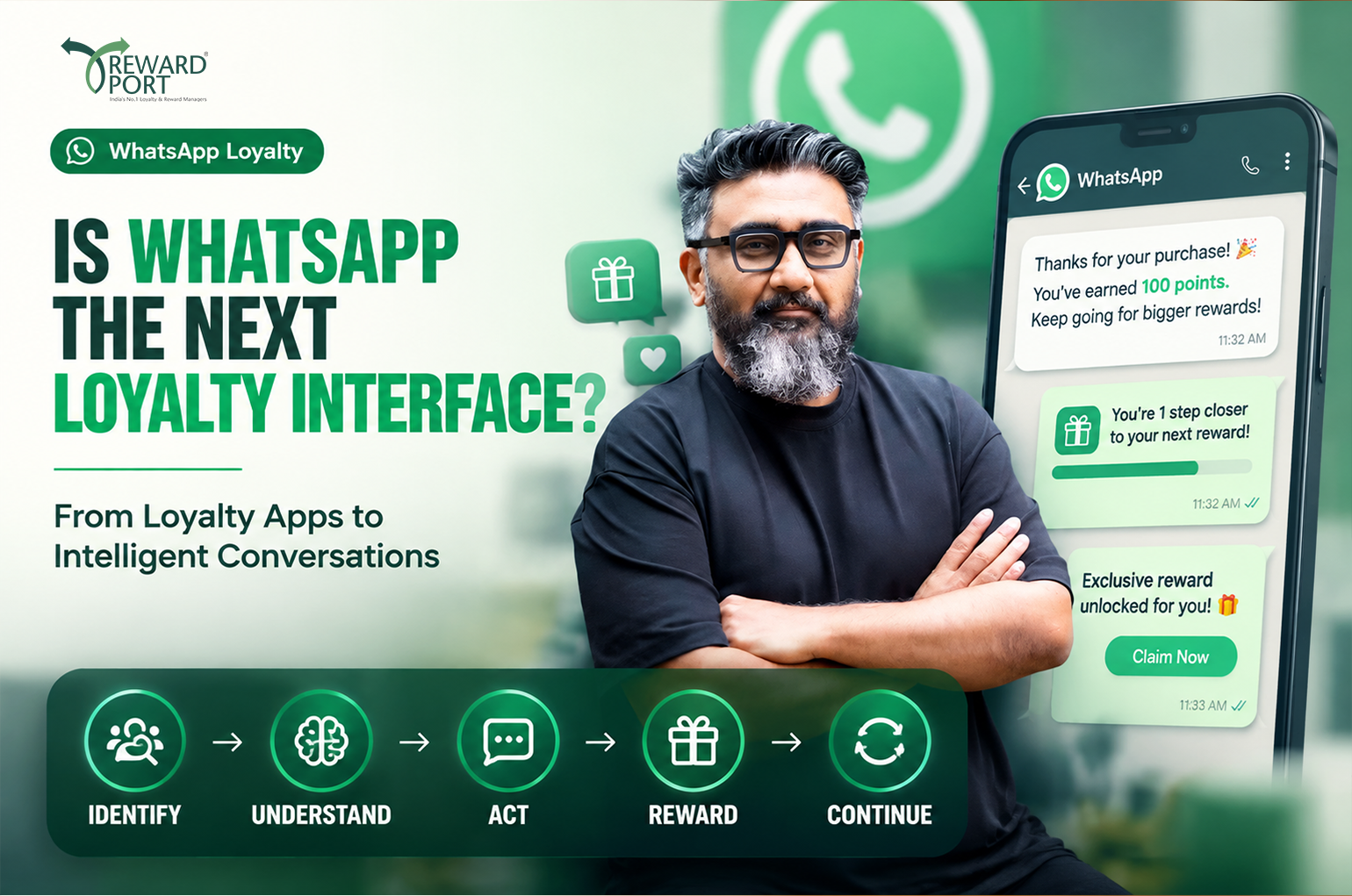
Is WhatsApp Becoming the New Loyalty Platform? What Kunal Shah, AI and Conversational Commerce Could Mean for Brands
WhatsApp is moving well beyond messaging.
In India, consumers can already use it for payments, prepaid mobile recharges, metro ticketing, business conversations and other everyday services. Meta is also introducing AI capabilities that can answer questions, recommend products, capture leads, book appointments and facilitate increasingly sophisticated commercial interactions.
At the same time, CRED founder Kunal Shah has been appointed global head of WhatsApp.
For loyalty leaders, these developments belong in the same conversation.
The question is no longer simply:
Should a brand use WhatsApp to communicate with loyalty members?
The more interesting question is:
Could WhatsApp become the interface through which loyalty itself happens?
The discussion below explores that possibility. It is a strategic interpretation of WhatsApp’s evolving capabilities—not a claim about Meta’s future product roadmap.
Kunal Shah Now Runs WhatsApp. Loyalty Leaders Should Pay Attention.
In June 2026, Meta appointed Kunal Shah, founder of CRED, as global head of WhatsApp, succeeding Will Cathcart.
Shah’s career has revolved around payments, rewards, membership, financial services, repeat behavior and customer engagement.
There is no evidence that WhatsApp will become CRED.
But the overlap between Shah’s experience and WhatsApp’s evolving direction makes the development particularly interesting for loyalty leaders.
The bigger question is what happens when a platform already embedded in consumers’ daily behavior becomes increasingly capable of supporting commerce, payments, AI and customer service.
WhatsApp Is Becoming a Place Where People Do Things, Not Just Talk
WhatsApp’s role in India has steadily expanded beyond person-to-person messaging.
Meta has added prepaid mobile recharges and access to UPI payments and metro services. It has also been expanding WhatsApp’s capabilities for businesses.
That changes the strategic role of the platform.
WhatsApp is increasingly becoming an environment where a conversation can potentially lead to an action without forcing the customer to move across multiple disconnected interfaces.
For loyalty programs, that matters.
Then Came Business AI
Meta launched Business AI on WhatsApp for small businesses in India in May 2026.
According to Meta, Business AI can support activities such as:
- Answering customer questions
- Capturing leads
- Booking appointments
- Recommending products
- Handing complex conversations back to a business owner
Meta also said Business AI would begin facilitating UPI payments directly inside chats.
The significance for loyalty is not simply automation.
It is the possibility of bringing understanding, action and transaction into the same conversational environment.
WhatsApp Is Increasingly Being Positioned as a Commerce Engine
Meta has described WhatsApp as an emerging commerce engine connecting discovery, purchase and post-purchase journeys within conversations.
The company has also highlighted the broader movement of Indian e-commerce from traditional search-and-transact journeys toward discovery, AI, short-form video and conversational messaging.
This raises an important question for brands:
If discovery, service and transactions can increasingly happen conversationally, why should every loyalty interaction require a separate destination?
Loyalty Has Historically Been a Destination
Most traditional loyalty programs ask customers to go somewhere.
Download an app.
Log in.
Check the balance.
Browse the catalogue.
Choose a reward.
Redeem.
Return later.
That model works particularly well in categories such as airlines, hotels, banking and large marketplaces, where customers may have sufficient reasons to engage frequently with a dedicated environment.
But not every consumer brand has enough standalone utility to justify another app or loyalty destination.
This creates what we can call the loyalty destination problem.
WhatsApp could change that relationship.
What If Loyalty Became a Conversation Instead?
Imagine a customer asking:
“How many points do I have?”
“I bought another pack today. Does my streak continue?”
“What can I redeem for my family?”
“My reward hasn’t arrived. Can you help?”
In a connected loyalty environment, these questions could potentially be answered without forcing customers to navigate through a separate interface.
Instead of asking customers to learn the program’s navigation structure, the program could begin understanding the customer’s intent.
That creates a different model for loyalty engagement.
The Conversational Loyalty Loop
A potential conversational loyalty journey can be expressed as:
Identify → Understand → Act → Reward → Continue
Identify
Recognizes the participant appropriately.
Understand
Connect relevant loyalty, transaction, status and service context.
Act
Allow the customer to verify, ask, register, redeem or request assistance.
Reward
Trigger the appropriate reward, benefit or response.
Continue
Make the next useful action clear.
The experience becomes less about navigating a loyalty system and more about having a useful interaction with it.
This Is Different From Putting a Chatbot on Top of Loyalty
Traditional WhatsApp automation is often menu-driven.
A customer may receive options such as:
Press 1 for Balance
Press 2 for Rewards
Press 3 for Support
Generative AI introduces the possibility of a different experience.
Instead of requiring customers to understand the menu, the system can potentially understand the customer’s request.
The interface moves from:
Navigation → Understanding
That distinction could significantly influence how future loyalty journeys are designed.
Why Kunal Shah Arrival Makes the Question More Interesting
Shah has spent years working around a fundamental consumer-engagement challenge:
How do you make people come back?
WhatsApp already possesses something most loyalty programs spend significant resources trying to create:
A high-frequency conversation habit.
This suggests an interesting potential architecture:
Messaging = Interface
Where the customer interacts.
AI = Understanding Layer
Where intent and context can be interpreted.
Payments = Transaction Layer
Where relevant transactions can happen.
Loyalty = Continuity Layer
Where past behavior, current status and the next valuable action are connected.
Again, this is not a claim about Meta’s roadmap.
It is a strategic possibility for how conversational loyalty could evolve.
Does This Mean Loyalty Apps Are Finished?
No.
The more useful question is:
Which loyalty interactions actually require a dedicated app?
Apps remain valuable when brands need:
- Complex account management
- Deep product or reward discovery
- Rich dashboards
- Extensive reward catalogues
- Location-based functionality
- High-frequency branded experiences
- Sophisticated member functionality
But many simpler loyalty interactions may not require a separate app.
Checking progress, asking about eligibility, finding a reward, reporting a missing benefit or understanding the next milestone could potentially happen conversationally.
The Loyalty App May Increasingly Become Infrastructure
The loyalty technology itself does not disappear.
The loyalty engine can remain behind the scenes.
So can:
CRM → Verification → Reward Fulfilment → Analytics → Fraud Controls → Transaction Systems
The difference is what the customer sees.
Instead of opening several screens, the customer may simply ask:
“What can I redeem?”
or:
“How close am I to my next reward?”
The technology becomes infrastructure.
Conversation becomes the experience.
Why India May Be Particularly Suited to Conversational Loyalty
India combines several behaviors and infrastructure layers that make conversational loyalty particularly interesting:
- Widespread WhatsApp usage
- UPI adoption
- Familiarity with QR-led interactions
- Mobile-first behavior
- Multilingual markets
- Large retailer and dealer ecosystems
- Increasing conversational commerce adoption
Meta cited a 2025 Kantar study stating that 91% of online adults in India chat with a business weekly.
For loyalty leaders, this means the conversational habit may already exist.
The challenge is turning that habit into genuinely useful loyalty interactions.
Five Loyalty Journeys That Could Move Into WhatsApp
1. Consumer Promotion to Ongoing Relationship
A customer enters a promotion through a QR code or other campaign mechanic.
Instead of the relationship ending after reward fulfilment, WhatsApp could become a continuing engagement interface.
2. Repeat-Purchase and Streak Programs
Customers could potentially check progress, verify qualifying actions and understand their next milestone conversationally.
3. Dealer and Retailer Loyalty
Trade partners could interact with programs without constantly navigating complex portals for basic queries and actions.
4. Reward Discovery
Instead of browsing an extensive catalogue, participants could ask:
“What can I redeem for my family?”
or:
“Show me entertainment options within my balance.”
5. Service Recovery
Missing rewards, verification questions, failed fulfilment or eligibility issues could be handled in the same conversation.
But Conversational Loyalty Could Go Wrong Quickly
There is an obvious danger.
If conversational loyalty becomes:
SALE!
BUY NOW!
LAST CHANCE!
POINTS EXPIRING!
brands will simply move promotional spam into a more personal channel.
That could damage rather than strengthen the relationship.
The guiding principle should therefore be:
Usefulness before frequency.
The objective should not be sending more messages.
It should be making valuable customer actions easier.
Fraud and Trust Will Become Part of Loyalty Design
Moving loyalty into a conversational interface does not remove the need for robust infrastructure.
Conversational loyalty still requires:
- Identity controls
- Transaction validation
- Fraud monitoring
- Reward controls
- Data governance
- Appropriate consent and communication management
Meta itself continues to introduce anti-scam protections for WhatsApp.
Convenience cannot come at the expense of trust.
Five Rules for Conversational Loyalty
1. Utility Before Promotion
Every interaction should provide genuine value.
2. Conversation Before Navigation
Allow customers to express what they want instead of forcing them through unnecessary menus.
3. Context Before Volume
Use relevant customer context to improve interactions rather than simply increasing communication frequency.
4. Humans Still Matter
AI should know when a conversation requires human intervention.
5. Customer Data Must Create Customer Value
If a loyalty system knows more about a customer, that intelligence should result in greater relevance, convenience or value for that customer.
How Brands Should Prepare
Brands do not need to rebuild their entire loyalty architecture immediately.
A more practical approach is to start with one useful journey.
Step 1: Map Existing Loyalty Interactions
Identify everything customers currently need to do within the program.
Step 2: Identify What Can Happen Conversationally
Determine which interactions genuinely benefit from conversation.
Step 3: Map the Required Backend Systems
Understand which CRM, loyalty, verification, reward and transaction systems need to connect.
Step 4: Design Around Customer Questions
Start with what customers naturally ask rather than what menu structure is easiest to build.
Step 5: Define AI Boundaries
Determine what AI can answer or execute and when a human needs to intervene.
Step 6: Start With One High-Value Journey
Test conversational loyalty where it can solve a meaningful customer problem.
What Should Conversational Loyalty Measure?
Success should not be measured by message volume.
Brands should examine:
Adoption
Are customers choosing to use the conversational journey?
Utility
Are customers successfully completing the actions they intended?
Engagement
Does conversation encourage meaningful continued participation?
Commercial Impact
Does it influence repeat purchase, retention, redemption or another defined business behaviour?
Experience
Does it reduce friction and improve customer satisfaction?
Trust
Are customers comfortable using the channel for loyalty-related interactions?
The key metric is not:
How many WhatsApp messages did we send?
It is:
How many useful customer actions did the conversation make easier?
WhatsApp may not become the loyalty platform itself.
But it could increasingly become the loyalty interface.
The loyalty engine can stay behind the scenes.
The CRM can stay behind the scenes.
Verification and reward fulfilment can stay behind the scenes.
The customer may simply experience a conversation.
That changes the question loyalty leaders need to ask.
Instead of:
“How do we get customers to use our loyalty app?”
The next question could become:
“What should customers be able to ask their loyalty program?”
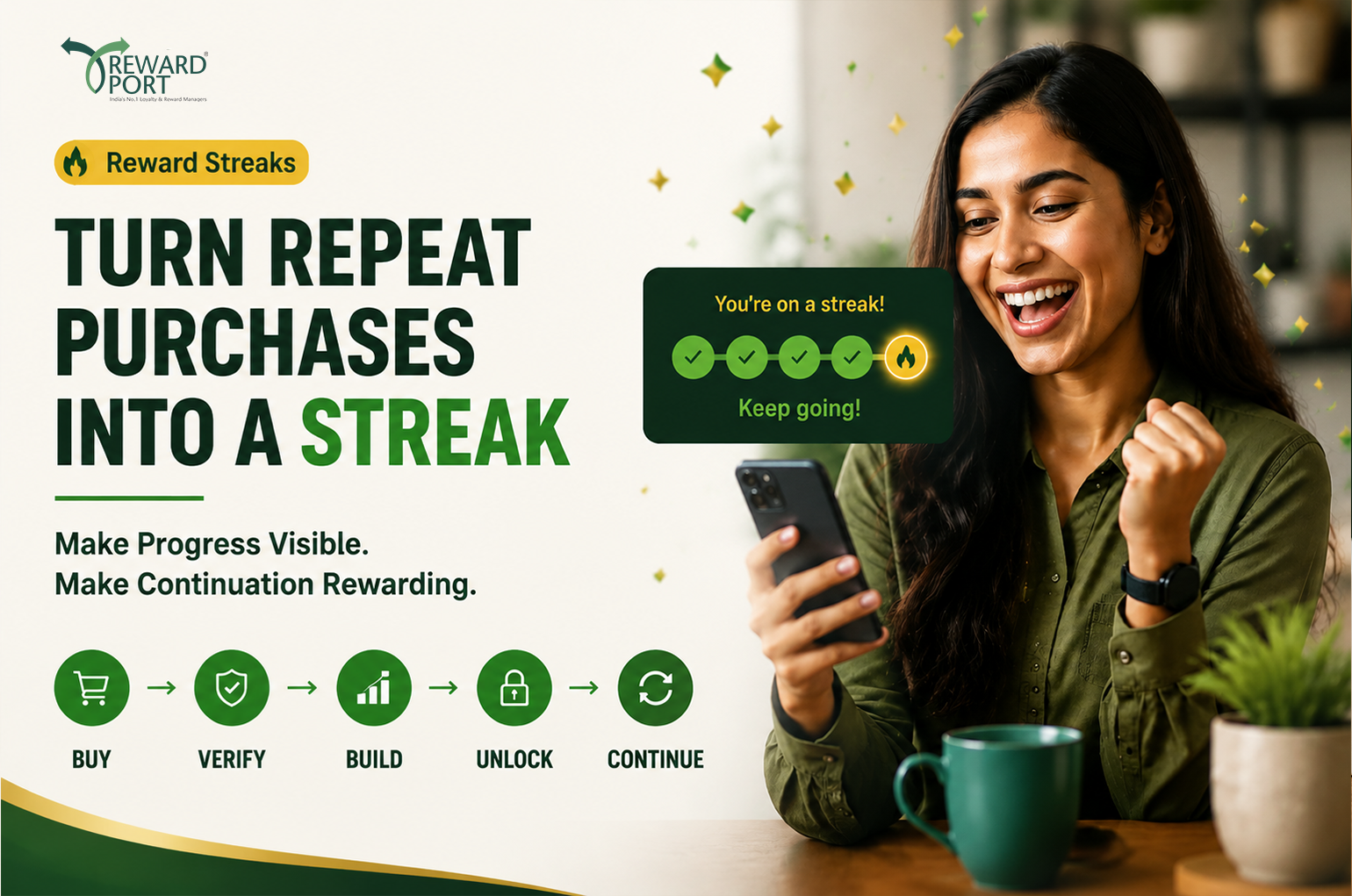
Reward Streaks: How Brands Can Turn Repeat Purchases Into a Habit Customers Want to Continue
Most consumer promotions reward a transaction.
A customer buys a product, scans a QR code, receives a cashback reward, and the interaction ends.
That can work when the objective is simply to stimulate one purchase.
But what if the brand wants the first purchase to become the beginning of a 30-day, 60-day, or 90-day relationship?
Instead of saying:
Buy. Get rewarded.
the brand can create a different journey:
Start. Continue. Progress. Unlock something better.
That is the idea behind Reward Streaks.
A Reward Streak is a loyalty mechanic that recognises customers for completing a desired behaviour repeatedly across a defined period. Rather than treating every transaction independently, it makes progress visible and gives customers a reason to keep going.
For repeat-purchase categories, this can turn an isolated promotion into a structured journey from first purchase to replenishment, retention, and category expansion.
Why Rewarding Every Purchase Is Not the Same as Building Repeat Behaviour
A flat cashback promotion treats every purchase as a separate event.
The customer buys once, receives the reward, and starts from zero again on the next purchase.
A streak introduces continuity.
The first model says:
“Here is something for buying.”
The second says:
“You have already made progress. Continue.”
That difference matters because visible progress can become a goal in itself.
Research published in the Journal of Consumer Research found across seven studies that highlighting an intact streak increased the likelihood that participants would continue the target behaviour compared with highlighting a broken streak.
For brands, the opportunity is not simply to copy the streak mechanics used by apps.
The more commercially useful question is:
What customer behaviour becomes more valuable when it is repeated?
What Exactly Is a Reward Streak?
A Reward Streak is a sequence of verified customer actions completed within predefined intervals, where continued progress unlocks increasingly relevant recognition or rewards.
For the mechanic to work, four things need to be true:
- There must be a behaviour worth repeating.
- The behaviour must be verifiable.
- Progress must be visible.
- Continuing should become more worthwhile.
The mechanic is therefore not simply a reward programme with another visual layer.
It is a structured behavioural journey.
The Reward Streak Loop
The core journey can be expressed simply:
Buy → Verify → Build → Unlock → Continue
Buy
The customer completes the desired purchase or qualifying action.
Verify
The brand confirms that the action genuinely occurred using an appropriate verification method.
Depending on the campaign, this might include a unique code, receipt verification, transaction data, or another approved evidence source.
Build
The verified action advances the customer’s visible progress.
The customer should understand where they are in the journey and what is required next.
Unlock
At meaningful milestones, the customer receives recognition, benefits, rewards, or access.
Continue
The next desired behaviour is made clear, giving the customer a reason to maintain the streak.
The objective is not simply to keep someone clicking or scanning.
It is to make repeat behaviour visible, understandable, and increasingly worthwhile.
A 90-Day Streak Does Not Mean Buying Every Day
One of the biggest mistakes brands can make is applying a digital-app definition of a streak to a physical consumer category.
A streak does not have to mean daily action.
The interval should reflect the natural purchase or usage cycle of the category.
For example:
- A shampoo bottle may last several weeks.
- A household consumable may be replenished monthly.
- A subscription may recur every month.
- A premium beauty product may be purchased every few months.
- A nutrition product may have a defined usage cycle.
A Reward Streak should therefore follow the customer’s natural journey, rather than forcing customers to follow an arbitrary promotional calendar.
The first design question should be:
How often does this behaviour naturally happen?
Only then should the streak window be decided.
Why Not Simply Give Cashback on Every Purchase?
Cashback can be effective when immediate value and simplicity are important.
But repeated flat cashback treats each transaction independently.
A streak creates visible momentum.
Consider the difference:
Flat Cashback
Purchase 1 → ₹20 Cashback
Purchase 2 → ₹20 Cashback
Purchase 3 → ₹20 Cashback
Each interaction stands alone.
Reward Streak
Purchase 1 → Streak Started
Purchase 2 → Progress Milestone
Purchase 3 → Better Unlock
Purchase 4 → Completion Benefit
The second model creates a sense of progression.
That progression can become part of the motivation.
Reward Streaks Are Not Simply Another Points Program
Traditional loyalty programs generally reward cumulative spending or transactions over an open-ended period.
Reward Streaks focus on continuity toward a specific objective.
The distinction is important.
Points may work well when customers transact frequently across a broad ecosystem and need flexibility in how value accumulates.
Streaks become particularly useful when the brand wants to establish a specific repeated behaviour.
For example:
- Replenish every month
- Complete three qualifying purchases
- Try a product consistently over a defined period
- Maintain a subscription
- Purchase across selected categories
- Complete a product-use journey
Neither mechanic is inherently better.
The correct choice depends on the behaviour the brand wants to create.
Three Illustrative Uses of Reward Streaks
1. A 90-Day Regimen Streak
A wellness or personal-care brand may want customers to continue using and repurchasing a product over a defined regimen period.
The journey could recognise the first purchase, replenishment, continued use, and completion.
2. A Household Continuity Streak
A recurring household service or subscription may encourage customers to maintain consecutive monthly participation.
The objective could be reducing lapses and increasing retention.
3. A Performance Routine Streak
A sports nutrition or similar category may reward customers for maintaining a verified purchase or usage routine aligned with the product’s natural cycle.
These are illustrative use cases, not RewardPort client case studies.
What Should Brands Reward at Each Stage?
The reward should evolve with the customer’s progress.
Early Stage
At the beginning, the priority is building trust and making progress visible.
Possible benefits include:
- Recognition
- Visible progress
- Small assured rewards
- Milestone acknowledgement
- Entry-level status
Middle Stage
As the customer builds continuity, rewards can become more meaningful.
Options may include:
- Digital vouchers
- Entertainment benefits
- Product-related benefits
- Relevant services
- Surprise unlocks
Completion Stage
Completion should feel meaningfully different from the first step.
Depending on the audience and economics, the brand may consider:
- Premium merchandise
- Higher-value vouchers
- Movies or entertainment
- Travel
- Experiences
- Exclusive access
- Special privileges
The principle is not simply to make every reward larger.
It is to make continued progress feel increasingly worthwhile.
What Happens When a Streak Breaks?
Streak mechanics can backfire if customers feel that one missed action destroys all their progress.
A broken streak can be demotivating.
Brands should therefore design recovery deliberately.
Possible approaches include:
Grace Periods
Allow a limited additional window for customers to complete the next qualifying action.
Streak Repair
Give customers an opportunity to restore the streak after completing a defined recovery action.
Pause Mechanisms
For categories with legitimate interruptions, customers may be able to temporarily pause progress under defined conditions.
Soft Resets
Instead of sending the customer back to zero, preserve part of their progress or status.
The recovery mechanic should reflect the category and commercial objective.
The goal is to encourage continuation without making the programme feel punitive.
Not Every Customer Wants to Play a Game
A Reward Streak does not require customers to feel as though they are participating in a game.
Gamification is optional.
Progress is the mechanic. Clarity is the experience.
A customer may simply see:
1 of 3 Purchases Completed
or
One More Purchase to Unlock Your Next Benefit
That can create sufficient motivation without badges, avatars, or complex game mechanics.
The programme should match the audience.
Eight Questions to Ask Before Launching a Reward Streak
Before building the mechanic, brands should answer eight questions:
1. What behaviour are we trying to change?
Define the commercial behaviour clearly.
2. What is the natural frequency of that behaviour?
Design the streak around the category’s real purchase or usage cycle.
3. How will the action be verified?
Use an appropriate evidence method for each qualifying action.
4. What should the customer see?
Progress should be visible and easy to understand.
5. What does each milestone unlock?
Define recognition and reward value before launch.
6. What happens when the streak breaks?
Build recovery rules rather than improvising later.
7. What happens when the streak finishes?
Completion should lead to a clear next step, benefit, or longer-term journey.
8. How will incrementality be measured?
The objective is to prove behavioural and commercial change—not simply count participants.
Reward Streak Measurement Scorecard
A strong Reward Streak programme should measure multiple layers.
Commercial Metrics
- Second-purchase rate
- Purchase frequency
- Replenishment rate
- Incremental units
- Average basket
- Retention
Streak Metrics
- Streak start rate
- Milestone completion
- Full completion
- Median streak length
- Break rate
- Recovery rate
Reward Metrics
- Reward cost per active participant
- Reward redemption
- Reward preference
- Cost per incremental behaviour
Operational Metrics
- Verification failures
- Fraud indicators
- Support contacts
- Fulfilment time
- Failed communications
The goal is not to produce the longest streak.
The goal is to produce economically valuable behavioural change.
Reward Streaks Can Create Better First-Party Intelligence
A one-time promotion tells a brand that someone participated once.
A Reward Streak can reveal a much richer journey:
Started → Replenished → Completed → Expanded Category → Responded to Reward
This creates a more useful picture of customer behaviour.
For example, the brand can begin understanding:
- Who starts but does not continue
- When customers typically replenish
- Which milestones produce the strongest response
- Which reward types influence continuation
- Which customers expand into another SKU or category
- Which customers recover after breaking a streak
This is where promotion design can begin becoming consumer intelligence infrastructure, rather than simply a reward expense.
Where Reward Streaks Fit in the Loyalty Journey
Brands should not begin with:
“Which reward should we give?”
They should begin with:
“Which behaviour should continue?”
Once that is clear, the programme can determine:
Behaviour → Verification → Progress → Milestone → Reward → Next Action
Reward Streaks are particularly relevant where continued behaviour has greater commercial value than a one-time transaction.
They can sit within consumer promotions, repeat-purchase campaigns, loyalty programmes, subscription journeys, product regimens, and other structured engagement initiatives.
How RewardPort Can Support Reward Streak Programs
RewardPort can help brands structure repeat-purchase campaigns around verified behaviour, progress visibility, milestone rewards, communication, fulfilment, and measurement.
Depending on the programme, RewardPort’s broader reward ecosystem can support multiple forms of value across different stages of the streak, including digital rewards, entertainment, merchandise, travel, and experiences.
The objective is not simply to issue more rewards.
It is to connect the reward to a specific behaviour, milestone, and next action.
For years, consumer promotions have largely asked:
What can we give customers for buying?
Reward Streaks introduce a different question:
What could we give customers a reason to continue?
The first purchase does not always need to be the end of the campaign.
Sometimes it can simply be the beginning of the streak.
Dealer Loyalty Ideas for Building Material Companies to Drive Growth in 2026
In India’s dynamic building materials sector, sustaining robust dealer loyalty is essential for growth and market leadership. With competitive pressures intensifying and channel partners playing a vital role in distribution, companies must innovate dealer loyalty ideas for building material companies that strengthen engagement, incentivize performance, and foster long-term collaboration.
Market Context and Industry Developments
The Indian building material industry is expanding rapidly, driven by infrastructure development, urbanisation, and government initiatives like Housing for All and smart cities. Dealers and distributors are the critical touchpoints for manufacturers to reach end users effectively across diverse geographies and customer segments.
However, dealer loyalty remains a challenge due to multiple competing brands, fragmented markets, and rising dealer expectations for meaningful incentives and support. Research shows that Indian dealers value reward programs that offer immediate gratification, flexibility in redemption, and recognition aligned with business outcomes.
Emerging Trends in Dealer Loyalty for 2026
Looking ahead to 2026, dealer loyalty programs are evolving to incorporate digital transformation, personalised rewards, and gamified engagement to boost participation and sales performance. Key trends include:
- Digital Rewards and Instant Gratification: Dealers prefer reward points or cashback redeemable instantly via digital wallets or UPI payments, enhancing immediacy and satisfaction.
- Multi-channel Incentive Platforms: Integrated platforms support dealer engagement via mobile apps, SMS, and web portals, providing transparency and ease of participation.
- Tiered and Gamified Programs: Reward tiers and gamification elements increase motivation through challenge and recognition, driving repeat business.
- Experiential and Lifestyle Rewards: Travel, entertainment, and dining rewards resonate well with dealers seeking premium incentives beyond conventional cash or vouchers.
Practical Implications for Marketers and Channel Leaders
For B2B marketers, trade teams, and channel leaders in building materials, implementing dealer loyalty ideas means designing programs that align incentives with business priorities: acquisition, repeat orders, upselling, and loyalty maintenance.
Key focus areas include seamless integration with sales processes, offering rewards valued by dealers, and providing real-time data analytics to measure program impact and fine-tune engagement strategies. Employee incentive programs can also complement dealer incentives by boosting internal sales motivation.
RewardPort Perspective and Solution Approach
At RewardPort, we specialise in channel partner incentive programs tailored for building material companies. Our solutions combine:
- Digital Reward Fulfilment: Instant cashback via UPI, multi-brand vouchers, and points redeemable across lifestyle, travel, and entertainment categories.
- Gamification Engine: Engaging branded games and contests to increase dealer participation and motivation.
- Comprehensive Analytics: Real-time tracking of dealer engagement, sales uplift, and redemption patterns to optimise campaigns.
- Plug-and-Play Modules: Including Dealer & Channel Partner Incentive Programs and Employee Incentive Programs that ensure rapid deployment and easy management.
Verified RewardPort Case-Study Learnings
RewardPort extensive experience spans over 11,000 programs and 7 million engaged customers annually, including dealer loyalty initiatives that demonstrate sales growth through targeted incentives. For instance, dealer programs combining cashback and multi-brand voucher rewards have delivered higher repeat purchases and channel push in fast-moving B2B categories.
Practical Recommendations for Implementation
To build an effective dealer loyalty program for building material companies in 2026, consider these steps:
- Identify key business goals and the dealer behaviors to influence (e.g., increased sales volume, new product adoption).
- Design a tiered rewards structure with instant gratification and aspirational rewards.
- Leverage digital platforms for easy participation and reward redemption.
- Incorporate gamification elements to enhance engagement and competition.
- Use analytics dashboards to monitor program success and adapt strategies.
- Complement dealer programs with internal employee incentives to align objectives.
Dealer loyalty ideas for building material companies are more critical than ever in 2026 as competition intensifies and dealer expectations evolve. By adopting integrated, digitally driven incentive programs with RewardPort expertise, Indian building materials companies can drive engagement, enhance sales performance, and build lasting partner relationships that fuel sustained growth.
Consumer Promotion Strategy for Tea Brands in India: A Trial-to-Repeat Growth Playbook
A tea-brand promotion should begin with one behavior to change.
That could be trial, larger-pack migration, repeat purchase, premium-range discovery or retailer advocacy.
The strongest programs then connect that behavior to suitable purchase evidence, a relevant reward and a clear next action. Consumer and retailer tracks should remain operationally distinct, while the insights from both contribute to a broader category-growth plan.
Key Takeaways
- Tea is a habitual category, so the strategic objective should extend beyond generating a one-time redemption to creating a measurable repeat-purchase pattern.
- Mass, premium, green, herbal, regional and gifting propositions should not automatically use the same reward rules.
- Pack size, blend, geography, season and purchase frequency can influence the appropriate promotion mechanic.
- Assured rewards can support the first action, while streaks, milestones and differentiated value can encourage subsequent purchases.
- Retailer advocacy requires separate evidence, targets, communication and rewards rather than competing with consumers for the same code pool.
Why Tea Brands Need a Category-Specific Promotion Design
Tea combines frequent consumption with complex consumer choice.
A household may already have:
- A preferred blend
- A regional taste preference
- A habitual pack size
- A trusted retailer
At the same time, the category covers mass black tea, premium blends, green and herbal variants, tea bags, wellness-positioned products, gifting and out-of-home consumption.
This creates several different growth objectives:
Recruit a New Household → Encourage Variant Trial → Increase Pack Size → Drive Repeat Purchase → Introduce Premium Products → Activate Regional Markets → Strengthen Retailer Recommendation
A promotion attempting to solve every objective simultaneously can quickly become expensive and difficult to measure.
The promotion decision therefore needs to be made at the brand, SKU, pack, channel and behavior level, rather than being based only on broad category trends.
The RewardPort BREW Growth Framework
The supplied RewardPort authority article introduces the BREW framework, a four-part approach for turning a tea promotion into a measurable behavior loop.
| Element | Decision | Tea-Brand Application |
|---|---|---|
| B — Behavior | What single action should change? | Trial, repeat, pack migration, variant discovery, referral, retailer recommendation or data opt-in |
| R — Route | Where and how will participation happen? | On-pack code, in-pack token, receipt upload, WhatsApp, retailer handoff, e-commerce order data or hybrid journey |
| E — Evidence | What proves the qualifying action? | Serialized code, receipt OCR, invoice, order feed, repeat sequence, retailer data or approved registration |
| W — Worth & Next Action | What value will motivate this audience, and what should happen next? | Cashback, voucher, merchandise, cinema, travel, experience, collect-and-unlock, referral or next-purchase benefit |
The loop becomes useful when the brand does not stop at recording redemption.
It should also understand:
Who participated → What they bought → Whether they returned → What reward they chose → What action should come next
Choose the Promotion Mechanic by Growth Objective
Different tea-brand objectives require different mechanics.
1. Drive Trial
Use a low-friction on-pack or receipt-verification journey with an assured entry reward and clear product education.
Measure:
- Cost per verified new buyer
- Participation by SKU and region
- First-to-second purchase
The first reward should make participation easy while creating a route towards the next purchase.
2. Move Consumers to a Larger Pack
Use tiered value based on verified pack size or provide an additional benefit when consumers upgrade within a defined period.
Measure:
- Pack-size mix
- Upgrade rate
- Cost per incremental gram/value
- Repeat behavior after upgrading
The objective is not simply to reward another transaction. It is to identify whether the promotion changes the consumer’s pack-size behavior.
3. Encourage Repeat Purchase
Use a collect-and-unlock, purchase streak or milestone mechanic based on a repeatable verification method such as serialized codes or receipt-based sequencing.
The consumer should be able to understand their progress and what the next verified purchase unlocks.
This turns:
Purchase → Reward
into:
First Purchase → Progress → Second Purchase → Higher Value → Repeat Behavior
4. Encourage Variant Discovery
Use guided discovery, variant-specific missions or cross-SKU progress to introduce consumers to other products in the portfolio.
This can be particularly useful when a brand has multiple blends, formats or propositions.
The campaign should measure whether participation actually converts into verified target-variant trial rather than only engagement with promotional communication.
5. Strengthen Retailer Recommendation
Retailer advocacy should have its own program track.
Retailers may be rewarded for approved actions such as:
- Verified stocking
- Product learning
- Sales missions
- Strategic SKU movement
- Other approved channel actions
Retailer and consumer reward rules, evidence and ledgers should remain distinct.
Mass and Premium Tea Should Not Automatically Use the Same Reward
Reward selection should reflect the proposition and desired behavior.
For a mass-market proposition, clarity and immediate value may be important.
For premium tea, the audience, margin, purchase barrier and brand positioning may support higher-perceived-value or experiential rewards.
Depending on the campaign, the reward architecture could include:
- Cashback
- Digital vouchers
- Merchandise
- Cinema
- Travel
- Experiences
- Next-purchase benefits
The key question is not simply:
“Which reward is most attractive?”
It is:
“Which reward is most appropriate for this audience, behavior and next action?”
Consumer and Retailer Tracks Should Work Together — Not Compete
A tea promotion can include both consumer and retailer engagement under the same overall growth strategy.
However, the two journeys should remain operationally separate.
Consumer Track
Could focus on:
Trial → Repeat → Pack Migration → Variant Discovery → Loyalty
Retailer Track
Could focus on:
Stocking → Product Knowledge → Recommendation → Sales Mission → Continued Advocacy
The evidence, reward rules, ledgers, fraud controls and applicable tax treatment may differ.
Keeping these tracks separate allows the brand to understand both consumer pull and retailer influence without creating attribution conflicts.
Metrics for the Tea-Brand Growth Loop
| Metric | Definition | Decision Supported |
|---|---|---|
| Verified Trial Cost | Total promotion cost ÷ verified first-time participants | Is customer recruitment economically sustainable? |
| Second-Purchase Rate | First-time verified buyers with a second verified purchase ÷ first-time verified buyers | Is the campaign creating repeat behavior? |
| Time to Repeat | Median days between first and second verified purchase | When should the next trigger happen? |
| Pack-Migration Rate | Verified buyers moving to target pack ÷ eligible verified buyers | Is the promotion changing pack-size mix? |
| Variant-Conversion Rate | Verified target-variant trials ÷ eligible participants | Is product discovery converting into purchase? |
| Reward Efficiency | Verified target actions ÷ total reward and fulfilment cost | Which rewards and cohorts create useful behavior? |
| Consumer Data Usability | Consented, complete, deduplicated records ÷ verified participants | Is the campaign producing reusable first-party intelligence? |
| Invalid & Duplicate Rate | Invalid or duplicate attempts ÷ total attempts | Are evidence and fraud controls working appropriately? |
| Retailer Active Rate | Retailers with verified target action ÷ enrolled eligible retailers | Is retailer participation genuine? |
These metrics shift the conversation from “How many rewards did we distribute?” to “What behavior did the promotion change?”
Illustrative Scenario: Regional Premium Tea Launch
Assume a tea company is introducing a premium regional blend across two states.
The objective is:
Verified Trial → Second Purchase Within 45 Days
Packs can carry a unique in-pack code, and the brand wants a WhatsApp-first journey available in two languages.
A possible pilot could work like this:
First Purchase
Unique Code → WhatsApp Verification → Assured Low-Friction Reward → Taste/Usage Prompt
Second Purchase
Second Valid Code Within 45 Days → Verification → Higher-Perceived-Value Benefit
Reward preference and repeat timing could be recorded with consent, while code duplication, device velocity and geography are monitored.
Retailers could participate through a separate learning and verified-stock or sales mission instead of accessing the consumer code pool.
This is an illustrative scenario, not a claimed RewardPort client result. Budget, pack operations, tax, promotion terms, data use and reward availability would need to be verified before launch.
RewardPort Tea Campaign Examples
RewardPort case-study library also contains tea-sector examples that can support the article.
Goodricke — Premium Tea Trial
RewardPort documented Goodricke campaign supported the launch of its Thurbo Darjeeling tea range with an assured ₹100 Uber voucher for qualifying purchases.
The campaign targeted urban premium tea consumers and used a practical lifestyle reward aligned with the audience.
Maharaja Tea — Assured Cashback for Repeat Purchase
RewardPort Maharaja Tea campaign used ₹50 assured cashback on every pack, with consumers redeeming a unique code digitally. The campaign has recorded 300,000+ cashback redemptions and was designed to encourage repeat purchase through simple, immediate value.
Vikram Tea — Assured Value + Aspirational Prize
For Vikram Gold’s 250g pack, RewardPort executed a consumer promotion combining ₹15 assured Paytm cashback with entry into a gold coin lucky draw.
The documented campaign used the combination of immediate value and an aspirational prize to support pack sales and engagement.
These examples illustrate why different tea propositions may require different reward architectures rather than one universal promotion mechanic.
How RewardPort Can Support Tea Brands
RewardPort can help tea brands move from a standalone offer to a connected promotion system spanning:
Objective & Mechanic Design → QR/Code Journeys → Purchase Verification → WhatsApp Participation → Rewards → Retailer Engagement → Fraud Controls → Fulfilment → Analytics
Consumer and channel journeys can remain role-specific while contributing to a broader picture of trial, repeat behavior, product mix and market response.
The right starting question is:
Which behavior should change in the next 90 days, and what evidence will prove that it changed?
Ask RewardPort for a tea-brand promotion blueprint covering behavior, pack and channel constraints, evidence, reward architecture, retailer activation and a measurable pilot.