
Most consumer promotions reward a transaction.
A customer buys a product, scans a QR code, receives a cashback reward, and the interaction ends.
That can work when the objective is simply to stimulate one purchase.
But what if the brand wants the first purchase to become the beginning of a 30-day, 60-day, or 90-day relationship?
Instead of saying:
Buy. Get rewarded.
the brand can create a different journey:
Start. Continue. Progress. Unlock something better.
That is the idea behind Reward Streaks.
A Reward Streak is a loyalty mechanic that recognises customers for completing a desired behaviour repeatedly across a defined period. Rather than treating every transaction independently, it makes progress visible and gives customers a reason to keep going.
For repeat-purchase categories, this can turn an isolated promotion into a structured journey from first purchase to replenishment, retention, and category expansion.
Why Rewarding Every Purchase Is Not the Same as Building Repeat Behaviour
A flat cashback promotion treats every purchase as a separate event.
The customer buys once, receives the reward, and starts from zero again on the next purchase.
A streak introduces continuity.
The first model says:
“Here is something for buying.”
The second says:
“You have already made progress. Continue.”
That difference matters because visible progress can become a goal in itself.
Research published in the Journal of Consumer Research found across seven studies that highlighting an intact streak increased the likelihood that participants would continue the target behaviour compared with highlighting a broken streak.
For brands, the opportunity is not simply to copy the streak mechanics used by apps.
The more commercially useful question is:
What customer behaviour becomes more valuable when it is repeated?
What Exactly Is a Reward Streak?
A Reward Streak is a sequence of verified customer actions completed within predefined intervals, where continued progress unlocks increasingly relevant recognition or rewards.
For the mechanic to work, four things need to be true:
- There must be a behaviour worth repeating.
- The behaviour must be verifiable.
- Progress must be visible.
- Continuing should become more worthwhile.
The mechanic is therefore not simply a reward programme with another visual layer.
It is a structured behavioural journey.
The Reward Streak Loop
The core journey can be expressed simply:
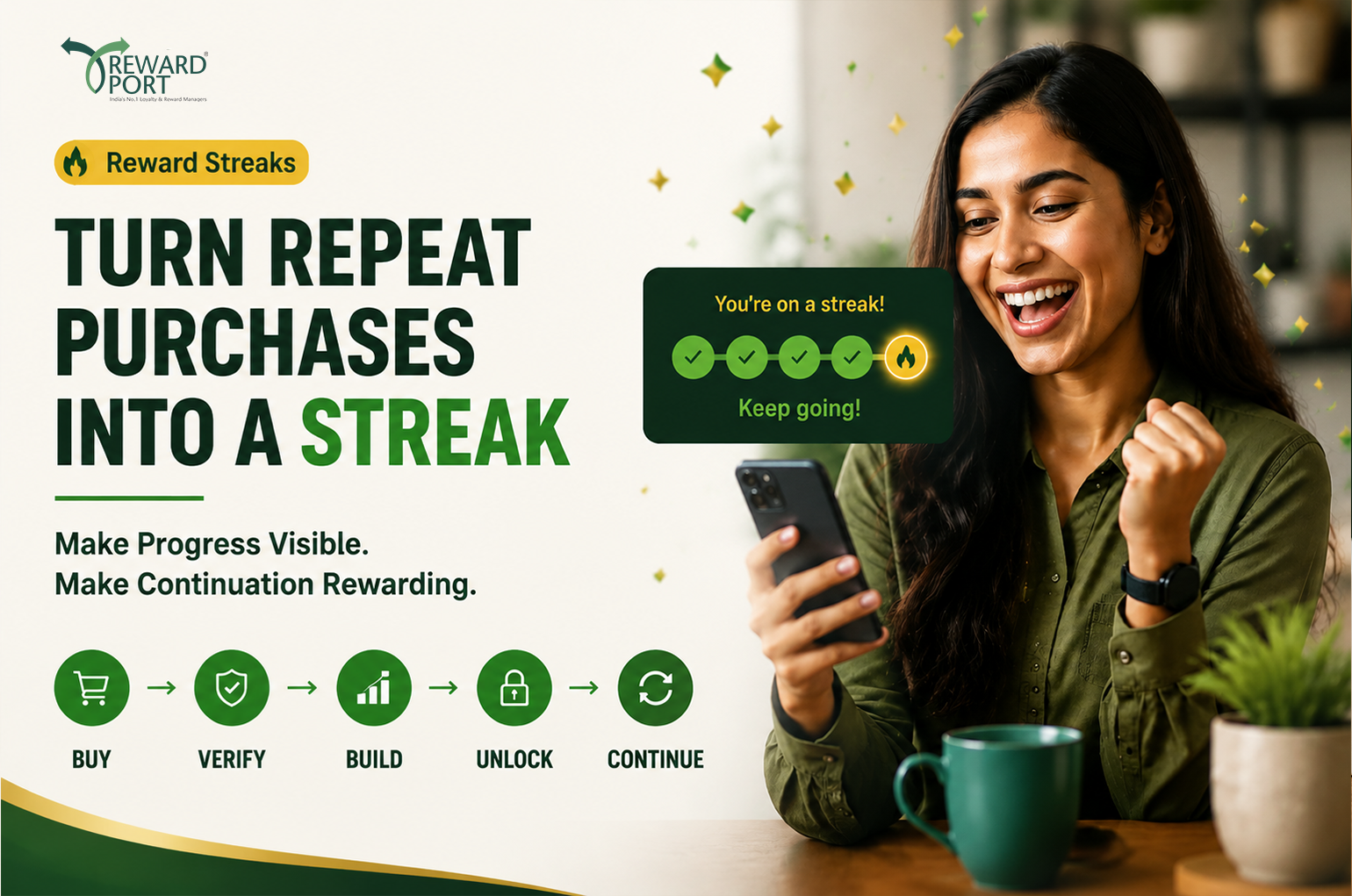
Buy → Verify → Build → Unlock → Continue
Buy
The customer completes the desired purchase or qualifying action.
Verify
The brand confirms that the action genuinely occurred using an appropriate verification method.
Depending on the campaign, this might include a unique code, receipt verification, transaction data, or another approved evidence source.
Build
The verified action advances the customer’s visible progress.
The customer should understand where they are in the journey and what is required next.
Unlock
At meaningful milestones, the customer receives recognition, benefits, rewards, or access.
Continue
The next desired behaviour is made clear, giving the customer a reason to maintain the streak.
The objective is not simply to keep someone clicking or scanning.
It is to make repeat behaviour visible, understandable, and increasingly worthwhile.
A 90-Day Streak Does Not Mean Buying Every Day
One of the biggest mistakes brands can make is applying a digital-app definition of a streak to a physical consumer category.
A streak does not have to mean daily action.
The interval should reflect the natural purchase or usage cycle of the category.
For example:
- A shampoo bottle may last several weeks.
- A household consumable may be replenished monthly.
- A subscription may recur every month.
- A premium beauty product may be purchased every few months.
- A nutrition product may have a defined usage cycle.
A Reward Streak should therefore follow the customer’s natural journey, rather than forcing customers to follow an arbitrary promotional calendar.
The first design question should be:
How often does this behaviour naturally happen?
Only then should the streak window be decided.
Why Not Simply Give Cashback on Every Purchase?
Cashback can be effective when immediate value and simplicity are important.
But repeated flat cashback treats each transaction independently.
A streak creates visible momentum.
Consider the difference:
Flat Cashback
Purchase 1 → ₹20 Cashback
Purchase 2 → ₹20 Cashback
Purchase 3 → ₹20 Cashback
Each interaction stands alone.
Reward Streak
Purchase 1 → Streak Started
Purchase 2 → Progress Milestone
Purchase 3 → Better Unlock
Purchase 4 → Completion Benefit
The second model creates a sense of progression.
That progression can become part of the motivation.
Reward Streaks Are Not Simply Another Points Program
Traditional loyalty programs generally reward cumulative spending or transactions over an open-ended period.
Reward Streaks focus on continuity toward a specific objective.
The distinction is important.
Points may work well when customers transact frequently across a broad ecosystem and need flexibility in how value accumulates.
Streaks become particularly useful when the brand wants to establish a specific repeated behaviour.
For example:
- Replenish every month
- Complete three qualifying purchases
- Try a product consistently over a defined period
- Maintain a subscription
- Purchase across selected categories
- Complete a product-use journey
Neither mechanic is inherently better.
The correct choice depends on the behaviour the brand wants to create.
Three Illustrative Uses of Reward Streaks
1. A 90-Day Regimen Streak
A wellness or personal-care brand may want customers to continue using and repurchasing a product over a defined regimen period.
The journey could recognise the first purchase, replenishment, continued use, and completion.
2. A Household Continuity Streak
A recurring household service or subscription may encourage customers to maintain consecutive monthly participation.
The objective could be reducing lapses and increasing retention.
3. A Performance Routine Streak
A sports nutrition or similar category may reward customers for maintaining a verified purchase or usage routine aligned with the product’s natural cycle.
These are illustrative use cases, not RewardPort client case studies.
What Should Brands Reward at Each Stage?
The reward should evolve with the customer’s progress.
Early Stage
At the beginning, the priority is building trust and making progress visible.
Possible benefits include:
- Recognition
- Visible progress
- Small assured rewards
- Milestone acknowledgement
- Entry-level status
Middle Stage
As the customer builds continuity, rewards can become more meaningful.
Options may include:
- Digital vouchers
- Entertainment benefits
- Product-related benefits
- Relevant services
- Surprise unlocks
Completion Stage
Completion should feel meaningfully different from the first step.
Depending on the audience and economics, the brand may consider:
- Premium merchandise
- Higher-value vouchers
- Movies or entertainment
- Travel
- Experiences
- Exclusive access
- Special privileges
The principle is not simply to make every reward larger.
It is to make continued progress feel increasingly worthwhile.
What Happens When a Streak Breaks?
Streak mechanics can backfire if customers feel that one missed action destroys all their progress.
A broken streak can be demotivating.
Brands should therefore design recovery deliberately.
Possible approaches include:
Grace Periods
Allow a limited additional window for customers to complete the next qualifying action.
Streak Repair
Give customers an opportunity to restore the streak after completing a defined recovery action.
Pause Mechanisms
For categories with legitimate interruptions, customers may be able to temporarily pause progress under defined conditions.
Soft Resets
Instead of sending the customer back to zero, preserve part of their progress or status.
The recovery mechanic should reflect the category and commercial objective.
The goal is to encourage continuation without making the programme feel punitive.
Not Every Customer Wants to Play a Game
A Reward Streak does not require customers to feel as though they are participating in a game.
Gamification is optional.
Progress is the mechanic. Clarity is the experience.
A customer may simply see:
1 of 3 Purchases Completed
or
One More Purchase to Unlock Your Next Benefit
That can create sufficient motivation without badges, avatars, or complex game mechanics.
The programme should match the audience.
Eight Questions to Ask Before Launching a Reward Streak
Before building the mechanic, brands should answer eight questions:
1. What behaviour are we trying to change?
Define the commercial behaviour clearly.
2. What is the natural frequency of that behaviour?
Design the streak around the category’s real purchase or usage cycle.
3. How will the action be verified?
Use an appropriate evidence method for each qualifying action.
4. What should the customer see?
Progress should be visible and easy to understand.
5. What does each milestone unlock?
Define recognition and reward value before launch.
6. What happens when the streak breaks?
Build recovery rules rather than improvising later.
7. What happens when the streak finishes?
Completion should lead to a clear next step, benefit, or longer-term journey.
8. How will incrementality be measured?
The objective is to prove behavioural and commercial change—not simply count participants.
Reward Streak Measurement Scorecard
A strong Reward Streak programme should measure multiple layers.
Commercial Metrics
- Second-purchase rate
- Purchase frequency
- Replenishment rate
- Incremental units
- Average basket
- Retention
Streak Metrics
- Streak start rate
- Milestone completion
- Full completion
- Median streak length
- Break rate
- Recovery rate
Reward Metrics
- Reward cost per active participant
- Reward redemption
- Reward preference
- Cost per incremental behaviour
Operational Metrics
- Verification failures
- Fraud indicators
- Support contacts
- Fulfilment time
- Failed communications
The goal is not to produce the longest streak.
The goal is to produce economically valuable behavioural change.
Reward Streaks Can Create Better First-Party Intelligence
A one-time promotion tells a brand that someone participated once.
A Reward Streak can reveal a much richer journey:
Started → Replenished → Completed → Expanded Category → Responded to Reward
This creates a more useful picture of customer behaviour.
For example, the brand can begin understanding:
- Who starts but does not continue
- When customers typically replenish
- Which milestones produce the strongest response
- Which reward types influence continuation
- Which customers expand into another SKU or category
- Which customers recover after breaking a streak
This is where promotion design can begin becoming consumer intelligence infrastructure, rather than simply a reward expense.
Where Reward Streaks Fit in the Loyalty Journey
Brands should not begin with:
“Which reward should we give?”
They should begin with:
“Which behaviour should continue?”
Once that is clear, the programme can determine:
Behaviour → Verification → Progress → Milestone → Reward → Next Action
Reward Streaks are particularly relevant where continued behaviour has greater commercial value than a one-time transaction.
They can sit within consumer promotions, repeat-purchase campaigns, loyalty programmes, subscription journeys, product regimens, and other structured engagement initiatives.
How RewardPort Can Support Reward Streak Programs
RewardPort can help brands structure repeat-purchase campaigns around verified behaviour, progress visibility, milestone rewards, communication, fulfilment, and measurement.
Depending on the programme, RewardPort’s broader reward ecosystem can support multiple forms of value across different stages of the streak, including digital rewards, entertainment, merchandise, travel, and experiences.
The objective is not simply to issue more rewards.
It is to connect the reward to a specific behaviour, milestone, and next action.
For years, consumer promotions have largely asked:
What can we give customers for buying?
Reward Streaks introduce a different question:
What could we give customers a reason to continue?
The first purchase does not always need to be the end of the campaign.
Sometimes it can simply be the beginning of the streak.
Frequently Asked Questions
What is a Reward Streak?
A Reward Streak is a structured sequence of verified customer behaviors in which continued progress toward defined milestones unlocks recognition, benefits, or rewards.
How is a Reward Streak different from a loyalty program?
Traditional loyalty programs often reward accumulated spend or transactions over time. A Reward Streak focuses on maintaining a particular repeated behaviour across defined intervals or milestones.
Do Reward Streaks require an app?
No. The core requirements are participant identification where necessary, behavior verification, progress tracking, and communication. The journey can potentially be delivered through different digital interfaces depending on the programmer.
Are Reward Streaks only useful for daily-purchase categories?
No. The streak period should follow the category's natural replenishment or transaction cycle. A streak may operate across days, weeks, or months.
Should every milestone provide a monetary reward?
No. Recognition, visible progress, status, access, surprise benefits, and privileges can complement cashback, vouchers, merchandise, or other tangible rewards.
What happens if a customer breaks a Reward Streak?
Brands can design grace periods, streak repairs, pause mechanisms, or soft resets depending on the behaviour and category. Recovery rules should be defined before launch.
How should brands measure a Reward Streak program?
Brands should measure behavioral and commercial outcomes such as second-purchase rate, purchase frequency, retention, streak completion, recovery, reward cost, and cost per incremental behavior.