
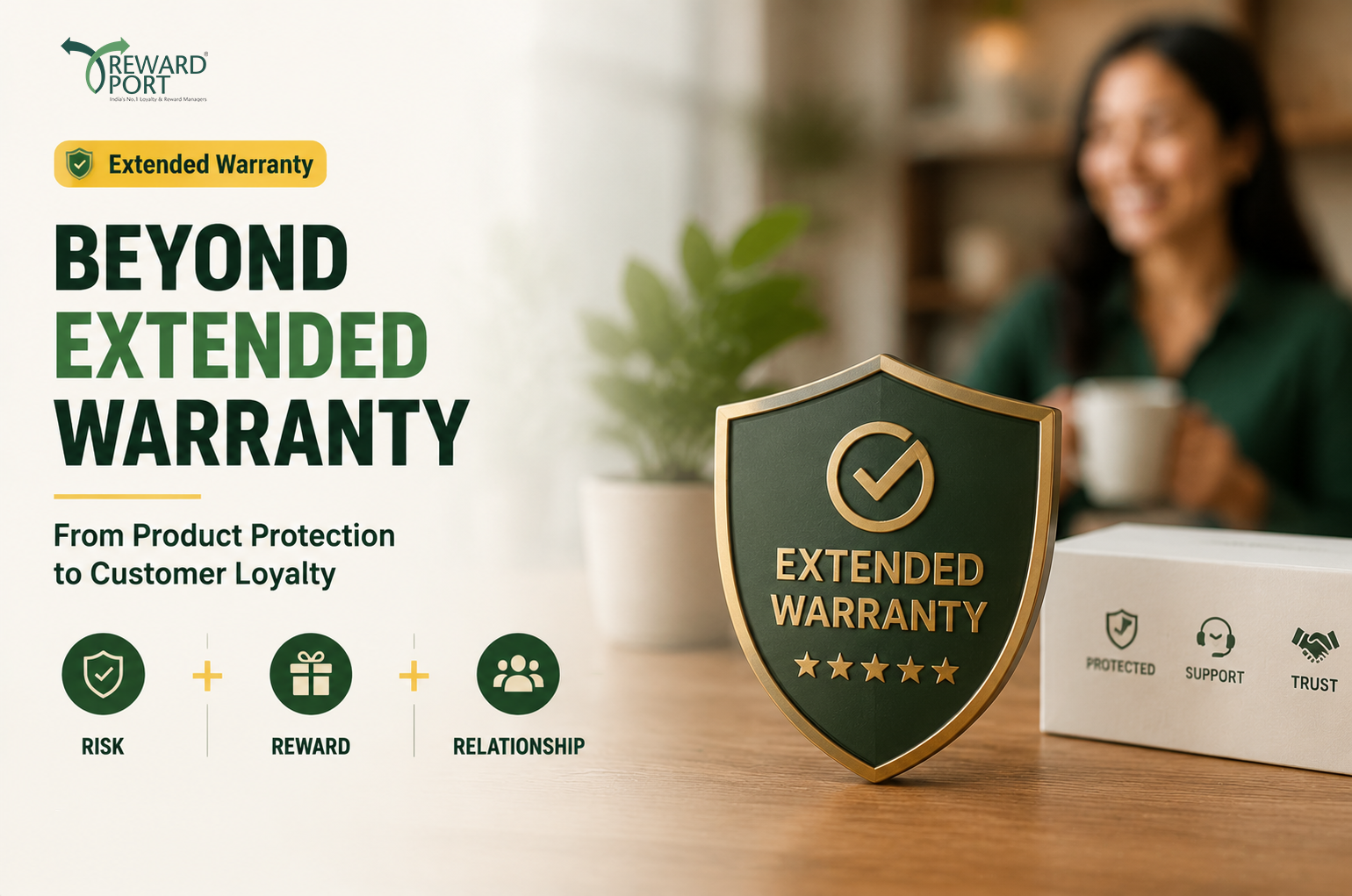
Extended warranty is changing.
What began as a relatively simple promise to cover repair risk is becoming broader, more flexible and more deeply connected to the ownership journey.
Samsung is expanding appliance protection into areas such as software support and scheduled maintenance. Godrej is using long-duration comprehensive warranty as a visible trust proposition. Apple has evolved device protection toward flexible, ongoing coverage models.
The next step may be even more important for retailers:
Can warranty evolve from a cost-of-failure product into a loyalty asset that creates value throughout ownership?
That means combining:
Risk + Reward + Relationship
The opportunity is to stop thinking about warranty purely as something customers use when a product fails and start exploring its potential as a post-purchase relationship layer.
Warranty Is Becoming a Marketing Proposition, Not Just a Service Promise
In April 2026, Godrej Appliances announced a five-year comprehensive warranty across a broad appliance portfolio and explicitly positioned the move around trust and loyalty.
That signals an important shift.
Warranty is no longer only something explained after a customer decides what to buy.
It can become part of the reason to buy.
When protection becomes visible at the consideration stage, it can communicate confidence, reassurance and commitment to the ownership experience.
Samsung Is Expanding What Protection Means
Samsung India expanded Samsung Care+ to cover more home appliances, including refrigerators, washing machines, air conditioners, microwaves and smart TVs.
Samsung also highlighted capabilities such as software-update and screen-malfunction protection, service tracking and scheduled-maintenance reminders.
The company also bundled a buy-one-year, get-two-years extended warranty offer around a refrigerator launch in April 2026.
The broader implication is important.
Warranty can simultaneously become:
Purchase Incentive → Service Promise → Ownership Experience → Marketing Differentiator
That takes protection beyond a back-end service function.
Apple Is Turning Protection Into a Relationship That Follows the Customer
Apple introduced AppleCare One in the US in July 2025, allowing customers to cover multiple devices under one monthly subscription and add or remove products as their ownership changes.
Apple subsequently expanded AppleCare+ coverage options in India, including monthly and annual plans and Theft and Loss protection for eligible iPhones.
The broader pattern is becoming clearer:
Protection is becoming more continuous, flexible, service-led and relationship-driven.
But there is still a fundamental challenge.
Most Warranty Programs Have One Structural Problem
They become most valuable when something goes wrong.
A customer pays for protection.
Then the customer, retailer and provider all hope it never needs to be used.
From a risk-management perspective, that makes sense.
From a loyalty perspective, however, it creates a missed opportunity.
The important question becomes:
What value could the customer receive while nothing is broken?
That is where warranty starts moving closer to loyalty.
From Risk to Risk + Reward + Relationship
A useful way to understand the evolution is through three stages.
Warranty 1.0: Risk
Something fails → Repair or replacement support according to the plan
Protection is the core value proposition.
Warranty 2.0: Risk + Service
Protection is supplemented with useful ownership support such as:
- Technical assistance
- Product guidance
- Service reminders
- Diagnostics
- Maintenance support
- Installation assistance
The relationship becomes more useful even before a major failure.
Warranty 3.0: Risk + Reward + Relationship
Now the ownership journey can potentially include positive value even when no claim occurs.
For example:
- Maintenance rewards
- Anniversary benefits
- Upgrade benefits
- Family benefits
- Assistance services
- Lifestyle privileges
- Referral recognition
- Trade-in benefits
- Next-purchase advantages
The warranty is no longer simply waiting for failure.
It becomes part of the customer’s ongoing relationship with the retailer or brand.
The Retailer Has an Advantage Individual Brands Do Not
Think about a typical household.
The television may come from Brand A.
The washing machine may come from Brand B.
The refrigerator may come from Brand C.
The air conditioner may come from Brand D.
But all four products could have been purchased from the same retailer.
That creates an interesting opportunity for consumer-durable retailers.
Instead of saying:
“Here is your extended warranty for this appliance.”
the retailer could potentially say:
“You are now part of our ownership program.”
The relationship shifts from one product to the household.
What Could a Modern Ownership Program Include?
A modern ownership relationship can be considered across five layers:
1. Protection
Protection remains the foundation.
Customers need confidence that the program will support them according to its defined terms when something goes wrong.
2. Assistance
Provide relevant support outside formal claims.
This might include product guidance, approved troubleshooting, maintenance information or service coordination.
3. Engagement
Create useful reasons for the customer to remain connected throughout the ownership lifecycle.
4. Reward
Introduce positive moments that recognize ownership, maintenance, milestones or other relevant behaviors.
5. Progression
Turn one protected product into a broader and potentially longer customer relationship.
Together, these create:
Protection → Assistance → Engagement → Reward → Progression
An Illustrative Refrigerator Ownership Journey
Consider how the experience around one appliance could evolve.
Day 1
Purchase + Protection Activated
Day 3
Installation Check + Digital Product Guide
Month 3
AI Assistance for Product Questions
Month 6
Preventive-Care Reminder
Month 12
Ownership Anniversary Benefit
Month 18
Family or Lifestyle Benefit
Month 24
Maintenance Prompt
Month 36
Upgrade Eligibility or Extension Offer
Anytime
Claims Coordination and Support
Next Appliance Purchase
Ownership Status Carries Forward
Protection remains central.
But protection becomes the entry point rather than the entire proposition.
Why Embed Rewards Into the Ownership Journey?
Because risk is largely invisible when everything works.
Rewards can create positive moments inside a product traditionally associated with negative events.
Imagine messages such as:
“Your appliance has completed one year. Here is an ownership benefit.”
“Your preventive service is complete. You have unlocked your next benefit.”
“You now have three products registered with us. Your household status has been upgraded.”
The psychological association changes.
Warranty stops being connected only with:
Breakdown → Claim → Repair
It can also become connected with:
Care → Recognition → Continuity
Rewards Cannot Compensate for Poor Protection
This distinction is critical.
No lifestyle benefit can compensate for:
- Poor claims handling
- Confusing exclusions
- Delayed repairs
- Weak service
- Poor customer communication
The hierarchy should always remain:
Trust First → Service → Engagement → Reward
Protection has to work before loyalty can be layered on top of it.
The Economics Could Also Change
Traditional warranty economics can be viewed simply as:
Warranty Revenue – Claims – Operating Cost
But an ownership relationship creates additional potential sources of value.
Ownership Relationship Economics
Protection Economics + Retention + Repeat Purchase + Referral + Service + Upgrade Value – Reward & Engagement Cost
This does not automatically make every ownership program profitable.
It does, however, create more ways for retailers to evaluate the investment.
Instead of measuring only the economics of claims, retailers can ask:
Does the protection relationship improve the economics of the customer lifecycle?
Retailers Should Think at Household Level, Not Product Level
Most warranties are organised around individual products.
Consumers live in households.
A retailer could potentially build a household ownership account that helps customers understand:
- Which products they own
- Which products are protected
- What requires service
- What protection expires next
- Which benefits are available
- Which upgrade opportunities exist
This creates a more useful relationship than treating every appliance as a disconnected warranty contract.
AI May Become Particularly Useful in the Ownership Journey
Customers frequently need assistance with:
- Product features
- Settings
- Connectivity
- Maintenance
- Error codes
- Troubleshooting
- Service requirements
A conversational AI layer could potentially identify the registered model, understand the relevant protection status, offer approved troubleshooting information and help determine whether service is required.
Where appropriate, it could then help move the customer into a service or support journey.
The goal should not be AI for its own sake.
It should be:
Faster understanding → Appropriate assistance → Better ownership experience
The Loyalty Opportunity Starts After the Sale
Retailers invest heavily in acquiring customers and getting them to the transaction.
Protection creates a legitimate reason for the retailer to remain connected after that transaction.
That makes extended warranty interesting not merely as an attach-rate product, but as a potential post-purchase relationship engine.
The customer has already bought.
The next opportunity is to build the relationship around ownership.
What Should Retailers Measure?
A broader ownership program requires a broader measurement framework.
Protection Metrics
- Attach rate
- Renewal
- Claims rate
- Claim acceptance
- Resolution time
- Servicing cost
- Customer satisfaction
Engagement Metrics
- Product registrations
- Active households
- Maintenance interactions
- Assistance usage
- Anniversary engagement
Reward Metrics
- Reward activation
- Redemption
- Reward cost
- Reward preference
- Cost per retained customer
Commercial Metrics
- Repeat purchase
- Category expansion
- Upgrade rate
- Referral rate
- Customer lifetime value
The central question becomes:
Does the protection program improve the economics of the customer relationship, not simply the economics of the claim?
A Practical Roadmap for Retailers
Phase 1: Improve Protection
Ensure the core protection proposition is clear, trustworthy and operationally sound.
Phase 2: Add Assistance
Introduce useful support throughout the ownership journey.
Phase 3: Build Ownership Identity
Connect products and customers into an ongoing ownership relationship.
Phase 4: Add Useful Engagement
Create relevant reasons to interact outside claims.
Phase 5: Add Rewards Selectively
Use rewards where they strengthen useful behaviours, milestones or relationship moments.
Phase 6: Measure Lifecycle Impact
Assess whether the program improves retention, repeat purchase, category expansion, referrals and overall customer value.
Where RewardCare Fits
RewardCare is designed around this broader concept of product ownership.
It can sit alongside an existing warranty provider and add layers such as:
- Activation
- Customer assistance
- Claims coordination
- AI-enabled product help
- Engagement
- Rewards
- Fulfilment
- Reporting
The larger idea is more important than the product name:
Protection becomes the anchor for an ongoing customer relationship.
This section should be fact-checked against RewardPort’s current RewardCare capabilities before publication, as specifically requested in the source brief.
The most successful warranty products have traditionally answered one question:
“What happens if something goes wrong?”
The next generation may need to answer another question too:
“What do I get while everything is going right?”
That creates a broader model:
Risk + Reward + Relationship
Risk creates reassurance.
Reward creates positive moments.
Relationship creates long-term value.
Extended warranty does not need to stop being a protection product.
But for retailers, protection could become the starting point for something much bigger.
Frequently Asked Questions
Can extended warranty become part of a loyalty program?
Potentially, yes. Protection can provide a reason for retailers or brands to remain connected with customers after purchase. Assistance, useful engagement and selective rewards can then be layered around the ownership journey, provided the core protection experience remains strong.
What is the Risk + Reward + Relationship model?
Risk refers to the core protection proposition. Reward introduces positive value during ownership, while Relationship focuses on creating an ongoing connection with the customer beyond a claim or individual transaction.
Why should retailers connect loyalty with product protection?
Retailers may have relationships across several products and brands within the same household. A broader ownership program could help connect protection, service, engagement and future purchase opportunities across that relationship.
What types of rewards could complement an ownership program?
Depending on the program, benefits could include ownership milestones, maintenance-related benefits, family or lifestyle rewards, upgrade privileges, referral recognition or next-purchase benefits.
Can AI support extended warranty and ownership programs?
AI could potentially support approved troubleshooting, product guidance, maintenance information and service journeys when appropriately connected to product and customer information.
Should rewards be added if claims handling is poor?
No. The priority should remain Trust → Service → Engagement → Reward. Rewards cannot compensate for unclear coverage, delayed repairs or poor claims experiences.