
What Should an AI Dealer Copilot Actually Do? 7 Jobs That Matter More Than Another Loyalty Dashboard
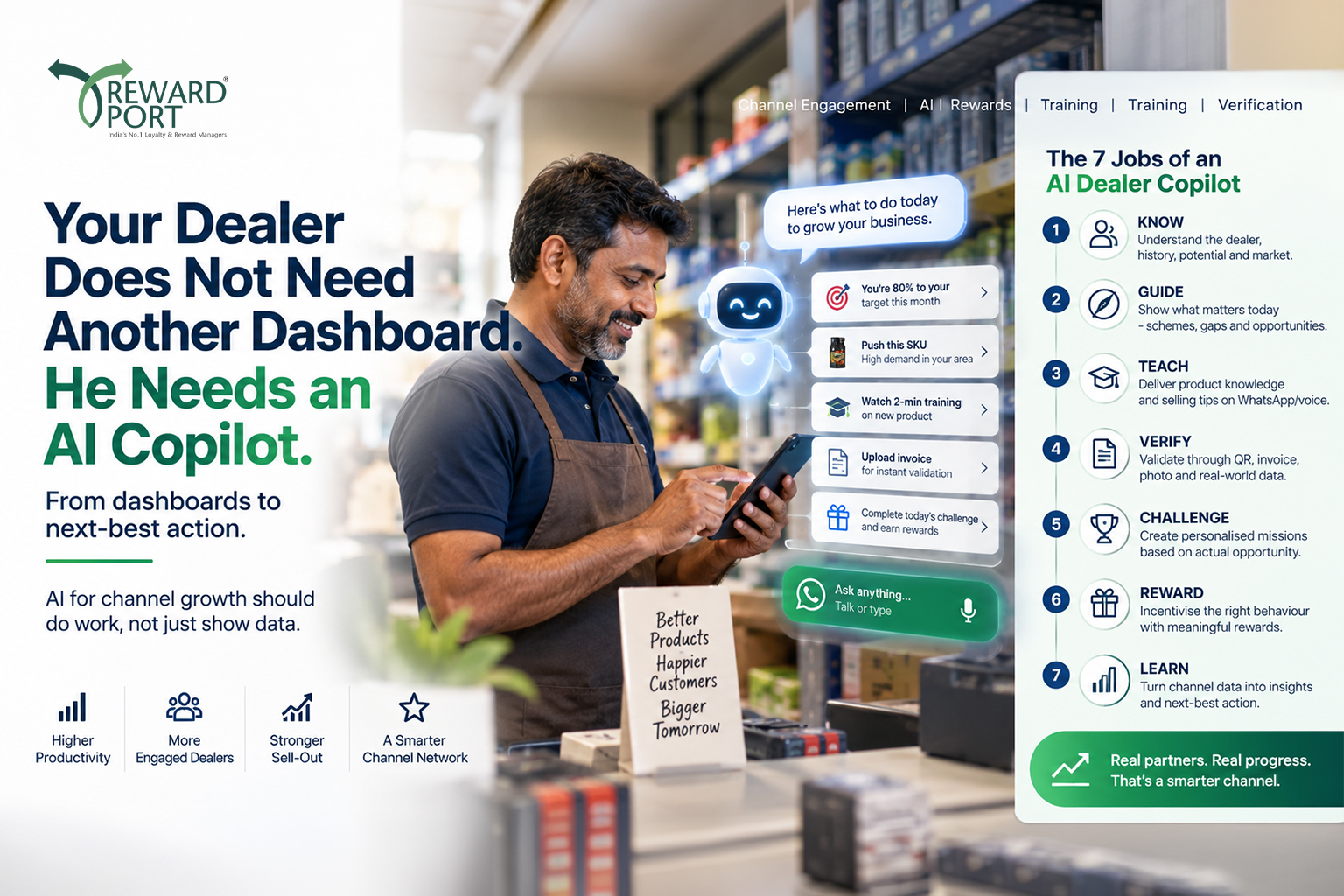
An AI dealer copilot should do more than display sales, points and scheme balances. It should understand each partner, identify what matters next, answer questions, teach product knowledge, verify activity, create relevant challenges, trigger the right reward and turn channel data into clear next actions. If the AI cannot help a dealer decide what to do today, it is probably still a dashboard with AI branding.
Key Takeaways
- Dealer dashboards describe activity. A useful AI copilot should recommend action.
- AI should work for the dealer as well as for head office.
- The most useful channel AI combines partner context, training, verification, incentives and decision support.
- Personalization without verification can simply personalize leakage.
- Brands should evaluate AI dealer platforms by the jobs they perform, not by the number of AI features in a presentation.
A Sales Dashboard Can Tell You Everything. Except What to Do Next.
A sales head opens the dealer dashboard.
There are 43 tiles.
Secondary sales.
Primary sales.
Scheme achievement.
Points earned.
Points redeemed.
Outstanding invoices.
Target versus achievement.
Product mix.
Last login.
A red arrow.
Three green arrows.
Everything is visible.
And yet one question remains unanswered:
What should this dealer do next?
That is the gap between a dashboard and a copilot.
For years, channel technology has focused on collecting information and showing it back to brands.
The next phase is more interesting.
Technology should help a dealer, retailer, distributor, mechanic, contractor or other channel partner make a better decision.
Not next quarter.
Not after somebody at head office exports the dashboard into Excel.
What Is an AI Dealer Copilot?
An AI dealer copilot is a decision and engagement layer that uses approved channel data to help an individual dealer or partner understand what matters, what action to take next and what value is available for taking that action.
It should be able to work with information such as:
- Sales and purchase history
- Product mix
- Scheme eligibility
- Target progress
- Verified invoices or transactions
- Training completion
- Reward history
- Geography
- Previous engagement
- Approved product and scheme information
The objective is not to replace the salesperson or channel manager.
It is to make every interaction more relevant.
A traditional dashboard says:
“You are at 72% of target.”
A useful copilot should be able to say:
“You are close to this month’s threshold. Based on your current mix, these are the products or actions relevant to closing the gap. Here is the current scheme. Would you like the two-minute product explainer?”
That is a very different experience.
The Market Is Already Moving Beyond Basic Loyalty Apps
There are clear signals from large Indian distribution businesses.
Polycab says its Experts App serves more than 2.5 lakh electricians and retailers. In its 2025–26 reporting, the company describes using machine learning for personalized offers, geospatial analytics for fraud detection and outlet validation, and plans for Polycab Polyratna, a unified AI-driven loyalty ecosystem.
Source: Polycab — Digital DNA: Redefining the Influencer and Retail Journey
UltraTech describes Trade Connect as a unified dealer and retailer app and a digital “nerve centre” for dealer operations. Its 2024–25 reporting says the company is enhancing the platform with AI-powered predictive insights, intelligent recommendations and more personalised experiences.
Source: UltraTech Cement — Integrated & Sustainability Report 2024–25
Asian Paints has also described MyAwaaz as a dealer-facing platform providing real-time information and personalised tools. Its 2024–25 reporting states that a next-generation loyalty management cloud was implemented to manage loyalty programs across regions, averaging 2,50,000 successful transactions per day.
Source: Asian Paints — Manufacturing & Innovation Report 2024–25
These examples point in the same direction.
Channel platforms are becoming smarter.
But “AI-powered” is becoming such a common description that buyers need a better evaluation question.
Not:
Does the platform have AI?
Ask:
What useful work does the AI actually do?
The RewardPort Seven-Job Test for an AI Dealer Copilot
We believe an AI dealer copilot should be able to perform seven practical jobs.
1. KNOW: Understand the Dealer Before Communicating With the Dealer
Most dealer communication starts with the brand.
“New scheme launched.”
“New product available.”
“Complete your target.”
A copilot should start with the partner.
Who is this dealer?
What have they bought?
Which categories are strong?
Which products are missing?
Which targets matter?
Which training has already been completed?
Which offers are actually relevant?
Which communication has already been ignored?
That context changes everything.
The same scheme should not necessarily produce the same message for every partner.
AI is useful when it converts a mass channel into thousands of relevant individual contexts without requiring a salesperson to manually analyse each one.
Buyer question
Can the system build a usable dealer context, or does it simply send segmented messages?
That distinction matters.
2. GUIDE: Tell the Partner What Matters Today
A dashboard waits to be interpreted.
A copilot should prioritize.
Imagine a dealer opening WhatsApp in the morning and asking:
“What should I focus on today?”
The answer might combine approved information from targets, active schemes, product gaps and training.
For example:
“You are close to completing your current slab.”
“This product family is under-represented in your mix.”
“A scheme relevant to you closes this week.”
“You have not completed training for the new launch.”
The objective is not to bombard the partner with more information.
It is to reduce the amount of information they need to process.
That is particularly important in Indian channel ecosystems where a dealer may simultaneously work with dozens of brands, schemes, representatives and product lines.
The difference is simple:
Dashboard: Here is everything.
Copilot: Here is what matters now.
3. TEACH: Turn Product Knowledge Into an On-Demand Channel Service
Training is often treated as an event.
Invite dealers.
Run a webinar.
Send a PDF.
Record attendance.
But knowledge is usually needed at a different moment.
A contractor is standing in front of a customer.
A retailer has been asked to compare two models.
A mechanic wants to know the correct application.
A dealer needs a quick explanation of a new scheme.
That is where voice and conversational AI become useful.
The partner should be able to ask a question naturally, including in an appropriate local language where supported, and receive an answer based on approved brand knowledge.
The system can then connect learning with action.
Learn about the product.
Answer a short question.
Complete a module.
Use the knowledge in the market.
Earn recognition or an incentive where appropriate.
This moves training from:
Content distributed
to:
Capability improved.
4. VERIFY: Know Whether the Claimed Action Really Happened
This may be the least glamorous job of AI.
It may also be one of the most commercially important.
If a program rewards sales, visibility, invoices, installations, displays, training or other actions, brands need to know whether the qualifying behaviour actually happened.
Depending on the program, verification may involve:
- QR or unique code validation
- Invoice or bill parsing
- OCR
- SKU extraction
- Photo validation
- Location checks
- OTP
- Transaction data
- Duplicate detection
- Anomaly rules
Why does this matter?
Because personalization without verification can simply create more personalized leakage.
Imagine using AI to create highly relevant dealer challenges while the underlying proof can be duplicated, manipulated or incorrectly submitted.
The engagement layer gets smarter.
The fraud gets smarter too.
AI dealer engagement therefore cannot be separated from trust and verification.
5. CHALLENGE: Give Different Partners Different Next Goals
Most incentive programs work in broad slabs.
Do X.
Get Y.
There is nothing inherently wrong with that.
But two dealers may have very different growth opportunities.
Dealer A may be one step away from a volume target.
Dealer B may already have strong volume but a weak product mix.
Dealer C may sell the products but has not completed training for the new range.
Dealer D may be inactive and needs re-engagement before any ambitious challenge makes sense.
This is where a challenge engine becomes more interesting than a static scheme.
The brand can define approved commercial objectives.
The system can then create relevant missions based on actual opportunity.
Examples:
- Complete the new product module.
- Add one qualifying SKU from this category.
- Upload the required visibility proof.
- Complete the next milestone before the scheme closes.
The principle is important:
Do not give everybody the same challenge merely because everybody belongs to the same channel.
6. REWARD: Incentivize the Right Behavior, Not Simply the Biggest Bill
Dealer loyalty has often been reduced to:
Purchase → Earn points → Redeem
That remains useful, but it leaves a lot of potential untouched.
The brand may want to reward:
- Growth
- Learning
- Product mix
- Verified visibility
- New product adoption
- Participation
- Referral
- Service quality
- Strategic SKUs
- Challenge completion
The reward should match the importance of the behaviour.
A small completed action may deserve a micro-reward.
A meaningful milestone might justify a more valuable reward, experience, recognition benefit or status change.
The AI layer can help determine relevance, but the commercial logic still needs human design and approved program rules.
AI should not decide what the business values.
It should help execute that strategy more intelligently.
7. LEARN: Turn Thousands of Channel Actions Into One Clear Management Answer
There is a second copilot sitting on the other side of the system.
The channel head.
The sales director.
The trade marketing team.
They should be able to ask:
“Which dealers are close to the next slab?”
“Where did participation drop this week?”
“Which region completed training but did not improve product adoption?”
“Which challenge is producing activity but not sales?”
“Where are suspicious claims concentrated?”
“Which reward is being selected by high-performing dealers?”
That is where Talk-to-Data becomes useful.
The value is not a prettier dashboard.
The value is reducing the distance between:
Question → Data → Interpretation → Action
Channel leaders should not need a new report every time they have a new question.
Case File: What This Could Look Like for an Electricals Brand
Consider an electricals company with retailers and electricians across multiple markets.
The traditional loyalty layer tracks purchases, points and redemptions.
A more intelligent engagement layer could work like this.
A retailer opens WhatsApp and asks:
“What do I need to do this month?”
The copilot checks approved program data.
It identifies the partner’s current progress, relevant schemes, missing training and a product opportunity.
The retailer receives three actions:
- Complete a two-minute product update.
- Focus on an eligible product family relevant to the current scheme.
- Upload the qualifying invoice when complete.
The invoice is parsed and checked.
The activity is validated.
The partner’s progress updates.
The next challenge changes accordingly.
Meanwhile, the channel manager can ask:
“Which retailers are one action away from completing this month’s challenge?”
That is not a loyalty ledger.
It is a closed behavioural loop.
This is an illustrative RewardPort program architecture, not a disclosed client result.
Case File: The Mechanic Who Does Not Want Another App
Now consider an auto aftermarket brand.
Its mechanics and retailers may already use several applications.
Adding another app can create friction before engagement even begins.
A WhatsApp or voice-first copilot could instead allow the mechanic to ask:
“What is the right application for this product?”
“What is the current scheme?”
“How many points do I have?”
“What do I need for the next level?”
The same conversation can connect product education, scheme communication, QR validation and rewards.
The interface becomes conversational.
The underlying system remains controlled.
And the partner does not need to learn another dashboard merely to participate.
This is an illustrative RewardPort program architecture. Actual design would depend on approved data access, channel structure, languages, products, commercial objectives and program rules.
AI Should Not Eliminate the Channel Manager
This deserves emphasis.
The best use of AI in channel engagement is not to remove the relationship.
It is to improve it.
A salesperson arriving at a dealer with better context can have a better conversation.
A channel manager who knows which partners need attention can prioritise their time.
A dealer who can answer a basic scheme question instantly does not need to wait for a call back.
AI handles repetition, retrieval, prioritisation and pattern recognition.
People handle relationships, negotiation, judgement and exceptions.
That combination is more useful than trying to replace one with the other.
How Should a Brand Evaluate an AI Dealer Engagement Platform?
Before selecting a partner or platform, ask these questions:
1. What data can the AI actually use?
Is it working with live approved program data, or only a generic chatbot?
2. What can the dealer ask?
Can partners ask about schemes, progress, products, training and rewards in natural language?
3. Can it recommend a next action?
Or does it only summarize the dashboard?
4. How is qualifying behaviour verified?
What happens with duplicate invoices, reused codes, suspicious images or inconsistent claims?
5. Can challenges differ by partner?
Can the program adapt goals based on partner context and commercial objectives?
6. Can the business ask questions of its own channel data?
How quickly can management move from a question to a reliable answer?
7. Is there human control?
Can teams define rules, approve knowledge sources, override exceptions and audit decisions?
8. Does it work where the channel already works?
App, web, WhatsApp and voice can all be relevant. The right interface depends on the partner.
What Metrics Should an AI Dealer Program Track?
Do not stop at logins.
Useful metrics can include:
- Active partner rate
- Verified activity rate
- Second and subsequent participation
- Scheme completion
- Training completion
- Product-mix movement
- Challenge participation
- Time to next action
- Reward cost per desired behaviour
- Suspicious or rejected claims
- Partner query resolution
- Repeat engagement
- Secondary-sales indicators where reliable data is available
And one particularly useful measure:
Recommended Action Completion Rate
Partners completing the recommended action ÷ partners receiving the recommendation
That tells you whether the intelligence is actually changing behaviour.
Consumer Promotion Strategy for Tea Brands in India: A Trial-to-Repeat Growth Playbook
A tea-brand promotion should begin with one behavior to change.
That could be trial, larger-pack migration, repeat purchase, premium-range discovery or retailer advocacy.
The strongest programs then connect that behavior to suitable purchase evidence, a relevant reward and a clear next action. Consumer and retailer tracks should remain operationally distinct, while the insights from both contribute to a broader category-growth plan.
Key Takeaways
- Tea is a habitual category, so the strategic objective should extend beyond generating a one-time redemption to creating a measurable repeat-purchase pattern.
- Mass, premium, green, herbal, regional and gifting propositions should not automatically use the same reward rules.
- Pack size, blend, geography, season and purchase frequency can influence the appropriate promotion mechanic.
- Assured rewards can support the first action, while streaks, milestones and differentiated value can encourage subsequent purchases.
- Retailer advocacy requires separate evidence, targets, communication and rewards rather than competing with consumers for the same code pool.
Why Tea Brands Need a Category-Specific Promotion Design
Tea combines frequent consumption with complex consumer choice.
A household may already have:
- A preferred blend
- A regional taste preference
- A habitual pack size
- A trusted retailer
At the same time, the category covers mass black tea, premium blends, green and herbal variants, tea bags, wellness-positioned products, gifting and out-of-home consumption.
This creates several different growth objectives:
Recruit a New Household → Encourage Variant Trial → Increase Pack Size → Drive Repeat Purchase → Introduce Premium Products → Activate Regional Markets → Strengthen Retailer Recommendation
A promotion attempting to solve every objective simultaneously can quickly become expensive and difficult to measure.
The promotion decision therefore needs to be made at the brand, SKU, pack, channel and behavior level, rather than being based only on broad category trends.
The RewardPort BREW Growth Framework
The supplied RewardPort authority article introduces the BREW framework, a four-part approach for turning a tea promotion into a measurable behavior loop.
| Element | Decision | Tea-Brand Application |
|---|---|---|
| B — Behavior | What single action should change? | Trial, repeat, pack migration, variant discovery, referral, retailer recommendation or data opt-in |
| R — Route | Where and how will participation happen? | On-pack code, in-pack token, receipt upload, WhatsApp, retailer handoff, e-commerce order data or hybrid journey |
| E — Evidence | What proves the qualifying action? | Serialized code, receipt OCR, invoice, order feed, repeat sequence, retailer data or approved registration |
| W — Worth & Next Action | What value will motivate this audience, and what should happen next? | Cashback, voucher, merchandise, cinema, travel, experience, collect-and-unlock, referral or next-purchase benefit |
The loop becomes useful when the brand does not stop at recording redemption.
It should also understand:
Who participated → What they bought → Whether they returned → What reward they chose → What action should come next
Choose the Promotion Mechanic by Growth Objective
Different tea-brand objectives require different mechanics.
1. Drive Trial
Use a low-friction on-pack or receipt-verification journey with an assured entry reward and clear product education.
Measure:
- Cost per verified new buyer
- Participation by SKU and region
- First-to-second purchase
The first reward should make participation easy while creating a route towards the next purchase.
2. Move Consumers to a Larger Pack
Use tiered value based on verified pack size or provide an additional benefit when consumers upgrade within a defined period.
Measure:
- Pack-size mix
- Upgrade rate
- Cost per incremental gram/value
- Repeat behavior after upgrading
The objective is not simply to reward another transaction. It is to identify whether the promotion changes the consumer’s pack-size behavior.
3. Encourage Repeat Purchase
Use a collect-and-unlock, purchase streak or milestone mechanic based on a repeatable verification method such as serialized codes or receipt-based sequencing.
The consumer should be able to understand their progress and what the next verified purchase unlocks.
This turns:
Purchase → Reward
into:
First Purchase → Progress → Second Purchase → Higher Value → Repeat Behavior
4. Encourage Variant Discovery
Use guided discovery, variant-specific missions or cross-SKU progress to introduce consumers to other products in the portfolio.
This can be particularly useful when a brand has multiple blends, formats or propositions.
The campaign should measure whether participation actually converts into verified target-variant trial rather than only engagement with promotional communication.
5. Strengthen Retailer Recommendation
Retailer advocacy should have its own program track.
Retailers may be rewarded for approved actions such as:
- Verified stocking
- Product learning
- Sales missions
- Strategic SKU movement
- Other approved channel actions
Retailer and consumer reward rules, evidence and ledgers should remain distinct.
Mass and Premium Tea Should Not Automatically Use the Same Reward
Reward selection should reflect the proposition and desired behavior.
For a mass-market proposition, clarity and immediate value may be important.
For premium tea, the audience, margin, purchase barrier and brand positioning may support higher-perceived-value or experiential rewards.
Depending on the campaign, the reward architecture could include:
- Cashback
- Digital vouchers
- Merchandise
- Cinema
- Travel
- Experiences
- Next-purchase benefits
The key question is not simply:
“Which reward is most attractive?”
It is:
“Which reward is most appropriate for this audience, behavior and next action?”
Consumer and Retailer Tracks Should Work Together — Not Compete
A tea promotion can include both consumer and retailer engagement under the same overall growth strategy.
However, the two journeys should remain operationally separate.
Consumer Track
Could focus on:
Trial → Repeat → Pack Migration → Variant Discovery → Loyalty
Retailer Track
Could focus on:
Stocking → Product Knowledge → Recommendation → Sales Mission → Continued Advocacy
The evidence, reward rules, ledgers, fraud controls and applicable tax treatment may differ.
Keeping these tracks separate allows the brand to understand both consumer pull and retailer influence without creating attribution conflicts.
Metrics for the Tea-Brand Growth Loop
| Metric | Definition | Decision Supported |
|---|---|---|
| Verified Trial Cost | Total promotion cost ÷ verified first-time participants | Is customer recruitment economically sustainable? |
| Second-Purchase Rate | First-time verified buyers with a second verified purchase ÷ first-time verified buyers | Is the campaign creating repeat behavior? |
| Time to Repeat | Median days between first and second verified purchase | When should the next trigger happen? |
| Pack-Migration Rate | Verified buyers moving to target pack ÷ eligible verified buyers | Is the promotion changing pack-size mix? |
| Variant-Conversion Rate | Verified target-variant trials ÷ eligible participants | Is product discovery converting into purchase? |
| Reward Efficiency | Verified target actions ÷ total reward and fulfilment cost | Which rewards and cohorts create useful behavior? |
| Consumer Data Usability | Consented, complete, deduplicated records ÷ verified participants | Is the campaign producing reusable first-party intelligence? |
| Invalid & Duplicate Rate | Invalid or duplicate attempts ÷ total attempts | Are evidence and fraud controls working appropriately? |
| Retailer Active Rate | Retailers with verified target action ÷ enrolled eligible retailers | Is retailer participation genuine? |
These metrics shift the conversation from “How many rewards did we distribute?” to “What behavior did the promotion change?”
Illustrative Scenario: Regional Premium Tea Launch
Assume a tea company is introducing a premium regional blend across two states.
The objective is:
Verified Trial → Second Purchase Within 45 Days
Packs can carry a unique in-pack code, and the brand wants a WhatsApp-first journey available in two languages.
A possible pilot could work like this:
First Purchase
Unique Code → WhatsApp Verification → Assured Low-Friction Reward → Taste/Usage Prompt
Second Purchase
Second Valid Code Within 45 Days → Verification → Higher-Perceived-Value Benefit
Reward preference and repeat timing could be recorded with consent, while code duplication, device velocity and geography are monitored.
Retailers could participate through a separate learning and verified-stock or sales mission instead of accessing the consumer code pool.
This is an illustrative scenario, not a claimed RewardPort client result. Budget, pack operations, tax, promotion terms, data use and reward availability would need to be verified before launch.
RewardPort Tea Campaign Examples
RewardPort case-study library also contains tea-sector examples that can support the article.
Goodricke — Premium Tea Trial
RewardPort documented Goodricke campaign supported the launch of its Thurbo Darjeeling tea range with an assured ₹100 Uber voucher for qualifying purchases.
The campaign targeted urban premium tea consumers and used a practical lifestyle reward aligned with the audience.
Maharaja Tea — Assured Cashback for Repeat Purchase
RewardPort Maharaja Tea campaign used ₹50 assured cashback on every pack, with consumers redeeming a unique code digitally. The campaign has recorded 300,000+ cashback redemptions and was designed to encourage repeat purchase through simple, immediate value.
Vikram Tea — Assured Value + Aspirational Prize
For Vikram Gold’s 250g pack, RewardPort executed a consumer promotion combining ₹15 assured Paytm cashback with entry into a gold coin lucky draw.
The documented campaign used the combination of immediate value and an aspirational prize to support pack sales and engagement.
These examples illustrate why different tea propositions may require different reward architectures rather than one universal promotion mechanic.
How RewardPort Can Support Tea Brands
RewardPort can help tea brands move from a standalone offer to a connected promotion system spanning:
Objective & Mechanic Design → QR/Code Journeys → Purchase Verification → WhatsApp Participation → Rewards → Retailer Engagement → Fraud Controls → Fulfilment → Analytics
Consumer and channel journeys can remain role-specific while contributing to a broader picture of trial, repeat behavior, product mix and market response.
The right starting question is:
Which behavior should change in the next 90 days, and what evidence will prove that it changed?
Ask RewardPort for a tea-brand promotion blueprint covering behavior, pack and channel constraints, evidence, reward architecture, retailer activation and a measurable pilot.