
September 2026 Was the Month AI Marketing Stopped Being About Content
For the past three years, much of the marketing conversation around artificial intelligence has been about making things:
Copy.
Images.
Videos.
Emails.
Campaign variations.
September 2026 suggests the next phase is different.
AI is beginning to sit inside the customer journey.
It can converse with customers, interpret intent, decide what action to take next, operate parts of campaigns, connect to business data and increasingly help determine whether marketing actually worked.
That is a much bigger change than faster content creation.
The short answer: What changed in AI marketing in September 2026?
Several developments point in the same direction.
OpenAI introduced Sponsored Agents that can allow a consumer to move from seeing an ad into a conversation with a business-sponsored AI agent.
Google introduced a Business Agent for YouTube Ads, allowing viewers to ask questions about products alongside an advertisement.
Salesforce is building marketing agents intended to participate in campaign planning and execution.
Google is also expanding AI-driven advertising controls and measurement capabilities, while emphasizing first-party data and causal measurement.
Source:
https://openai.com/index/reimagining-advertising-with-ai/
The common thread is important:
AI is moving from making marketing to doing parts of marketing.
Five things marketers should take away
1. Advertising is becoming conversational
The customer may increasingly ask the advertisement questions instead of merely clicking it.
2. Campaign management is becoming agentic
AI is moving closer to deciding, coordinating and executing actions rather than only generating assets.
3. First-party data becomes more important, not less
Better AI requires better signals about customers, transactions and behaviour.
4. Measurement has to move beyond reporting
AI systems need feedback about what genuinely created incremental behaviour.
5. The competitive advantage may shift
The advantage may move from who has the best AI tool to who has the best action and data loop.
1. Advertising is beginning to answer back
For decades, an advertisement essentially did one thing.
It delivered a message.
Search advertising improved this by making the message more relevant to intent.
Social media advertising improved targeting and interaction.
Performance marketing made response measurable.
Conversational AI potentially changes the unit again.
On 16 September, OpenAI announced Sponsored Agents for ChatGPT Ads.
Instead of an advertisement simply sending someone elsewhere, OpenAI describes a model where a person can begin interacting with a business-sponsored agent after clicking an ad.
The company also announced AI-assisted ad creation and integrations with HubSpot and Shopify.
Source:
https://openai.com/index/reimagining-advertising-with-ai/
Eight days later, Google announced Business Agent for YouTube Ads.
A viewer can interact with conversational AI alongside a video advertisement with a product feed and ask questions about the product or brand without leaving that context.
Source:
https://blog.google/products/ads-commerce/demand-gen-drop-september-2026/
Consider what this means.
The old advertising journey could look like:
Ad → Click → Landing page → Search for information → Form → Follow-up
An emerging journey could look more like:
Ad → Conversation → Clarification → Recommendation → Action
The advertisement starts behaving less like a poster and more like a knowledgeable salesperson.
For marketers, this changes what an advertising asset needs to know.
It needs more than a headline and an image.
It may eventually need:
- Product information
- Pricing rules
- Eligibility conditions
- Inventory
- FAQs
- Customer context
- Promotion rules
- Ability to trigger an approved next action
That is no longer simply creative production.
It is marketing infrastructure.
2. AI agents are moving from assistants to operators
Another shift became particularly visible around Salesforce’s Dreamforce announcements.
Salesforce expanded Agentforce with job-oriented agents intended to handle increasingly complex work.
Its marketing products now include concepts such as Campaign Agent and Marketing Agent, moving AI deeper into activities such as campaign creation, audience decisions and coordination.
Source:
The distinction matters.
A marketing copilot waits for a marketer to ask:
“Write five subject lines.”
An agentic marketing system can potentially be given an objective:
“Increase repeat purchase among customers who bought this product in the last 60 days.”
It then has to work out some combination of:
- Audience
- Message
- Channel
- Timing
- Offer
- Next action
within the permissions it has been given.
Humans are still responsible for strategy, economics, brand standards, governance and outcomes.
But the operational interface starts changing.
Instead of marketers manually operating every tool, they increasingly define objectives, rules and guardrails.
3. The real AI advantage may be first-party data
There is a paradox in AI marketing.
As AI models become more widely available, access to AI itself becomes less distinctive.
The differentiation moves toward what the AI knows.
Google made this point explicitly in its September measurement announcements.
It described a strong data foundation, multiple signals and causal proof as three ingredients required for AI-powered measurement and decision-making.
Source:
https://blog.google/products/ads-commerce/data-strength-updates/
This has major implications for promotions and loyalty.
Imagine two brands using essentially the same AI technology.
Brand A knows that a customer opened an email.
Brand B knows that a customer:
- Scanned a QR code
- Authenticated a purchase
- Uploaded an invoice
- Redeemed an offer
- Selected a reward
- Purchased again 37 days later
Which AI has the more useful context?
The advantage is not necessarily the model.
It is the behavioural data surrounding the model.
That is why QR, transaction validation, OTP, invoice recognition, loyalty participation and reward redemption should no longer be considered merely campaign plumbing.
They are potential intelligence signals.
RewardPort’s broader engagement model is built around this sequence:
Start with the commercial behaviour a brand wants to influence, verify the qualifying action, deliver suitable value, measure the response and use the resulting intelligence to improve the next intervention.
AI makes that loop more powerful.
It does not make the loop unnecessary.
4. AI advertising is already moving beyond experimental scale
There are also signs that this is becoming operational rather than theoretical.
Amazon India reported in September that adoption of its AI advertising tools had grown 77% year on year, while SMB sellers using AI created 62% more advertising creatives in Q1 2026.
The figures are Amazon’s own platform data, so they should be understood in that specific context, but they illustrate how rapidly AI-assisted advertising tools are becoming part of everyday seller workflows.
Source:
Amazon is also putting AI on the consumer side of commerce.
Its Ganesh Chaturthi Store in India highlighted tools including Rufus, Lens AI, Review Highlights and Price History to assist consumers with product discovery and purchase decisions.
Source:
This creates an interesting situation.
AI is appearing on both sides of the transaction.
The marketer has AI.
The platform has AI.
And increasingly, the customer has AI.
Marketing therefore has to work in a world where machines may help create the offer, deliver the offer, interpret the offer and evaluate the offer.
5. Search advertising is becoming less about individual keywords
Google’s September announcements provide another signal.
AI Brief for AI Max allows advertisers to provide richer information about their business, audience and messaging in natural language.
Google is also introducing reporting designed to show how search terms, creative assets and landing destinations interact within AI-driven Search campaigns.
Source:
https://blog.google/products/ads-commerce/ai-max-language-reporting-features/
Traditional search advertising was built around:
Keyword
↓
Bid
↓
Creative
↓
Landing page
AI-driven systems increasingly work with richer context and larger decision spaces.
That makes the marketer’s inputs different.
Instead of merely selecting keywords, marketers increasingly need to articulate:
- Who are we trying to influence?
- What do we know about them?
- What behaviour are we trying to create?
- What proposition is valid?
- What should never be offered?
- What business outcome matters?
- How will we know whether it worked?
Those are strategy questions.
Not prompt-engineering questions.
6. Marketing measurement is about to become even more important
When AI can generate thousands of variations and change decisions dynamically, traditional campaign reporting becomes insufficient.
A high click-through rate may simply mean the AI found better clickers.
A high redemption rate might mean the offer was generous.
A large number of conversations might mean people were curious.
None necessarily proves incremental business impact.
The measurement question becomes:
Did the AI cause a commercially useful behaviour that would otherwise have been less likely to happen?
That requires a stronger relationship between marketing data and actual behaviour.
Useful signals might include:
- Purchase verification
- Repeat purchase
- Product registration
- Retailer billing
- Referral completion
- Training completion
- Store visibility
- Invoice validation
- Reward redemption
Google’s own measurement framing is moving in this direction by emphasizing causal proof rather than treating measurement as merely a retrospective report card.
Source:
https://blog.google/products/ads-commerce/data-strength-updates/
AI makes measurement more powerful.
It also makes sloppy measurement more dangerous.
If an AI system learns from the wrong success signal, it can become extremely efficient at optimizing the wrong thing.
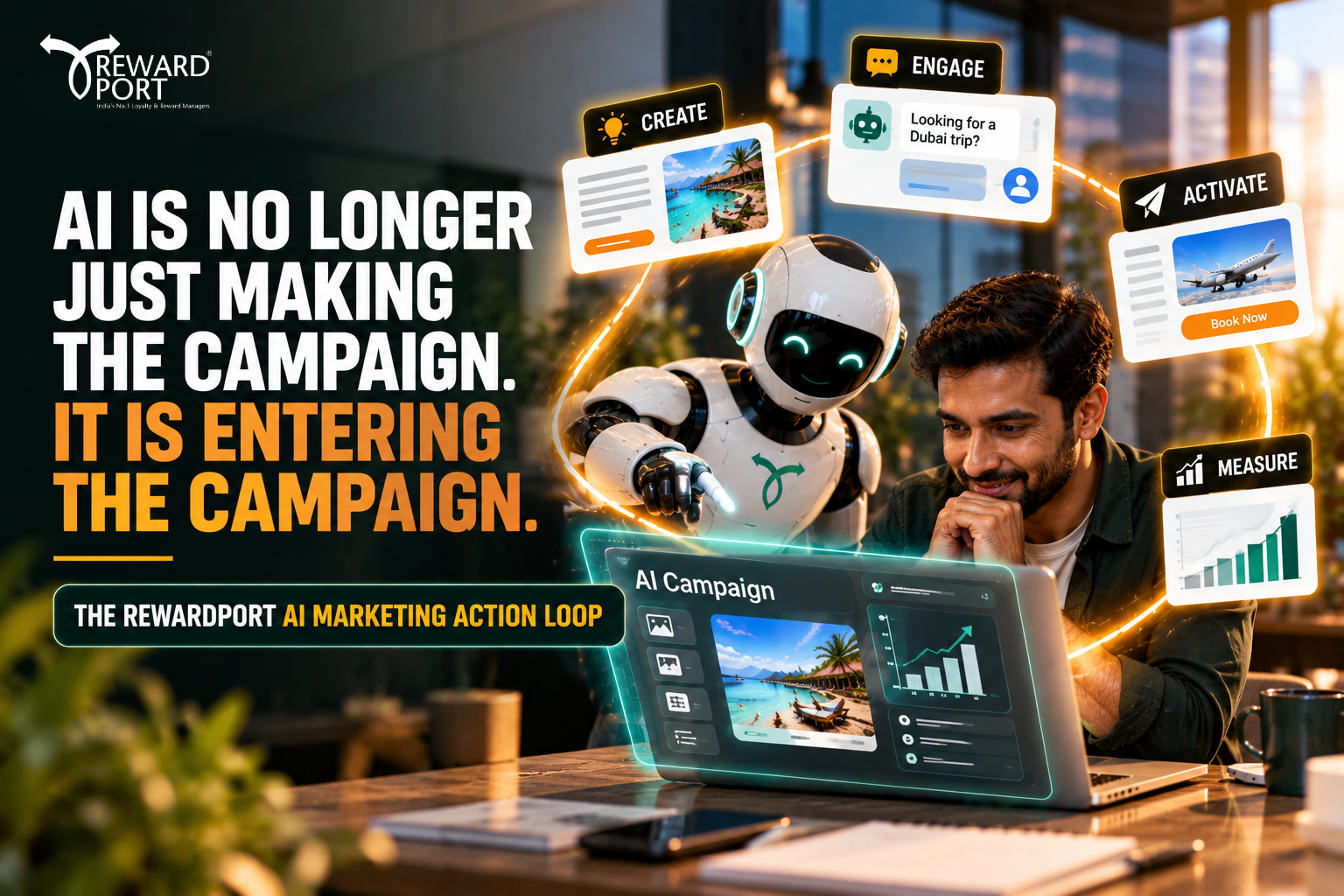
The RewardPort AI Marketing Action Loop
One useful way to think about this next phase is as a six-stage loop.
1. SIGNAL
What do we know?
Examples:
- Purchase
- QR scan
- Transaction
- Bill
- Location
- Previous response
2. UNDERSTAND
What might this person or partner need?
Examples:
- Segment
- Intent
- Propensity
- Context
3. DECIDE
What action should happen next?
Examples:
- Offer
- Message
- Challenge
- Reminder
- Training
4. INTERACT
How should the action reach them?
Examples:
- Web
- Campaign agent
- Promotion
- Dealer interface
5. VERIFY
Did the required behaviour actually occur?
Examples:
- OTP
- QR
- OCR
- Invoice
- Transaction
- Approved operational data
6. LEARN
What should happen differently next time?
Examples:
- Change audience
- Incentive
- Timing
- Communication
- Next-best action
This is where AI becomes materially more interesting for:
- Consumer promotions
- Dealer programs
- Loyalty
The intelligence is not isolated from execution.
It closes the loop.
RewardPort already operates across areas including AI bill parsing, talk-to-data, visibility detection and AI-supported channel engagement alongside promotion verification and reward fulfilment.
The useful role for AI is therefore not simply producing more campaign copy.
It is improving decisions, verification and business outcomes.
What should marketing leaders do now?
The first response should probably not be to buy another AI platform.
Start with the customer journey.
Take one important commercial behaviour such as:
- Repeat purchase
- Referral
- Dealer activation
- Product registration
- Trial conversion
Then ask:
Where do we currently lose information?
Which decisions are currently generic?
Which actions could AI help recommend or execute?
Can we verify whether the desired behaviour actually happened?
Can that result improve the next decision?
This identifies the practical AI opportunity far faster than beginning with a catalogue of tools.
AI will make average marketing cheaper. It may make great marketing harder.
When everyone can generate competent copy, thousands of creatives and personalized variations, production becomes less scarce.
Judgement becomes more scarce.
What should the brand say?
Who should receive an incentive?
How much should it cost?
What behaviour deserves a reward?
When should the brand remain silent?
What data can legitimately be used?
When should a human intervene?
What constitutes genuine incremental growth?
Those questions cannot be solved by adding another image generator.
They require a marketing system.
So, did AI marketing change in September 2026?
Not overnight.
But several announcements this month make the direction easier to see.
OpenAI is putting conversational agents behind advertisements.
Google is putting conversational AI alongside YouTube ads and richer AI inside campaign management and measurement.
Salesforce is turning agents into participants in marketing work.
Amazon is embedding AI deeper into both seller advertising and consumer product discovery.
The first chapter of generative AI in marketing was largely:
AI helps us make more marketing.
The next chapter looks increasingly like:
AI helps decide what marketing should happen, carries out parts of it, interacts with the customer and learns from what happens next.
For marketers, that means the most important question is no longer:
“Which AI tool should we use?”
A better question is:
“What behaviour are we trying to create, what signals can our AI learn from, and can we close the loop between decision, action and measurable outcome?”
That may prove to be the much bigger AI marketing story of 2026.

Stop Giving Discounts Away: The New Rule for Consumer Promotions
That “something” does not always have to be more sales immediately.
It could be a verified purchase, a second purchase, first-party data, a referral, product trial, permission to communicate, category discovery or simply a better understanding of who is actually buying.
The problem with many promotions is simpler:
The brand gives. The consumer takes. And the relationship ends there.
That is becoming an increasingly expensive way to do marketing.
The ₹100 Question
Imagine this.
A customer walks into a supermarket.
Your brand gives her ₹100 off.
She buys.
She leaves.
The campaign report shows:
- Coupon redeemed
- Unit sold
- ₹100 promotion cost
- Successful transaction
Everything looks fine.
Except for one question.
What did the brand learn or change?
Do you know who bought?
Was she already planning to buy?
Did she try the product for the first time?
Will she buy again?
Can you communicate with her?
Did she switch from a competitor?
Did she buy another SKU?
Did the discount actually create incremental behaviour?
If the answer to all of these is “we don’t know”, then the brand may have successfully subsidised a transaction without creating much beyond it.
Discounts are not the problem.
Giving them away without a strategic exchange is.
Consumer Promotions Are Changing
The traditional promotion model has often been built around broad offers:
- ₹20 off
- Buy one, get one
- 10% cashback
- Free gift inside
- Scratch and win
These mechanics are still useful.
What is changing is the intelligence around them.
McKinsey’s 2026 research on grocery retail found that grocers expect promotions to become significantly more targeted, digital, loyalty-integrated and focused on measurable effectiveness.
In its survey, the share of promotions expected to be fully personalised was projected to rise from about 35% today to 55% within two to three years. Between 88% and 94% of grocers said they expected to prioritise targeted offers, loyalty integration, digital promotions and greater focus on promotion effectiveness and ROI.
Source: https://www.mckinsey.com/industries/retail/our-insights/the-state-of-grocery-north-america
The direction is clear.
Promotions are moving from:
“What discount should we run this month?”
toward:
“What behaviour are we trying to create, for whom, and at what economic cost?”
That is a much more useful question.
The Give/Get Promotion Model
We use a simple way to think about modern consumer promotions.
Every promotion should answer two questions.
What Does the Customer Get?
Possibilities include:
- Cashback
- Discount
- Merchandise
- Voucher
- Free product
- Movie ticket
- Travel benefit
- Experience
- Access
- Recognition
- Chance to win
Then ask:
What Does the Brand Get?
Possibilities include:
- Product trial
- Verified purchase
- Consumer identity
- Permission to communicate
- First-party data
- Second purchase
- Increased frequency
- Larger basket
- Category trial
- Referral
- Product review
- Retailer visibility
- Preference information
- Measurable engagement
That is the Give/Get Promotion Model.
A useful promotion should create value on both sides.
Not because consumers owe brands their data.
They don’t.
But because a promotion should have a clearly defined commercial or behavioural purpose beyond simply distributing money.
Seven Things a Modern Promotion Can Earn Back
1. Identity
A surprisingly large number of brands still sell millions of products without knowing who their end customer actually is.
Distribution works.
Sales happen.
But the consumer remains anonymous.
A simple promotion can change that.
For example:
Purchase product → Scan QR → Verify → Register → Receive reward
Now a previously anonymous transaction can become a direct consumer relationship, subject to the appropriate consent and privacy requirements.
That does not mean asking for twenty fields of information.
Often, less is better.
The objective is not to create friction.
It is to begin a useful relationship.
2. Proof of Purchase
Promotions become far more powerful when brands can distinguish between:
Someone interested in the campaign
and
Someone who actually purchased.
Verification can happen in several ways depending on the category:
- Unique QR
- Alphanumeric code
- OTP
- Receipt upload
- Invoice validation
- OCR
- Transaction information
- Retailer validation
This is particularly important when the reward has meaningful value.
A campaign that cannot confidently determine who qualified can create leakage, fraud and poor economics.
Verification turns promotion participation into usable commercial information.
3. A Second Purchase
Brands spend enormous sums convincing people to make their first purchase.
But for many businesses, the second purchase is more strategically interesting.
Why?
Because one purchase may indicate curiosity.
Two purchases begin to indicate behaviour.
Instead of:
Buy today and get ₹100 back
consider:
Buy today and unlock ₹100 on your next verified purchase.
The promotional spend now has another job.
It is attempting to create repetition.
McKinsey’s research on targeted promotions describes exactly this shift toward promotions designed around lifecycle stages such as acquisition, repeat purchase, retention, cross-selling and churn prevention rather than simply mass discounting.
4. Product Discovery
Many brands have a range problem.
Consumers know one hero SKU but ignore the rest of the portfolio.
The obvious response is another discount.
But promotions can be designed more intelligently.
For example:
Buy product A → Discover B → Try B → Unlock reward
Or:
Buy any three different products from the range → Complete the collection → Unlock an experience
The promotion is not merely making an existing transaction cheaper.
It is helping the brand expand category penetration.
5. Referrals
There is a major difference between:
“Share this campaign on social media”
and:
“Bring us another genuine customer.”
Referral mechanics can turn promotion budgets toward acquisition.
For example:
Purchase → Refer → Friend purchases → Both unlock value
Now the incentive is tied to verified behaviour rather than generic sharing.
For high-consideration categories, this can become even more powerful.
Think appliances, consumer electronics, automobiles, education, financial products, travel or premium services.
A happy customer may be more persuasive than another advertisement.
6. Permission for an Ongoing Relationship
A transaction is a moment.
A relationship can be much more valuable.
Promotions can provide a legitimate reason for consumers to voluntarily enter an ongoing communication journey.
That might include:
- WhatsApp updates
- Loyalty participation
- Future offers
- New product discovery
- Contests
- Rewards
- Relevant content
The important word is voluntarily.
A badly designed promotion collects contact details because it can.
A better promotion explains the value exchange clearly.
Stay connected because there is something useful to stay connected for.
7. Learning
This is possibly the most underrated return from a promotion.
Every campaign should make the next campaign smarter.
Which reward produced more participation?
Did ₹50 cashback work better than a movie voucher?
Did first-time buyers respond differently from repeat buyers?
Which city produced greater trial?
Did a smaller guaranteed reward outperform a large chance-to-win prize?
Which SKU generated the most referrals?
How many consumers completed a second purchase?
The campaign itself becomes an experiment.
That means the value of a promotion is not just:
Sales generated today.
It is also:
What the brand knows tomorrow.
Old Promotion vs. Give/Get Promotion
| Traditional Promotion | Give/Get Version |
|---|---|
| ₹100 cashback | Verified purchase + ₹100 cashback |
| 20% off | Register and unlock a targeted offer |
| Free sample | Try + give feedback + unlock next benefit |
| Scratch and win | Verify purchase + play + enter relationship |
| Gift with purchase | Purchase + registration + relevant future offer |
| Generic coupon | Behaviour-based next-purchase incentive |
| Contest entry | Purchase or action + participation + measurable outcome |
| Referral code | Verified friend conversion + reward |
| Dealer payout | Verified sale + learning or target action + incentive |
The customer can receive exactly the same reward.
What changes is the intelligence and behavioural architecture surrounding it.
Personalisation Does Not Mean Sending More Offers
There is a danger here.
Once brands collect more data, the instinct is often:
Great. Now we can send people more promotions.
That is not the point.
Better data should allow a brand to send fewer, more relevant interventions.
McKinsey notes that broad promotion management is increasingly being replaced by targeted offers connected to specific customer stages and business objectives.
The most valuable promotion may sometimes be:
No promotion at all.
If a customer was going to buy anyway, why discount the transaction?
The incentive budget can be redirected toward someone whose behaviour can actually be changed.
The Promotion Exchange Test
Before launching a consumer promotion, ask five questions.
1. What Are We Giving?
Be precise.
₹100?
A movie?
A gift?
A chance to win?
Access?
An experience?
2. What Behaviour Are We Trying to Create?
Not “engagement”.
That is too vague.
Try:
- First purchase
- Second purchase
- Product trial
- Premium upgrade
- Larger basket
- Referral
- Registration
- Return visit
3. How Will We Verify It?
If you cannot verify the action, you may not be able to distinguish real performance from campaign activity.
4. What Reusable Value Do We Gain?
Consumer relationship?
Permission?
Behavioural insight?
New customer?
Cross-category adoption?
Repeat purchase?
5. How Will We Know Whether the Reward Caused the Behaviour?
This is the hardest question.
Many promotions generate redemptions.
That does not automatically mean they generated incremental sales.
McKinsey has previously observed that even sophisticated retailers can find 10% to 15% of promotions dilute sales and margins once factors such as stock-up, cannibalisation and halo effects are properly considered.
Source: https://www.mckinsey.com/industries/retail/our-insights/pushing-granular-decisions-through-analytics
That is why measuring promotion effectiveness matters.
A Promotion Should Create a Loop, Not a Dead End
Traditional Campaign
Advertisement → Discount → Purchase → Finished
Connected Promotion
Purchase → Verify → Reward → Understand → Next Relevant Action → Repeat or Referral → Measure → Improve
The first is a campaign.
The second starts becoming infrastructure.
If every campaign begins from zero, the brand keeps buying attention repeatedly.
If campaigns contribute to an ongoing consumer relationship, each intervention can make the next one more intelligent.
Does Every Consumer Need to Register?
No.
Forcing registration into every promotion can destroy participation.
Sometimes the commercially correct objective is simply:
Sell more products this weekend.
That is fine.
Promotions should not become over-engineered data traps.
The Give/Get principle is not:
“Always collect customer data.”
It is:
“Know what commercial value you expect in return for promotional spend.”
Sometimes that value is identity.
Sometimes trial.
Sometimes distribution.
Sometimes frequency.
Sometimes market share.
Sometimes simply incremental volume.
The important thing is that it is intentional.
Promotions Need Different Rewards for Different Jobs
Another common mistake is deciding the reward before deciding the behaviour.
“We’ll give cashback.”
“Let’s give Amazon vouchers.”
“Let’s do a lucky draw.”
That is backwards.
Start with the audience and objective.
Then select the reward.
A small instant cashback may work well when immediate comprehension matters.
A movie reward might create more perceived value in another context.
An experience could work for a high-value milestone.
A sweepstake may work when excitement and reach matter.
Travel or access can work where aspiration matters.
A micro-reward may be perfect for completing a small digital action.
There is no universally superior reward.
There is only a reward that is more or less appropriate for the behaviour you want.
How Should Consumer Promotion ROI Be Measured?
Do not stop at redemptions.
A modern consumer promotion dashboard can include four layers.
Participation
- Scans
- Registrations
- Claims
- Redemption
- Completion rate
Behaviour
- Verified purchases
- Repeat purchases
- Referrals
- Category trial
- Basket expansion
- Reactivation
Economics
- Incremental revenue
- Gross margin
- Reward cost
- Cost per verified action
- Cost per incremental customer
- Fraud leakage
- Fulfilment cost
Intelligence
- Known consumers created
- Consented relationships
- Preference signals
- Geographic patterns
- Reward preferences
- Product combinations
- Repeat behaviour
The final question is not:
“How many people participated?”
It is:
“What did the promotion change?”
What This Means for FMCG and Consumer Brands in India
The opportunity is particularly relevant in India because many brands still reach consumers through large distribution networks where the final buyer relationship traditionally belongs to the retailer.
A packaged-food brand can sell millions of units and still know comparatively little about individual end consumers.
Promotions create one of the rare moments when the consumer has a reason to identify themselves directly to the brand.
A pack.
A QR.
A receipt.
An invoice.
A WhatsApp journey.
A cashback claim.
A contest.
A referral.
Each can become a bridge between an offline transaction and a direct digital relationship.
That bridge becomes strategically useful only if brands design it deliberately.
Where RewardPort Fits
RewardPort approaches consumer promotions as a combination of:
Behaviour + Verification + Reward + Intelligence
The objective might be product trial, repeat purchase, referral, channel movement or another measurable action.
The qualifying behaviour can then be verified through mechanisms appropriate to the program, such as QR, OTP, invoice, receipt, OCR or approved transaction information.
Finally, the reward can be selected according to the audience and objective, ranging from cashback and vouchers to merchandise, movies, travel and experiences.
The important point is not the reward catalogue.
It is the loop:
Objective → Action → Verification → Reward → Data → Next Action
That is when a promotion starts creating value beyond a single redemption.
The New Rule for Consumer Promotions
The next time someone proposes:
“Let’s give customers ₹100 cashback.”
Do not immediately ask:
“Can we reduce it to ₹75?”
Ask something more important.
“What are we buying with that ₹100?”
A sale?
A second sale?
A new customer?
A referral?
Trial?
Identity?
Permission?
Learning?
If nobody can answer clearly, the promotion probably needs another round of thinking.
Because brands should absolutely keep giving customers reasons to choose them.
They should simply become much clearer about what that generosity is designed to create.
The best promotion is not the one that gives away the most.
It is the one where both sides walk away with something valuable.
How to Increase Repeat Purchase: Solve the Second Purchase Problem Before Building a Loyalty Program
Turn first-time buyers into repeat customers by designing what happens after Purchase #1.
The fastest way to increase repeat purchase is not to give a bigger reward on the first transaction. It is to design what should happen after it. Brands need to identify the natural repurchase window, recognise the next verified action, show visible progress and increase the value of staying engaged. The objective is simple: turn Purchase #1 into Purchase #2, then turn repetition into habit.
A consumer buys your product.
They scan the pack.
They get ₹50 cashback.
Everyone celebrates the redemption numbers.
Then somebody in the review meeting asks a slightly uncomfortable question:
How many of them bought again?
That is where many consumer-promotion programs suddenly run out of answers.
The first purchase got all the creativity, media money, packaging space, QR technology and reward budget.
Purchase number two was left to hope.
That may be the wrong way around.
The Real Loyalty Problem Is Often Purchase #2
Marketers usually talk about acquisition and retention as two different disciplines.
Consumers do not experience them that way.
There is simply a sequence of decisions.
Should I try this?
Should I buy it again?
Should I keep buying it?
Should this become my brand?
For brands in categories such as nutrition, packaged food, beverages, personal care, OTC, baby care and household products, this creates an important design opportunity.
Instead of asking:
“What reward should we give for purchase?”
ask:
“What behaviour should happen next?”
That single question changes the architecture of the program.
Cashback can still play a role. So can vouchers, merchandise, cinema, travel, experiences and instant-win rewards.
But the reward is no longer the campaign.
It becomes one intervention inside a behavioural sequence.
What Is Habit-Based Loyalty?
Habit-based loyalty is a loyalty or consumer-promotion model that rewards a sequence of desired, verifiable behaviours instead of treating every transaction as an isolated event.
A simple version could look like this:
Try → Return → Repeat → Build progress → Reach a milestone → Unlock greater value
For a coffee brand, that could mean repeat purchase.
For a nutrition product, it could mean replenishment at an appropriate interval.
For skincare, it might be continuation of a regimen and subsequent purchase.
For a financial product, it might mean repeated use of an activated feature.
The exact behaviour changes by category.
The principle does not.
Do not reward activity just because you can measure it. Reward the behaviour that moves the commercial relationship forward.
Starbucks Is Designing for Frequency, Not Only Transactions
The refreshed Starbucks Rewards program launched in March 2026 provides a useful example.
Starbucks introduced Green, Gold and Reserve levels, faster earning at higher levels, personalised offers and increasingly premium benefits. Importantly, Starbucks itself said the program was designed to create the potential for increases in frequency and transactions. Green members can also extend the life of expiring Stars through qualifying monthly activity.
Source: Starbucks — Reimagined Loyalty Program
Look at what is happening underneath the rewards.
The consumer is not merely collecting currency.
There is progress.
There is status.
There is continued activity.
There is something else to reach.
That is a fundamentally different psychological proposition from:
“Buy this today and get ₹50 back.”
One rewards a moment.
The other tries to create momentum.
Duolingo Demonstrates Why Visible Progress Matters
Duolingo is not an FMCG loyalty program, but its famous streak provides one of the clearest demonstrations of behavioural design.
A streak tells a user:
You have already come this far. Don’t stop now.
Duolingo previously reported that learners who reached a seven-day streak were 2.4 times more likely to return the following day than learners without a streak. An experiment separating the streak from the daily goal also produced a 3.3% increase in Day 14 retention in that test.
Source: Duolingo — How Streak Builds Habit
The important lesson for brands is not “copy Duolingo”.
It is this:
Past behaviour can become motivation for the next behaviour.
Most purchase promotions throw that asset away.
Purchase #2 is treated exactly like Purchase #1.
Purchase #3 is treated exactly like Purchase #2.
The consumer sees no journey.
Vitality Shows That the Rewarded Action Does Not Have to Be a Purchase
Vitality takes the idea further.
Members can earn points through activities such as physical activity and other qualifying health-related actions. Weekly activity targets, points, status and rewards create an ongoing engagement system rather than a single transaction-reward exchange.
Source: Vitality — How Points Work
That provides another important lesson.
A loyalty program becomes more interesting when the brand asks:
What useful behaviour exists between two purchases?
It could be:
- education
- registration
- a challenge
- a product-care action
- a referral
- a review
- a service interaction
- a legitimate usage-related action
- or simply progress toward the next relevant purchase window
That is where loyalty starts becoming an engagement system rather than a points ledger.
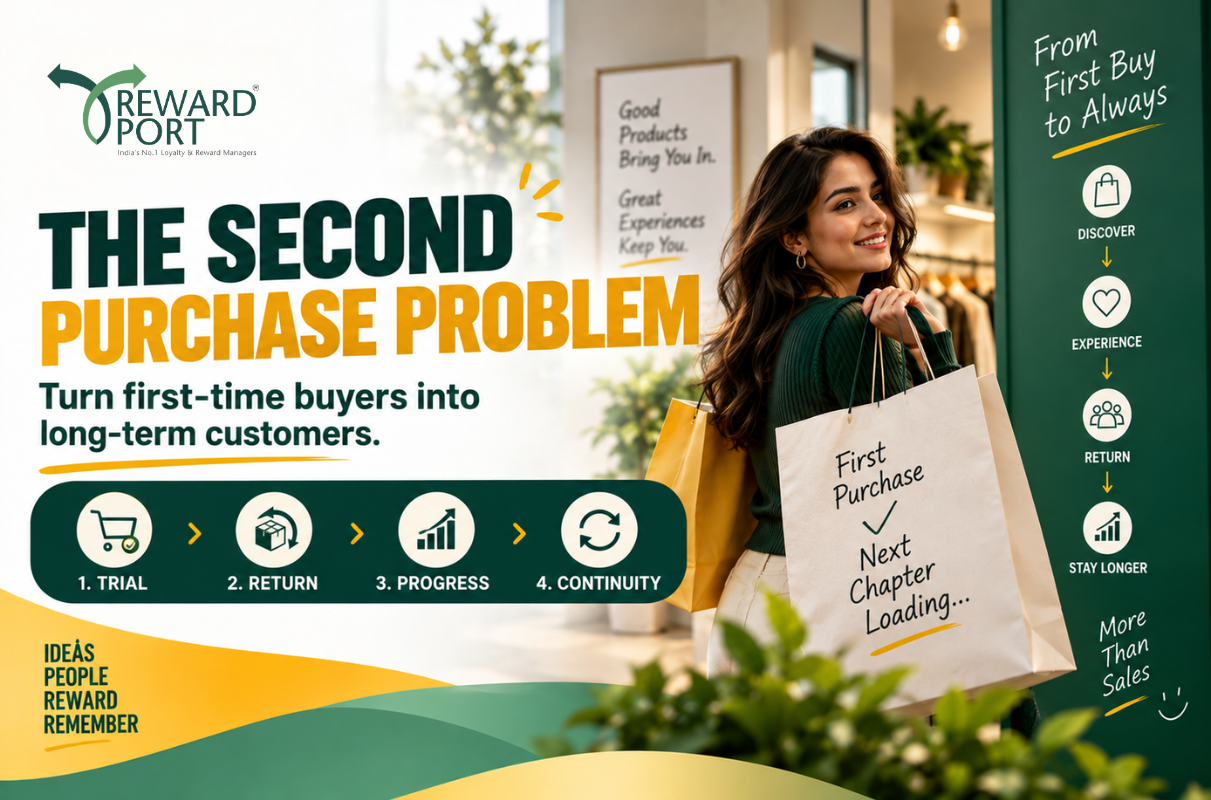
The RewardPort 2-3-4 Repeat Loop
For program-design purposes, we can think differently about the first four purchases.
| Purchase | Role | Objective | Consumer Experience | Example Mechanic |
|---|---|---|---|---|
| Purchase #1 | Trial | Remove trial friction | “I got something immediately.” | Cashback, instant reward, sample benefit |
| Purchase #2 | Return | Create the return | “There is a reason to come back.” | Replenishment reward, second-purchase bonus |
| Purchase #3 | Progress | Make progress visible | “I am building towards something.” | Streak, challenge, milestone |
| Purchase #4+ | Continuity | Build continuity | “Staying with this brand has value.” | Status, premium benefits, experiences, recognition |
The important point is not whether four is the magic number.
It isn’t.
Different categories have different purchase cycles.
The idea is to stop designing all purchases as identical events.
Purchase #1 is trial.
Purchase #2 is evidence that the first transaction was not an accident.
Purchases #3 and #4 are opportunities to build continuity.
A good program should know the difference.
Case File: The 30-Day Nutrition Replenishment Loop
Consider a nutrition brand selling a product typically consumed over several weeks.
The conventional promotion might put a QR code on the pack and offer cashback.
That can stimulate trial.
But what if the commercial objective is actually repeat consumption?
A RewardPort-style program could be designed differently.
The first verified pack activates the consumer journey and delivers an immediate micro-reward.
Rather than disappearing after redemption, the consumer can enter a WhatsApp-based journey containing product information, reminders and progress.
At an appropriate replenishment window, the consumer receives a second-purchase challenge.
The second purchase is independently verified through a unique pack code, QR, invoice or other approved proof mechanism.
Now something changes.
The customer is no longer on Day 1.
They have reached Milestone 2.
Purchase #3 could unlock a higher-value benefit.
Purchase #4 could unlock an experience, membership benefit, entertainment reward, merchandise or another reward whose perceived value is considerably higher than another small cashback.
The journey becomes:
Trial → Replenishment → Streak → Milestone
The brand can now analyse something more valuable than redemption.
It can study where consumers stop.
Did they scan once and disappear?
Did they return for Purchase #2 but not Purchase #3?
Which acquisition channel created more repeaters?
Which SKU produced stronger continuation?
Which reward accelerated the next purchase without unnecessarily increasing reward cost?
That is a loyalty dataset.
A cashback report alone is not.
This is an illustrative program architecture, not a disclosed RewardPort client case or performance claim.
Case File: A Personal-Care Brand That Stops Rewarding Every Purchase Equally
Now imagine a personal-care brand where the usual approach is:
Scan. Earn points. Redeem eventually.
Instead, the brand maps an expected replenishment journey.
The consumer receives a small instant benefit at entry.
The second verified purchase unlocks a bonus.
The third opens a choice between several rewards.
The fourth creates status and unlocks something meaningfully different, perhaps cinema, dining, an experience or a higher-perceived-value benefit.
The crucial change is that reward value follows behavioural value.
A consumer completing the behaviour the brand most wants does not receive exactly the same treatment as someone entering for the first time.
That also gives the marketer more control over economics.
Instead of distributing the entire incentive budget at Purchase #1, some value is reserved for people demonstrating the behaviour the program was intended to create.
Again, this is an illustrative RewardPort program design. Actual cadence, qualifying rules and reward economics would need to be based on the category and brand.
Why Not Simply Offer Cashback on Every Purchase?
Because cashback answers a different question.
Cashback is excellent when immediacy, price-value perception or trial is the objective.
But increasing repeat purchase may require additional mechanics.
A customer receiving ₹50 four times sees four transactions.
A customer seeing:
1 of 4 completed
then
2 of 4 completed
then
One more purchase to unlock your reward
sees progress.
Those experiences are not identical.
This does not mean every promotion needs badges, confetti and spinning wheels.
Gamification should not become decoration.
Progress should exist because the underlying behaviour matters.
The Most Important Part of a Streak Is Verification
There is an uncomfortable problem with rewarding repeated behaviour.
The more valuable the reward becomes, the more valuable cheating becomes too.
If a consumer can photograph the same invoice repeatedly, share codes, scan multiple packs in suspicious sequences or manufacture qualifying behaviour, the program can end up rewarding fraud rather than loyalty.
That is why modern habit-based loyalty needs a verification layer.
Depending on the program, this may include:
- unique codes
- QR validation
- OTP
- invoice parsing
- OCR
- SKU verification
- transaction validation
- timing rules
- device controls
- anomaly detection
The design question becomes:
Did the person actually perform the behaviour we wanted to reward?
Without that answer, sophisticated gamification can simply create sophisticated leakage.
How Do You Build a Repeat-Purchase Program?
1. Define the commercial behaviour
Decide whether the program is trying to create second purchase, increased frequency, cross-SKU adoption, replenishment, referral or another measurable action.
2. Understand the natural purchase cycle
A seven-day streak makes no sense for a product normally bought every six weeks.
3. Choose the verification method
Determine how each qualifying behaviour will be validated before designing the reward.
4. Design Purchase #2 before Purchase #1
Work backwards from the behaviour you actually want.
5. Create visible progress
Consumers should understand what they have achieved, what comes next and what additional value is available.
6. Match reward value to behavioural value
Use instant micro-rewards for small actions and more meaningful benefits for higher-value milestones.
7. Measure drop-off between stages
The biggest insight may not be who completed the journey, but where everyone else stopped.
What Should Marketers Measure?
The headline number should not simply be registrations.
Measure Second Purchase Conversion:
Consumers completing Purchase #2 within the defined window ÷ verified first purchasers
Then measure movement from Purchase #2 to #3, time between purchases, streak completion, break points, reward cost per repeat purchaser, fraud rate and the incremental behaviour associated with each intervention.
A brand might discover that increasing the reward makes little difference.
Or that a reminder matters more.
Or that experiential rewards disproportionately motivate the fourth purchase.
Or that one SKU produces a completely different replenishment pattern.
That is the larger opportunity.
The program starts teaching the brand how its consumers behave.

When AI Chooses What Consumers Buy, What Happens to Brand Loyalty?
For decades, brands competed for consumer attention.
They fought for:
- Search visibility
- Shelf presence
- Marketplace ranking
- Advertising recall
- Social media engagement
The consumer still made the final decision.
They compared options, read reviews, explored alternatives and selected a brand.
But commerce is entering a new phase.
Artificial intelligence is moving from helping consumers find products to helping them decide what to buy.
This shift changes the marketing challenge.
The question is no longer only:
“How do we get noticed?”
It becomes:
“How do we remain preferred when AI is helping someone choose?”
Brand loyalty does not become less important in this environment.
It becomes more valuable.
The brands that build strong direct relationships, understand consumer preferences and create meaningful reasons for customers to choose them will have a stronger advantage in AI-mediated commerce.
At RewardPort, we believe the next generation of loyalty will require what we call:
Loyalty Moat for Agentic Commerce
A framework designed to help brands build stronger consumer relationships before autonomous shopping becomes mainstream.
Key Takeaways
- AI is moving from search assistance towards decision assistance and transaction support.
- Brand visibility alone may not guarantee consideration when AI narrows choices for consumers.
- Loyalty programs must evolve beyond points accumulation towards stronger preference creation.
- First-party consumer relationships will become increasingly valuable.
- Promotions, rewards, warranties and post-purchase engagement can help brands build direct connections.
- Brands should start building a Loyalty Moat for Agentic Commerce.
AI Is Moving From Search to Decision
Traditional digital marketing focused on winning attention.
Brands competed to appear:
- Higher in search results
- More prominently on marketplaces
- More frequently in advertising
- More visibly on social platforms
The consumer then completed the evaluation process.
AI changes this journey.
Shopping assistants can increasingly help consumers:
- Discover products
- Compare options
- Understand features
- Evaluate alternatives
- Make purchase decisions
Research from NIQ highlights the growing role of AI in product discovery and purchase journeys.
Technology platforms are also building commerce infrastructure that allows AI systems to participate further in shopping journeys.
Google’s Universal Commerce Protocol is designed to support commerce interactions between AI agents and retailers, while Universal Cart enables consumers to manage products from multiple merchants within a connected shopping experience.
Source:
https://blog.google/products-and-platforms/products/shopping/google-shopping-cart/
Open Ai’ Agentic Commerce Protocol similarly focuses on enabling interactions between consumers, AI agents and merchants to support purchasing experiences.
Source:
https://openai.com/index/buy-it-in-chatgpt/
The infrastructure for AI-assisted commerce is already developing.
What Is Agentic Commerce?
Agentic commerce refers to a shopping model where AI performs part of the discovery, evaluation, recommendation or transaction process on behalf of consumers.
The level of AI involvement can vary.
Today, a consumer may ask:
“Which smartphone should I buy under ₹30,000?”
The AI compares options.
Tomorrow, the interaction could become:
“Choose the best option under ₹30,000 with good battery life and delivery before Saturday.”
The consumer defines the objective.
The AI helps execute the journey.
This creates a major shift for marketers.
The brand may no longer compete only for human attention.
It may also need to remain relevant within machine-assisted decision-making.
What Happens If Consumers Never See the Shelf?
Traditional buying behavior gives brands many opportunities to influence decisions.
A consumer walking through a store may notice:
- Packaging
- Promotions
- Brand familiarity
- Displays
- Recommendations
An online shopper may compare:
- Reviews
- Prices
- Features
- Offers
But an AI-assisted shopper may receive only a few recommendations.
Imagine a consumer asking:
“Recommend a protein snack for my child with low sugar under ₹50.”
Instead of comparing dozens of products, the consumer receives a shortlist.
The marketing challenge changes.
Brands must move from:
How do we appear?
to:
How do we remain preferred?
This affects categories including:
- Consumer electronics
- Appliances
- Beauty
- Packaged foods
- Travel
- Insurance
- Financial products
- Fashion
- Household products
Does AI Make Brands Less Important?
Not necessarily.
Trusted brands may become even more important.
AI systems require signals to understand what consumers value.
Those signals can include:
- Past purchases
- Loyalty membership
- Brand preference
- Reviews
- Product experience
- Consumer feedback
A consumer may tell an AI assistant:
“Choose my usual brand unless another option is significantly better.”
That preference becomes a powerful signal.
Google has already introduced identity-linked loyalty capabilities within its commerce ecosystem, allowing participating shopping experiences to recognise retailer-linked information such as loyalty benefits.
Source:
https://blog.google/products-and-platforms/products/shopping/ucp-updates/
The future of loyalty is not necessarily disappearing.
It is evolving into:
Portable consumer preference.
RewardPort’s Loyalty Moat for Agentic Commerce
Brands should begin thinking about loyalty as a connected system.
A strong loyalty moat consists of six layers:
1. Recognition
Does the brand know who the customer is?
Anonymous purchases create limited relationship value.
Recognition converts an unknown buyer into a known consumer.
Brands can build recognition through:
- QR registration
- Warranty activation
- Membership
- WhatsApp opt-in
- Purchase verification
- Cashback redemption
- Referral programs
- Contest participation
The objective is not only immediate sales.
It is creating a relationship foundation.
2. Permission
Can the brand continue the relationship?
Knowing a customer exists is different from having permission to engage.
Brands need clear value exchanges.
Consumers may provide permission in return for:
- Loyalty benefits
- Rewards
- Warranty support
- Personalized offers
- Product education
- Service updates
- Exclusive access
As AI-driven commerce grows, direct communication channels become increasingly valuable.
3. Preference
Why would a customer choose the brand again?
Many loyalty programs measure activity.
But activity does not always equal preference.
A customer collecting points may not necessarily prefer the brand.
True preference means:
“When I have a choice, I want this brand.”
Brands should understand signals such as:
- Repeat purchase
- Purchase frequency
- Reward choices
- Category preference
- Referrals
- Engagement behavior
- Response to offers
The goal is not only tracking transactions.
The goal is understanding preference.
4. Reward
What value changes behavior?
Rewards remain an important part of loyalty.
But the reward itself is not the strategy.
The strategy is understanding:
Which value is meaningful for which customer?
Different consumers may value different benefits.
Examples:
- Cashback for immediate value
- Entertainment benefits for engagement
- Travel experiences for aspiration
- Lifestyle rewards for premium audiences
- Practical vouchers for everyday needs
A reward catalogue supports loyalty.
It does not create loyalty by itself.
The behavior strategy comes first.
5. Direct Relationship
Can the brand maintain a connection without depending completely on intermediaries?
As AI shopping grows, brands may increasingly compete through platforms, marketplaces and AI agents.
The brands that maintain direct consumer relationships will have a stronger advantage.
That relationship can begin through:
Purchase → Verification → Benefit → Permission → Engagement
The transaction may happen through an intermediary.
The relationship can still belong to the brand.
6. Re-Engagement
How does the brand strengthen preference over time?
The future of loyalty is not sending discounts repeatedly.
It is creating relevant interactions.
Brands can:
- Recognize milestones
- Recommend relevant products
- Reward meaningful behavior
- Encourage referrals
- Reactivate inactive customers
- Personalize engagement
The objective:
Make consumer preference stronger over time.
Loyalty Benefits Will Need to Become AI-Readable
Today, loyalty programs are primarily designed for humans.
Consumers understand:
- Gold membership
- Reward points
- Cashback offers
- Exclusive benefits
- Free delivery
But as AI systems increasingly participate in shopping decisions, loyalty benefits may also need to become structured and understandable for machines.
Future AI shopping assistants may need to understand:
- Is the consumer a loyalty member?
- What benefits are available?
- Can rewards be applied?
- Does the customer have preferred status?
- Are there personalized offers available?
- Does buying directly create additional value?
Google’s commerce ecosystem already indicates movement towards identity-linked loyalty experiences where benefits can be recognized within shopping journeys.
Source:
https://blog.google/products-and-platforms/products/shopping/ucp-updates/
This creates a new opportunity.
Loyalty is no longer only about communicating benefits to customers.
It may also become about making those benefits visible to systems acting on behalf of customers.
Could AI Expose Weak Loyalty Programs?
AI-assisted commerce may create challenges for brands that rely only on discounts.
Consider a consumer instruction:
“Buy my usual coffee unless another equally rated option is 20% cheaper.”
An AI system can continuously compare:
- Price
- Reviews
- Availability
- Offers
- Alternatives
If price is the only reason a customer stays, AI may make switching easier.
This creates a risk for discount-led loyalty.
Strong loyalty requires deeper reasons to choose a brand.
These can include:
- Trust
- Familiarity
- Product experience
- Service quality
- Warranty
- Exclusive access
- Membership benefits
- Personal relevance
- Emotional connection
The future advantage will belong to brands that build preference, not only promotions.
AI Can Also Make Loyalty More Intelligent
The conversation around AI and loyalty should not only focus on disruption.
AI can also improve how brands understand and engage customers.
Future loyalty systems can potentially identify:
- What customers regularly purchase
- When they may need replenishment
- Which rewards they value
- Which incentives are unnecessary
- Which products are relevant next
- When a customer is becoming inactive
- Which intervention has worked previously
This can transform loyalty from:
Everyone receives the same offer
to:
Each customer receives the most relevant next action.
The objective is not simply increasing rewards.
It is improving relevance.
Why India Could Experience AI Commerce Differently
India’s consumer journey is already highly fragmented.
Customers move across:
- Physical stores
- Marketplaces
- Quick commerce
- Social platforms
- Messaging apps
- Brand websites
The future journey may not be:
Website → AI Assistant → Purchase
Instead, it may look like:
Creator → AI → Marketplace → Store → QR → WhatsApp → UPI → Loyalty → AI-assisted Repurchase
The winning brands may not be those with the highest number of channels.
They may be those that can recognize the same consumer across multiple interactions.
Meta and the Retailers Association of India highlighted the growing importance of omnichannel shopping behaviour in India, including online research before offline purchase and offline research before online purchase.
Google has also expanded AI-powered shopping experiences in India through Gemini and AI Mode.
What Should CMOs Do Now?
Brands do not need to wait for fully autonomous shopping.
They can begin preparing today.
1. Convert Anonymous Buyers Into Known Consumers
The first step is building recognition.
Brands should identify moments where consumers have a reason to connect directly.
Examples:
- Product registration
- Warranty activation
- QR engagement
- Cashback redemption
- Loyalty enrolment
- Customer support interaction
A known customer creates relationship possibilities.
2. Audit Loyalty Beyond Points
Brands should ask:
Does the program create genuine preference?
Or does it only distribute discounts?
A successful loyalty program should understand:
- Why customers return
- What benefits they value
- What behaviors indicate preference
3. Build First-Party Behavioral Signals
AI-powered engagement requires quality signals.
Brands should understand:
- Purchase frequency
- Reward preference
- Engagement behavior
- Product interest
- Repeat behavior
- Referral activity
Data should create better experiences, not just better reports.
4. Connect Promotions With Loyalty
A promotion should not end when the reward is delivered.
The customer journey can continue:
Purchase
↓
Verification
↓
Reward
↓
Permission
↓
Relationship
↓
Repeat Engagement
Consumer promotions can become entry points into deeper loyalty ecosystems.
5. Make Benefits More Portable
As commerce becomes more connected, customers will expect benefits to move with their identity.
Brands should think about:
- Membership recognition
- Reward availability
- Warranty access
- Consumer preferences
- Purchase history
The future of loyalty may depend on whether benefits can travel with the customer.
6. Measure Preference, Not Only Redemption
A high redemption rate tells brands:
“Customers liked receiving value.”
It does not necessarily mean:
“Customers became more loyal.”
Brands should measure:
- Repeat purchase
- Retention
- Preference signals
- Direct engagement
- Referral behavior
- Incremental behavior after incentives
How RewardPort Helps Brands Build Future-Ready Loyalty
RewardPort helps brands create consumer engagement ecosystems combining:
- Consumer promotions
- Loyalty programs
- Cashback campaigns
- QR-based engagement
- WhatsApp engagement journeys
- Digital reward fulfilment
- Personalized rewards
The objective is to help brands move from one-time transactions towards continuous relationships.
A typical journey can look like:
Consumer Purchase
↓
Verification & Identification
↓
Reward Experience
↓
Consumer Permission
↓
Personalized Engagement
↓
Repeat Purchase & Loyalty
As AI changes how consumers discover and buy products, owning the relationship becomes increasingly important.
Measuring Loyalty in an AI-Assisted Commerce World
Brands should move beyond traditional loyalty metrics.
Consumer Identity Metrics
- Known consumer rate
- Registration rate
- Opt-in percentage
- Profile completeness
Engagement Metrics
- Repeat purchase
- Purchase frequency
- Reward interaction
- Content participation
- Referral behavior
Reward Metrics
- Redemption rate
- Reward preference
- Cost per incremental action
- Reward effectiveness
Relationship Metrics
- Direct consumer engagement
- Retention after incentives
- Reactivation
- Category expansion
Operational Metrics
- Purchase verification success
- Fraud prevention
- Fulfilment performance
- Customer support experience
The objective is not simply measuring rewards.
It is measuring whether preference is becoming stronger.
The Future of Loyalty: From Points to Preference
For many years, loyalty was defined by:
Earn points → Collect points → Redeem points
That model still has value.
But the future will require more.
Brands will need to create systems where consumers:
- Are recognized
- Give permission
- Develop preference
- Receive relevant value
- Maintain direct relationships
- Continue engaging
This is the foundation of a stronger loyalty moat.
AI-assisted commerce will change how consumers discover, compare and purchase products.
But it will not eliminate brand loyalty.
It will redefine it.
The brands that succeed will not only be those that appear in AI recommendations.
They will be those that consumers already prefer.
Building that preference requires a stronger approach:
Loyalty Moat for Agentic Commerce
Recognition
Know the consumer.
Permission
Earn the right to continue the relationship.
Preference
Create reasons to choose the brand.
Reward
Deliver meaningful value.
Direct Relationship
Maintain connection beyond transactions.
Re-engagement
Strengthen loyalty over time.
The future of loyalty is not about having more points.
It is about building relationships strong enough to survive when AI starts making choices alongside consumers.
Is WhatsApp Becoming the New Loyalty Platform? What Kunal Shah, AI and Conversational Commerce Could Mean for Brands
WhatsApp is moving well beyond messaging.
In India, consumers can already use it for payments, prepaid mobile recharges, metro ticketing, business conversations and other everyday services. Meta is also introducing AI capabilities that can answer questions, recommend products, capture leads, book appointments and facilitate increasingly sophisticated commercial interactions.
At the same time, CRED founder Kunal Shah has been appointed global head of WhatsApp.
For loyalty leaders, these developments belong in the same conversation.
The question is no longer simply:
Should a brand use WhatsApp to communicate with loyalty members?
The more interesting question is:
Could WhatsApp become the interface through which loyalty itself happens?
The discussion below explores that possibility. It is a strategic interpretation of WhatsApp’s evolving capabilities—not a claim about Meta’s future product roadmap.
Kunal Shah Now Runs WhatsApp. Loyalty Leaders Should Pay Attention.
In June 2026, Meta appointed Kunal Shah, founder of CRED, as global head of WhatsApp, succeeding Will Cathcart.
Shah’s career has revolved around payments, rewards, membership, financial services, repeat behavior and customer engagement.
There is no evidence that WhatsApp will become CRED.
But the overlap between Shah’s experience and WhatsApp’s evolving direction makes the development particularly interesting for loyalty leaders.
The bigger question is what happens when a platform already embedded in consumers’ daily behavior becomes increasingly capable of supporting commerce, payments, AI and customer service.
WhatsApp Is Becoming a Place Where People Do Things, Not Just Talk
WhatsApp’s role in India has steadily expanded beyond person-to-person messaging.
Meta has added prepaid mobile recharges and access to UPI payments and metro services. It has also been expanding WhatsApp’s capabilities for businesses.
That changes the strategic role of the platform.
WhatsApp is increasingly becoming an environment where a conversation can potentially lead to an action without forcing the customer to move across multiple disconnected interfaces.
For loyalty programs, that matters.
Then Came Business AI
Meta launched Business AI on WhatsApp for small businesses in India in May 2026.
According to Meta, Business AI can support activities such as:
- Answering customer questions
- Capturing leads
- Booking appointments
- Recommending products
- Handing complex conversations back to a business owner
Meta also said Business AI would begin facilitating UPI payments directly inside chats.
The significance for loyalty is not simply automation.
It is the possibility of bringing understanding, action and transaction into the same conversational environment.
WhatsApp Is Increasingly Being Positioned as a Commerce Engine
Meta has described WhatsApp as an emerging commerce engine connecting discovery, purchase and post-purchase journeys within conversations.
The company has also highlighted the broader movement of Indian e-commerce from traditional search-and-transact journeys toward discovery, AI, short-form video and conversational messaging.
This raises an important question for brands:
If discovery, service and transactions can increasingly happen conversationally, why should every loyalty interaction require a separate destination?
Loyalty Has Historically Been a Destination
Most traditional loyalty programs ask customers to go somewhere.
Download an app.
Log in.
Check the balance.
Browse the catalogue.
Choose a reward.
Redeem.
Return later.
That model works particularly well in categories such as airlines, hotels, banking and large marketplaces, where customers may have sufficient reasons to engage frequently with a dedicated environment.
But not every consumer brand has enough standalone utility to justify another app or loyalty destination.
This creates what we can call the loyalty destination problem.
WhatsApp could change that relationship.
What If Loyalty Became a Conversation Instead?
Imagine a customer asking:
“How many points do I have?”
“I bought another pack today. Does my streak continue?”
“What can I redeem for my family?”
“My reward hasn’t arrived. Can you help?”
In a connected loyalty environment, these questions could potentially be answered without forcing customers to navigate through a separate interface.
Instead of asking customers to learn the program’s navigation structure, the program could begin understanding the customer’s intent.
That creates a different model for loyalty engagement.
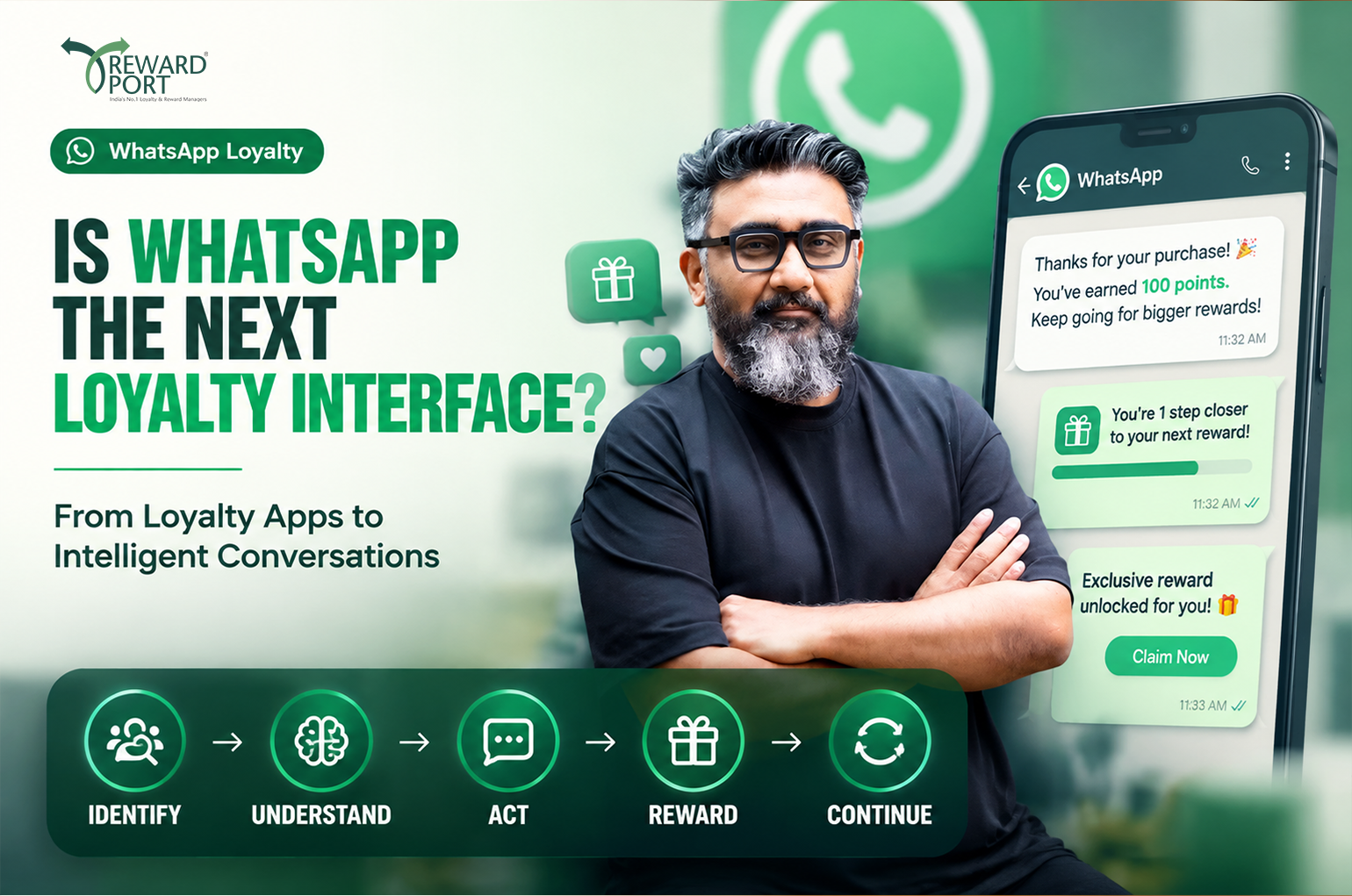
The Conversational Loyalty Loop
A potential conversational loyalty journey can be expressed as:
Identify → Understand → Act → Reward → Continue
Identify
Recognizes the participant appropriately.
Understand
Connect relevant loyalty, transaction, status and service context.
Act
Allow the customer to verify, ask, register, redeem or request assistance.
Reward
Trigger the appropriate reward, benefit or response.
Continue
Make the next useful action clear.
The experience becomes less about navigating a loyalty system and more about having a useful interaction with it.
This Is Different From Putting a Chatbot on Top of Loyalty
Traditional WhatsApp automation is often menu-driven.
A customer may receive options such as:
Press 1 for Balance
Press 2 for Rewards
Press 3 for Support
Generative AI introduces the possibility of a different experience.
Instead of requiring customers to understand the menu, the system can potentially understand the customer’s request.
The interface moves from:
Navigation → Understanding
That distinction could significantly influence how future loyalty journeys are designed.
Why Kunal Shah Arrival Makes the Question More Interesting
Shah has spent years working around a fundamental consumer-engagement challenge:
How do you make people come back?
WhatsApp already possesses something most loyalty programs spend significant resources trying to create:
A high-frequency conversation habit.
This suggests an interesting potential architecture:
Messaging = Interface
Where the customer interacts.
AI = Understanding Layer
Where intent and context can be interpreted.
Payments = Transaction Layer
Where relevant transactions can happen.
Loyalty = Continuity Layer
Where past behavior, current status and the next valuable action are connected.
Again, this is not a claim about Meta’s roadmap.
It is a strategic possibility for how conversational loyalty could evolve.
Does This Mean Loyalty Apps Are Finished?
No.
The more useful question is:
Which loyalty interactions actually require a dedicated app?
Apps remain valuable when brands need:
- Complex account management
- Deep product or reward discovery
- Rich dashboards
- Extensive reward catalogues
- Location-based functionality
- High-frequency branded experiences
- Sophisticated member functionality
But many simpler loyalty interactions may not require a separate app.
Checking progress, asking about eligibility, finding a reward, reporting a missing benefit or understanding the next milestone could potentially happen conversationally.
The Loyalty App May Increasingly Become Infrastructure
The loyalty technology itself does not disappear.
The loyalty engine can remain behind the scenes.
So can:
CRM → Verification → Reward Fulfilment → Analytics → Fraud Controls → Transaction Systems
The difference is what the customer sees.
Instead of opening several screens, the customer may simply ask:
“What can I redeem?”
or:
“How close am I to my next reward?”
The technology becomes infrastructure.
Conversation becomes the experience.
Why India May Be Particularly Suited to Conversational Loyalty
India combines several behaviors and infrastructure layers that make conversational loyalty particularly interesting:
- Widespread WhatsApp usage
- UPI adoption
- Familiarity with QR-led interactions
- Mobile-first behavior
- Multilingual markets
- Large retailer and dealer ecosystems
- Increasing conversational commerce adoption
Meta cited a 2025 Kantar study stating that 91% of online adults in India chat with a business weekly.
For loyalty leaders, this means the conversational habit may already exist.
The challenge is turning that habit into genuinely useful loyalty interactions.
Five Loyalty Journeys That Could Move Into WhatsApp
1. Consumer Promotion to Ongoing Relationship
A customer enters a promotion through a QR code or other campaign mechanic.
Instead of the relationship ending after reward fulfilment, WhatsApp could become a continuing engagement interface.
2. Repeat-Purchase and Streak Programs
Customers could potentially check progress, verify qualifying actions and understand their next milestone conversationally.
3. Dealer and Retailer Loyalty
Trade partners could interact with programs without constantly navigating complex portals for basic queries and actions.
4. Reward Discovery
Instead of browsing an extensive catalogue, participants could ask:
“What can I redeem for my family?”
or:
“Show me entertainment options within my balance.”
5. Service Recovery
Missing rewards, verification questions, failed fulfilment or eligibility issues could be handled in the same conversation.
But Conversational Loyalty Could Go Wrong Quickly
There is an obvious danger.
If conversational loyalty becomes:
SALE!
BUY NOW!
LAST CHANCE!
POINTS EXPIRING!
brands will simply move promotional spam into a more personal channel.
That could damage rather than strengthen the relationship.
The guiding principle should therefore be:
Usefulness before frequency.
The objective should not be sending more messages.
It should be making valuable customer actions easier.
Fraud and Trust Will Become Part of Loyalty Design
Moving loyalty into a conversational interface does not remove the need for robust infrastructure.
Conversational loyalty still requires:
- Identity controls
- Transaction validation
- Fraud monitoring
- Reward controls
- Data governance
- Appropriate consent and communication management
Meta itself continues to introduce anti-scam protections for WhatsApp.
Convenience cannot come at the expense of trust.
Five Rules for Conversational Loyalty
1. Utility Before Promotion
Every interaction should provide genuine value.
2. Conversation Before Navigation
Allow customers to express what they want instead of forcing them through unnecessary menus.
3. Context Before Volume
Use relevant customer context to improve interactions rather than simply increasing communication frequency.
4. Humans Still Matter
AI should know when a conversation requires human intervention.
5. Customer Data Must Create Customer Value
If a loyalty system knows more about a customer, that intelligence should result in greater relevance, convenience or value for that customer.
How Brands Should Prepare
Brands do not need to rebuild their entire loyalty architecture immediately.
A more practical approach is to start with one useful journey.
Step 1: Map Existing Loyalty Interactions
Identify everything customers currently need to do within the program.
Step 2: Identify What Can Happen Conversationally
Determine which interactions genuinely benefit from conversation.
Step 3: Map the Required Backend Systems
Understand which CRM, loyalty, verification, reward and transaction systems need to connect.
Step 4: Design Around Customer Questions
Start with what customers naturally ask rather than what menu structure is easiest to build.
Step 5: Define AI Boundaries
Determine what AI can answer or execute and when a human needs to intervene.
Step 6: Start With One High-Value Journey
Test conversational loyalty where it can solve a meaningful customer problem.
What Should Conversational Loyalty Measure?
Success should not be measured by message volume.
Brands should examine:
Adoption
Are customers choosing to use the conversational journey?
Utility
Are customers successfully completing the actions they intended?
Engagement
Does conversation encourage meaningful continued participation?
Commercial Impact
Does it influence repeat purchase, retention, redemption or another defined business behaviour?
Experience
Does it reduce friction and improve customer satisfaction?
Trust
Are customers comfortable using the channel for loyalty-related interactions?
The key metric is not:
How many WhatsApp messages did we send?
It is:
How many useful customer actions did the conversation make easier?
WhatsApp may not become the loyalty platform itself.
But it could increasingly become the loyalty interface.
The loyalty engine can stay behind the scenes.
The CRM can stay behind the scenes.
Verification and reward fulfilment can stay behind the scenes.
The customer may simply experience a conversation.
That changes the question loyalty leaders need to ask.
Instead of:
“How do we get customers to use our loyalty app?”
The next question could become:
“What should customers be able to ask their loyalty program?”
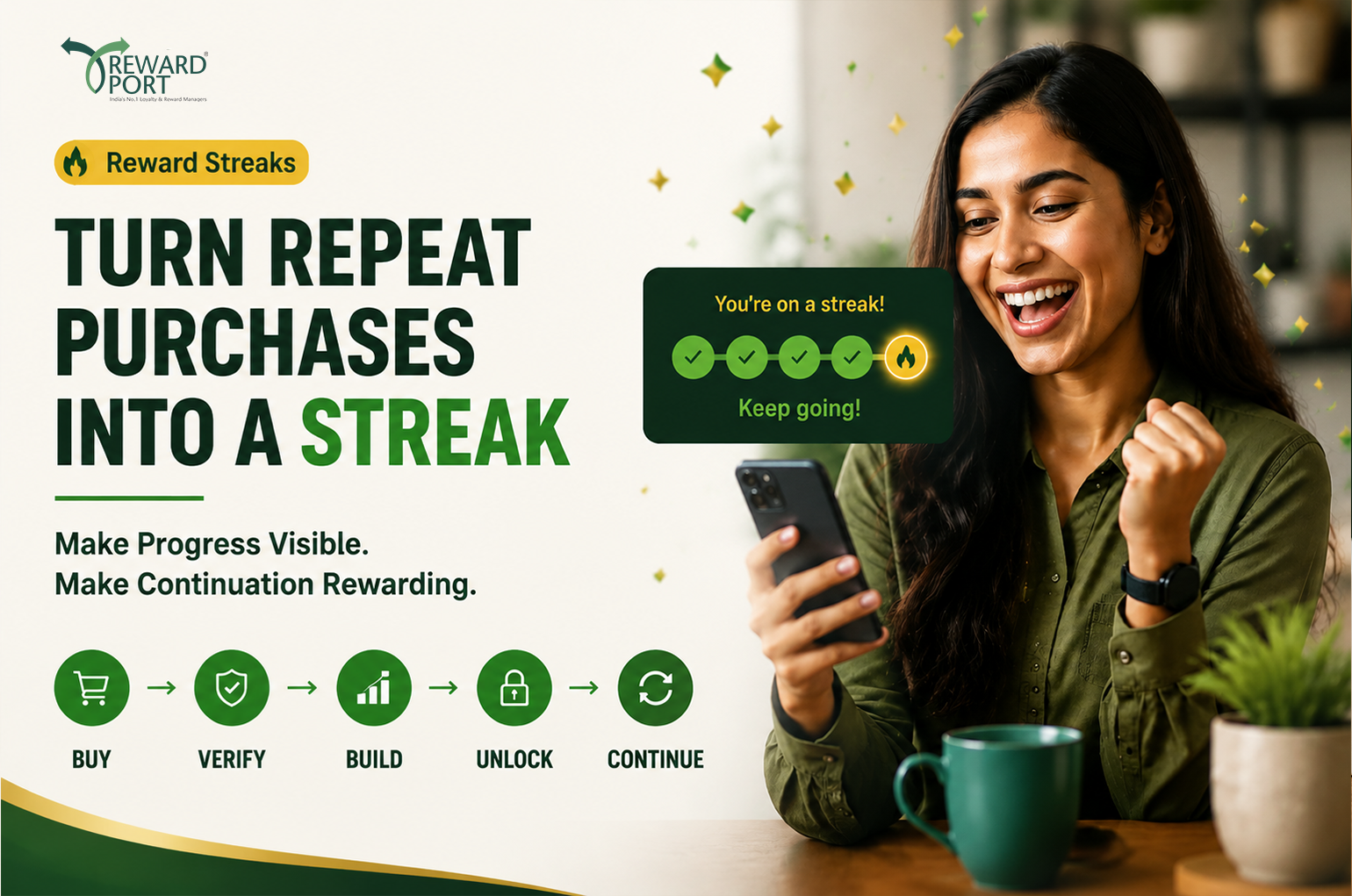
Reward Streaks: How Brands Can Turn Repeat Purchases Into a Habit Customers Want to Continue
Most consumer promotions reward a transaction.
A customer buys a product, scans a QR code, receives a cashback reward, and the interaction ends.
That can work when the objective is simply to stimulate one purchase.
But what if the brand wants the first purchase to become the beginning of a 30-day, 60-day, or 90-day relationship?
Instead of saying:
Buy. Get rewarded.
the brand can create a different journey:
Start. Continue. Progress. Unlock something better.
That is the idea behind Reward Streaks.
A Reward Streak is a loyalty mechanic that recognises customers for completing a desired behaviour repeatedly across a defined period. Rather than treating every transaction independently, it makes progress visible and gives customers a reason to keep going.
For repeat-purchase categories, this can turn an isolated promotion into a structured journey from first purchase to replenishment, retention, and category expansion.
Why Rewarding Every Purchase Is Not the Same as Building Repeat Behaviour
A flat cashback promotion treats every purchase as a separate event.
The customer buys once, receives the reward, and starts from zero again on the next purchase.
A streak introduces continuity.
The first model says:
“Here is something for buying.”
The second says:
“You have already made progress. Continue.”
That difference matters because visible progress can become a goal in itself.
Research published in the Journal of Consumer Research found across seven studies that highlighting an intact streak increased the likelihood that participants would continue the target behaviour compared with highlighting a broken streak.
For brands, the opportunity is not simply to copy the streak mechanics used by apps.
The more commercially useful question is:
What customer behaviour becomes more valuable when it is repeated?
What Exactly Is a Reward Streak?
A Reward Streak is a sequence of verified customer actions completed within predefined intervals, where continued progress unlocks increasingly relevant recognition or rewards.
For the mechanic to work, four things need to be true:
- There must be a behaviour worth repeating.
- The behaviour must be verifiable.
- Progress must be visible.
- Continuing should become more worthwhile.
The mechanic is therefore not simply a reward programme with another visual layer.
It is a structured behavioural journey.
The Reward Streak Loop
The core journey can be expressed simply:
Buy → Verify → Build → Unlock → Continue
Buy
The customer completes the desired purchase or qualifying action.
Verify
The brand confirms that the action genuinely occurred using an appropriate verification method.
Depending on the campaign, this might include a unique code, receipt verification, transaction data, or another approved evidence source.
Build
The verified action advances the customer’s visible progress.
The customer should understand where they are in the journey and what is required next.
Unlock
At meaningful milestones, the customer receives recognition, benefits, rewards, or access.
Continue
The next desired behaviour is made clear, giving the customer a reason to maintain the streak.
The objective is not simply to keep someone clicking or scanning.
It is to make repeat behaviour visible, understandable, and increasingly worthwhile.
A 90-Day Streak Does Not Mean Buying Every Day
One of the biggest mistakes brands can make is applying a digital-app definition of a streak to a physical consumer category.
A streak does not have to mean daily action.
The interval should reflect the natural purchase or usage cycle of the category.
For example:
- A shampoo bottle may last several weeks.
- A household consumable may be replenished monthly.
- A subscription may recur every month.
- A premium beauty product may be purchased every few months.
- A nutrition product may have a defined usage cycle.
A Reward Streak should therefore follow the customer’s natural journey, rather than forcing customers to follow an arbitrary promotional calendar.
The first design question should be:
How often does this behaviour naturally happen?
Only then should the streak window be decided.
Why Not Simply Give Cashback on Every Purchase?
Cashback can be effective when immediate value and simplicity are important.
But repeated flat cashback treats each transaction independently.
A streak creates visible momentum.
Consider the difference:
Flat Cashback
Purchase 1 → ₹20 Cashback
Purchase 2 → ₹20 Cashback
Purchase 3 → ₹20 Cashback
Each interaction stands alone.
Reward Streak
Purchase 1 → Streak Started
Purchase 2 → Progress Milestone
Purchase 3 → Better Unlock
Purchase 4 → Completion Benefit
The second model creates a sense of progression.
That progression can become part of the motivation.
Reward Streaks Are Not Simply Another Points Program
Traditional loyalty programs generally reward cumulative spending or transactions over an open-ended period.
Reward Streaks focus on continuity toward a specific objective.
The distinction is important.
Points may work well when customers transact frequently across a broad ecosystem and need flexibility in how value accumulates.
Streaks become particularly useful when the brand wants to establish a specific repeated behaviour.
For example:
- Replenish every month
- Complete three qualifying purchases
- Try a product consistently over a defined period
- Maintain a subscription
- Purchase across selected categories
- Complete a product-use journey
Neither mechanic is inherently better.
The correct choice depends on the behaviour the brand wants to create.
Three Illustrative Uses of Reward Streaks
1. A 90-Day Regimen Streak
A wellness or personal-care brand may want customers to continue using and repurchasing a product over a defined regimen period.
The journey could recognise the first purchase, replenishment, continued use, and completion.
2. A Household Continuity Streak
A recurring household service or subscription may encourage customers to maintain consecutive monthly participation.
The objective could be reducing lapses and increasing retention.
3. A Performance Routine Streak
A sports nutrition or similar category may reward customers for maintaining a verified purchase or usage routine aligned with the product’s natural cycle.
These are illustrative use cases, not RewardPort client case studies.
What Should Brands Reward at Each Stage?
The reward should evolve with the customer’s progress.
Early Stage
At the beginning, the priority is building trust and making progress visible.
Possible benefits include:
- Recognition
- Visible progress
- Small assured rewards
- Milestone acknowledgement
- Entry-level status
Middle Stage
As the customer builds continuity, rewards can become more meaningful.
Options may include:
- Digital vouchers
- Entertainment benefits
- Product-related benefits
- Relevant services
- Surprise unlocks
Completion Stage
Completion should feel meaningfully different from the first step.
Depending on the audience and economics, the brand may consider:
- Premium merchandise
- Higher-value vouchers
- Movies or entertainment
- Travel
- Experiences
- Exclusive access
- Special privileges
The principle is not simply to make every reward larger.
It is to make continued progress feel increasingly worthwhile.
What Happens When a Streak Breaks?
Streak mechanics can backfire if customers feel that one missed action destroys all their progress.
A broken streak can be demotivating.
Brands should therefore design recovery deliberately.
Possible approaches include:
Grace Periods
Allow a limited additional window for customers to complete the next qualifying action.
Streak Repair
Give customers an opportunity to restore the streak after completing a defined recovery action.
Pause Mechanisms
For categories with legitimate interruptions, customers may be able to temporarily pause progress under defined conditions.
Soft Resets
Instead of sending the customer back to zero, preserve part of their progress or status.
The recovery mechanic should reflect the category and commercial objective.
The goal is to encourage continuation without making the programme feel punitive.
Not Every Customer Wants to Play a Game
A Reward Streak does not require customers to feel as though they are participating in a game.
Gamification is optional.
Progress is the mechanic. Clarity is the experience.
A customer may simply see:
1 of 3 Purchases Completed
or
One More Purchase to Unlock Your Next Benefit
That can create sufficient motivation without badges, avatars, or complex game mechanics.
The programme should match the audience.
Eight Questions to Ask Before Launching a Reward Streak
Before building the mechanic, brands should answer eight questions:
1. What behaviour are we trying to change?
Define the commercial behaviour clearly.
2. What is the natural frequency of that behaviour?
Design the streak around the category’s real purchase or usage cycle.
3. How will the action be verified?
Use an appropriate evidence method for each qualifying action.
4. What should the customer see?
Progress should be visible and easy to understand.
5. What does each milestone unlock?
Define recognition and reward value before launch.
6. What happens when the streak breaks?
Build recovery rules rather than improvising later.
7. What happens when the streak finishes?
Completion should lead to a clear next step, benefit, or longer-term journey.
8. How will incrementality be measured?
The objective is to prove behavioural and commercial change—not simply count participants.
Reward Streak Measurement Scorecard
A strong Reward Streak programme should measure multiple layers.
Commercial Metrics
- Second-purchase rate
- Purchase frequency
- Replenishment rate
- Incremental units
- Average basket
- Retention
Streak Metrics
- Streak start rate
- Milestone completion
- Full completion
- Median streak length
- Break rate
- Recovery rate
Reward Metrics
- Reward cost per active participant
- Reward redemption
- Reward preference
- Cost per incremental behaviour
Operational Metrics
- Verification failures
- Fraud indicators
- Support contacts
- Fulfilment time
- Failed communications
The goal is not to produce the longest streak.
The goal is to produce economically valuable behavioural change.
Reward Streaks Can Create Better First-Party Intelligence
A one-time promotion tells a brand that someone participated once.
A Reward Streak can reveal a much richer journey:
Started → Replenished → Completed → Expanded Category → Responded to Reward
This creates a more useful picture of customer behaviour.
For example, the brand can begin understanding:
- Who starts but does not continue
- When customers typically replenish
- Which milestones produce the strongest response
- Which reward types influence continuation
- Which customers expand into another SKU or category
- Which customers recover after breaking a streak
This is where promotion design can begin becoming consumer intelligence infrastructure, rather than simply a reward expense.
Where Reward Streaks Fit in the Loyalty Journey
Brands should not begin with:
“Which reward should we give?”
They should begin with:
“Which behaviour should continue?”
Once that is clear, the programme can determine:
Behaviour → Verification → Progress → Milestone → Reward → Next Action
Reward Streaks are particularly relevant where continued behaviour has greater commercial value than a one-time transaction.
They can sit within consumer promotions, repeat-purchase campaigns, loyalty programmes, subscription journeys, product regimens, and other structured engagement initiatives.
How RewardPort Can Support Reward Streak Programs
RewardPort can help brands structure repeat-purchase campaigns around verified behaviour, progress visibility, milestone rewards, communication, fulfilment, and measurement.
Depending on the programme, RewardPort’s broader reward ecosystem can support multiple forms of value across different stages of the streak, including digital rewards, entertainment, merchandise, travel, and experiences.
The objective is not simply to issue more rewards.
It is to connect the reward to a specific behaviour, milestone, and next action.
For years, consumer promotions have largely asked:
What can we give customers for buying?
Reward Streaks introduce a different question:
What could we give customers a reason to continue?
The first purchase does not always need to be the end of the campaign.
Sometimes it can simply be the beginning of the streak.
Cashback vs Vouchers vs Merchandise vs Experiences: How Brands Should Choose the Right Reward
There is no universally best reward.
Cashback is strong when certainty, speed and simple value matter. Vouchers add choice and category relevance. Merchandise creates visibility and ownership. Experiences can generate aspiration and memory.
The right reward is the one that best fits the audience, required behaviour, timing, perceived value, delivery effort, fraud risk and commercial objective.
Key Takeaways
- Choose the behavior first and the reward second.
- Compare perceived value, not only procurement cost or face value.
- Use different reward types for different segments, milestones and levels of effort.
- Design fulfilment, expiry, support and fraud controls as part of the reward proposition.
- More reward choice can be valuable, but only when the experience remains simple to understand.
What Is Reward Architecture?
Reward architecture is the structured process of deciding:
What value should we offer, to whom, for which behavior, at what point in the journey and under which economic and operational rules?
It includes much more than selecting items from a reward catalogue.
A complete reward architecture considers:
- Audience and segment
- Target behavior
- Eligibility and verification
- Reward type and value
- Certainty, choice and timing
- Tiers, milestones and progression
- Caps, expiry and liability
- Delivery, support and replacement
- Fraud controls
- Measurement and optimization
A catalogue answers:
“What can we give?”
Reward architecture answers:
“What should we give to create the intended outcome?”
Why the Cheapest Reward Can Be Expensive
Brands sometimes select rewards by unit cost alone.
That can create weak participation, low relevance, support complaints or a high nominal-value offer that very few people can actually use.
The opposite mistake is assuming that face value equals motivational power.
₹500 in immediate cashback, a ₹500 voucher, merchandise costing ₹500 and an experience promoted at ₹500 do not necessarily feel identical to the recipient.
They differ in:
- Certainty
- Flexibility
- Salience
- Effort
- Memory
- Delivery risk
The commercial objective should therefore be to optimise motivation per rupee of total program cost, rather than simply minimising the purchase price of the reward.
The RewardPort VALUE Fit Framework
RewardPort’s article proposes the VALUE Fit Framework for evaluating rewards across five dimensions.
V — Value Perception
How valuable will the audience believe the reward is?
Consider:
- Relevance
- Exclusivity
- Visibility
- Utility
- Emotional appeal
Do not judge the reward only by its face value.
A — Action Fit
Does the reward match the effort, risk and importance of the required behaviour?
A small verified action may require fast, accessible micro-value.
A significant annual achievement may justify recognition or a more aspirational reward.
L — Logistics & Liability
How difficult and costly will the reward be to deliver reliably?
Consider:
- Procurement
- Inventory
- Fulfilment
- Expiry
- Replacement
- Support
- Breakage
- Financial liability
U — User Choice
How much choice should the participant receive?
Too little choice can reduce relevance.
Too much choice can create complexity and decision friction.
The appropriate level depends on the audience and program.
E — Experience & Emotion
What will the participant remember about receiving and using the reward?
A reward can provide functional value, emotional value, recognition or aspiration.
The correct balance depends on the behaviour and audience.
Cashback vs Vouchers vs Merchandise vs Experiences
Each reward format performs a different role.
Cashback
Best suited when:
- Certainty matters
- Speed matters
- The action is frequent
- The audience understands monetary value easily
- Simple communication is important
Strengths
Cashback is straightforward and liquid. Participants understand the value immediately, making it useful when the program requires a clear connection between action and reward.
Watch-outs
Cashback can become purely transactional if used without broader engagement or progression.
Brands should also consider payout failures, verification, support, liability and fraud controls.
Digital Vouchers
Best suited when:
- Choice matters
- The audience has varied preferences
- Digital fulfilment is desirable
- The brand wants more control than unrestricted cash provides
Strengths
Vouchers can combine relatively simple digital delivery with choice across categories or brands.
They can also be segmented by audience, achievement or value band.
Watch-outs
Brands need to consider:
- Expiry
- Redemption restrictions
- Availability
- Failed delivery
- Replacement
- Customer support
A large catalogue does not automatically create a better reward experience.
Merchandise
Best suited when:
- Tangibility matters
- Recognition matters
- The reward should remain visible after earning
- Achievement is significant enough to justify physical fulfilment
Strengths
Merchandise creates ownership and can make an achievement more tangible.
Unlike purely digital value, a physical reward may continue to remind the participant of the milestone after the campaign has ended.
Watch-outs
Merchandise introduces additional operational requirements such as:
- Inventory
- Shipping
- Address accuracy
- Product availability
- Returns
- Replacement
- Damage
- Delivery timelines
These costs need to be included when evaluating the true economics of the reward.
Experiences
Best suited when:
- Aspiration matters
- Emotional engagement is important
- The achievement is significant
- The brand wants the reward to create a memorable moment
Strengths
Experiences can include categories such as:
- Travel
- Cinema
- Entertainment
- Attractions
- Dining
- Leisure activities
They can create a different form of value from purely monetary rewards.
Watch-outs
An experience is valuable only when the recipient can realistically use it.
Brands therefore need to communicate:
- Availability
- Booking requirements
- Geography
- Validity
- Exclusions
- Eligibility
- Redemption conditions
clearly.
Reward Comparison at a Glance
| Reward Type | Core Strength | Particularly Useful When | Key Operational Consideration |
|---|---|---|---|
| Cashback | Certainty and simplicity | Immediate action needs reinforcement | Verification, payout and fraud |
| Vouchers | Choice and flexibility | Audience preferences vary | Expiry, availability and support |
| Merchandise | Tangibility and ownership | Recognition should remain visible | Inventory, logistics and replacement |
| Experiences | Aspiration and memory | Milestones deserve emotional value | Availability, booking and restrictions |
The key point is not to declare one format the winner.
The question is:
Which format best fits the behaviour you want to create?
Should Brands Use One Reward Type or a Reward Portfolio?
A single reward type can be appropriate when the audience and desired behaviour are straightforward.
But many programs contain multiple behaviours and achievement levels.
For example, a program might use:
Frequent Action → Small, immediate value
Milestone Achievement → Greater choice
Major Achievement → Aspirational reward or recognition
This allows the value of the reward to progress with the value of the behaviour.
However, more choice is not automatically better.
The reward journey should remain easy for participants to understand.
How to Choose the Right Reward
Before selecting the reward, answer these questions:
1. Who is the audience?
Consumer, dealer, distributor, employee or another stakeholder?
2. What behaviour are we rewarding?
Trial, repeat purchase, referral, sales achievement, learning, retention or another verified action?
3. How much effort does the action require?
The reward should feel proportionate.
4. Does certainty or excitement matter more?
Some behaviours benefit from assured value. Others may support progression, recognition or aspirational rewards.
5. How quickly should the reward arrive?
Immediate gratification and delayed milestone recognition serve different purposes.
6. How much choice does the audience need?
Choice can improve relevance, but too many options can introduce friction.
7. What is the true cost?
Include more than procurement.
Consider fulfilment, technology, communication, support, replacement, fraud and liability.
8. Can the reward be delivered reliably?
A compelling offer that repeatedly fails during redemption can damage the program experience.
Reward Economics: Look Beyond Face Value
Brands should distinguish between:
Procurement Cost — What the reward costs the program.
Communicated Value — What value is presented to the participant.
Perceived Value — How valuable the participant personally considers it.
Usable Value — How much value the participant can realistically obtain after considering availability and conditions.
These are not always the same.
That is particularly important for merchandise and experiences, where usability, restrictions and fulfilment can materially affect the participant’s experience.
Reward Fit Should Change Across the Journey
Different moments can require different forms of motivation.
Acquisition or Trial
Simple, understandable rewards can reduce hesitation and encourage the first action.
Repeat Behaviour
Frequent rewards, progression or accumulated value can encourage continued participation.
Milestones
Higher-value vouchers, merchandise or experiences can recognise a more meaningful achievement.
Loyalty & Recognition
Aspirational benefits, experiences or exclusive access can help differentiate major achievements from routine transactions.
The reward should therefore be treated as part of the behavioural journey, not as an item added after the campaign mechanic has already been designed.
QR-Based Promotions in India: Benefits, Challenges & Best Practices for 2026
In the evolving landscape of Indian marketing, QR-based promotions have emerged as a pivotal tool for brands and businesses to engage consumers, partners, and employees. By 2026, leveraging QR technology effectively represents a significant opportunity for marketers to drive participation, sales, and loyalty. This article explores why QR-based promotions matter for Indian businesses, the latest market dynamics, challenges, and best practices, all from RewardPort perspective.
Understanding the Market Context and Consumer Behavior
India’s deep adoption of digital payments, primarily propelled by the Unified Payments Interface (UPI), has created a fertile ground for QR-based interactions. Consumers are highly accustomed to scanning QR codes for everyday transactions, which sets a natural stage for brands to integrate promotions and loyalty programs seamlessly. This mass familiarity extends from urban metros to Tier 2 and Tier 3 cities, making QR-based promotions a cost-effective way to reach a broad demographic.
Moreover, QR codes enable real-time data collection on consumer preferences, purchase patterns, and geographic insights, empowering marketers with actionable analytics for personalized offers. These insights help shape consumer promotions and loyalty campaigns that resonate more effectively with their target audiences.
Emerging Trends in QR-Based Promotions for 2026
Looking ahead, several key trends are shaping QR-based promotions in India:
- Enhanced Reward Variety: Beyond instant cashback and digital vouchers, brands are increasingly offering experiential rewards such as movie tickets, dining vouchers, and wellness subscriptions, tapping into evolving consumer expectations.
- Instant Gratification: QR codes facilitate immediate reward redemption, critical for generating quick participation and loyalty, especially in consumer and employee engagement programs.
- Integrated Digital Ecosystems: QR scanning is becoming seamlessly integrated with CRM and ERP systems to harmonize channel partner incentive schemes, dealer rewards, and sales incentive management on a single platform.
Challenges Indian Businesses Face with QR-Based Promotions
Despite the benefits, there are notable challenges to consider:
- Digital Divide and Connectivity Gaps: Uneven smartphone penetration and internet access in rural India can limit campaign reach and inclusivity.
- Consumer QR Fatigue and Security Concerns: Overexposure to QR campaigns or fears about fraudulent codes can reduce trust and participation.
- Technological Integration Complexity: Combining QR campaigns with diverse reward catalogs like cashback, multi-brand vouchers, and experiential rewards requires robust backend infrastructure.
Practical Implications for B2B and Trade Marketers
Marketers, brand managers, and channel leaders must design QR-based promotions that balance clear value propositions with seamless user experiences. For channel incentivization, QR codes printed on product packaging or invoices can allow dealers and retailers to instantly claim rewards, boosting transparency and motivation. For consumer promotions, QR scans can trigger immediate discounts, loyalty points, or sweepstakes entries.
RewardPort Perspective and Solution Approach
RewardPort leverages its expertise through digital reward fulfillment platforms and a diverse reward catalog to support impactful QR-based promotions. Our offerings include instant gratification rewards, cashback and UPI-based incentives, multi-brand vouchers, and entertainment options like movie tickets and travel experiences, aligning with Indian consumer preferences.
We also support integrated channel partner incentive programs where QR codes enable performance tracking and real-time rewards, enhancing dealer and distributor engagement. Our gamification engine and WhatsApp redemption flows further enrich user experiences, making QR-based promotions more interactive and accessible across customer and channel touchpoints.
Verified RewardPort Case-Study Learnings
RewardPort has facilitated multiple brand promotions employing QR scan-to-win campaigns and instant cashback rewards that have driven repeat purchases and higher engagement. For example, a festive QR Scan-to-Win campaign combining digital vouchers, OTT subscriptions, and travel prizes yielded a measurable uplift in sales and customer participation. Such campaigns highlight the effectiveness of instant gratification and diversified rewards in maintaining consumer interest in QR promotions.
Best Practices and Implementation Framework
- Clear and Incentive-Driven CTAs: Clearly communicate rewards via the QR code to overcome consumer hesitation and QR fatigue.
- Mobile-Optimized and Multilingual Support: Provide streamlined scanning and redemption experiences accessible to diverse Indian audiences.
- Robust Security Measures: Use verified QR codes to build trust and mitigate fraud concerns.
- Data-Driven Personalization: Leverage real-time analytics to tailor offers dynamically, boosting relevance and ROI.
- Reward Variety: Combine instant cashback, experiential, and wellness rewards to appeal to different consumer segments.
Implementing these strategies within RewardPort integrated digital platforms ensures scalable, measurable, and audience-aligned campaigns.
QR-based promotions stand as a cornerstone tactic in India’s marketing ecosystem for 2026 and beyond. By understanding benefits and challenges and adhering to best practices, businesses can significantly enhance consumer and partner engagement while driving sales and loyalty. RewardPort specialized digital reward solutions and strategic insights equip Indian brands and channel leaders to harness the full potential of QR-based promotions with measurable outcomes and sustainable growth.