
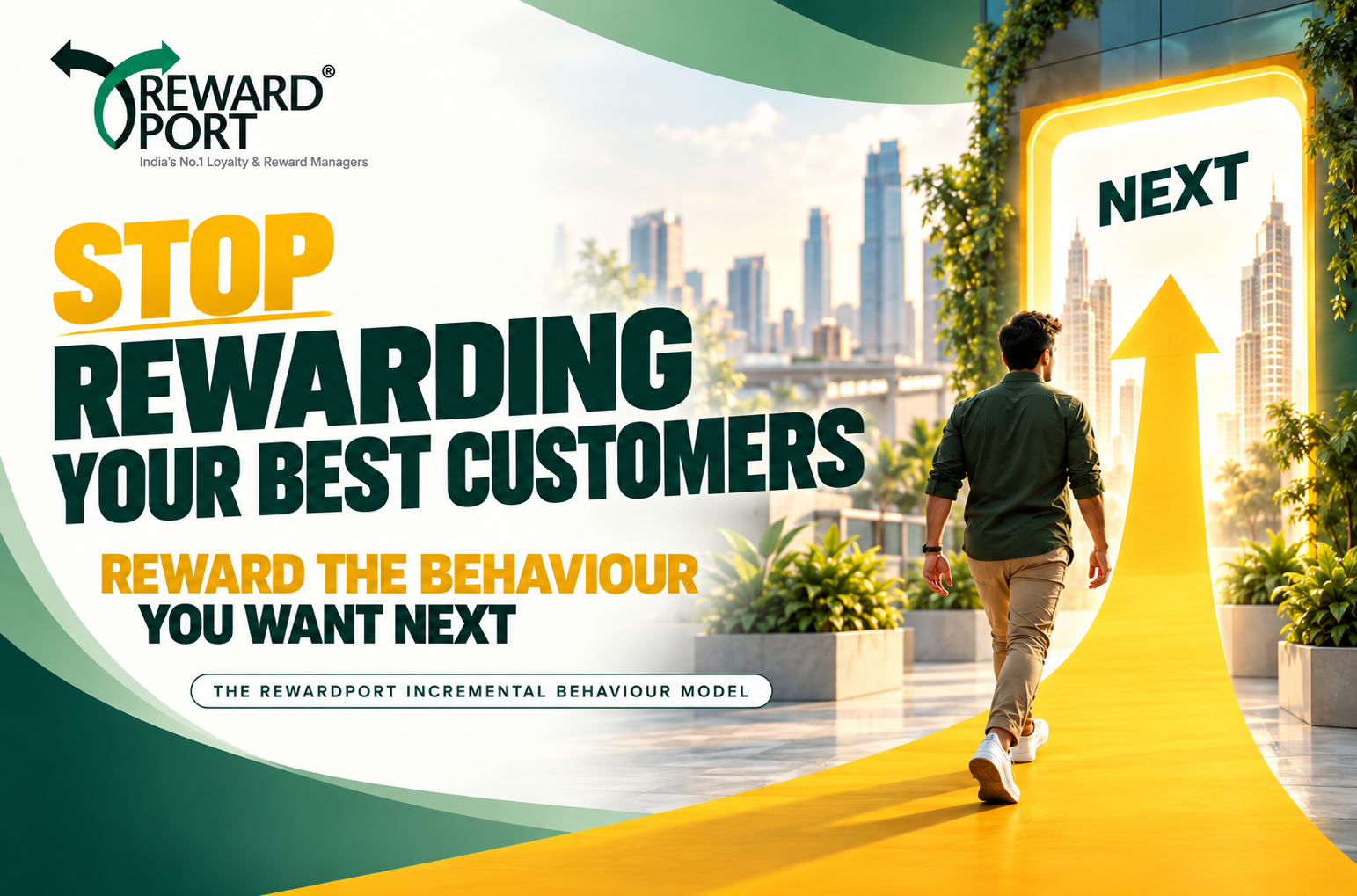
Stop Rewarding Your Best Customers: Reward the Behavior You Want Instead
Most loyalty programs reward customers for what they have already done. Better loyalty programs reward customers for what the brand wants them to do next.
That might mean making a second purchase, trying a new category, returning sooner, referring a friend, completing product education or increasing share of wallet.
The difference sounds small.
Commercially, it is enormous.
Because the real question behind loyalty program ROI is not:
“Did this customer buy?”
It is:
“Would this customer have bought anyway?”
The problem with rewarding your best customers
Imagine you run a coffee chain.
One customer visits you five mornings every week.
You introduce a loyalty program and start giving them points for every cup.
At the end of the month, they have earned free coffee.
Your loyalty dashboard looks excellent.
High engagement.
High frequency.
High redemption.
High member spend.
There is just one awkward question.
Did the loyalty program change anything?
If that customer was already going to visit five times a week, you may simply have given away margin on purchases you would have received anyway.
That does not mean loyal customers should not be recognized.
It means recognition and behavioral incentives are two different jobs.
And too many loyalty programs confuse them.
What should a loyalty program actually reward?
A loyalty program should ideally reward incremental behavior, meaning behavior that probably would not have happened without the intervention.
Examples include:
- turning a first-time customer into a second-time buyer
- getting an occasional buyer to purchase more frequently
- encouraging someone to try another product category
- recovering a customer who has stopped buying
- generating a genuine referral
- increasing a retailer’s range or secondary sales
- encouraging product training or participation
- getting customers to provide verified purchase information
- moving purchases toward a strategically important product or channel
The reward is not the objective.
The behavior is the objective.
The reward is one of the tools used to influence it.
That distinction should shape the entire program.
Why traditional loyalty metrics can be misleading
Loyalty teams understandably monitor transactions, points issued, redemptions, active members and member revenue.
Those numbers matter.
But they cannot always tell you whether the program caused the behavior.
BCG made this point particularly clearly in its July 2026 work on incrementality. It found that organizations using rigorous testing frequently discover that 20% to 40% of active marketing programs produce marginal or negative incremental lift, even though customers respond to them.
Source:
https://www.bcg.com/publications/2026/measuring-incrementality-in-next-best-action-programs
In other words, an offer can produce a conversion without actually causing the conversion.
Suppose you send a ₹500 reward to 10,000 customers who are statistically your most likely buyers.
A large percentage subsequently purchases.
The campaign looks successful.
But you selected people who were already highly likely to purchase.
How much of that revenue did the reward actually create?
Without a control group or another credible method of measuring incrementality, you may not know.
Loyalty ROI should start with one question
Before designing a reward, ask:
What behavior are we trying to change?
Not:
“What reward should we give?”
Not:
“How many points should customers earn?”
Not:
“Should we give vouchers or cashback?”
Those questions come later.
Start here:
What would we like this customer to do that they are unlikely to do without some intervention?
Once that behavior is clear, the incentive becomes much easier to design.
McKinsey has previously found that top-performing loyalty programs can increase revenue from customers who redeem points by 15% to 25% annually through increased purchase frequency, basket size, or both.
But the same research also warned that many established loyalty programs fail to create value.
The opportunity is therefore not to abandon loyalty.
It is to make loyalty more precise.
The RewardPort Incremental Behavior Model
A useful way to design a program is to move through five questions.
1. Baseline: What is the customer already doing?
Start by understanding normal behavior.
If a customer already purchases every week, simply rewarding the weekly transaction may add very little.
If another customer purchases once every three months, getting that person to return in six weeks represents a potentially meaningful behavioral change.
Without a baseline, almost every subsequent loyalty metric becomes harder to interpret.
2. Behavior: What do we want them to do next?
Define one specific action.
For example:
Consumer
First purchase → second purchase
Retailer
Stocks three SKUs → stocks five SKUs
Dealer
Registers → completes product training
Customer
Buys product A → tries product B
Dormant member
No purchase for 90 days → returns
Advocate
Happy customer → verified referral
Each creates a clearer reason for rewarding someone.
3. Friction: Why aren’t they doing it already?
Customers do not always need more money.
They may need:
- a reminder
- greater convenience
- recognition
- information
- reassurance
- progress toward something
- excitement
- access
- status
- a relevant experience
BCG’s loyalty research has similarly found that customers value more than monetary rewards alone and that relevance and experience influence program satisfaction.
Source:
https://www.bcg.com/publications/2023/loyalty-programs-need-to-continue-to-evolve
This is why automatically increasing cashback is not always the answer.
4. Incentive: What is the smallest meaningful intervention?
Only now should you choose the reward.
Different behaviors may call for very different incentives.
A ₹20 instant reward might be enough to encourage a small verified action.
A high-value experience might be better for a meaningful milestone.
Recognition may work better than cash for another audience.
A retailer challenge could combine progress, competition and a payout.
The objective is not to give the biggest reward.
It is to create enough perceived value to change behavior while maintaining attractive program economics.
5. Incrementality: Did behavior actually change?
Finally, measure the difference between:
What happened
and
What would probably have happened anyway.
This can be evaluated using holdout groups, controlled tests, matched audiences, historical baselines or more sophisticated modelling depending on the scale and sophistication of the program.
That is a better definition of loyalty ROI.
Recognition and incentives should not be confused
There is an important qualification to the headline of this article.
Your best customers absolutely deserve recognition.
They may deserve better service, priority access, exclusive experiences, status or surprise benefits.
That reinforces the relationship.
But constantly discounting every transaction of your most loyal customer is something else entirely.
Think of it this way:
| Customer situation | Traditional approach | Behavior-led approach |
|---|---|---|
| Already buys weekly | Give points every week | Recognize loyalty, then incentivize a new behavior |
| Buys one category | Reward same purchase | Reward trial of an adjacent category |
| High-spending dealer | Increase payout | Incentivize range, training or secondary sales |
| Dormant customer | Generic points | Give a targeted return mission |
| New customer | Reward first purchase heavily | Put stronger incentive behind the second purchase |
| Advocate | Give another purchase discount | Reward a verified referral |
The best programs can do both.
Recognize existing loyalty. Create incentives for incremental behavior.
Stop treating every customer action as equally valuable
Consider two customers.
Customer A spends ₹50,000 every year and would probably continue doing so without your loyalty program.
Customer B spends ₹10,000 but could realistically spend ₹20,000 if the brand could win a greater share of their purchases.
Which one deserves more incentive investment?
The obvious answer is not necessarily Customer A.
A smarter loyalty strategy looks at incremental opportunity, not simply historical spend.
That might mean allocating greater incentive budgets toward:
- customers close to making a second purchase
- customers whose frequency can realistically increase
- cross-category opportunities
- dormant but recoverable customers
- high-potential channel partners
- referrals with a high probability of converting
Loyal customers remain valuable.
But loyalty investment should follow opportunity, not habit.
Cashback is not the problem
Cashback is often criticized as being transactional.
That criticism misses the point.
Cashback can be extremely effective when attached to the right behavior.
So can points.
So can merchandise.
So can vouchers, movies, experiences, travel benefits, status or recognition.
The real question is:
What behavior is this reward buying?
₹100 cashback for a purchase someone was already going to make is very different from ₹100 cashback that causes a customer to try a new SKU, return sooner or complete a verified action.
The reward instrument may be identical.
The economics are completely different.
A simple loyalty ROI formula
At a basic level, brands should think about:
Incremental Value Created
minus
Reward Cost + Program Cost
= Incremental Program Contribution
The difficult part is not calculating the cost.
The difficult part is identifying the incremental value.
BCG has long argued that loyalty economics ultimately depend on whether the incremental margin generated by a program exceeds the cost of providing the benefits.
This is why redemption rates alone cannot tell you whether a loyalty program is working.
Neither can enrolments.
Neither can member revenue.
They describe activity.
Not necessarily causality.
What should loyalty teams measure instead?
The precise metrics depend on the objective, but useful measures can include:
Behavior metrics
- Purchase frequency
- Time to second purchase
- Category penetration
- Dormant customer reactivation
- Referral conversion
- Retailer range expansion
- Training completion
- Target achievement
Commercial metrics
- Incremental revenue
- Incremental gross margin
- Cost per incremental action
- Reward cost
- Customer lifetime value change
- Incremental share of wallet
Engagement metrics
- Participation
- Redemption
- Challenge completion
- Repeat engagement
- Reward preference
Control metrics
- Fraud rates
- Duplicate claims
- Invalid invoices
- Suspicious redemption behavior
- Cost leakage
The question behind every dashboard should remain the same:
What changed because the program existed?
What does this mean for consumer promotions?
Exactly the same principle applies.
A consumer promotion should not merely generate claims.
It should have a defined behavioral job.
For one brand, that might be trial.
For another, repeat purchase.
For another, collecting first-party consumer data.
For another, increasing basket size.
For another, driving referrals.
For another, moving customers toward a premium product.
QR codes, OTP validation, invoice parsing, cashback, gamification and rewards are the execution tools.
They should not become the strategy itself.
Where RewardPort fits
RewardPort’s approach to consumer promotions, loyalty and channel engagement begins with the behavior a brand wants to influence, then connects verification, engagement and an appropriate reward mechanism around it.
Depending on the program, qualifying actions can be validated through mechanisms such as QR, OTP, invoices, OCR or other approved transaction data.
Rewards can then range from cashback and vouchers to merchandise, cinema, travel and experiences.
The objective is not simply to issue rewards.
It is to build a measurable loop:
Define behavior → verify action → reward intelligently → measure response → improve the next intervention.
That is where loyalty begins to become growth infrastructure rather than an expense line.
The final question
Before approving your next loyalty campaign, remove the points, vouchers, cashback and rewards from the presentation.
Then look at what remains.
Can you clearly complete this sentence?
“We are investing in this program because we want this customer to ______.”
If the answer is not immediately obvious, the program probably needs more work.
Because the future of loyalty is not about rewarding more behavior.
It is about knowing which behavior is actually worth rewarding.
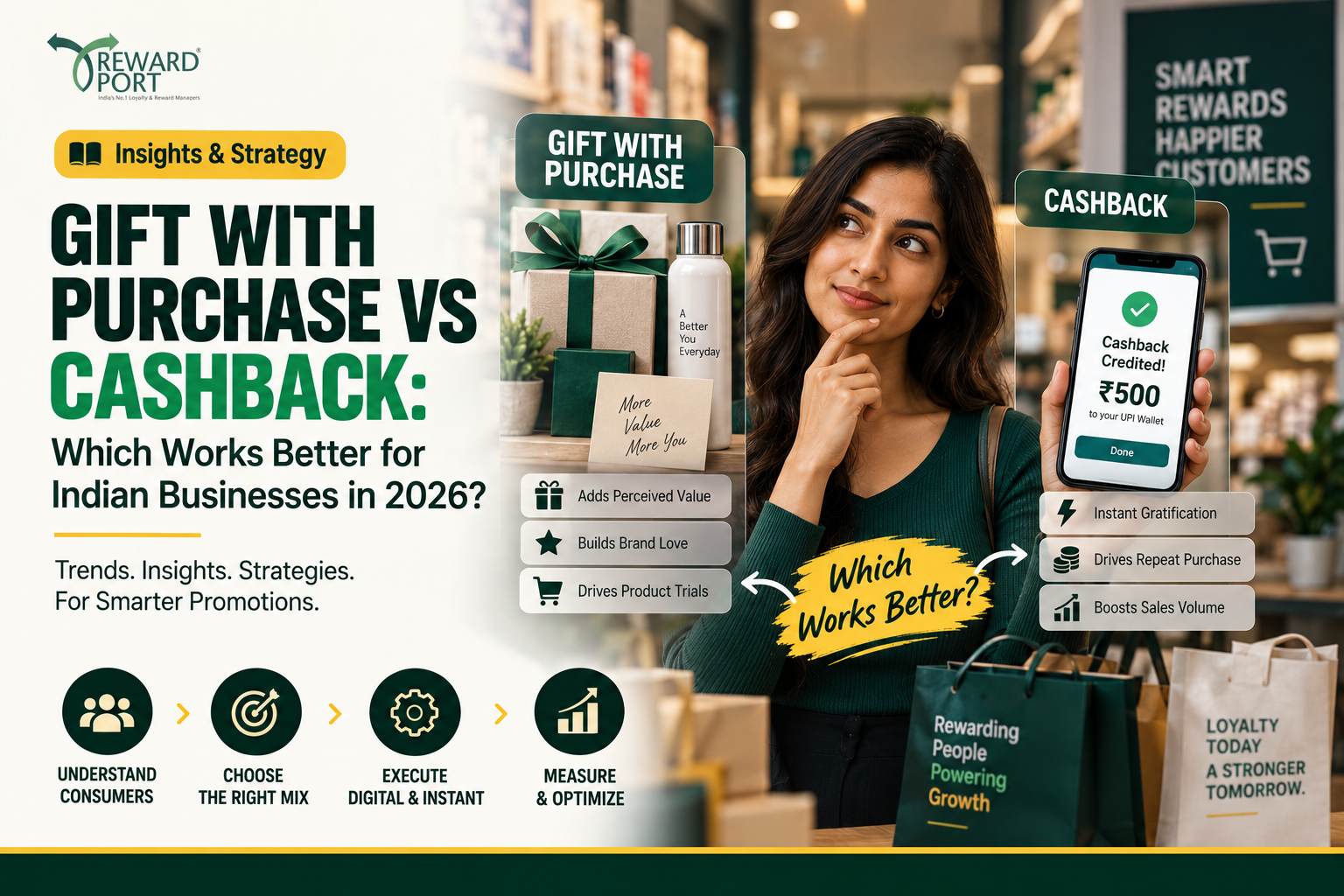
Gift with Purchase vs Cashback: Which Works Better for Indian Businesses in 2026?
In an increasingly competitive Indian market, businesses constantly seek effective promotional strategies to engage consumers, drive sales, and build lasting loyalty. Among these strategies, the debate between gift with purchase vs cashback remains prominent. Choosing the right approach can significantly influence consumer behaviour, retailer partnerships, and ultimately, business growth in 2026 and beyond. This article explores the latest trends, market insights, and strategic applications of these two promotional methods in India, offering a RewardPort perspective grounded in proven expertise and industry developments.
Market Context and Consumer Behaviour in India
India’s diverse consumer base exhibits varying preferences influenced by culture, income, and tech adoption. Recent studies reveal a strong inclination towards instant gratification facilitated by digital technology, especially UPI and mobile wallets. While cashback rewards appeal to the price-sensitive segments by reducing out-of-pocket costs, gift with purchase (GWP) strategies appeal more to consumers looking for added value or discovery opportunities, especially in premium and lifestyle categories such as beauty, electronics accessories, and wellness.
Brands nationwide increasingly blend cashback and GWP offers to cater to heterogeneous consumer motivations and enhance overall campaign impact. This aligns with findings that consumers respond well when rewards are immediate and tangible, boosting participation and repeat purchase behaviour.
Emerging Trends Relevant to 2026
The future of consumer promotions in India is shaped by personalization, flexibility, and digital integration. Loyalty programs now leverage AI and data analytics to personalise rewards, offering consumers the choice between cashback or a curated GWP, based on their buying patterns.
Additionally, businesses incorporate tiered reward structures, allowing higher-tier customers to access premium experiential GWPs or enhanced cashback benefits. Digital wallets and points systems integrate seamlessly, making rewards instantaneously redeemable, aligning with prevalent consumer expectations.
Channel partner incentives are evolving too, with top performers receiving aspirational experiential gifts, such as luxurious travel or exclusive event access, while cashback or volume-based rewards continue to motivate broader dealer and distributor networks effectively. Instant and transparent digital payout mechanisms remain critical across all stakeholder groups.
Practical Implications for B2B Marketers and Channel Leaders
For marketers, trade teams, and HR leaders managing incentives, understanding when to deploy GWP versus cashback is key. Gift with purchase works best to elevate brand perception, encourage product trials, and target premium consumer segments. It adds emotional value and can introduce consumers to new offerings within a brand portfolio, fostering cross-category discovery.
Cashback, however, excels in driving repeat purchases, especially in high-frequency consumable categories and price-sensitive markets. It simplifies the value proposition by directly lowering consumer costs, quickly boosting sales volume and channel partner profitability.
A RewardPort Perspective: Integrated Solutions for Enhanced Engagement
RewardPort specialises in designing and executing both GWP and cashback campaigns, aligning them with business goals and target audiences. Our strengths lie in:
- Consumer promotion formats like assured GWP and tiered cashback campaigns, ensuring instant gratification through digital fulfilment.
- Channel partner incentive programs offering multi-brand vouchers, travel club rewards, and digital cashback, fused with CRM and ERP systems for seamless tracking and reward delivery.
- Gamification engines that blend fun engagement with points, sweepstakes, and digital rewards redeemable across entertainment, food, travel, and wellness categories.
- Robust campaign analytics helping marketers optimize mix and deployment of GWP versus cashback based on participation and ROI metrics.
Verified RewardPort Case-Study Learnings
Through multiple deployments, RewardPort has observed that campaigns combining GWP and cashback elements yield superior engagement. For example, a leading FMCG brand saw a 27% repeat purchase increase by integrating assured vouchers (a form of GWP) with cashback rewards in a tiered loyalty scheme. Similarly, channel partner programs blending instant cashback bonuses with aspirational travel rewards deliver sustained trade activation and loyalty.
Practical Recommendations and Implementation Framework
To harness the strengths of both gifting and cashback in 2026, Indian businesses should consider the following approach:
- Segment Customers and Channel Partners: Identify segments that prioritize value (cashback) versus those favoring exclusivity and added value (GWP).
- Invest in Digital and Instant Rewards: Leverage UPI and digital wallets for immediate cashback and instant GWP redemption to maximize participation.
- Integrate Personalization: Use data analytics and AI to tailor reward offerings within loyalty programs and promotional campaigns.
- Balance Fun and Functionality: Employ gamification where appropriate to enhance engagement outcomes alongside straightforward cashback and gifting mechanics.
- Measure and Optimize: Utilize RewardPort analytics tools to assess campaign success and fine-tune the gifting versus cashback mix continually.
Choosing between gift with purchase vs cashback is not a binary decision but an opportunity to craft nuanced, consumer-centric promotions driving measurable business results. For Indian businesses targeting diverse markets in 2026, leveraging both strategically within digital, personalized, and gamified frameworks maximizes engagement, repeat purchase, and channel activation. RewardPort comprehensive solutions empower brands and sales leaders to implement these sophisticated campaigns with data-driven precision and reliable fulfilment, ensuring rewarding experiences that boost growth sustainably.

When AI Chooses What Consumers Buy, What Happens to Brand Loyalty?
For decades, brands competed for consumer attention.
They fought for:
- Search visibility
- Shelf presence
- Marketplace ranking
- Advertising recall
- Social media engagement
The consumer still made the final decision.
They compared options, read reviews, explored alternatives and selected a brand.
But commerce is entering a new phase.
Artificial intelligence is moving from helping consumers find products to helping them decide what to buy.
This shift changes the marketing challenge.
The question is no longer only:
“How do we get noticed?”
It becomes:
“How do we remain preferred when AI is helping someone choose?”
Brand loyalty does not become less important in this environment.
It becomes more valuable.
The brands that build strong direct relationships, understand consumer preferences and create meaningful reasons for customers to choose them will have a stronger advantage in AI-mediated commerce.
At RewardPort, we believe the next generation of loyalty will require what we call:
Loyalty Moat for Agentic Commerce
A framework designed to help brands build stronger consumer relationships before autonomous shopping becomes mainstream.
Key Takeaways
- AI is moving from search assistance towards decision assistance and transaction support.
- Brand visibility alone may not guarantee consideration when AI narrows choices for consumers.
- Loyalty programs must evolve beyond points accumulation towards stronger preference creation.
- First-party consumer relationships will become increasingly valuable.
- Promotions, rewards, warranties and post-purchase engagement can help brands build direct connections.
- Brands should start building a Loyalty Moat for Agentic Commerce.
AI Is Moving From Search to Decision
Traditional digital marketing focused on winning attention.
Brands competed to appear:
- Higher in search results
- More prominently on marketplaces
- More frequently in advertising
- More visibly on social platforms
The consumer then completed the evaluation process.
AI changes this journey.
Shopping assistants can increasingly help consumers:
- Discover products
- Compare options
- Understand features
- Evaluate alternatives
- Make purchase decisions
Research from NIQ highlights the growing role of AI in product discovery and purchase journeys.
Technology platforms are also building commerce infrastructure that allows AI systems to participate further in shopping journeys.
Google’s Universal Commerce Protocol is designed to support commerce interactions between AI agents and retailers, while Universal Cart enables consumers to manage products from multiple merchants within a connected shopping experience.
Source:
https://blog.google/products-and-platforms/products/shopping/google-shopping-cart/
Open Ai’ Agentic Commerce Protocol similarly focuses on enabling interactions between consumers, AI agents and merchants to support purchasing experiences.
Source:
https://openai.com/index/buy-it-in-chatgpt/
The infrastructure for AI-assisted commerce is already developing.
What Is Agentic Commerce?
Agentic commerce refers to a shopping model where AI performs part of the discovery, evaluation, recommendation or transaction process on behalf of consumers.
The level of AI involvement can vary.
Today, a consumer may ask:
“Which smartphone should I buy under ₹30,000?”
The AI compares options.
Tomorrow, the interaction could become:
“Choose the best option under ₹30,000 with good battery life and delivery before Saturday.”
The consumer defines the objective.
The AI helps execute the journey.
This creates a major shift for marketers.
The brand may no longer compete only for human attention.
It may also need to remain relevant within machine-assisted decision-making.
What Happens If Consumers Never See the Shelf?
Traditional buying behavior gives brands many opportunities to influence decisions.
A consumer walking through a store may notice:
- Packaging
- Promotions
- Brand familiarity
- Displays
- Recommendations
An online shopper may compare:
- Reviews
- Prices
- Features
- Offers
But an AI-assisted shopper may receive only a few recommendations.
Imagine a consumer asking:
“Recommend a protein snack for my child with low sugar under ₹50.”
Instead of comparing dozens of products, the consumer receives a shortlist.
The marketing challenge changes.
Brands must move from:
How do we appear?
to:
How do we remain preferred?
This affects categories including:
- Consumer electronics
- Appliances
- Beauty
- Packaged foods
- Travel
- Insurance
- Financial products
- Fashion
- Household products
Does AI Make Brands Less Important?
Not necessarily.
Trusted brands may become even more important.
AI systems require signals to understand what consumers value.
Those signals can include:
- Past purchases
- Loyalty membership
- Brand preference
- Reviews
- Product experience
- Consumer feedback
A consumer may tell an AI assistant:
“Choose my usual brand unless another option is significantly better.”
That preference becomes a powerful signal.
Google has already introduced identity-linked loyalty capabilities within its commerce ecosystem, allowing participating shopping experiences to recognise retailer-linked information such as loyalty benefits.
Source:
https://blog.google/products-and-platforms/products/shopping/ucp-updates/
The future of loyalty is not necessarily disappearing.
It is evolving into:
Portable consumer preference.
RewardPort’s Loyalty Moat for Agentic Commerce
Brands should begin thinking about loyalty as a connected system.
A strong loyalty moat consists of six layers:
1. Recognition
Does the brand know who the customer is?
Anonymous purchases create limited relationship value.
Recognition converts an unknown buyer into a known consumer.
Brands can build recognition through:
- QR registration
- Warranty activation
- Membership
- WhatsApp opt-in
- Purchase verification
- Cashback redemption
- Referral programs
- Contest participation
The objective is not only immediate sales.
It is creating a relationship foundation.
2. Permission
Can the brand continue the relationship?
Knowing a customer exists is different from having permission to engage.
Brands need clear value exchanges.
Consumers may provide permission in return for:
- Loyalty benefits
- Rewards
- Warranty support
- Personalized offers
- Product education
- Service updates
- Exclusive access
As AI-driven commerce grows, direct communication channels become increasingly valuable.
3. Preference
Why would a customer choose the brand again?
Many loyalty programs measure activity.
But activity does not always equal preference.
A customer collecting points may not necessarily prefer the brand.
True preference means:
“When I have a choice, I want this brand.”
Brands should understand signals such as:
- Repeat purchase
- Purchase frequency
- Reward choices
- Category preference
- Referrals
- Engagement behavior
- Response to offers
The goal is not only tracking transactions.
The goal is understanding preference.
4. Reward
What value changes behavior?
Rewards remain an important part of loyalty.
But the reward itself is not the strategy.
The strategy is understanding:
Which value is meaningful for which customer?
Different consumers may value different benefits.
Examples:
- Cashback for immediate value
- Entertainment benefits for engagement
- Travel experiences for aspiration
- Lifestyle rewards for premium audiences
- Practical vouchers for everyday needs
A reward catalogue supports loyalty.
It does not create loyalty by itself.
The behavior strategy comes first.
5. Direct Relationship
Can the brand maintain a connection without depending completely on intermediaries?
As AI shopping grows, brands may increasingly compete through platforms, marketplaces and AI agents.
The brands that maintain direct consumer relationships will have a stronger advantage.
That relationship can begin through:
Purchase → Verification → Benefit → Permission → Engagement
The transaction may happen through an intermediary.
The relationship can still belong to the brand.
6. Re-Engagement
How does the brand strengthen preference over time?
The future of loyalty is not sending discounts repeatedly.
It is creating relevant interactions.
Brands can:
- Recognize milestones
- Recommend relevant products
- Reward meaningful behavior
- Encourage referrals
- Reactivate inactive customers
- Personalize engagement
The objective:
Make consumer preference stronger over time.
Loyalty Benefits Will Need to Become AI-Readable
Today, loyalty programs are primarily designed for humans.
Consumers understand:
- Gold membership
- Reward points
- Cashback offers
- Exclusive benefits
- Free delivery
But as AI systems increasingly participate in shopping decisions, loyalty benefits may also need to become structured and understandable for machines.
Future AI shopping assistants may need to understand:
- Is the consumer a loyalty member?
- What benefits are available?
- Can rewards be applied?
- Does the customer have preferred status?
- Are there personalized offers available?
- Does buying directly create additional value?
Google’s commerce ecosystem already indicates movement towards identity-linked loyalty experiences where benefits can be recognized within shopping journeys.
Source:
https://blog.google/products-and-platforms/products/shopping/ucp-updates/
This creates a new opportunity.
Loyalty is no longer only about communicating benefits to customers.
It may also become about making those benefits visible to systems acting on behalf of customers.
Could AI Expose Weak Loyalty Programs?
AI-assisted commerce may create challenges for brands that rely only on discounts.
Consider a consumer instruction:
“Buy my usual coffee unless another equally rated option is 20% cheaper.”
An AI system can continuously compare:
- Price
- Reviews
- Availability
- Offers
- Alternatives
If price is the only reason a customer stays, AI may make switching easier.
This creates a risk for discount-led loyalty.
Strong loyalty requires deeper reasons to choose a brand.
These can include:
- Trust
- Familiarity
- Product experience
- Service quality
- Warranty
- Exclusive access
- Membership benefits
- Personal relevance
- Emotional connection
The future advantage will belong to brands that build preference, not only promotions.
AI Can Also Make Loyalty More Intelligent
The conversation around AI and loyalty should not only focus on disruption.
AI can also improve how brands understand and engage customers.
Future loyalty systems can potentially identify:
- What customers regularly purchase
- When they may need replenishment
- Which rewards they value
- Which incentives are unnecessary
- Which products are relevant next
- When a customer is becoming inactive
- Which intervention has worked previously
This can transform loyalty from:
Everyone receives the same offer
to:
Each customer receives the most relevant next action.
The objective is not simply increasing rewards.
It is improving relevance.
Why India Could Experience AI Commerce Differently
India’s consumer journey is already highly fragmented.
Customers move across:
- Physical stores
- Marketplaces
- Quick commerce
- Social platforms
- Messaging apps
- Brand websites
The future journey may not be:
Website → AI Assistant → Purchase
Instead, it may look like:
Creator → AI → Marketplace → Store → QR → WhatsApp → UPI → Loyalty → AI-assisted Repurchase
The winning brands may not be those with the highest number of channels.
They may be those that can recognize the same consumer across multiple interactions.
Meta and the Retailers Association of India highlighted the growing importance of omnichannel shopping behaviour in India, including online research before offline purchase and offline research before online purchase.
Google has also expanded AI-powered shopping experiences in India through Gemini and AI Mode.
What Should CMOs Do Now?
Brands do not need to wait for fully autonomous shopping.
They can begin preparing today.
1. Convert Anonymous Buyers Into Known Consumers
The first step is building recognition.
Brands should identify moments where consumers have a reason to connect directly.
Examples:
- Product registration
- Warranty activation
- QR engagement
- Cashback redemption
- Loyalty enrolment
- Customer support interaction
A known customer creates relationship possibilities.
2. Audit Loyalty Beyond Points
Brands should ask:
Does the program create genuine preference?
Or does it only distribute discounts?
A successful loyalty program should understand:
- Why customers return
- What benefits they value
- What behaviors indicate preference
3. Build First-Party Behavioral Signals
AI-powered engagement requires quality signals.
Brands should understand:
- Purchase frequency
- Reward preference
- Engagement behavior
- Product interest
- Repeat behavior
- Referral activity
Data should create better experiences, not just better reports.
4. Connect Promotions With Loyalty
A promotion should not end when the reward is delivered.
The customer journey can continue:
Purchase
↓
Verification
↓
Reward
↓
Permission
↓
Relationship
↓
Repeat Engagement
Consumer promotions can become entry points into deeper loyalty ecosystems.
5. Make Benefits More Portable
As commerce becomes more connected, customers will expect benefits to move with their identity.
Brands should think about:
- Membership recognition
- Reward availability
- Warranty access
- Consumer preferences
- Purchase history
The future of loyalty may depend on whether benefits can travel with the customer.
6. Measure Preference, Not Only Redemption
A high redemption rate tells brands:
“Customers liked receiving value.”
It does not necessarily mean:
“Customers became more loyal.”
Brands should measure:
- Repeat purchase
- Retention
- Preference signals
- Direct engagement
- Referral behavior
- Incremental behavior after incentives
How RewardPort Helps Brands Build Future-Ready Loyalty
RewardPort helps brands create consumer engagement ecosystems combining:
- Consumer promotions
- Loyalty programs
- Cashback campaigns
- QR-based engagement
- WhatsApp engagement journeys
- Digital reward fulfilment
- Personalized rewards
The objective is to help brands move from one-time transactions towards continuous relationships.
A typical journey can look like:
Consumer Purchase
↓
Verification & Identification
↓
Reward Experience
↓
Consumer Permission
↓
Personalized Engagement
↓
Repeat Purchase & Loyalty
As AI changes how consumers discover and buy products, owning the relationship becomes increasingly important.
Measuring Loyalty in an AI-Assisted Commerce World
Brands should move beyond traditional loyalty metrics.
Consumer Identity Metrics
- Known consumer rate
- Registration rate
- Opt-in percentage
- Profile completeness
Engagement Metrics
- Repeat purchase
- Purchase frequency
- Reward interaction
- Content participation
- Referral behavior
Reward Metrics
- Redemption rate
- Reward preference
- Cost per incremental action
- Reward effectiveness
Relationship Metrics
- Direct consumer engagement
- Retention after incentives
- Reactivation
- Category expansion
Operational Metrics
- Purchase verification success
- Fraud prevention
- Fulfilment performance
- Customer support experience
The objective is not simply measuring rewards.
It is measuring whether preference is becoming stronger.
The Future of Loyalty: From Points to Preference
For many years, loyalty was defined by:
Earn points → Collect points → Redeem points
That model still has value.
But the future will require more.
Brands will need to create systems where consumers:
- Are recognized
- Give permission
- Develop preference
- Receive relevant value
- Maintain direct relationships
- Continue engaging
This is the foundation of a stronger loyalty moat.
AI-assisted commerce will change how consumers discover, compare and purchase products.
But it will not eliminate brand loyalty.
It will redefine it.
The brands that succeed will not only be those that appear in AI recommendations.
They will be those that consumers already prefer.
Building that preference requires a stronger approach:
Loyalty Moat for Agentic Commerce
Recognition
Know the consumer.
Permission
Earn the right to continue the relationship.
Preference
Create reasons to choose the brand.
Reward
Deliver meaningful value.
Direct Relationship
Maintain connection beyond transactions.
Re-engagement
Strengthen loyalty over time.
The future of loyalty is not about having more points.
It is about building relationships strong enough to survive when AI starts making choices alongside consumers.
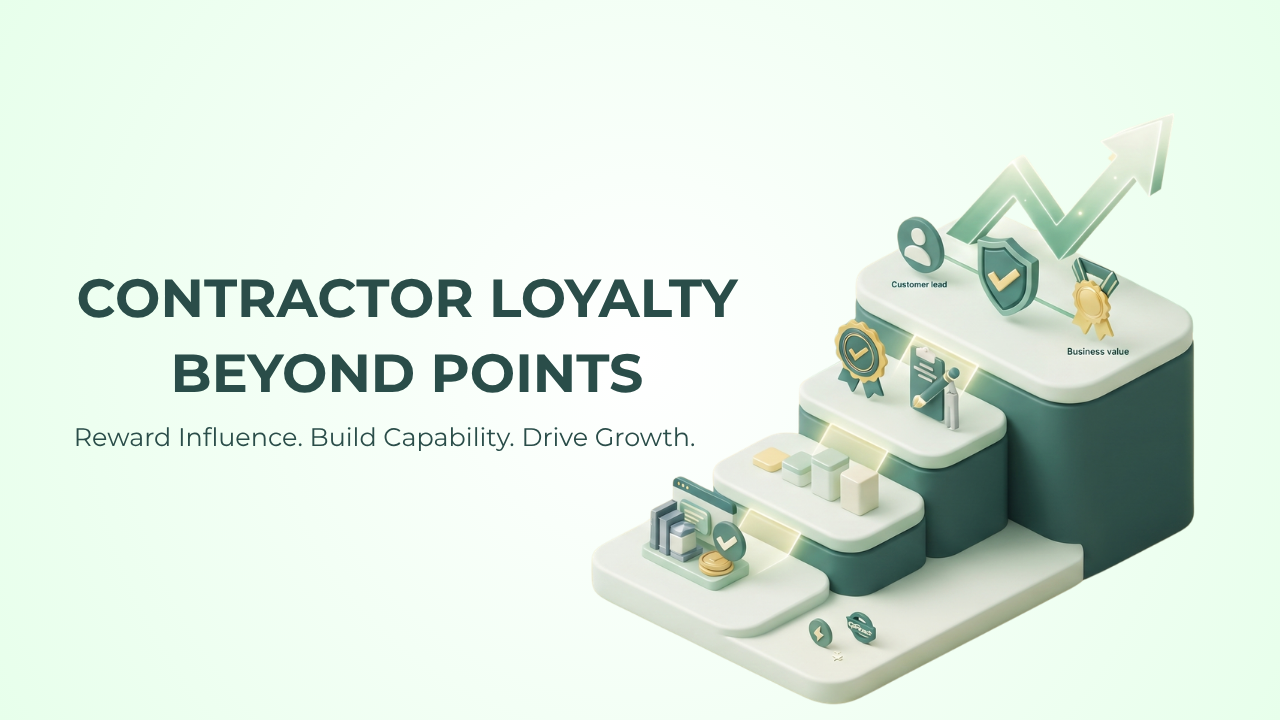
How to Build a Contractor Loyalty Program in India: Beyond Points and Cashback
Contractor loyalty programs in India need to go beyond the traditional scan, earn points and redeem rewards model.
In many industries, the professional who influences the brand decision is not necessarily the person who purchases the product. A painter may recommend a paint brand, an electrician may specify an electrical product, or a carpenter may influence the choice of plywood while the actual transaction is completed by a dealer or customer.
This makes contractor loyalty fundamentally different from conventional dealer loyalty.
A strong contractor program should identify the actions contractors genuinely influence, verify those actions fairly and create value that helps contractors progress professionally as well as financially.
What Is a Contractor Loyalty Program?
A contractor loyalty program is a structured engagement system designed for independent professionals who influence, recommend, buy, apply, install or service a brand’s products.
Depending on the industry, participants may include:
- Painters
- Plumbers
- Electricians
- Mechanics
- Carpenters
- Masons
- Fabricators
- Installers
- Technicians
- Small contracting firms
These professionals often operate between the manufacturer, distributor or dealer and the end customer.
The challenge is that their influence can be commercially significant while the evidence of that influence is fragmented.
One person may recommend the product, another may purchase it, the dealer may generate the invoice and a separate crew may complete the installation.
A loyalty program based only on billing therefore captures only part of the commercial journey.
Why Conventional Points Programs Can Underperform
The traditional model is straightforward:
Scan Code → Earn Points → Redeem Rewards
While this can encourage participation, it becomes limiting when the brand wants to influence behaviors beyond purchase volume.
Common weaknesses include:
- Rewarding volume without distinguishing genuine influence from simple code access.
- Using identical earning rules for individual professionals and multi-crew contractors.
- Ignoring product learning, installation quality, warranty registration, referrals and strategic product-mix objectives.
- Treating every participant as an individual even when projects are completed by teams.
- Creating status levels without meaningful professional or business benefits.
- Measuring registrations and payouts without understanding active participation, repeat behavior or suspicious claims.
The objective should therefore be to build a broader contractor engagement ecosystem, rather than simply another points catalogue.
The RewardPort Contractor Influence Loop
RewardPort’s proposed Contractor Influence Loop structures contractor engagement around six connected stages.
| Stage | Key Question | Possible Approach |
|---|---|---|
| 1. Identify Influence | What role does the contractor control? | Recommendation, purchase, specification, application, installation, service or referral |
| 2. Verify Action | What proves the qualifying behavior? | Unique code, invoice OCR, installation proof, serial number, warranty registration, training record or approved site data |
| 3. Reward Progress | What immediate and aspirational value fits the participant? | Cashback, vouchers, tools, merchandise, cinema, travel, experiences, status or business benefits |
| 4. Build Capability | What knowledge improves results for both sides? | Product learning, Q&A, quizzes, certification, application guidance and new-product challenges |
| 5. Create Business Value | How can the program help contractors earn or operate better? | Leads, recognition, service priority, business tools, customer handoffs or access benefits |
| 6. Learn & Refine | What should the brand do next? | Segment by behavior, risk, product mix, geography, learning and response to missions |
The key principle is simple: reward the behavior the contractor can genuinely influence.
Map Rewards to Actions Contractors Actually Control
Different contractor situations require different loyalty rules.
| Contractor Reality | Weak Rule | Stronger Rule |
|---|---|---|
| Influences brand but dealer buys | Reward only invoice owner | Reward verified specification, installation or customer registration while preventing duplicate claims |
| Works through a crew | Credit only account holder | Define crew attribution, supervisor approval and shared milestones |
| Uses several brands by project | Reward total volume only | Create missions for strategic SKUs, cross-category adoption or repeat usage |
| Has seasonal demand | Use rigid monthly targets | Use rolling tiers, seasonal accelerators or progress bands |
| Needs confidence in a new product | Offer larger cashback | Combine learning, proof of knowledge, first-use support and verified trial |
| Values business growth | Offer only a generic catalogue | Add tools, recognition, leads, service access or professional benefits |
This makes the program relevant to how contractors actually work rather than forcing every participant into the same transaction-based model.
How Can Contractor Actions Be Verified?
The evidence layer should correspond to the contractor’s actual role.
Unique Codes
Controlled pack or token codes can support verified product claims.
Invoice or Bill Upload
OCR-based verification can help establish product, quantity, outlet and transaction date.
Proof of Installation
Serial numbers, warranty registrations, job cards or approved site evidence can establish installation-related actions.
Dealer or Distributor Confirmation
Useful where the contractor influences the sale but does not hold the invoice.
Learning Records
Quiz completion, learning modules or other approved interactions can verify capability-building missions.
Referral or Customer Handoff
Verified referral records can recognize contractors who influence new business.
The difficult part is attribution.
If a dealer, contractor and installer can all access the same code, the program needs clear rules defining who can claim which benefit.
Role-specific wallets, claim windows, evidence requirements and approval paths can help prevent multiple participants from claiming the same value.
Design Contractor Rewards in Four Layers
A stronger loyalty program does not depend on one type of reward.
| Value Layer | Purpose | Examples |
|---|---|---|
| Immediate Value | Reinforce the first verified action | Small cashback, voucher, mobile utility or instant acknowledgement |
| Progress Value | Make continued participation visible | Milestones, streaks, tiers, category completion and challenge badges |
| Aspirational Value | Encourage behavior consolidation | Premium merchandise, tools, family rewards, cinema, travel or experiences |
| Business & Professional Value | Help contractors grow professionally | Certification, leads, service access, learning, recognition and business support |
This gives contractors reasons to remain engaged beyond accumulating points.
A 10-Step Contractor Loyalty Implementation Process
1. Segment Participant Roles
Define contractors, applicators, installers, dealers, crew leads and other relevant participants before creating earning rules.
2. Select One Primary Commercial Objective
For example: new-SKU adoption, repeat usage, premium mix, warranty registration or training completion.
3. Map Influence and Evidence
Determine what each participant controls and what evidence exists at that stage.
4. Keep Earning Rules Simple
A contractor should ideally understand the earning mechanic through one screen or one WhatsApp message.
5. Establish Attribution Rules
Define duplicate, conflict and claim ownership rules before generating codes or rewards.
6. Build the Reward Architecture
Combine immediate, progress, aspirational and professional benefits based on contractor segments.
7. Create a Mobile-Friendly Journey
Use mobile and WhatsApp-friendly participation, with vernacular support where required.
8. Pilot Before Scaling
Start with a bounded geography, product range and participant cohort.
9. Monitor the Pilot
Review legitimate rejections, support queries, suspicious patterns and reward fulfilment time.
10. Scale Based on Evidence
Expand only after the program demonstrates participant usability and clean commercial evidence.
What Should a Contractor Loyalty Dashboard Measure?
A contractor loyalty dashboard should measure more than registrations and points issued.
Participation: Eligible contractors, enrolments, first actions and monthly active contractors.
Commercial Action: Verified purchases, installations, registrations, referrals and strategic-SKU actions.
Capability: Training starts, completion, pass rates and certification.
Progress: Tier movement, streak continuation, multi-category adoption and repeat-action rates.
Experience: Time to reward, support contacts, grievance outcomes and false rejects.
Risk: Duplicate attempts, shared-device patterns, claim velocity, role conflicts and manual reviews.
Economics: Reward cost, operating cost, cost per verified action and liability by cohort.
These measures help brands understand whether the program is genuinely influencing contractor behavior.
Illustrative Example: Electrical Products
Consider an electrical-products brand introducing a new premium range.
Dealers hold the invoices, but electricians influence product selection and complete installations. The brand also needs electricians to understand compatibility and safety information before recommending the range.
A pilot could:
Dealer Referral → Electrician Enrolment → Product Learning → Knowledge Check → First Installation → Verified Action → Progressive Benefits
The electrician could complete short mobile learning followed by a knowledge check. Proof of installation or customer registration could validate the first-use mission.
Dealers would operate under a separate sales rule.
Dealer and electrician claims should be stored separately so that the same commercial event is not rewarded twice under an unclear rule.
This is an illustrative design, not a reported RewardPort client result. The evidence, compliance and reward structure would need to be validated for the specific product and channel.
How RewardPort Connects Contractor Growth
RewardPort can help brands connect program design, role-based journeys, verification, challenges, learning, communication, reward fulfilment and analytics within contractor and channel engagement programs.
The approach can support dealers, retailers, contractors, mechanics and other influencers while keeping earning and evidence rules relevant to each role.
The objective should not be another points screen.
It should be a governed engagement system that helps the brand understand:
Who is active → What they influence → What they achieve → What support they need → What intervention comes next
Ask RewardPort for a contractor-program design session covering role mapping, evidence, attribution, learning, reward architecture, fraud controls and a bounded pilot plan.