
India’s Festive Discount War Has a Problem: Everyone Is Giving More. Few Are Getting More Behaviour Back.
India’s festive season is becoming bigger, faster and more complex.
But for brands, the central promotion question has not changed:
What behaviour are we buying with the incentive?
A discount can trigger a transaction. A well-designed promotion can do considerably more.
It can encourage trial, increase basket size, capture first-party data, influence repeat purchase, activate retailers, generate referrals and create a measurable reason for the customer to come back.
That distinction matters even more when almost everyone is offering a deal.
The short answer: What should brands do differently this festive season?
Brands should stop treating the festive promotion as a single discount event.
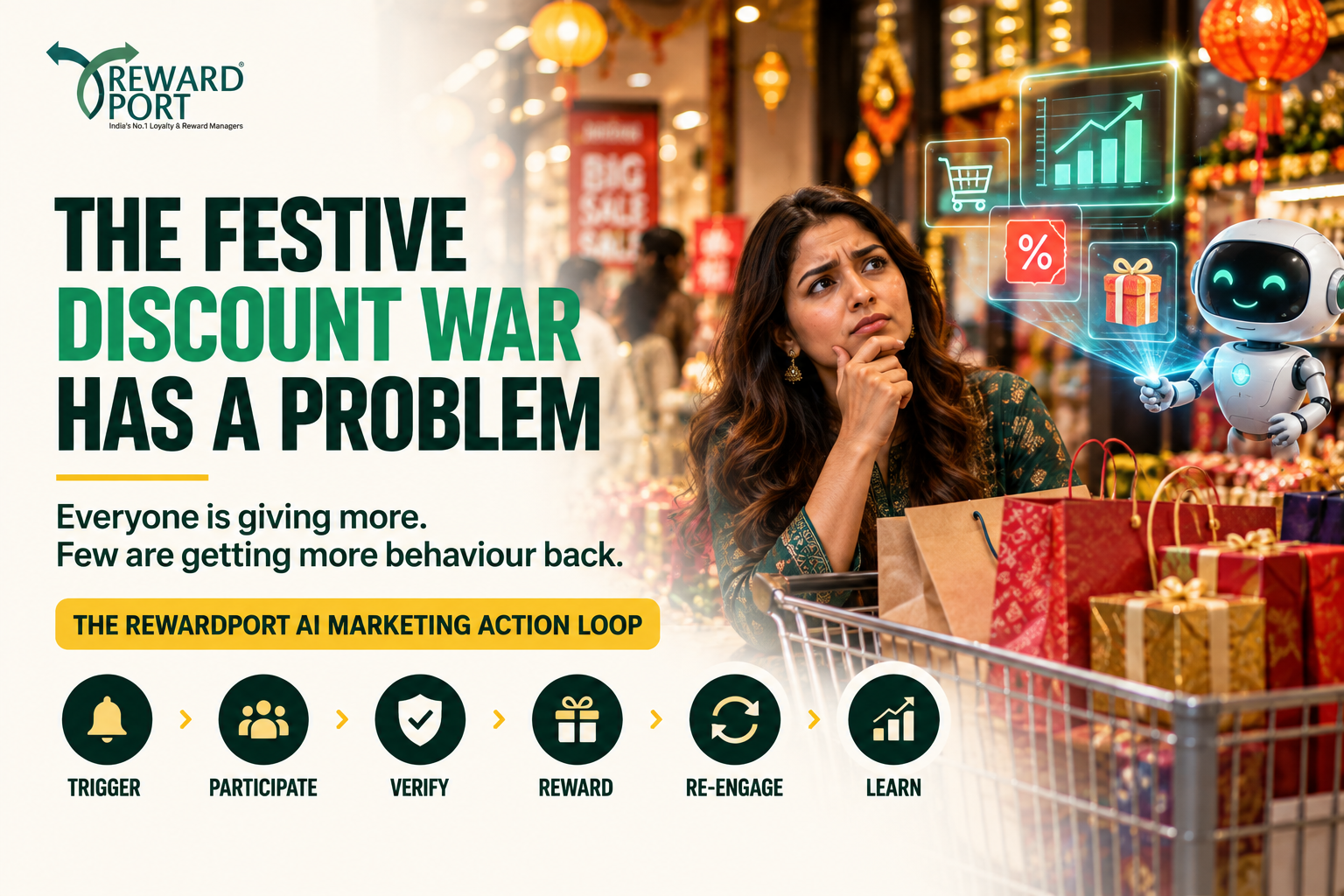
A stronger model connects six stages:
Trigger → Participate → Verify → Reward → Re-engage → Learn
The promotion should begin with the behaviour the business wants to influence, not with the reward it wants to give away.
That could mean:
- Getting a new customer to try the product
- Encouraging an existing buyer to purchase again
- Increasing basket size
- Activating a retailer
- Generating a referral
- Driving registration after purchase
The incentive then becomes the mechanism, not the strategy.
Five things marketers should know about festive promotions in 2026
- Indian festive shoppers are researching across more touchpoints before buying.
- At the same time, spontaneous festive purchases remain significant.
- AI is becoming part of product discovery and purchase decision-making.
- A generic discount is increasingly easy for competitors to replicate.
- The most valuable promotion may therefore be one that creates both a transaction and a reusable customer signal.
Google’s September 2026 India festive research says nine in ten Navratri/Diwali purchasers researched before buying, while shoppers averaged 8.3 search-engine searches and 7.7 online videos during their shopping journey. Yet 70% also reported making a spontaneous festive purchase.
That combination is important.
The Indian festive customer can be highly considered and highly impulsive at the same time.
A promotion has to work in both moments.
India is certainly not running out of discounts
Look at the major festive platforms.
Amazon’s Great Indian Festival includes card discounts, cashback offers, Prime benefits, rapid delivery and multiple category-level discounts. Amazon is also integrating AI-powered shopping tools into the purchase journey.
Source:
https://www.aboutamazon.in/news/retail/amazon-great-indian-festival-2026-deals
Flipkart’s Big Billion Days also continues to build large-scale festive shopping momentum with its festive campaigns and offers.
Source:
https://stories.flipkart.com/
There is nothing inherently wrong with discounting.
Price remains one of the strongest reasons to act.
But the strategic problem for an individual brand is obvious:
If everybody is offering discounts and cashback, how much of the customer relationship actually belongs to the brand?
A discount can win the transaction.
It does not automatically win the next transaction.
The real problem is not discounting. It is discounting without an objective.
Promotions often begin in the wrong place.
The conversation starts with:
“What should we give?”
₹50 cashback?
A voucher?
A free product?
A contest?
Movie tickets?
A holiday?
That reverses the logic.
The first question should be:
“What behaviour do we want to change?”
Consider how different the answer becomes.
If the objective is trial, an instant low-friction reward may make sense.
If it is repeat purchase, the second reward should probably depend on another verified purchase.
If it is basket growth, the mechanic could unlock progressively better value as spend increases.
If the objective is referral, the reward should follow successful acquisition, not simply sharing a link.
If the objective is dealer activation, incentives might depend on billing, learning, display compliance or sell-out rather than merely enrolment.
Same festive period.
Completely different promotion architecture.
The Festive Behaviour Loop
A practical way to build a modern festive promotion is through six connected stages.
1. Trigger
What exactly are you asking the customer to do?
Examples might include:
- Buy a specific SKU
- Buy two instead of one
- Spend above a threshold
- Try a new variant
- Scan the pack
- Upload an invoice
- Refer another customer
- Register the product
- Make another purchase within 30 days
The more precise the behaviour, the easier it becomes to design the incentive and measure success.
2. Participate
Make joining the promotion as easy as the behaviour permits.
For many Indian campaigns this could involve:
- QR code
- Microsite
- WhatsApp journey
A customer might:
Scan → WhatsApp opens → OTP verifies → Purchase details submitted → Reward unlocked
There is no universal ideal flow.
A ₹20 impulse reward should not require six screens and a lengthy form.
A high-value promotion involving expensive products may legitimately need stronger verification.
Friction should match risk.
3. Verify
This may be the least glamorous part of a campaign, but increasingly one of the most important.
Did the qualifying behaviour genuinely happen?
Verification might involve:
- QR code
- OTP
- Unique code
- Invoice
- OCR
- Transaction record
- Serial number
- Approved channel data
Without verification, brands may know that someone participated.
They may not know whether the desired commercial action occurred.
4. Reward
Now ask what kind of value best fits the customer and behaviour.
Cashback is one option.
It is not the only one.
Depending on audience, campaign economics and objective, a reward architecture might include:
- UPI cashback
- Vouchers
- Merchandise
- Cinema
- OTT
- Travel
- Experiences
- Club benefits
- Sweepstakes
- Milestone rewards
- Instant wins
The key consideration is not simply the rupee cost of the reward.
It is the perceived value relative to the behaviour being requested.
5. Re-engage
This is where many promotions unnecessarily end.
Customer participates.
Reward is delivered.
Campaign closes.
But the first verified interaction can be the beginning of the next one.
For example:
Purchase 1 → Instant reward → Second-purchase challenge → Milestone → Referral → Reactivation
Instead of one festive transaction, the brand begins creating a behaviour sequence.
6. Learn
The final stage is intelligence.
Brands should understand:
- Which SKU generated participation?
- Which reward drove stronger response?
- Which consumers purchased again?
- Where was fraud concentrated?
- Which retail locations produced engagement?
- Did a higher-value reward materially alter behaviour?
- Which customers should receive the next offer?
A promotion should ideally finish with more knowledge than the brand had when it started.
That knowledge becomes the input to the next campaign.
From festive promotion to festive behaviour system
Traditional festive promotion:
- Start with an offer
- Give everyone the same incentive
- Count redemptions
- Campaign ends after fulfilment
- Focus on reach and participation
- Data sits in a campaign report
Behaviour-led festive promotion:
- Start with a business behaviour
- Match incentive to objective or audience
- Verify qualifying behaviour
- Trigger a next action
- Measure incremental commercial behaviour
- Use data to inform the next intervention
This does not mean every promotion needs to become complicated.
The customer experience can remain extremely simple.
The sophistication belongs behind the scenes.
The next opportunity: consumer promotion and channel promotion should talk to each other
Consumer campaigns and retailer schemes are frequently planned as two separate activities.
But both sides are influencing the same sale.
Imagine a packaged-goods brand launching a festive SKU.
The consumer promotion might reward:
Purchase → Scan → Verified participation → Reward
At the same time, the retailer program could reward:
Stocking → Display compliance → Product learning → Verified sale → Milestone incentive
Now the brand can potentially see demand from both directions.
The consumer layer creates pull.
The channel layer strengthens availability, visibility and advocacy.
AI makes this architecture more interesting
The festive shopper is increasingly using AI in the purchase journey.
Google reports that Indian shoppers who used AI platforms or AI features during Navratri/Diwali shopping used generative AI chatbots during their journey. Among those users, AI helped many shoppers make decisions and shorten decision-making time.
Brands increasingly face customers whose decisions are assisted by software.
That makes better offer design, product information and customer data more important.
AI can also support promotions by helping brands:
- Interpret uploaded invoices
- Detect anomalies
- Identify participation patterns
- Answer promotion questions
- Recommend next-best actions
- Analyse campaign data
- Identify retailer engagement opportunities
- Personalise follow-up journeys
The important point is that AI should improve the promotion system.
It should not merely write the promotion headline.
A ₹50 cashback is not automatically a ₹50 marketing idea
Suppose two campaigns have the same funded reward cost.
Campaign A
Buy product.
Receive ₹50.
Campaign B
Buy product.
Scan QR.
Verify purchase.
Choose between movie, voucher, cashback or experience benefit.
Complete another purchase within 30 days to unlock additional value.
Strategically, they are purchasing different things.
Campaign A primarily incentivises one purchase.
Campaign B may generate a verified customer relationship, reward preference data and a reason for a second interaction.
That is why promotion ROI cannot be assessed simply by looking at how many rewards were redeemed.
What should brands measure?
Commercial
- Incremental units sold
- Incremental revenue
- Basket-size change
- Repeat purchase
- Cost per incremental action
Engagement
- Participation rate
- Completion rate
- Reward selection
- Referral completion
- Repeat engagement
Operational
- Verification success
- Fulfilment time
- Support queries
- Channel participation
Risk
- Duplicate claims
- Invalid invoices
- Suspicious code activity
- Reward abuse
Intelligence
- Verified first-party profiles created
- Identifiable repeat purchasers
- Reward preferences
- Geography and channel patterns
A campaign with one million scans is not necessarily more successful than one with 200,000.
The question is what those scans represented.
Five festive promotion designs worth considering
1. The repeat-purchase festive challenge
Purchase once and receive an instant benefit.
Purchase again within a defined period to unlock a stronger reward.
Best suited for: FMCG, food, beverages, personal care and repeat-purchase categories.
2. The festive reward wallet
Each qualifying purchase adds value or unlocks another benefit.
The customer has a reason to continue participating during the season.
3. The experience unlock
Use a transaction to unlock access to a higher perceived-value benefit such as movies, entertainment, travel or experiences.
4. Consumer + retailer twin promotion
Reward the consumer for verified purchase while simultaneously giving participating retailers goals around visibility, knowledge or sell-out.
5. Festive purchase to post-festive loyalty
Use the festive offer to acquire the customer, but reserve part of the value for an action in November or December.
How RewardPort fits into this model
RewardPort’s role in consumer promotions spans the infrastructure required to connect these stages:
- QR and on-pack campaigns
- WhatsApp journeys
- OTP and purchase verification
- Invoice and OCR-based validation
- Cashback
- Gamification
- Multiple reward categories
The more important principle, however, is not the technology itself.
It is the sequence:
Objective → Behaviour → Verification → Reward → Measurement → Next Action
A festive promotion should therefore not be viewed simply as a seasonal giveaway.
Done properly, it becomes a measurable demand loop.
The festive opportunity is bigger than the festive offer
Festive marketing will always contain deals.
Customers expect them.
The opportunity for brands is to stop treating the deal as the entire campaign.
The strongest promotion architecture starts by asking:
What do we want the customer or channel partner to do differently?
Then:
Can we make that behaviour easy?
Can we verify it?
Can we reward it appropriately?
Can we create a reason for another action?
Can what we learn make the next intervention better?
The festive brands that answer those questions are doing more than giving customers a better deal.
They are using the festive season to build a better growth system.
The Shelf Is Still a Blind Spot: How AI Shelf Monitoring Turns Store Photos Into Retail Execution Data
AI shelf monitoring uses computer vision to convert store or shelf photos into structured data about product presence, facings, placement, share of shelf, promotional material and compliance. The bigger opportunity is what happens next: brands can turn that verified evidence into corrective tasks, retailer incentives and learning loops, making retail execution measurable at outlet level rather than relying only on periodic audits or self-reporting.
A brand can know almost everything about a campaign before the product reaches the shelf.
Media impressions.
Clicks.
Distributor billing.
Primary sales.
Secondary sales, where data is available.
Scheme participation.
Redemptions.
Then the product reaches the store.
And suddenly, visibility becomes surprisingly fuzzy.
Is the SKU actually there?
Is it at eye level?
Did the retailer give the brand the promised space?
Is the launch display still live?
Did the POS material reach the outlet?
Is the competitor occupying twice the space this week?
Did the field representative execute the planogram?
Did the retailer really complete the visibility challenge for which a reward is being claimed?
For many businesses, the most commercially important square metre in the entire journey is still being measured with photographs, spreadsheets, occasional audits and human judgement.
That is changing.
What Is AI Shelf Monitoring?
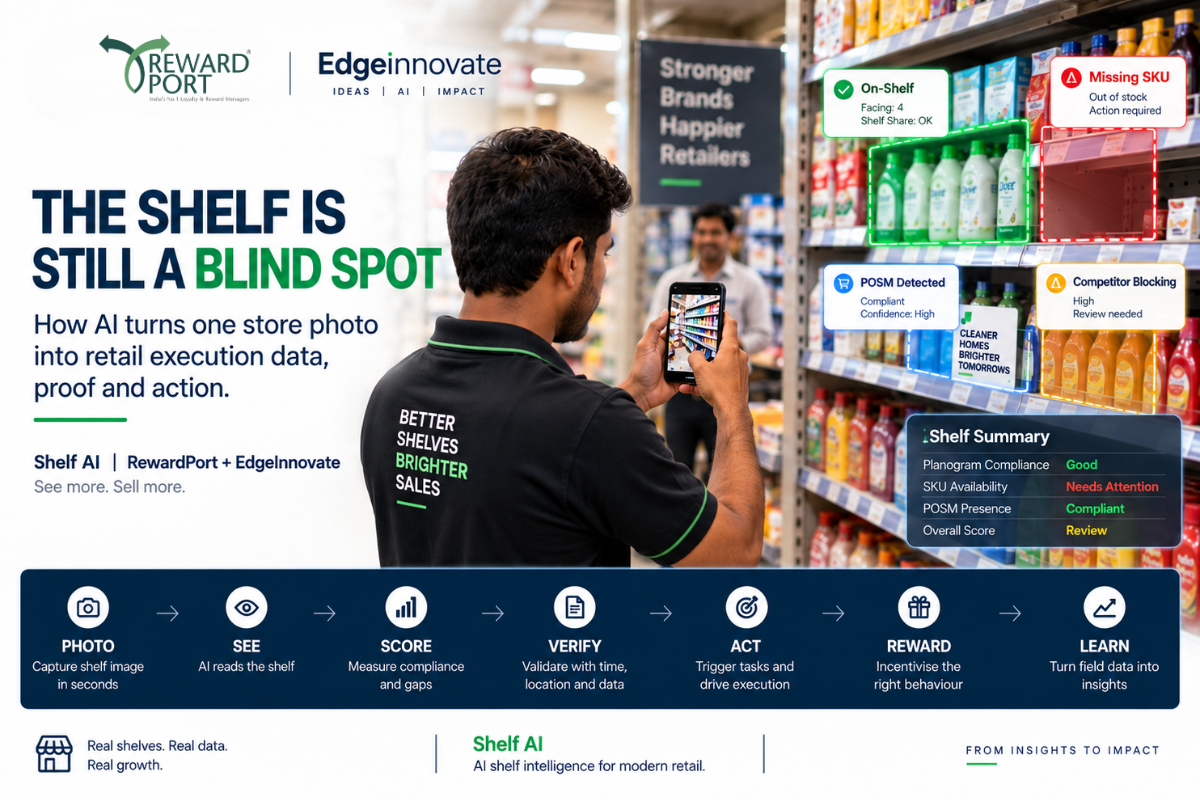
AI shelf monitoring uses computer vision and business rules to analyse photos of retail shelves, counters, coolers, displays or fixtures and convert what is visible into structured retail-execution data.
Depending on the category and program, a system can be configured to detect:
- Whether a defined SKU is present
- Approximate facing counts
- Product blocking
- Shelf position
- Out-of-stock or missing-SKU conditions
- Share of shelf
- Planogram or display compliance
- Promotional material or POSM presence
- Competitor products and adjacencies
- Image quality or suspected duplicate submissions
The important word is not AI.
It is evidence.
A photograph that used to sit in somebody’s WhatsApp group can become a measurable, auditable business event.
Why Is the Physical Shelf Still Difficult to Measure?
Retail execution has a structural problem.
Head office can define the “picture of success”.
But execution happens across thousands of individual moments:
One outlet.
One shelf.
One visit.
One retailer.
One display.
One product arrangement.
By the time a traditional audit reaches management, the shelf may already have changed.
Self-reporting creates another problem.
If the person executing the display is also the person scoring the display, measurement and incentive become entangled.
That is why computer vision is becoming useful in retail execution.
It separates:
“I did it.”
from:
“Here is evidence of what was actually visible.”
This Is Already Happening at Scale
The technology is no longer theoretical.
Sanofi has publicly been featured in a retail image-recognition case study involving its Perfect Store program. According to Trax, Sanofi deployed image recognition across 75,000 stores in more than 30 countries, allowing sales representatives to photograph shelves and management teams to see actual merchandising conditions remotely.
Source: https://traxretail.com/case-studies/sanofi/
Henkel has also been featured in a Trax case study covering more than 900 SKUs across 2,500 stores in Germany. The vendor reported a 4.3% reduction in out-of-stocks and a 2.1% sales uplift, alongside reductions in audit time and more time available for active selling.
Source: https://traxretail.com/case-studies/henkel/
And the direction continues in 2026.
ParallelDots currently cites Unilever Ghana as a ShelfWatch customer and reports that, after the partnership began in March 2024, on-shelf availability improved from 46% to nearly 91% and share of shelf rose to 66%, with the relationship expanding further by the end of Q1 2026.
Source: https://www.paralleldots.com/
These are vendor-published case studies and testimonials, so the results should be read in that context.
But collectively they show something important:
The shelf is becoming machine-readable.
The next question is what a brand does with that information.
The Shelf AI Execution Loop
At RewardPort and EdgeInnovate, we think the more useful model is not simply:
Photo → AI score
It is:
PHOTO → SEE → SCORE → VERIFY → ACT → REWARD → LEARN
Each step solves a different business problem.
1. PHOTO: Capture Reality Where It Happens
The first requirement is simple.
Get a usable image of the real retail environment.
That photo may come from a field representative, merchandiser, retailer, store employee or other approved participant.
The capture flow should guide users towards images that are useful for analysis.
Blurry, incomplete, repeated or unusable images should be identified before they become “data”.
The easier the capture process, the more likely it is to work at scale.
For some programs, that can mean a dedicated mobile workflow.
For others, a lower-friction web or WhatsApp-led journey may be more practical.
The interface is not the intelligence.
It is simply how reality enters the system.
2. SEE: Recognise What Is Actually on the Shelf
This is the computer-vision layer.
Configured products and SKUs are identified from the image.
The system may analyse presence, counts, facings, placement, shelf position, POSM and other visual conditions relevant to the brand’s rule set.
The objective is not to recognise every object in the store.
It is to recognise the objects and conditions that matter commercially.
A shampoo company may care about brand blocking and facings.
A beverage company may care about cooler purity and POSM.
A cosmetics brand may care about counter blocking and range presence.
An OTC brand may care about whether seasonal SKUs are visible in a chemist outlet.
Different category.
Different definition of a “good shelf”.
3. SCORE: Turn the Image Into a Decision
Recognition alone is not enough.
A list of detected products does not tell a marketer whether execution was good.
That requires rules.
For example:
- Hero SKU present: 20 points
- Minimum four facings: 20 points
- Correct brand block: 20 points
- Required POSM visible: 20 points
- No disallowed competitor encroachment: 20 points
Now the photo produces a score.
That score can represent:
- Planogram compliance
- Launch execution
- Visibility quality
- Share-of-shelf performance
- Display quality
- Retailer challenge completion
This is where Shelf AI becomes useful as an operating tool rather than an image-recognition demo.
4. VERIFY: Separate Clear Evidence From Ambiguity
AI systems should not pretend uncertainty does not exist.
Lighting changes.
Packs look similar.
Products overlap.
Small sachets can be difficult.
Prices and labels may require OCR.
A photograph may be cropped.
An unusual display may confuse the standard rule set.
A credible architecture therefore needs confidence handling.
Routine images can be processed through computer vision and deterministic rules.
OCR or more advanced vision-language models can be used selectively where text or context is genuinely needed.
Low-confidence or ambiguous cases can be routed for human review.
Most importantly:
Business rules, not an AI prompt, should make the final compliance or reward decision.
That distinction matters whenever money, retailer incentives, audit results or contractual compliance are involved.
5. ACT: Tell Somebody What Needs to Change
This is where a lot of shelf technology can lose commercial value.
It produces a dashboard.
The dashboard shows a red score.
Then everybody waits for a meeting.
The better question is:
What should happen because the shelf failed?
A missing SKU might trigger a replenishment task.
Weak blocking might create an instruction for the field rep.
Missing POSM might create a corrective action.
An underperforming geography might move higher in the supervisor’s priority list.
A competitor gaining space might create a sales conversation.
The value of shelf intelligence is not seeing the problem.
It is shortening the distance between:
Detection → Correction
6. REWARD: Incentivise Verified Execution
This is where shelf intelligence becomes particularly interesting for RewardPort.
Many retail incentive programs reward an activity because somebody said it happened.
AI shelf evidence creates the possibility of rewarding the verified outcome.
A retailer could be asked to create a defined display.
They submit a photo.
The system evaluates the agreed conditions.
The image receives a compliance score.
The approved score determines the reward tier.
That changes the incentive architecture.
Instead of:
“Upload a photo and get rewarded.”
the program becomes:
“Execute the agreed visibility standard, prove it, and earn according to the verified quality of execution.”
The same principle can work for:
- Launch displays
- Festive visibility
- Counter share
- POSM execution
- Strategic SKU presence
- Cooler compliance
- Retailer challenges
Now the reward is connected to what the brand actually wanted.
7. LEARN: Turn Thousands of Photographs Into Market Intelligence
One image answers a store-level question.
Thousands of images answer a strategy question.
Which SKU disappears most frequently?
Where is our shelf share weakening?
Which retailer format executes launches best?
Where does competitor blocking increase?
Which POS material survives beyond week one?
Which field teams consistently improve poor stores?
Which display rule actually correlates with better sell-out, where sales data is available?
This is where Shelf AI moves from audit automation toward retail intelligence.
The brand is no longer looking at photos.
It is learning from physical retail at scale.
Case File: The Colour-Cosmetics Counter
Illustrative Shelf AI program architecture — not a disclosed client result.
Imagine a cosmetics brand expanding through general trade.
Its challenge is not merely distribution.
The products may be in the store but invisible behind the counter.
So the brand creates a monthly visibility program for participating retailers.
The retailer submits a counter photograph.
Shelf AI evaluates configured conditions such as:
- Required SKU presence
- Brand blocking
- Number of visible facings
- Display cleanliness or obstruction rules
- POSM presence
A score is produced.
The verified score determines the retailer’s monthly reward slab.
A strong execution earns more than a token photograph.
And management receives geo-linked visual proof of how the brand is appearing at outlet level.
The program therefore connects:
Retail execution + Verification + Incentive
rather than running those as three separate systems.
Case File: The OTC Brand That Cannot Visit Every Chemist
Illustrative Shelf AI program architecture — not a disclosed client result.
Consider an OTC or wellness brand during a seasonal sales period.
The company wants a specific set of products to be available and visible across participating chemists.
Traditionally, the brand could ask a field team to audit a sample of stores.
But the commercial question is larger:
What is actually happening across the long tail of outlets?
A photo-led program can allow participating stores or field users to submit evidence.
Shelf AI checks for the configured SKUs and visibility rules.
Compliant stores qualify for the relevant incentive.
Non-compliant stores receive a corrective action rather than an automatic rejection with no explanation.
At management level, the images create a location-by-location picture of availability and execution.
That can make a retail promotion measurable in a way that pure sell-in data cannot.
Again, this is an illustrative program design.
Why Not Just Ask Field Reps to Report Compliance?
Because a checkbox has almost no information inside it.
“Display complete: Yes.”
A photograph contains substantially more.
It can be rechecked.
It can be compared.
It can be annotated.
It can be scored against different rules.
It can become evidence for a retailer conversation.
And over time, it can become a dataset.
That is the fundamental shift.
Retail photos stop being documentation and start becoming data.
Does Shelf AI Need Generative AI for Everything?
No.
In fact, this is one area where “more AI” is not automatically better.
For routine shelf execution, the architecture should favour predictable computer vision and explicit business rules.
Use advanced models selectively when the image is ambiguous or contextual interpretation is genuinely required.
Why?
Because:
“Is this display eligible for a ₹500 incentive?”
is not the same type of question as:
“Write me a marketing headline.”
It needs consistency.
Auditability.
Confidence thresholds.
And a clear escalation path.
A good shelf-intelligence system should know when it knows.
And know when a human should review.
How Should Brands Evaluate an AI Shelf Monitoring System?
Ask seven practical questions.
1. What Exactly Can the System Recognized?
Do not accept “computer vision” as an answer.
Ask about your pack types, sachets, variants, fixtures, counters, shelf conditions and POS material.
2. How Does It Handle Poor Images?
The system should identify unusable captures, not quietly turn them into unreliable data.
3. Can Business Rules Be Configured?
Your definition of compliance should not be hard-coded into a generic model.
4. What Happens When Confidence Is Low?
There should be a clear review path.
5. Can It Show the Evidence Behind the Score?
For important decisions, brands need annotated images and audit trails rather than a mysterious number.
6. Can the Result Trigger an Action?
A shelf score becomes far more useful when it can trigger tasks, communication, workflows or incentives.
7. Can the Data Be Integrated?
The long-term value increases when shelf intelligence can connect with SFA, DMS, CRM, incentive, sales or analytics systems.
What Should a Shelf AI Program Measure?
A useful measurement framework can include:
- Usable-photo rate
- SKU presence rate
- On-shelf availability
- Average facings
- Share of shelf
- Planogram compliance
- POSM compliance
- Display score
- Low-confidence review rate
- Rejected or suspicious submission rate
- Corrective-action closure rate
- Time from image submission to action
- Incentive cost per verified compliant execution
- Change in execution score over time
And one particularly important metric:
Verified Execution Rate
Outlets meeting the defined shelf standard ÷ outlets submitting valid evidence
That tells the brand whether activity is producing the intended physical-world outcome.
The Shelf Is Becoming a Data Source
For years, brands have invested heavily in understanding everything around the sale.
Consumer data.
Distributor data.
Media data.
CRM data.
Loyalty data.
The physical shelf has often remained the awkward gap between intention and reality.
Computer vision changes that.
But the most interesting future is not one where AI simply tells us:
“There are four bottles on that shelf.”
It is one where the business can say:
We saw the shelf.
We measured the gap.
We verified the execution.
We triggered the next action.
We rewarded the right behaviour.
And we learned what happened across the market.
That is the idea behind Shelf AI from the RewardPort + EdgeInnovate partnership.
Not AI for the photograph.
AI for what the photograph can make possible.
How Should FMCG Brands Design Consumer Promotions for Quick Commerce?
By Javed Akhtar, Founder & CEO, RewardPort
How are consumer promotions different on quick-commerce platforms?
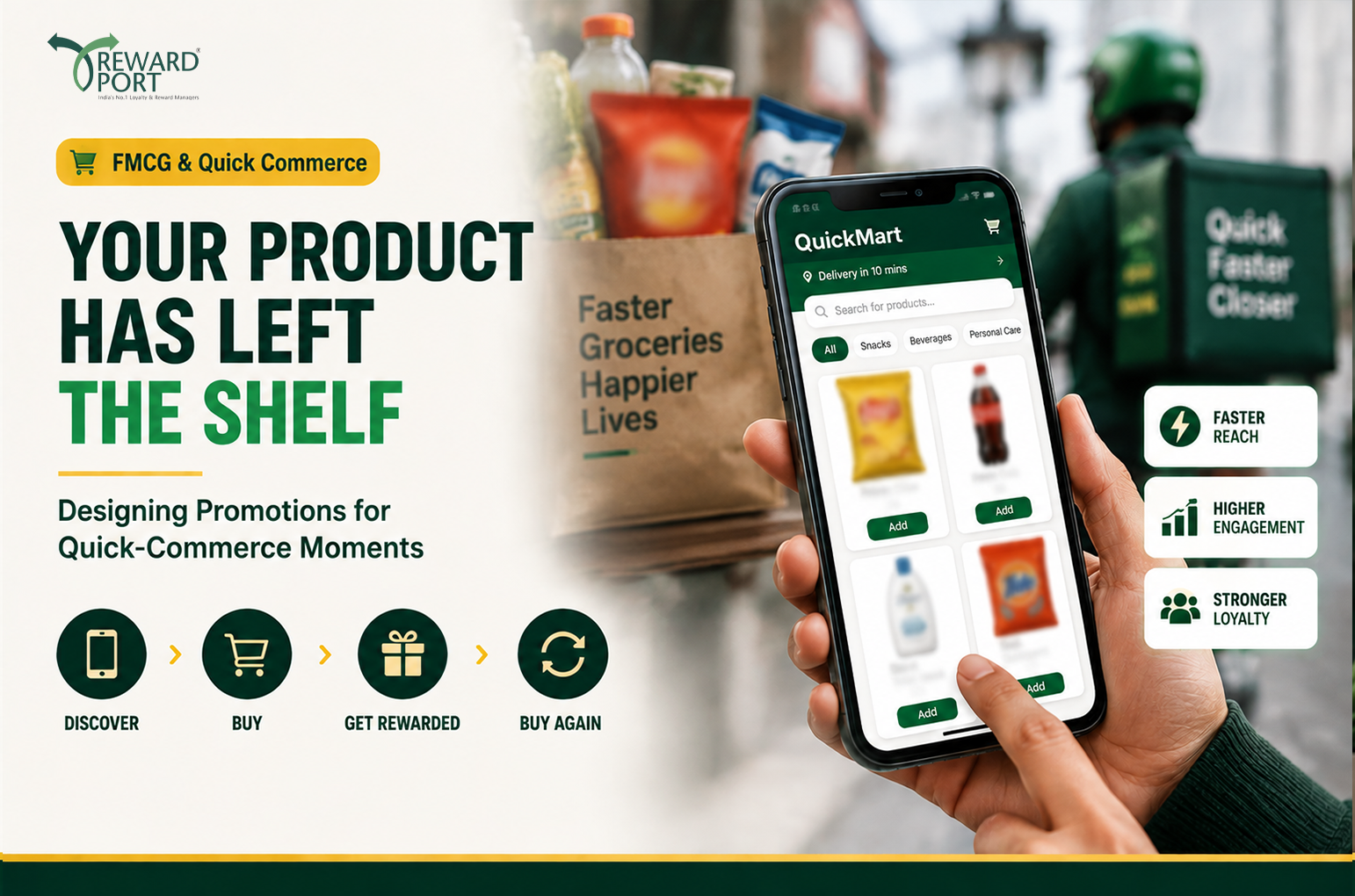
Direct answer: Quick-commerce promotions must win attention on the first screen, fit a short and specific shopping mission, communicate value within a small product tile, remain available at the shopper’s location and continue after delivery through the pack or a permission-based digital journey.
Speed changes discovery, conversion, fulfilment and measurement. It should also change promotion design.
Key takeaways
- Quick commerce compresses product discovery and purchase into minutes.
- A promotion that is invisible in the search result is invisible when it matters.
- Assortment, inventory and promotion design must work together at the micro-market level.
- The platform may drive the sale, but the delivered pack can begin the brand relationship.
- Brands should measure the complete journey from visibility to verified repeat purchase.
Quick commerce did not just speed up delivery
It sped up deciding.
That changes everything.
In a supermarket, a promotion can interrupt a shopper in the aisle. The pack, shelf strip, promoter or end-cap can create the moment.
In quick commerce, the shopper may arrive with a specific mission:
- the milk has finished;
- guests have arrived;
- the child needs a snack;
- the detergent is running out;
- the match starts in 20 minutes; or
- someone suddenly wants ice cream.
The mission is immediate.
The decision window is small.
The screen is crowded.
Your product does not have an aisle.
It has a tile.
How fast is quick-commerce shopping in India?
Bain and Flipkart’s How India Shops Online 2026 estimates that Indian quick commerce reached $10 billion to $11 billion in gross merchandise value in 2025 after doubling annually over the previous two years.
The more important insight for promotion design is behavioral.
Bain describes quick-commerce sessions as typically lasting less than five minutes, compared with more than ten minutes for traditional e-retail.
It reports roughly eight times higher visit-to-order conversion, greater search-led sales, fewer product pages viewed and a stronger role for top-up missions and small packs.
This is not browsing with faster delivery.
It is high-intent shopping with compressed consideration.
WPP Media and Meta’s January 2026 India report adds another signal. It says quick commerce accounted for 45% of festive shopping among the consumers studied, with 91% awareness and more than half reporting use in the preceding week.
The numbers will vary by category, city and study.
The direction is clear.
Quick commerce is becoming both a shelf and a media channel.
Why does the traditional on-pack promotion model need to change?
Because the shopper may choose the product before seeing the pack.
A physical pack can still carry a powerful QR code, unique code or reward message. But on quick commerce, it often becomes visible only after the purchase.
That means the promotion now has two jobs:
- Win the purchase before delivery.
- Build the relationship after delivery.
Many campaigns do one and forget the other.
A platform-funded discount may win the basket but create no direct brand relationship.
An on-pack reward may build engagement but fail if the product tile never communicates that the offer exists.
The promotion has to travel across both environments.
Traditional retail promotion versus quick-commerce promotion
| Decision factor | Traditional retail | Quick commerce |
|---|---|---|
| Discovery | Aisle, shelf, display, promoter | Search, first screen, recommendation, sponsored placement |
| Decision window | Longer physical browsing | Often a short, mission-led session |
| Promotion surface | Pack and point of sale | Product tile, product page, basket and delivered pack |
| Assortment | Store or chain level | Dark-store and micro-market availability |
| Measurement | Often delayed and aggregated | Potentially faster, more granular and location specific |
| Brand relationship | Retailer, pack and brand can all influence it | Platform owns the purchase interface; the pack can create the direct post-purchase connection |
The RewardPort FAST Promotion Framework
A quick-commerce consumer promotion should pass four tests.
F: First-screen clarity
The product and promotion must make sense before the shopper opens the product page.
The product tile should communicate one useful promise:
- assured cashback;
- extra quantity;
- a relevant bundle;
- buy two and unlock a benefit;
- trial reward on a new variant; or
- a clear post-purchase experience.
Do not make the shopper decode a campaign.
Use a short benefit, legible imagery and a precise condition.
Then ensure the product page contains the complete terms without hiding the basic mechanic.
A: Assortment and action fit
Quick-commerce missions are not identical.
A 10 pm indulgence purchase is different from a morning replenishment.
An emergency need is different from a planned stock-up.
A ₹10 trial pack serves a different job from a family bundle.
Match the SKU, pack size and reward to the mission.
Bain specifically recommends micro-market assortment and mission-led pricing and marketing.
A national promotion that ignores local availability can spend on visibility for a product the nearest dark store cannot deliver.
S: Speed-matched value
A ten-minute shopping promise followed by a seven-day reward journey feels broken.
The promotional experience should respect the speed that attracted the shopper.
Where verification permits, deliver an assured benefit quickly.
Show claim status clearly.
If a larger reward requires validation, acknowledge the action instantly and state the exact timeline.
Speed does not always mean cashback.
It means reducing uncertainty.
An instant confirmation, progress marker, voucher, movie benefit or choice of rewards can also fit the moment.
T: Traceable next action
The sale is not the end.
It is the first verified signal.
Use the delivered pack, insert, QR code or consented WhatsApp journey to create an appropriate direct relationship.
The consumer can validate the purchase, receive the benefit, indicate a preference or see progress toward a repeat-purchase milestone.
The next action must be useful, permission-based and measurable.
FAST means: First-screen clarity, Assortment and action fit, Speed-matched value and a Traceable next action.
What are the five promotion moments on quick commerce?
- Inspiration — Social, creator, search or retail media creates the need.
- First screen — The shopper sees a product tile, ranking, badge, price and availability.
- Basket — Bundles, thresholds, combinations and recommendations shape the order.
- Doorstep — The physical product arrives and the pack becomes visible.
- Direct relationship — A QR, code or permission-based message connects the verified action to reward, learning and repeat purchase.
A complete quick-commerce promotion assigns a job to every relevant moment.
Not every campaign needs activity across all five.
But every campaign should know where discovery starts, where the choice is made and where the brand relationship continues.
How should FMCG brands build a quick-commerce promotion?
- Choose the shopping mission. Replenishment, emergency, trial, indulgence, occasion or planned basket.
- Define one primary behavior. Trial, switch, add another product, buy a bundle, repeat or refer.
- Select the right SKU and geography. Confirm local inventory and pack relevance.
- Write the tile-level promise. Make it understandable at thumbnail size.
- Design the basket mechanic. Decide whether the action involves a threshold, combination, quantity or product variant.
- Connect the delivered pack. Use QR, unique code, receipt or another suitable proof.
- Deliver value at channel speed. Minimize delay and uncertainty.
- Create the next action. Show progress, replenishment timing, referral or a relevant follow-on benefit.
- Measure the whole loop. Do not stop at platform orders or code scans.
What would a quick-commerce promotion look like in practice?
Illustrative scenario: A snack brand wants to win evening group occasions, not simply discount single packs.
It creates a “Movie Night in 15 Minutes” bundle for selected city catchments.
The product tile communicates the bundle and assured benefit clearly.
The platform basket combines two snack products and a beverage at an occasion-relevant price.
After delivery, the consumer scans a unique code on the pack.
A simple WhatsApp journey validates participation and unlocks a movie or entertainment benefit.
The confirmation then offers progress toward another occasion reward after a second verified purchase within a defined period.
The campaign measures:
- first-screen impression to product-page or add-to-cart rate;
- bundle attach rate;
- order conversion and average basket;
- availability and out-of-stock loss by micro-market;
- unique-code activation;
- reward delivery and use;
- purchase number two; and
- cost per incremental occasion purchase.
This is an illustrative scenario, not a RewardPort client case study.
Why is inventory part of promotion performance?
Because an unavailable product cannot convert, regardless of media or reward quality.
Quick-commerce inventory is hyperlocal.
A campaign can be live nationally while the promoted SKU is absent from relevant dark stores.
Track availability beside media and promotion metrics.
Pause or redirect spend where stock is unavailable.
Treat out-of-stock impressions as a combined marketing and supply problem, not only an operations problem.
Should brands offer the same promotion on every platform?
No. Keep the objective consistent, but adapt the mechanic to the platform, mission and available inventory.
A universal national promise may be useful for simplicity.
The displayed SKU, basket combination, time window and reward presentation can still vary by platform or location.
Any variation should remain fair, transparent and operationally manageable.
Do on-pack QR promotions still matter in quick commerce?
Yes. They become more important after delivery because they can connect the platform purchase to a direct, permission-based brand journey.
The QR code should not merely open a generic form.
It should recognize the campaign, explain the value, validate the action with minimal friction and give the consumer a clear reason to continue.
Should the reward be instant?
The acknowledgement should be instant. The reward should be delivered as quickly as verification and risk permit.
For a low-value assured benefit, near-instant fulfilment may be appropriate.
For a higher-value claim, the consumer should immediately receive confirmation, status visibility and a credible timeline.
How can quick-commerce promotions create first-party data?
Ask for a direct interaction after purchase and collect only the data needed to provide value or improve a defined decision.
Use clear consent.
Explain why information is being requested.
Connect the data to reward delivery, preference, replenishment, service or another visible benefit.
Do not convert every scan into a long questionnaire.
Which metrics matter most?
Brands should look beyond platform orders and measure the full promotion journey.
Important metrics include:
- First-screen visibility and search share
- Product-tile click or add-to-cart rate
- Basket conversion and attach rate
- Average order value or units per order
- Availability and out-of-stock rate by micro-market
- Platform promotion cost per incremental order
- Verified pack activation rate
- Reward delivery time and success rate
- Repeat purchase within the relevant consumption window
- Cost per incremental repeat purchase
- Duplicate, rejected and suspicious claims
Consent, opt-out and support-contact rates
What is the biggest quick-commerce promotion mistake?
Treating quick commerce as a delivery channel instead of a compressed decision environment.
The winning promotion is not simply the loudest discount.
It is the one that:
- matches the mission;
- wins the first screen;
- is actually available;
- delivers value at the speed expected; and
- turns the delivered product into a measurable next relationship.
Where RewardPort fits
RewardPort can help brands connect quick-commerce promotion design with the post-purchase engagement layer.
This may include:
- campaign mechanics;
- QR and unique codes;
- receipt or invoice validation;
- WhatsApp journeys;
- UPI cashback;
- vouchers;
- merchandise;
- cinema rewards;
- travel and experiences;
- fraud controls;
- fulfilment; and
- reporting.
The goal is not to replace the platform relationship.
It is to make the promotion work harder across the full journey:
First screen to basket. Basket to pack. Pack to repeat purchase.
Planning an FMCG promotion for quick commerce?
RewardPort can help map the offer across the FAST framework and the five promotion moments.
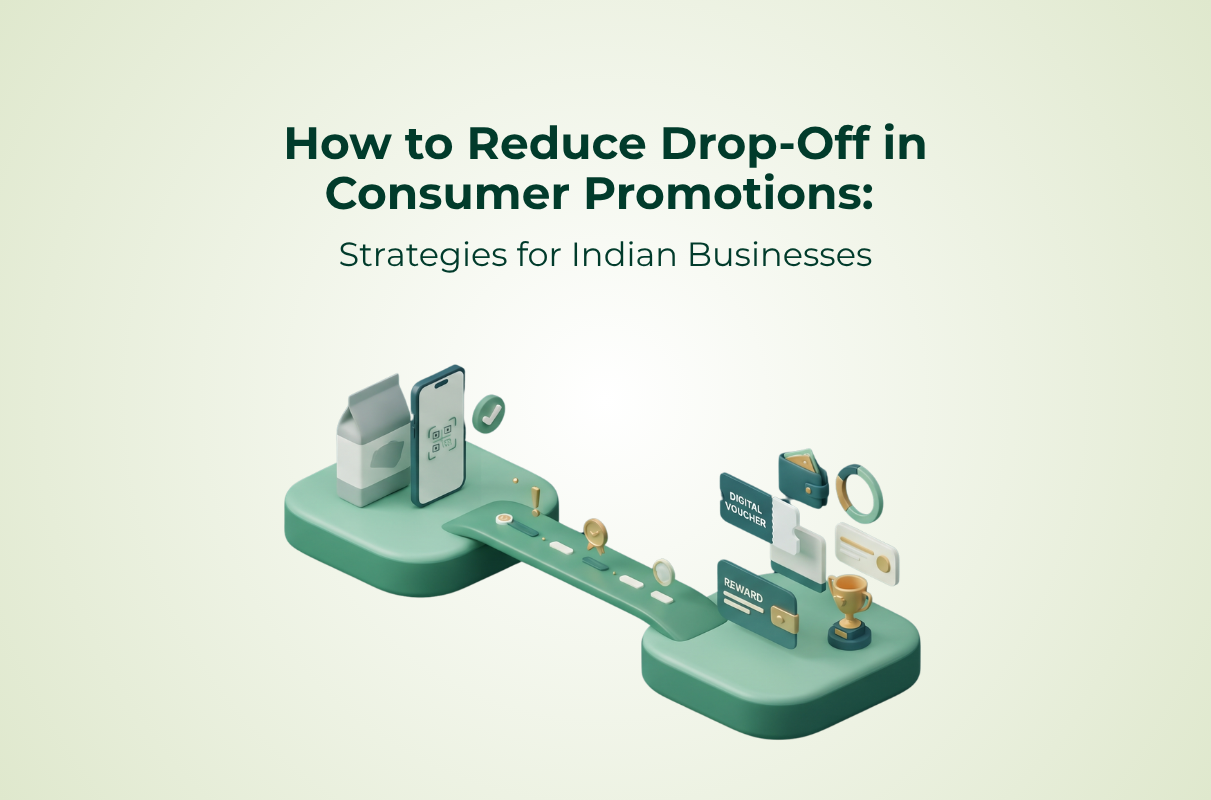
How to Reduce Drop-Off in Consumer Promotions: Strategies for Indian Businesses
In India’s dynamic market landscape, reducing drop-off in consumer promotions is crucial for brands seeking to maximise participation, engagement, and ultimately sales. Despite rising demand for innovative promotional campaigns, many brands face challenges with consumer drop-off—where prospects abandon the promotion before completing the intended action. This article explores why reducing drop-off matters, current market trends in India, and actionable strategies supported by RewardPort expertise and solutions to enhance campaign effectiveness in 2026 and beyond.
Understanding Consumer Drop-Off in Promotions: Market Context and Behaviour
Consumer drop-off refers to the loss of participants at various stages of a promotional funnel, such as during entry, validation, or reward redemption. In India, this issue is influenced by diverse factors including digital literacy, payment preferences, regional language barriers, and trust in promotion authenticity.
Research shows that Indian consumers increasingly expect seamless digital experiences with instant gratification options such as digital vouchers, cashback, and gamified rewards. However, complex entry processes, delayed gratification, and limited reward relevance are common causes of drop-off.
Emerging Trends Shaping Consumer Promotions in 2026
By 2026, consumer promotions in India are embracing key trends to tackle drop-off:
- Instant Gratification: Immediate rewards like cashback, multi-brand vouchers, and digital coupons help maintain enthusiasm and reduce churn.
- Gamification: Interactive games and scratch cards engage consumers more deeply, creating entertainment value alongside promotional impact.
- Localized Engagement: Campaigns tailored linguistically and culturally connect better and cut drop-off due to comprehension gaps.
- Omnichannel Access: Combining digital, retail, and mobile touchpoints ensures consumers can participate effortlessly regardless of preferred platform.
- Reward Personalization: Offering relevant rewards such as travel vouchers, entertainment passes, or essential services keeps consumers motivated to complete participation.
Practical Implications for B2B Marketers and Channel Leaders
For marketers and sales leaders in India, reducing drop-off is directly linked to improved campaign ROI, higher repeat purchase rates, and stronger channel partner activation. Simplifying promotional processes and choosing execution methods aligned with target demographics are essential. Moreover, tracking participation at every touchpoint provides insights to identify friction points and iterate quickly.
RewardPort Perspective and Solutions to Reduce Drop-Off
RewardPort leverages deep market expertise and digital technology to help Indian businesses reduce drop-off in consumer promotions through:
- Plug-and-Play Campaign Modules: Instant-win scratch cards, QR scan-to-win, and WhatsApp-based entry methods enhance user convenience and speed of engagement.
- Rich Reward Catalogue: Multi-brand vouchers, cashback options, travel and entertainment rewards deliver relevant choices that resonate with diverse audiences.
- Gamification Engine: Over 100 branded games that boost fun and sustained participation.
- Instant Redemption Platforms: Freebucks points system and RewardOne voucher engine ensure hassle-free, real-time reward fulfilment.
- Advanced Analytics and Tracking: Monitor drop-off trends and participation metrics to refine targeting and campaign design.
Verified RewardPort Case Study Insights
One notable RewardPort-led campaign combined a gift-with-purchase promotion using branded scratch cards rewarding movie tickets instantly. This approach reduced drop-off significantly by merging familiar consumer habits with instant gratification rewards, driving increased participation and sales uplift. Similarly, channel partner incentive programs integrating easy redemption travel rewards saw better engagement and redemption rates, underscoring the impact of personalized, accessible rewards.
Implementing a Drop-Off Reduction Framework
Businesses can adopt a stepwise approach:
- Map User Journeys: Identify drop-off points in the promotional funnel.
- Simplify Entry Mechanisms: Use QR codes, WhatsApp participation, or receipt uploads to lower barriers.
- Leverage Gamification: Include engaging games and contests to maintain interest.
- Offer Instant Rewards: Prioritize digital vouchers, cashback, and instant-win campaigns.
- Utilize Analytics: Continuously monitor and optimise using data-driven insights.
- Customize Rewards: Ensure rewards align with consumer preferences and regional nuances.
Reducing drop-off in consumer promotions is a strategic imperative for Indian businesses aiming to maximise campaign participation, engagement, and sustained customer loyalty. By adopting instant gratification, gamification, personalized rewards, and seamless digital experiences—backed by RewardPort advanced platforms and diverse reward catalogue—brands can significantly lower drop-off rates and boost promotional success in 2026 and beyond.
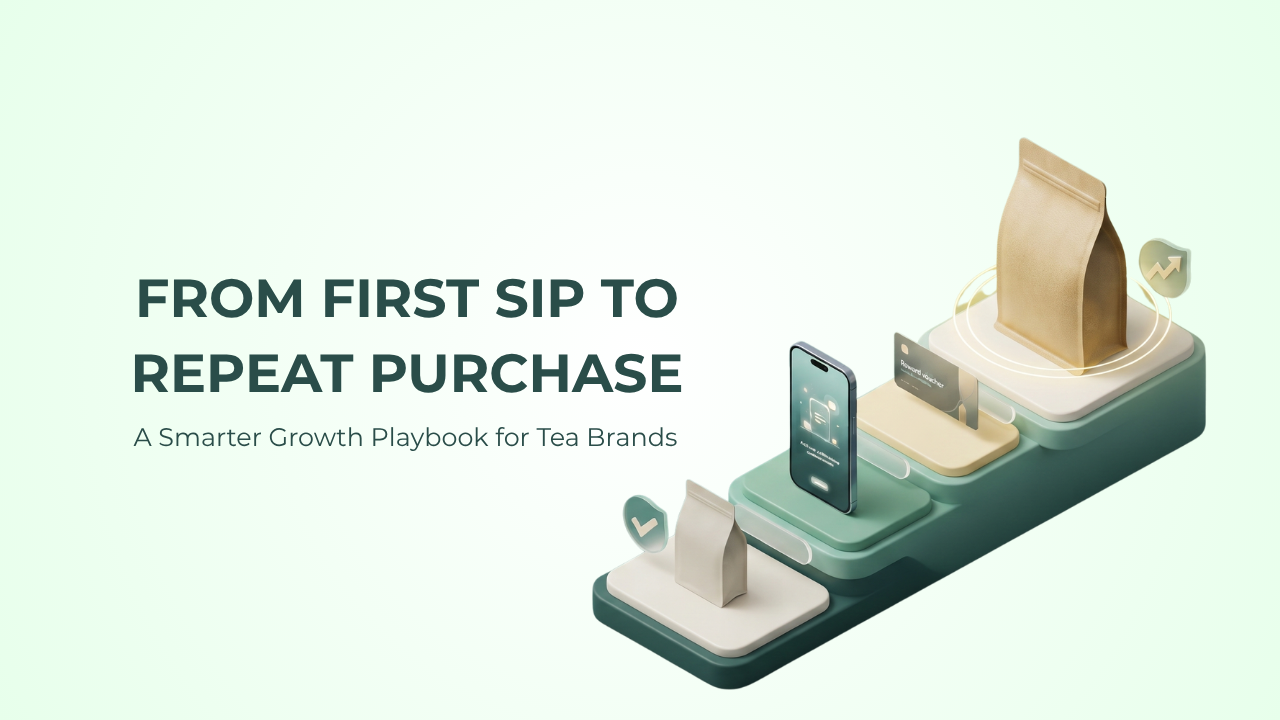
Consumer Promotion Strategy for Tea Brands in India: A Trial-to-Repeat Growth Playbook
A tea-brand promotion should begin with one behavior to change.
That could be trial, larger-pack migration, repeat purchase, premium-range discovery or retailer advocacy.
The strongest programs then connect that behavior to suitable purchase evidence, a relevant reward and a clear next action. Consumer and retailer tracks should remain operationally distinct, while the insights from both contribute to a broader category-growth plan.
Key Takeaways
- Tea is a habitual category, so the strategic objective should extend beyond generating a one-time redemption to creating a measurable repeat-purchase pattern.
- Mass, premium, green, herbal, regional and gifting propositions should not automatically use the same reward rules.
- Pack size, blend, geography, season and purchase frequency can influence the appropriate promotion mechanic.
- Assured rewards can support the first action, while streaks, milestones and differentiated value can encourage subsequent purchases.
- Retailer advocacy requires separate evidence, targets, communication and rewards rather than competing with consumers for the same code pool.
Why Tea Brands Need a Category-Specific Promotion Design
Tea combines frequent consumption with complex consumer choice.
A household may already have:
- A preferred blend
- A regional taste preference
- A habitual pack size
- A trusted retailer
At the same time, the category covers mass black tea, premium blends, green and herbal variants, tea bags, wellness-positioned products, gifting and out-of-home consumption.
This creates several different growth objectives:
Recruit a New Household → Encourage Variant Trial → Increase Pack Size → Drive Repeat Purchase → Introduce Premium Products → Activate Regional Markets → Strengthen Retailer Recommendation
A promotion attempting to solve every objective simultaneously can quickly become expensive and difficult to measure.
The promotion decision therefore needs to be made at the brand, SKU, pack, channel and behavior level, rather than being based only on broad category trends.
The RewardPort BREW Growth Framework
The supplied RewardPort authority article introduces the BREW framework, a four-part approach for turning a tea promotion into a measurable behavior loop.
| Element | Decision | Tea-Brand Application |
|---|---|---|
| B — Behavior | What single action should change? | Trial, repeat, pack migration, variant discovery, referral, retailer recommendation or data opt-in |
| R — Route | Where and how will participation happen? | On-pack code, in-pack token, receipt upload, WhatsApp, retailer handoff, e-commerce order data or hybrid journey |
| E — Evidence | What proves the qualifying action? | Serialized code, receipt OCR, invoice, order feed, repeat sequence, retailer data or approved registration |
| W — Worth & Next Action | What value will motivate this audience, and what should happen next? | Cashback, voucher, merchandise, cinema, travel, experience, collect-and-unlock, referral or next-purchase benefit |
The loop becomes useful when the brand does not stop at recording redemption.
It should also understand:
Who participated → What they bought → Whether they returned → What reward they chose → What action should come next
Choose the Promotion Mechanic by Growth Objective
Different tea-brand objectives require different mechanics.
1. Drive Trial
Use a low-friction on-pack or receipt-verification journey with an assured entry reward and clear product education.
Measure:
- Cost per verified new buyer
- Participation by SKU and region
- First-to-second purchase
The first reward should make participation easy while creating a route towards the next purchase.
2. Move Consumers to a Larger Pack
Use tiered value based on verified pack size or provide an additional benefit when consumers upgrade within a defined period.
Measure:
- Pack-size mix
- Upgrade rate
- Cost per incremental gram/value
- Repeat behavior after upgrading
The objective is not simply to reward another transaction. It is to identify whether the promotion changes the consumer’s pack-size behavior.
3. Encourage Repeat Purchase
Use a collect-and-unlock, purchase streak or milestone mechanic based on a repeatable verification method such as serialized codes or receipt-based sequencing.
The consumer should be able to understand their progress and what the next verified purchase unlocks.
This turns:
Purchase → Reward
into:
First Purchase → Progress → Second Purchase → Higher Value → Repeat Behavior
4. Encourage Variant Discovery
Use guided discovery, variant-specific missions or cross-SKU progress to introduce consumers to other products in the portfolio.
This can be particularly useful when a brand has multiple blends, formats or propositions.
The campaign should measure whether participation actually converts into verified target-variant trial rather than only engagement with promotional communication.
5. Strengthen Retailer Recommendation
Retailer advocacy should have its own program track.
Retailers may be rewarded for approved actions such as:
- Verified stocking
- Product learning
- Sales missions
- Strategic SKU movement
- Other approved channel actions
Retailer and consumer reward rules, evidence and ledgers should remain distinct.
Mass and Premium Tea Should Not Automatically Use the Same Reward
Reward selection should reflect the proposition and desired behavior.
For a mass-market proposition, clarity and immediate value may be important.
For premium tea, the audience, margin, purchase barrier and brand positioning may support higher-perceived-value or experiential rewards.
Depending on the campaign, the reward architecture could include:
- Cashback
- Digital vouchers
- Merchandise
- Cinema
- Travel
- Experiences
- Next-purchase benefits
The key question is not simply:
“Which reward is most attractive?”
It is:
“Which reward is most appropriate for this audience, behavior and next action?”
Consumer and Retailer Tracks Should Work Together — Not Compete
A tea promotion can include both consumer and retailer engagement under the same overall growth strategy.
However, the two journeys should remain operationally separate.
Consumer Track
Could focus on:
Trial → Repeat → Pack Migration → Variant Discovery → Loyalty
Retailer Track
Could focus on:
Stocking → Product Knowledge → Recommendation → Sales Mission → Continued Advocacy
The evidence, reward rules, ledgers, fraud controls and applicable tax treatment may differ.
Keeping these tracks separate allows the brand to understand both consumer pull and retailer influence without creating attribution conflicts.
Metrics for the Tea-Brand Growth Loop
| Metric | Definition | Decision Supported |
|---|---|---|
| Verified Trial Cost | Total promotion cost ÷ verified first-time participants | Is customer recruitment economically sustainable? |
| Second-Purchase Rate | First-time verified buyers with a second verified purchase ÷ first-time verified buyers | Is the campaign creating repeat behavior? |
| Time to Repeat | Median days between first and second verified purchase | When should the next trigger happen? |
| Pack-Migration Rate | Verified buyers moving to target pack ÷ eligible verified buyers | Is the promotion changing pack-size mix? |
| Variant-Conversion Rate | Verified target-variant trials ÷ eligible participants | Is product discovery converting into purchase? |
| Reward Efficiency | Verified target actions ÷ total reward and fulfilment cost | Which rewards and cohorts create useful behavior? |
| Consumer Data Usability | Consented, complete, deduplicated records ÷ verified participants | Is the campaign producing reusable first-party intelligence? |
| Invalid & Duplicate Rate | Invalid or duplicate attempts ÷ total attempts | Are evidence and fraud controls working appropriately? |
| Retailer Active Rate | Retailers with verified target action ÷ enrolled eligible retailers | Is retailer participation genuine? |
These metrics shift the conversation from “How many rewards did we distribute?” to “What behavior did the promotion change?”
Illustrative Scenario: Regional Premium Tea Launch
Assume a tea company is introducing a premium regional blend across two states.
The objective is:
Verified Trial → Second Purchase Within 45 Days
Packs can carry a unique in-pack code, and the brand wants a WhatsApp-first journey available in two languages.
A possible pilot could work like this:
First Purchase
Unique Code → WhatsApp Verification → Assured Low-Friction Reward → Taste/Usage Prompt
Second Purchase
Second Valid Code Within 45 Days → Verification → Higher-Perceived-Value Benefit
Reward preference and repeat timing could be recorded with consent, while code duplication, device velocity and geography are monitored.
Retailers could participate through a separate learning and verified-stock or sales mission instead of accessing the consumer code pool.
This is an illustrative scenario, not a claimed RewardPort client result. Budget, pack operations, tax, promotion terms, data use and reward availability would need to be verified before launch.
RewardPort Tea Campaign Examples
RewardPort case-study library also contains tea-sector examples that can support the article.
Goodricke — Premium Tea Trial
RewardPort documented Goodricke campaign supported the launch of its Thurbo Darjeeling tea range with an assured ₹100 Uber voucher for qualifying purchases.
The campaign targeted urban premium tea consumers and used a practical lifestyle reward aligned with the audience.
Maharaja Tea — Assured Cashback for Repeat Purchase
RewardPort Maharaja Tea campaign used ₹50 assured cashback on every pack, with consumers redeeming a unique code digitally. The campaign has recorded 300,000+ cashback redemptions and was designed to encourage repeat purchase through simple, immediate value.
Vikram Tea — Assured Value + Aspirational Prize
For Vikram Gold’s 250g pack, RewardPort executed a consumer promotion combining ₹15 assured Paytm cashback with entry into a gold coin lucky draw.
The documented campaign used the combination of immediate value and an aspirational prize to support pack sales and engagement.
These examples illustrate why different tea propositions may require different reward architectures rather than one universal promotion mechanic.
How RewardPort Can Support Tea Brands
RewardPort can help tea brands move from a standalone offer to a connected promotion system spanning:
Objective & Mechanic Design → QR/Code Journeys → Purchase Verification → WhatsApp Participation → Rewards → Retailer Engagement → Fraud Controls → Fulfilment → Analytics
Consumer and channel journeys can remain role-specific while contributing to a broader picture of trial, repeat behavior, product mix and market response.
The right starting question is:
Which behavior should change in the next 90 days, and what evidence will prove that it changed?
Ask RewardPort for a tea-brand promotion blueprint covering behavior, pack and channel constraints, evidence, reward architecture, retailer activation and a measurable pilot.