
A tea-brand promotion should begin with one behavior to change.
That could be trial, larger-pack migration, repeat purchase, premium-range discovery or retailer advocacy.
The strongest programs then connect that behavior to suitable purchase evidence, a relevant reward and a clear next action. Consumer and retailer tracks should remain operationally distinct, while the insights from both contribute to a broader category-growth plan.
Key Takeaways
- Tea is a habitual category, so the strategic objective should extend beyond generating a one-time redemption to creating a measurable repeat-purchase pattern.
- Mass, premium, green, herbal, regional and gifting propositions should not automatically use the same reward rules.
- Pack size, blend, geography, season and purchase frequency can influence the appropriate promotion mechanic.
- Assured rewards can support the first action, while streaks, milestones and differentiated value can encourage subsequent purchases.
- Retailer advocacy requires separate evidence, targets, communication and rewards rather than competing with consumers for the same code pool.
Why Tea Brands Need a Category-Specific Promotion Design
Tea combines frequent consumption with complex consumer choice.
A household may already have:
- A preferred blend
- A regional taste preference
- A habitual pack size
- A trusted retailer
At the same time, the category covers mass black tea, premium blends, green and herbal variants, tea bags, wellness-positioned products, gifting and out-of-home consumption.
This creates several different growth objectives:
Recruit a New Household → Encourage Variant Trial → Increase Pack Size → Drive Repeat Purchase → Introduce Premium Products → Activate Regional Markets → Strengthen Retailer Recommendation
A promotion attempting to solve every objective simultaneously can quickly become expensive and difficult to measure.
The promotion decision therefore needs to be made at the brand, SKU, pack, channel and behavior level, rather than being based only on broad category trends.
The RewardPort BREW Growth Framework
The supplied RewardPort authority article introduces the BREW framework, a four-part approach for turning a tea promotion into a measurable behavior loop.
| Element | Decision | Tea-Brand Application |
|---|---|---|
| B — Behavior | What single action should change? | Trial, repeat, pack migration, variant discovery, referral, retailer recommendation or data opt-in |
| R — Route | Where and how will participation happen? | On-pack code, in-pack token, receipt upload, WhatsApp, retailer handoff, e-commerce order data or hybrid journey |
| E — Evidence | What proves the qualifying action? | Serialized code, receipt OCR, invoice, order feed, repeat sequence, retailer data or approved registration |
| W — Worth & Next Action | What value will motivate this audience, and what should happen next? | Cashback, voucher, merchandise, cinema, travel, experience, collect-and-unlock, referral or next-purchase benefit |
The loop becomes useful when the brand does not stop at recording redemption.
It should also understand:
Who participated → What they bought → Whether they returned → What reward they chose → What action should come next
Choose the Promotion Mechanic by Growth Objective
Different tea-brand objectives require different mechanics.
1. Drive Trial
Use a low-friction on-pack or receipt-verification journey with an assured entry reward and clear product education.
Measure:
- Cost per verified new buyer
- Participation by SKU and region
- First-to-second purchase
The first reward should make participation easy while creating a route towards the next purchase.
2. Move Consumers to a Larger Pack
Use tiered value based on verified pack size or provide an additional benefit when consumers upgrade within a defined period.
Measure:
- Pack-size mix
- Upgrade rate
- Cost per incremental gram/value
- Repeat behavior after upgrading
The objective is not simply to reward another transaction. It is to identify whether the promotion changes the consumer’s pack-size behavior.
3. Encourage Repeat Purchase
Use a collect-and-unlock, purchase streak or milestone mechanic based on a repeatable verification method such as serialized codes or receipt-based sequencing.
The consumer should be able to understand their progress and what the next verified purchase unlocks.
This turns:
Purchase → Reward
into:
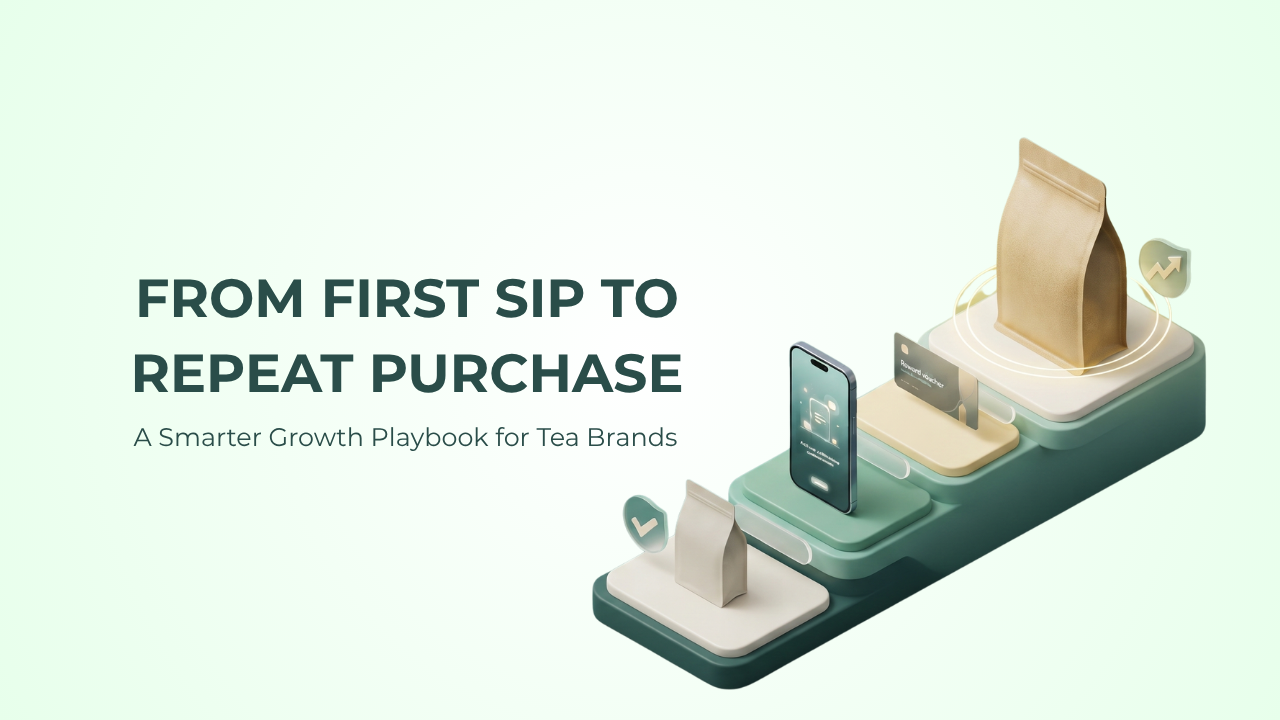
First Purchase → Progress → Second Purchase → Higher Value → Repeat Behavior
4. Encourage Variant Discovery
Use guided discovery, variant-specific missions or cross-SKU progress to introduce consumers to other products in the portfolio.
This can be particularly useful when a brand has multiple blends, formats or propositions.
The campaign should measure whether participation actually converts into verified target-variant trial rather than only engagement with promotional communication.
5. Strengthen Retailer Recommendation
Retailer advocacy should have its own program track.
Retailers may be rewarded for approved actions such as:
- Verified stocking
- Product learning
- Sales missions
- Strategic SKU movement
- Other approved channel actions
Retailer and consumer reward rules, evidence and ledgers should remain distinct.
Mass and Premium Tea Should Not Automatically Use the Same Reward
Reward selection should reflect the proposition and desired behavior.
For a mass-market proposition, clarity and immediate value may be important.
For premium tea, the audience, margin, purchase barrier and brand positioning may support higher-perceived-value or experiential rewards.
Depending on the campaign, the reward architecture could include:
- Cashback
- Digital vouchers
- Merchandise
- Cinema
- Travel
- Experiences
- Next-purchase benefits
The key question is not simply:
“Which reward is most attractive?”
It is:
“Which reward is most appropriate for this audience, behavior and next action?”
Consumer and Retailer Tracks Should Work Together — Not Compete
A tea promotion can include both consumer and retailer engagement under the same overall growth strategy.
However, the two journeys should remain operationally separate.
Consumer Track
Could focus on:
Trial → Repeat → Pack Migration → Variant Discovery → Loyalty
Retailer Track
Could focus on:
Stocking → Product Knowledge → Recommendation → Sales Mission → Continued Advocacy
The evidence, reward rules, ledgers, fraud controls and applicable tax treatment may differ.
Keeping these tracks separate allows the brand to understand both consumer pull and retailer influence without creating attribution conflicts.
Metrics for the Tea-Brand Growth Loop
| Metric | Definition | Decision Supported |
|---|---|---|
| Verified Trial Cost | Total promotion cost ÷ verified first-time participants | Is customer recruitment economically sustainable? |
| Second-Purchase Rate | First-time verified buyers with a second verified purchase ÷ first-time verified buyers | Is the campaign creating repeat behavior? |
| Time to Repeat | Median days between first and second verified purchase | When should the next trigger happen? |
| Pack-Migration Rate | Verified buyers moving to target pack ÷ eligible verified buyers | Is the promotion changing pack-size mix? |
| Variant-Conversion Rate | Verified target-variant trials ÷ eligible participants | Is product discovery converting into purchase? |
| Reward Efficiency | Verified target actions ÷ total reward and fulfilment cost | Which rewards and cohorts create useful behavior? |
| Consumer Data Usability | Consented, complete, deduplicated records ÷ verified participants | Is the campaign producing reusable first-party intelligence? |
| Invalid & Duplicate Rate | Invalid or duplicate attempts ÷ total attempts | Are evidence and fraud controls working appropriately? |
| Retailer Active Rate | Retailers with verified target action ÷ enrolled eligible retailers | Is retailer participation genuine? |
These metrics shift the conversation from “How many rewards did we distribute?” to “What behavior did the promotion change?”
Illustrative Scenario: Regional Premium Tea Launch
Assume a tea company is introducing a premium regional blend across two states.
The objective is:
Verified Trial → Second Purchase Within 45 Days
Packs can carry a unique in-pack code, and the brand wants a WhatsApp-first journey available in two languages.
A possible pilot could work like this:
First Purchase
Unique Code → WhatsApp Verification → Assured Low-Friction Reward → Taste/Usage Prompt
Second Purchase
Second Valid Code Within 45 Days → Verification → Higher-Perceived-Value Benefit
Reward preference and repeat timing could be recorded with consent, while code duplication, device velocity and geography are monitored.
Retailers could participate through a separate learning and verified-stock or sales mission instead of accessing the consumer code pool.
This is an illustrative scenario, not a claimed RewardPort client result. Budget, pack operations, tax, promotion terms, data use and reward availability would need to be verified before launch.
RewardPort Tea Campaign Examples
RewardPort case-study library also contains tea-sector examples that can support the article.
Goodricke — Premium Tea Trial
RewardPort documented Goodricke campaign supported the launch of its Thurbo Darjeeling tea range with an assured ₹100 Uber voucher for qualifying purchases.
The campaign targeted urban premium tea consumers and used a practical lifestyle reward aligned with the audience.
Maharaja Tea — Assured Cashback for Repeat Purchase
RewardPort Maharaja Tea campaign used ₹50 assured cashback on every pack, with consumers redeeming a unique code digitally. The campaign has recorded 300,000+ cashback redemptions and was designed to encourage repeat purchase through simple, immediate value.
Vikram Tea — Assured Value + Aspirational Prize
For Vikram Gold’s 250g pack, RewardPort executed a consumer promotion combining ₹15 assured Paytm cashback with entry into a gold coin lucky draw.
The documented campaign used the combination of immediate value and an aspirational prize to support pack sales and engagement.
These examples illustrate why different tea propositions may require different reward architectures rather than one universal promotion mechanic.
How RewardPort Can Support Tea Brands
RewardPort can help tea brands move from a standalone offer to a connected promotion system spanning:
Objective & Mechanic Design → QR/Code Journeys → Purchase Verification → WhatsApp Participation → Rewards → Retailer Engagement → Fraud Controls → Fulfilment → Analytics
Consumer and channel journeys can remain role-specific while contributing to a broader picture of trial, repeat behavior, product mix and market response.
The right starting question is:
Which behavior should change in the next 90 days, and what evidence will prove that it changed?
Ask RewardPort for a tea-brand promotion blueprint covering behavior, pack and channel constraints, evidence, reward architecture, retailer activation and a measurable pilot.
Frequently Asked Questions
What Is the Best Consumer Promotion for a Tea Brand?
There is no universal best mechanic.
Match the promotion to the behavior: assured value for trial, collect-and-unlock for repeat, tiered value for pack migration, guided discovery for variants and a separate retailer program for recommendation.
Should a Tea Promotion Use Cashback?
Cashback can be useful when clarity and immediate value matter.
It should be compared with vouchers, merchandise, cinema, travel and experiences according to the product position, target audience and desired next action.
How Can a Tea Brand Measure Repeat Purchase Without a Loyalty Card?
Serialized codes, receipt verification, e-commerce order data or another repeatable evidence source can be linked to a consented participant identity.
The evidence method should remain practical across the intended channels.
Should Mass and Premium Tea Use the Same Reward?
Usually not.
The audience, margin, purchase barrier, desired behavior and brand meaning can differ. A premium proposition may benefit from a higher-perceived-value or experiential reward, while another proposition may require simpler immediate value.
Can the Same Campaign Reward Consumers and Retailers?
They can operate under the same growth strategy, but their rules, evidence, ledgers, tax treatment and fraud controls should remain distinct.
How Long Should a Tea Promotion Pilot Run?
Long enough to observe the target behavior.
Trial may appear quickly, but measuring repeat requires a realistic consumption and repurchase window. The source's illustrative plan uses 12 weeks, but the appropriate duration depends on pack size and household usage.
What Claims Should Tea Brands Avoid in Promotion Content?
Avoid unsupported health, wellness or performance claims.
Product and promotional communication should be reviewed against applicable food, consumer-protection and advertising requirements before launch.