
How Should Gig Workers Be Rewarded Beyond Cash Incentives?
Gig workers do not need another generic points program.
They need a benefit architecture that reflects the realities of variable income, long working hours, family responsibilities, occupational risk and limited access to employer-style benefits.
Cash incentives still matter. For many workers, they may remain the most immediately useful form of reward.
But the strongest programs can go further by combining:
Income + Protection + Everyday Value + Family + Aspiration
The goal is not to replace cash. It is to create a broader definition of value around the worker relationship.
Key Takeaways
- Gig-worker reward programs should begin with worker economics, not a rewards catalogue.
- Cash incentives remain important for productivity and peak-hour behaviour, but should not be the only form of recognition.
- India’s regulatory direction is moving toward more formal social protection for gig and platform workers.
- Relevant non-cash benefits can include health, accident protection, everyday savings, family experiences, mobility support and access to public welfare.
- Benefits should be portable and easy to understand because workers may operate across multiple platforms.
- Incentives should reward valuable behaviour without creating unsafe pressure to work excessive hours.
India Is Starting to Rethink What a Gig Worker Should Receive
For years, the gig economy has largely optimised the task:
Deliver this order.
Complete this ride.
Finish this installation.
Meet this target.
Log in during peak hours.
Incentives naturally followed the same structure:
Do more work → Earn more money
That model is simple and useful.
But it is increasingly incomplete.
The Code on Social Security, 2020, which came into force on 21 November 2025, formally recognises gig and platform workers within India’s social-security framework. Government material states that eligible social-security measures can include areas such as life and disability cover, accident insurance, health and maternity benefits, old-age protection and other notified benefits.
The direction is important.
A gig worker is gradually being viewed not merely as a unit of available labour, but as a person who needs greater security, continuity and dignity around work.
That should influence reward design too.
Cash Is Necessary. But Cash Alone Is Not a Benefits Strategy.
For someone with variable income, immediate cash can be more valuable than almost any reward.
Cash incentives can be useful for:
- Peak periods
- Task milestones
- Service quality
- Difficult routes
- Attendance
- Undersupplied areas
But there is an important distinction.
An incentive asks:
“What will make me complete this next task?”
A benefits program asks:
“Why is this platform worth continuing to work with?”
The two should not be confused.
A strong gig-worker proposition may need both.
The Biggest Mistake: Designing Gig-Worker Rewards Like Employee Rewards
Gig workers can face a very different economic reality from conventional employees.
Depending on the work model, this may include:
- Variable monthly income
- No guaranteed hours
- Multiple platform relationships
- Road or occupational risk
- Personal vehicle or equipment costs
- Family responsibilities
- High dependence on daily cash flow
So the starting question should not be:
“What rewards do we have?”
It should be:
“What would meaningfully improve this worker’s life or working economics?”
That leads to a different framework.
A Five-Layer Framework for Gig-Worker Benefits
Income → Protection → Everyday Value → Family → Aspiration
Each layer answers a different worker need.
1. Income
Good incentive design should be:
Simple. Predictable. Timely. Achievable.
Possible mechanisms can include:
- Task-completion bonuses
- Milestone incentives
- Peak-hour rewards
- Quality bonuses
- Consistency rewards
- Referral incentives
- Limited-period challenges
But there should always be an important safeguard.
Incentives should never encourage unsafe behaviour such as speeding, excessive hours or skipping reasonable rest.
More productivity is not valuable if the incentive mechanic creates avoidable risk.
2. Protection
Protection may be one of the most important non-cash layers.
Depending on the worker and program, this can include:
- Personal accident cover
- Disability protection
- Hospital support
- Health benefits
- Family health access
- Emergency assistance
The Union Budget 2025–26 announced registration of online platform workers on the e-Shram portal, identity cards and healthcare coverage under Ayushman Bharat PM-JAY for eligible platform workers.
By December 2025, the Ministry of Labour & Employment said approximately 5.12 lakh platform workers were registered on e-Shram.
This creates an important principle for private benefit programs.
They do not always need to duplicate government entitlements.
They could instead help workers:
Understand → Discover Eligibility → Register → Navigate Documentation → Access Benefits
Supplementary benefits can then be considered where meaningful gaps remain.
Sometimes the most valuable benefit is helping someone access something they were already entitled to.
3. Everyday Value
A ₹500 aspirational reward may sound attractive.
But repeatedly saving ₹50 on something a worker already needs could sometimes create greater real-world value.
Relevant categories may include:
- Fuel
- Mobile recharge
- Vehicle servicing
- Tyres
- Food
- Groceries
- Pharmacy
- Utilities
- Insurance
- Education
- Financial services
Consider a delivery or ride worker.
Fuel is a cost of work.
Vehicle maintenance is a cost of work.
Mobile data is a cost of work.
Reducing those expenses effectively improves disposable income.
So the right question isn’t simply:
“What is the reward worth?”
It is:
“What is the worker actually saving?”
4. Family
This is an often-underused part of worker benefit design.
Workers have families.
And a benefit that extends to the household can have disproportionately high perceived value because it turns an individual work benefit into something shared.
Potential benefit areas could include:
- Cinema
- Local attractions
- Children’s activities
- Family meals
- Festive benefits
- Pilgrimage access
- Local experiences
- School-related savings
- Family health services
The underlying principle is more important than any specific benefit:
“Because of my work, my family gets something too.”
That can create a very different emotional relationship with the platform.
5. Aspiration
Gig workers are not only trying to earn today.
Many are also trying to move forward.
An aspiration layer can potentially include:
- Skills development
- Digital training
- Financial literacy
- Certifications
- Savings education
- Vehicle ownership pathways
- Recognition
- Status
- Meaningful experiences
But status should provide genuine value.
A digital badge that changes nothing for the worker is unlikely to create meaningful loyalty.
Progress should feel like progress.
The Gig Worker Value Stack
A simple framework for designing the complete experience is:
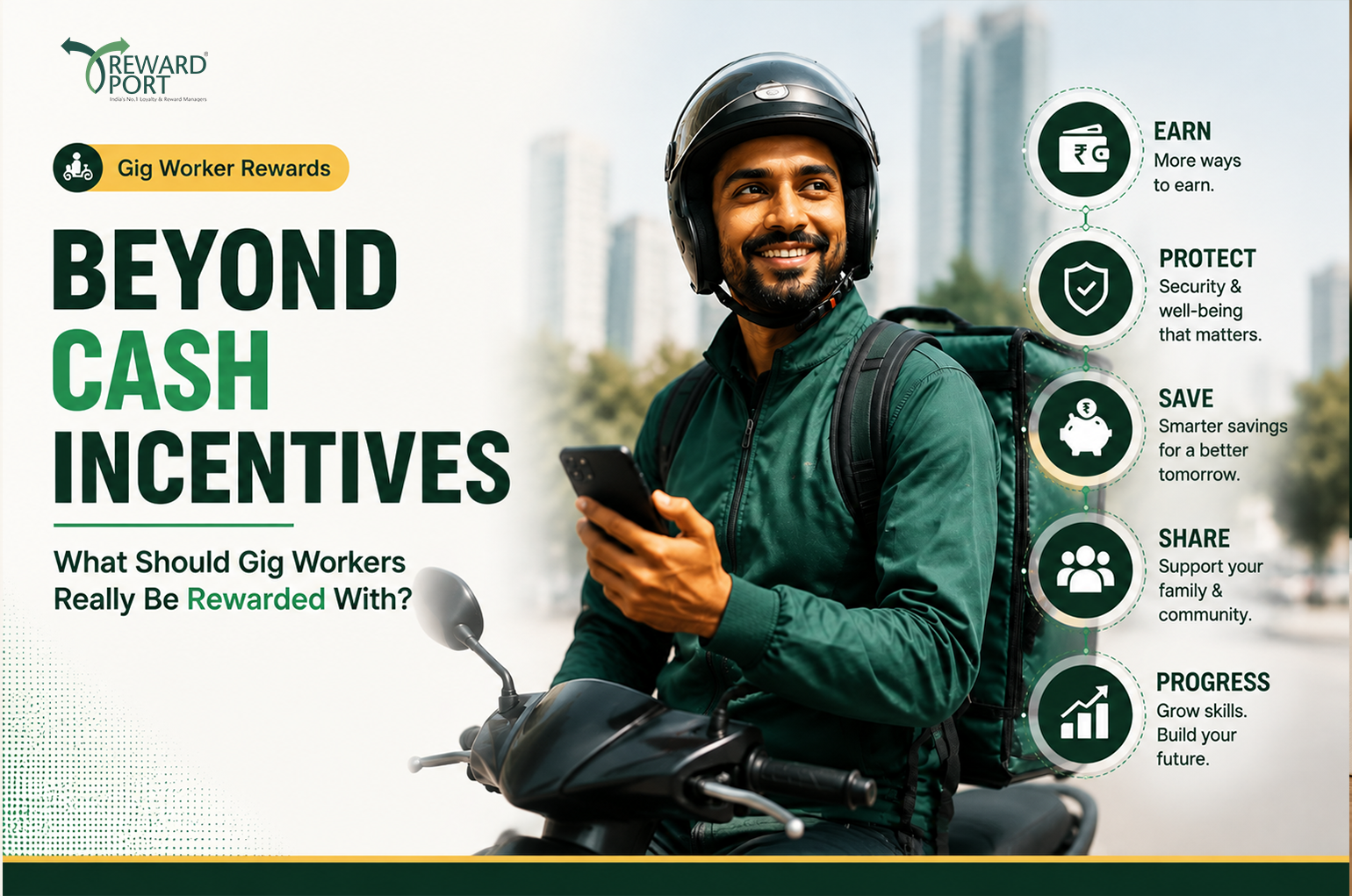
Earn → Protect → Save → Share → Progress
Earn
Help workers increase income fairly.
Protect
Reduce exposure to catastrophic financial risk.
Save
Improve everyday working economics.
Share
Extend meaningful value to the worker’s family.
Progress
Create pathways toward aspiration and mobility.
Together, these layers create a broader value proposition than cash incentives alone.
One Worker Does Not Equal One Worker Type
The term gig worker covers very different people.
A food delivery partner is not necessarily economically similar to:
- A taxi driver
- A Beauty professional
- An electrician
- A warehouse worker
- A field salesperson
- A tutor
- A freelance designer
Their working costs, risks, schedules, income patterns and aspirations may all be different.
That means benefits should be designed around actual worker economics, rather than a single generic gig-worker persona.
Portability Will Become Increasingly Important
Gig workers may work across multiple platforms.
Government policy is already moving toward portability.
Under the emerging framework described in the source material, workers registered on e-Shram receive an Aadhaar-linked identity intended to help make social-security benefits portable even when they switch platforms.
This concept should influence private programs too.
Foundational benefits increasingly need to feel:
Worker-Centric
rather than exclusively:
Platform-Centric
Reward Behaviour — But Don’t Turn Everything Into a Game
Gamification can increase participation.
But not every behaviour should become a leaderboard.
Imagine a leaderboard celebrating the worker who completes the maximum number of jobs.
It may initially look motivating.
But what if it indirectly encourages excessive hours or unsafe behaviour?
Every gig-worker incentive should therefore pass one simple test:
Does this mechanic encourage the behaviour we want without creating a behaviour we don’t want?
Useful behaviours to recognise could include:
- Service quality
- Training completion
- Safety
- Documentation compliance
- Reliability
- Retention
- Referrals
Not just volume.
Recognition Should Be More Human
Platforms can easily reduce workers to dashboards and performance metrics.
Recognition provides an opportunity to do something different.
Milestones can acknowledge genuine achievement:
One year with the platform.
1,000 successful jobs.
100 five-star reviews.
Safety milestone achieved.
Training certification completed.
These milestones could trigger appropriate recognition, family benefits, status or experiences.
The important idea is to recognise the person behind the metric.
Six Questions Companies Should Ask Before Designing a Program
1. Who exactly are the workers?
Understand the worker segments rather than treating everyone identically.
2. What creates financial pressure?
Identify the everyday costs that affect the worker’s economics.
3. Which risks matter most?
Consider occupational, health, accident and income-related risks relevant to the worker group.
4. What benefits already exist?
Understand existing government, platform or third-party support before adding another layer.
5. What behaviour is the platform trying to improve?
Define the desired outcome before choosing the incentive.
6. What benefit produces the highest perceived value per rupee?
Optimise for usefulness, not catalogue size.
A ₹1,000 Reward Budget Can Be Used Very Differently
A simple ₹1,000 voucher can be useful.
But its impact may be short-lived.
The same theoretical budget could potentially be distributed across several forms of value, such as:
Protection Contribution + Fuel/Recharge Savings + Family Experience + Recognition + Government-Benefit Navigation
The exact economics will differ by program and worker segment.
The principle is:
Maximise actual utility, not simply the number of benefits offered.
How Should Success Be Measured?
The success of a gig-worker benefit program should not be measured only by how many rewards were distributed.
Worker Metrics
- Retention
- Satisfaction
- Benefit adoption
- Savings
- Protection enrolment
- Training completion
- Family-benefit usage
Platform Metrics
- Availability
- Quality
- Customer satisfaction
- Referral rate
- Attrition
- Training compliance
Safety Metrics
- Working hours
- Accident incidents
- Safe-driving behaviour
- Fatigue-related patterns
Economic Metrics
- Benefit cost per active worker
- Retention value
- Incremental productivity
- Recruitment savings
- Referral acquisition cost
Ultimately, the question is:
Did the benefits make working with the platform meaningfully better?
What Companies Should Not Do
- Do not disguise earnings as rewards.
- Do not create impossible targets.
- Do not encourage unsafe productivity.
- Do not offer benefits workers cannot realistically use.
- Do not make access unnecessarily complicated.
A rewards program should improve the worker relationship, not create another layer of friction or pressure.
India’s gig economy is becoming more formal.
Social-security regulation is expanding. Healthcare access and portable identities are becoming increasingly important parts of the conversation.
The old question was:
“How much should we pay per task?”
That will always matter.
But companies increasingly need to answer another question:
“What is the total value of working with us?”
A useful model is:
Earn → Protect → Save → Share → Progress
Cash helps workers today.
Protection reduces tomorrow’s risk.
Savings improve everyday economics.
Family benefits make work feel more meaningful.
Aspiration gives workers a reason to believe the relationship can lead somewhere.
That is a much broader—and potentially more useful—definition of reward than simply paying another bonus.

Cashback vs Vouchers vs Merchandise vs Experiences: How Brands Should Choose the Right Reward
There is no universally best reward.
Cashback is strong when certainty, speed and simple value matter. Vouchers add choice and category relevance. Merchandise creates visibility and ownership. Experiences can generate aspiration and memory.
The right reward is the one that best fits the audience, required behaviour, timing, perceived value, delivery effort, fraud risk and commercial objective.
Key Takeaways
- Choose the behavior first and the reward second.
- Compare perceived value, not only procurement cost or face value.
- Use different reward types for different segments, milestones and levels of effort.
- Design fulfilment, expiry, support and fraud controls as part of the reward proposition.
- More reward choice can be valuable, but only when the experience remains simple to understand.
What Is Reward Architecture?
Reward architecture is the structured process of deciding:
What value should we offer, to whom, for which behavior, at what point in the journey and under which economic and operational rules?
It includes much more than selecting items from a reward catalogue.
A complete reward architecture considers:
- Audience and segment
- Target behavior
- Eligibility and verification
- Reward type and value
- Certainty, choice and timing
- Tiers, milestones and progression
- Caps, expiry and liability
- Delivery, support and replacement
- Fraud controls
- Measurement and optimization
A catalogue answers:
“What can we give?”
Reward architecture answers:
“What should we give to create the intended outcome?”
Why the Cheapest Reward Can Be Expensive
Brands sometimes select rewards by unit cost alone.
That can create weak participation, low relevance, support complaints or a high nominal-value offer that very few people can actually use.
The opposite mistake is assuming that face value equals motivational power.
₹500 in immediate cashback, a ₹500 voucher, merchandise costing ₹500 and an experience promoted at ₹500 do not necessarily feel identical to the recipient.
They differ in:
- Certainty
- Flexibility
- Salience
- Effort
- Memory
- Delivery risk
The commercial objective should therefore be to optimise motivation per rupee of total program cost, rather than simply minimising the purchase price of the reward.
The RewardPort VALUE Fit Framework
RewardPort’s article proposes the VALUE Fit Framework for evaluating rewards across five dimensions.
V — Value Perception
How valuable will the audience believe the reward is?
Consider:
- Relevance
- Exclusivity
- Visibility
- Utility
- Emotional appeal
Do not judge the reward only by its face value.
A — Action Fit
Does the reward match the effort, risk and importance of the required behaviour?
A small verified action may require fast, accessible micro-value.
A significant annual achievement may justify recognition or a more aspirational reward.
L — Logistics & Liability
How difficult and costly will the reward be to deliver reliably?
Consider:
- Procurement
- Inventory
- Fulfilment
- Expiry
- Replacement
- Support
- Breakage
- Financial liability
U — User Choice
How much choice should the participant receive?
Too little choice can reduce relevance.
Too much choice can create complexity and decision friction.
The appropriate level depends on the audience and program.
E — Experience & Emotion
What will the participant remember about receiving and using the reward?
A reward can provide functional value, emotional value, recognition or aspiration.
The correct balance depends on the behaviour and audience.
Cashback vs Vouchers vs Merchandise vs Experiences
Each reward format performs a different role.
Cashback
Best suited when:
- Certainty matters
- Speed matters
- The action is frequent
- The audience understands monetary value easily
- Simple communication is important
Strengths
Cashback is straightforward and liquid. Participants understand the value immediately, making it useful when the program requires a clear connection between action and reward.
Watch-outs
Cashback can become purely transactional if used without broader engagement or progression.
Brands should also consider payout failures, verification, support, liability and fraud controls.
Digital Vouchers
Best suited when:
- Choice matters
- The audience has varied preferences
- Digital fulfilment is desirable
- The brand wants more control than unrestricted cash provides
Strengths
Vouchers can combine relatively simple digital delivery with choice across categories or brands.
They can also be segmented by audience, achievement or value band.
Watch-outs
Brands need to consider:
- Expiry
- Redemption restrictions
- Availability
- Failed delivery
- Replacement
- Customer support
A large catalogue does not automatically create a better reward experience.
Merchandise
Best suited when:
- Tangibility matters
- Recognition matters
- The reward should remain visible after earning
- Achievement is significant enough to justify physical fulfilment
Strengths
Merchandise creates ownership and can make an achievement more tangible.
Unlike purely digital value, a physical reward may continue to remind the participant of the milestone after the campaign has ended.
Watch-outs
Merchandise introduces additional operational requirements such as:
- Inventory
- Shipping
- Address accuracy
- Product availability
- Returns
- Replacement
- Damage
- Delivery timelines
These costs need to be included when evaluating the true economics of the reward.
Experiences
Best suited when:
- Aspiration matters
- Emotional engagement is important
- The achievement is significant
- The brand wants the reward to create a memorable moment
Strengths
Experiences can include categories such as:
- Travel
- Cinema
- Entertainment
- Attractions
- Dining
- Leisure activities
They can create a different form of value from purely monetary rewards.
Watch-outs
An experience is valuable only when the recipient can realistically use it.
Brands therefore need to communicate:
- Availability
- Booking requirements
- Geography
- Validity
- Exclusions
- Eligibility
- Redemption conditions
clearly.
Reward Comparison at a Glance
| Reward Type | Core Strength | Particularly Useful When | Key Operational Consideration |
|---|---|---|---|
| Cashback | Certainty and simplicity | Immediate action needs reinforcement | Verification, payout and fraud |
| Vouchers | Choice and flexibility | Audience preferences vary | Expiry, availability and support |
| Merchandise | Tangibility and ownership | Recognition should remain visible | Inventory, logistics and replacement |
| Experiences | Aspiration and memory | Milestones deserve emotional value | Availability, booking and restrictions |
The key point is not to declare one format the winner.
The question is:
Which format best fits the behaviour you want to create?
Should Brands Use One Reward Type or a Reward Portfolio?
A single reward type can be appropriate when the audience and desired behaviour are straightforward.
But many programs contain multiple behaviours and achievement levels.
For example, a program might use:
Frequent Action → Small, immediate value
Milestone Achievement → Greater choice
Major Achievement → Aspirational reward or recognition
This allows the value of the reward to progress with the value of the behaviour.
However, more choice is not automatically better.
The reward journey should remain easy for participants to understand.
How to Choose the Right Reward
Before selecting the reward, answer these questions:
1. Who is the audience?
Consumer, dealer, distributor, employee or another stakeholder?
2. What behaviour are we rewarding?
Trial, repeat purchase, referral, sales achievement, learning, retention or another verified action?
3. How much effort does the action require?
The reward should feel proportionate.
4. Does certainty or excitement matter more?
Some behaviours benefit from assured value. Others may support progression, recognition or aspirational rewards.
5. How quickly should the reward arrive?
Immediate gratification and delayed milestone recognition serve different purposes.
6. How much choice does the audience need?
Choice can improve relevance, but too many options can introduce friction.
7. What is the true cost?
Include more than procurement.
Consider fulfilment, technology, communication, support, replacement, fraud and liability.
8. Can the reward be delivered reliably?
A compelling offer that repeatedly fails during redemption can damage the program experience.
Reward Economics: Look Beyond Face Value
Brands should distinguish between:
Procurement Cost — What the reward costs the program.
Communicated Value — What value is presented to the participant.
Perceived Value — How valuable the participant personally considers it.
Usable Value — How much value the participant can realistically obtain after considering availability and conditions.
These are not always the same.
That is particularly important for merchandise and experiences, where usability, restrictions and fulfilment can materially affect the participant’s experience.
Reward Fit Should Change Across the Journey
Different moments can require different forms of motivation.
Acquisition or Trial
Simple, understandable rewards can reduce hesitation and encourage the first action.
Repeat Behaviour
Frequent rewards, progression or accumulated value can encourage continued participation.
Milestones
Higher-value vouchers, merchandise or experiences can recognise a more meaningful achievement.
Loyalty & Recognition
Aspirational benefits, experiences or exclusive access can help differentiate major achievements from routine transactions.
The reward should therefore be treated as part of the behavioural journey, not as an item added after the campaign mechanic has already been designed.
How to Choose a Dealer Loyalty Platform in India: A 12-Question Buyer’s Guide
Choosing a dealer loyalty platform should begin with one question:
Can this system influence and verify the business behaviours that actually matter?
A modern dealer loyalty platform should do much more than manage points, catalogues and dashboards. It should support partner identity, multi-tier rules, sales or activity validation, communication, training, challenges, relevant rewards, fraud controls, service operations, analytics and integration with the brand’s commercial systems.
Key Takeaways
- Begin with channel objectives and partner behaviour, not a feature checklist.
- Distinguish dealers, distributors, retailers, mechanics, contractors and influencers because they do not create value in the same way.
- Verify the source of every qualifying action before attaching a reward.
- Evaluate communication, capability building and operational support alongside payout technology.
- Select a partner that can convert program data into better actions for field teams and channel members.
What Is a Dealer Loyalty Platform?
A dealer loyalty platform is the operating system used by a brand to identify channel partners, communicate schemes, record and validate qualifying activities, calculate incentives, deliver rewards, resolve exceptions and analyse performance.
Depending on the industry and route to market, it may serve:
- Distributors
- Dealers
- Retailers
- Stockists
- Mechanics
- Contractors
- Architects
- Technicians
- Other trade influencers
Channel partners are independent businesses rather than a captive employee audience. That distinction matters because their participation must continually earn attention and demonstrate value.
Why Catalogue-Led Selection Produces Weak Programs
Many platform-selection conversations begin with questions such as:
How many vouchers are available?
Does the platform support points?
Can it make payouts?
Does it have a leaderboard?
These are legitimate questions, but they begin too late in the process.
A catalogue cannot correct unclear scheme communication.
A points engine cannot establish whether reported sales are valid.
A leaderboard cannot improve product knowledge by itself.
And an attractive app does not automatically solve duplicate membership, inactive partners, field-team adoption or disputed claims.
The better buying question is:
Can this system help us create, verify and improve the channel behaviour that produces growth?
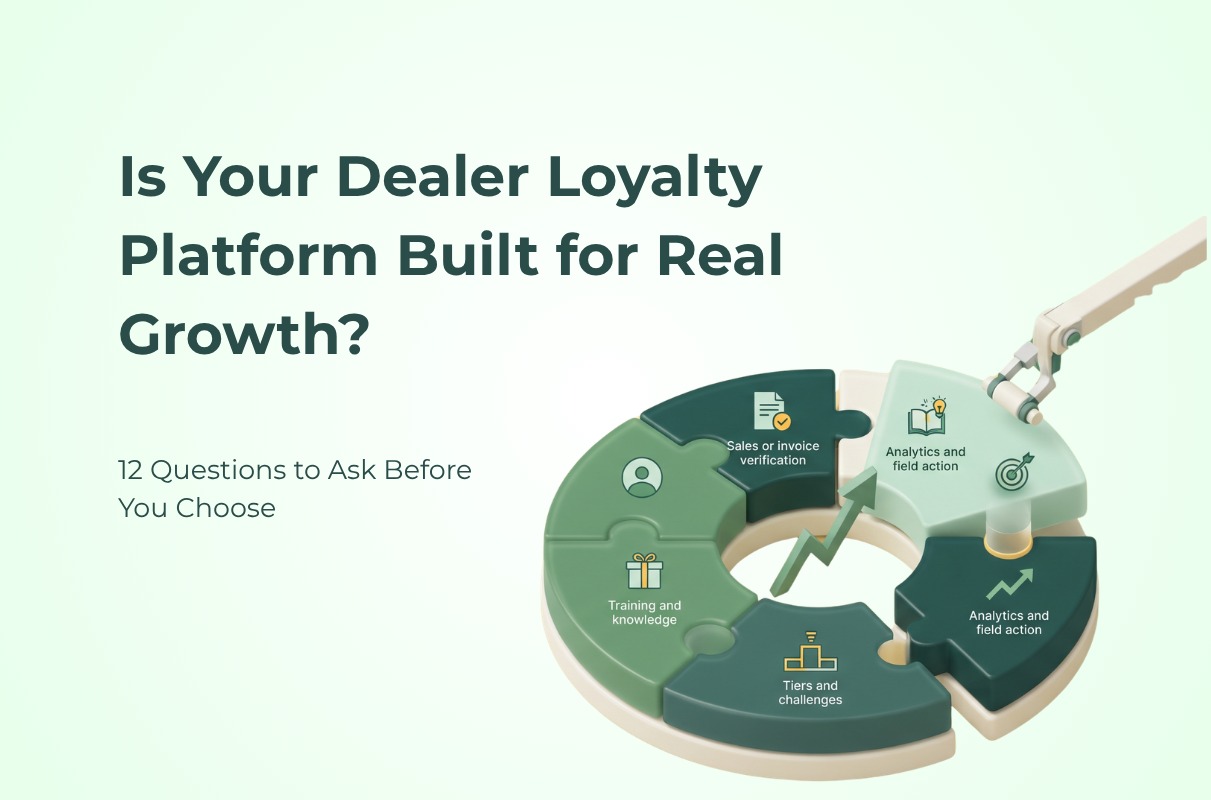
The RewardPort Channel Growth Stack
The article proposes a seven-layer framework for evaluating a dealer loyalty platform.
1. Identity
The platform should create a reliable partner record covering role, geography, channel tier, business identity, language, consent and relevant hierarchy.
It should also be able to manage duplicate records, changes in ownership and inactive members.
2. Visibility
Brands need an approved source of truth for relevant activity.
Depending on the program, this could include:
- Primary sales
- Secondary sales
- Invoice uploads
- Unique product codes
- Target achievement
- Visibility evidence
- Training
- Referrals
3. Capability
Channel growth can depend on knowledge as much as stock.
Where relevant, the platform should support scheme explanation, product learning, question answering, quizzes, certifications or field-guided support.
4. Motivation
Rules, tiers, challenges, milestones, streaks and recognition should make the desired behaviour clear and attainable.
Gamification should support a commercial objective rather than create activity merely for its own sake.
5. Verification
The system should validate an action before calculating its reward value.
Depending on the program, verification could involve ERP or distributor data, invoice review, OCR-assisted bill parsing, QR or code validation, approved images, location signals or human review for exceptions.
6. Value
Rewards should fit both the partner segment and the effort required.
Depending on the program, options can include cashback, vouchers, merchandise, cinema, travel, experiences, business benefits or recognition.
The same reward catalogue does not necessarily need to be shown to every participant.
7. Intelligence
The platform should help brand, sales and channel teams understand participation, sales, learning, claims, risk, reward preferences and next actions.
The objective is to use program data to improve the next scheme, field conversation and partner intervention.
12 Questions to Ask Every Dealer Loyalty Platform Provider
1. Which Business Behaviours Can the Program Influence?
Ask the provider to connect platform capabilities directly with your objectives.
These might include:
- Incremental sales
- Product mix
- New-product trial
- Outlet coverage
- Training
- Display compliance
- Referrals
- Service quality
- Data capture
2. Can the Rules Reflect Our Actual Channel Structure?
Test whether the platform can accommodate distributors, dealers, retailers and influencer hierarchies, along with:
- Territories
- Product categories
- Tiers
- Overlapping roles
- Target periods
- Exclusions
- Approval levels
3. What Is the Source of Truth for Each Qualifying Action?
Do not accept “sales data” as a complete answer.
Establish whether qualification is based on:
- ERP
- DMS
- Distributor uploads
- Invoices
- QR codes
- Unique codes
- Image evidence
- Manual approval
- A reconciled combination of sources
4. How Are Duplicates, False Claims and Collusion Handled?
Ask for the fraud and exception framework.
It should consider duplicate identities, repeated invoices or codes, abnormal submission velocity, shared devices, suspicious clusters, rejected claims, override rights and audit trails.
5. How Will Partners Understand the Scheme?
Evaluate the complete communication journey, including:
- Onboarding
- Language
- WhatsApp or app communication
- Scheme explainers
- Balance visibility
- Reminders
- Expiry messages
- Grievance support
A complex scheme that partners do not understand can underperform regardless of the reward value.
6. Can the Platform Improve Partner Capability?
If product knowledge or selling quality matters, evaluate whether the platform can support appropriate learning journeys, text or voice assistance, quizzes, certifications and targeted content.
7. How Flexible Is the Incentive and Challenge Engine?
Test the platform’s ability to manage:
- Slabs
- Thresholds
- Tiers
- Accelerators
- Team challenges
- Limited-time missions
- Non-sales actions
- Approval flows
- Negative adjustments
- Rule changes and version history
8. How Are Rewards Matched to Different Partners?
Ask whether reward choice can vary according to:
- Tier
- Geography
- Role
- Achievement
- Preference
Also examine delivery times, expiry, cancellation, failed fulfilment and replacement handling.
9. What Will the Field Sales Team See and Do?
A dealer loyalty platform should not become an isolated marketing portal.
Field users may need visibility into:
- Partner status
- Scheme understanding
- Unresolved issues
- Learning gaps
- Opportunity signals
- Recommended actions
10. What Integrations Are Genuinely Required?
Map potential integrations across ERP, CRM, DMS, SFA, finance, messaging, KYC, payment, catalogue and analytics systems.
Separate launch-critical integrations from later enhancements so that the pilot does not become an endless technology project.
11. How Will the Program Be Operated After Launch?
Clarify responsibility for:
- Onboarding
- Data processing
- Claims
- Approvals
- Support
- Reward catalogue
- Communication
- Reconciliation
- Tax documentation
- Fraud review
- Reporting
- Change requests
12. How Will We Know Whether the Program Worked?
Agree on the metrics, baseline, comparison logic, reporting cadence and decision rights before launch.
The provider should be able to explain how campaign activity connects with commercial outcomes.
Dealer Loyalty Platform Comparison Scorecard
Score each area from 0 to 3:
0 = Absent | 1 = Largely manual/limited | 2 = Operationally adequate | 3 = Strong and configurable
| Evaluation Area | Weight | What Strong Looks Like |
|---|---|---|
| Objective & Rule Fit | 15% | Rules map to real channel behaviours and hierarchies |
| Data & Verification | 15% | Clear source of truth, validation and audit trail |
| Partner Experience | 10% | Simple onboarding, communication, balance and support |
| Capability Building | 10% | Targeted learning and knowledge support where required |
| Motivation Design | 10% | Flexible tiers, challenges, recognition and non-sales actions |
| Reward Architecture | 10% | Relevant choice, reliable fulfilment and segment control |
| Fraud & Governance | 10% | Preventive controls, exception process and role-based access |
| Analytics & Actions | 10% | Decision-ready views for brand, sales and field teams |
| Integration & Scale | 5% | Practical APIs, batch routes and performance fit |
| Service Operations | 5% | Clear SLAs, reconciliation, support and change management |
The weighting should change according to the use case.
For a high-value product-code program, verification and fraud may deserve greater weight. For a product-education program, capability building and field action may matter more.
Agency vs Software Platform vs Rewards Provider vs Integrated Operator
| Model | Strength | Common Limitation | Best Fit |
|---|---|---|---|
| Promotion/Loyalty Agency | Strategy, creative, communication and managed execution | May depend on separate technology or fulfilment systems | Brands requiring a managed campaign with limited integration |
| Software Platform | Rules, automation, APIs and direct administrative control | Brand may need to assemble strategy, operations, support and rewards separately | Teams with mature internal program operations |
| Rewards/Payout Provider | Fast access to value distribution | Can become a transaction layer without behaviour design or channel intelligence | Programs with already-defined rules and verified outcomes |
| Integrated Operator | Connects strategy, technology, verification, rewards, operations and analytics | Requires disciplined scoping to avoid unnecessary complexity | Brands seeking one accountable operating model |
The correct model depends on the organisation’s internal capabilities.
The important requirement is that no critical job is left without an owner.
A Phased Dealer Loyalty Platform Implementation Process
Phase 1: Channel Diagnosis
Interview sales, trade marketing, finance, technology, field teams and a sample of channel partners.
Document objectives, available data, current schemes, disputes and adoption barriers.
Phase 2: Behaviour and Economics Design
Define segments, qualifying actions, source of truth, baseline, incentive rules, caps, liability, exception handling and success measures.
Phase 3: Pilot Build
Launch with a bounded geography, partner group or product category.
Include actual operations and support—not merely a demonstration interface.
Phase 4: Adoption and Field Activation
Train field teams, simplify partner onboarding, communicate the value clearly and monitor where participants abandon or misunderstand the journey.
Phase 5: Evaluation and Scale
Compare commercial and behavioural performance with the agreed baseline.
Resolve data, rules and support issues before adding features or expanding nationally.
Dealer Loyalty Metrics That Matter
Commercial Metrics
- Incremental sales or contribution against baseline
- Product mix and target achievement
- Active outlet or partner coverage
- Cost per incremental outcome
Engagement Metrics
- Eligible versus enrolled partners
- Monthly active and transacting partners
- Challenge, learning and communication participation
- Repeat activity and tier progression
Operational Metrics
- Claim-processing time and approval rate
- Data latency and reconciliation errors
- Reward-delivery success and support-resolution time
- Field-team adoption and unresolved exceptions
Fraud & Governance Metrics
- Duplicate identities, invoices or codes
- Abnormal submission patterns
- Manual overrides and reasons
- Fraud loss and prevented liability
An Illustrative Building-Materials Scenario
Assume a building-materials brand wants to grow a new premium range through dealers and contractor influencers.
Billing alone will not reveal whether partners understand the product or recommend it correctly.
The program therefore rewards a combination of:
- Verified sales
- Product-learning completion
- Approved project referrals
- Selected visibility actions
Different activities use different evidence.
Sales come from approved commercial data. Learning comes from platform completion. Referrals require qualification. Visibility evidence follows a defined review process.
Dealers may receive tier progression and business-relevant benefits, while contractors may prefer smaller, faster rewards.
Field teams can see who is close to a milestone, who has a learning gap and where claims are being rejected.
Important: This is an illustrative design and not a published RewardPort case study.