

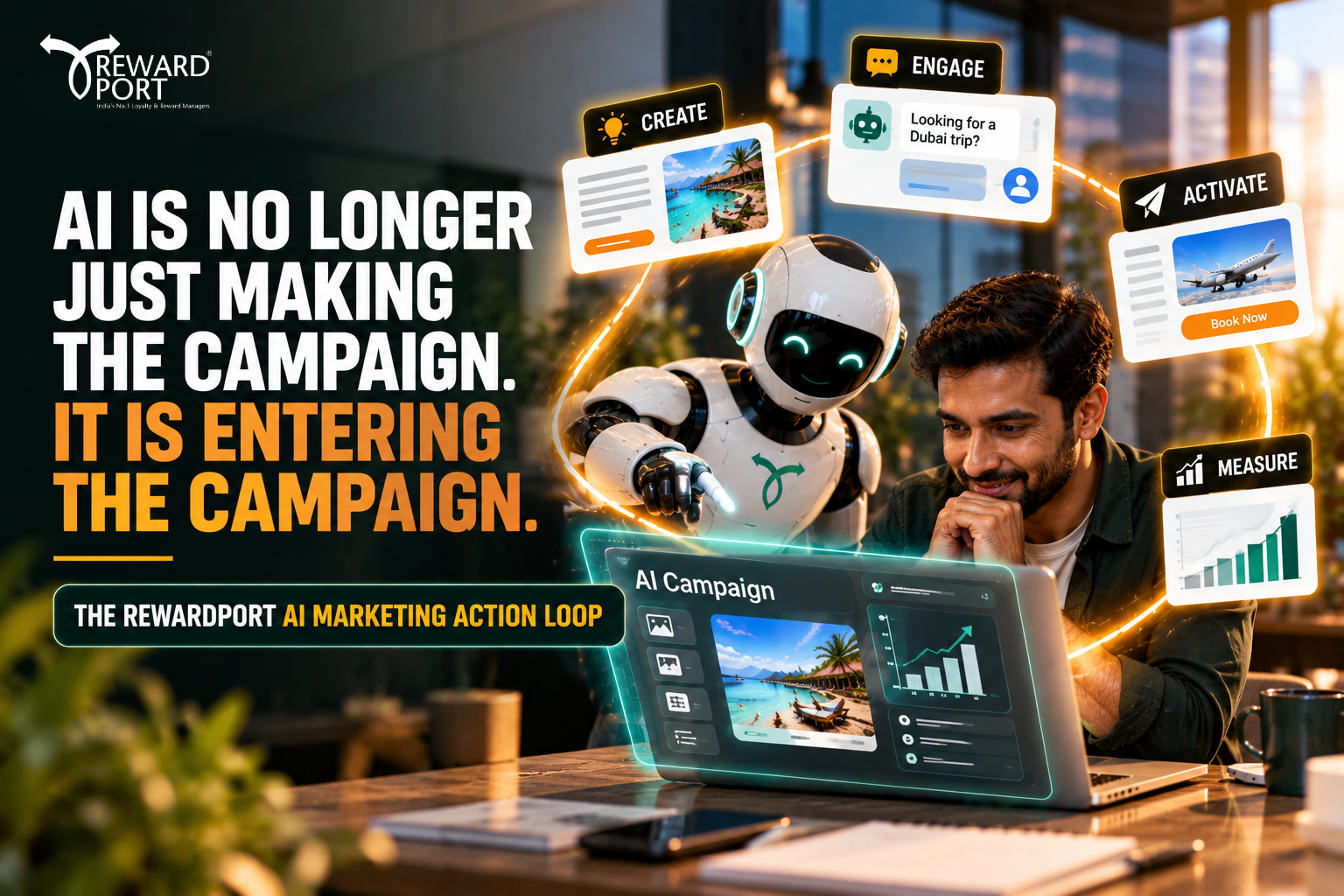
September 2026 Was the Month AI Marketing Stopped Being About Content
For the past three years, much of the marketing conversation around artificial intelligence has been about making things:
Copy.
Images.
Videos.
Emails.
Campaign variations.
September 2026 suggests the next phase is different.
AI is beginning to sit inside the customer journey.
It can converse with customers, interpret intent, decide what action to take next, operate parts of campaigns, connect to business data and increasingly help determine whether marketing actually worked.
That is a much bigger change than faster content creation.
The short answer: What changed in AI marketing in September 2026?
Several developments point in the same direction.
OpenAI introduced Sponsored Agents that can allow a consumer to move from seeing an ad into a conversation with a business-sponsored AI agent.
Google introduced a Business Agent for YouTube Ads, allowing viewers to ask questions about products alongside an advertisement.
Salesforce is building marketing agents intended to participate in campaign planning and execution.
Google is also expanding AI-driven advertising controls and measurement capabilities, while emphasizing first-party data and causal measurement.
Source:
https://openai.com/index/reimagining-advertising-with-ai/
The common thread is important:
AI is moving from making marketing to doing parts of marketing.
Five things marketers should take away
1. Advertising is becoming conversational
The customer may increasingly ask the advertisement questions instead of merely clicking it.
2. Campaign management is becoming agentic
AI is moving closer to deciding, coordinating and executing actions rather than only generating assets.
3. First-party data becomes more important, not less
Better AI requires better signals about customers, transactions and behaviour.
4. Measurement has to move beyond reporting
AI systems need feedback about what genuinely created incremental behaviour.
5. The competitive advantage may shift
The advantage may move from who has the best AI tool to who has the best action and data loop.
1. Advertising is beginning to answer back
For decades, an advertisement essentially did one thing.
It delivered a message.
Search advertising improved this by making the message more relevant to intent.
Social media advertising improved targeting and interaction.
Performance marketing made response measurable.
Conversational AI potentially changes the unit again.
On 16 September, OpenAI announced Sponsored Agents for ChatGPT Ads.
Instead of an advertisement simply sending someone elsewhere, OpenAI describes a model where a person can begin interacting with a business-sponsored agent after clicking an ad.
The company also announced AI-assisted ad creation and integrations with HubSpot and Shopify.
Source:
https://openai.com/index/reimagining-advertising-with-ai/
Eight days later, Google announced Business Agent for YouTube Ads.
A viewer can interact with conversational AI alongside a video advertisement with a product feed and ask questions about the product or brand without leaving that context.
Source:
https://blog.google/products/ads-commerce/demand-gen-drop-september-2026/
Consider what this means.
The old advertising journey could look like:
Ad → Click → Landing page → Search for information → Form → Follow-up
An emerging journey could look more like:
Ad → Conversation → Clarification → Recommendation → Action
The advertisement starts behaving less like a poster and more like a knowledgeable salesperson.
For marketers, this changes what an advertising asset needs to know.
It needs more than a headline and an image.
It may eventually need:
- Product information
- Pricing rules
- Eligibility conditions
- Inventory
- FAQs
- Customer context
- Promotion rules
- Ability to trigger an approved next action
That is no longer simply creative production.
It is marketing infrastructure.
2. AI agents are moving from assistants to operators
Another shift became particularly visible around Salesforce’s Dreamforce announcements.
Salesforce expanded Agentforce with job-oriented agents intended to handle increasingly complex work.
Its marketing products now include concepts such as Campaign Agent and Marketing Agent, moving AI deeper into activities such as campaign creation, audience decisions and coordination.
Source:
The distinction matters.
A marketing copilot waits for a marketer to ask:
“Write five subject lines.”
An agentic marketing system can potentially be given an objective:
“Increase repeat purchase among customers who bought this product in the last 60 days.”
It then has to work out some combination of:
- Audience
- Message
- Channel
- Timing
- Offer
- Next action
within the permissions it has been given.
Humans are still responsible for strategy, economics, brand standards, governance and outcomes.
But the operational interface starts changing.
Instead of marketers manually operating every tool, they increasingly define objectives, rules and guardrails.
3. The real AI advantage may be first-party data
There is a paradox in AI marketing.
As AI models become more widely available, access to AI itself becomes less distinctive.
The differentiation moves toward what the AI knows.
Google made this point explicitly in its September measurement announcements.
It described a strong data foundation, multiple signals and causal proof as three ingredients required for AI-powered measurement and decision-making.
Source:
https://blog.google/products/ads-commerce/data-strength-updates/
This has major implications for promotions and loyalty.
Imagine two brands using essentially the same AI technology.
Brand A knows that a customer opened an email.
Brand B knows that a customer:
- Scanned a QR code
- Authenticated a purchase
- Uploaded an invoice
- Redeemed an offer
- Selected a reward
- Purchased again 37 days later
Which AI has the more useful context?
The advantage is not necessarily the model.
It is the behavioural data surrounding the model.
That is why QR, transaction validation, OTP, invoice recognition, loyalty participation and reward redemption should no longer be considered merely campaign plumbing.
They are potential intelligence signals.
RewardPort’s broader engagement model is built around this sequence:
Start with the commercial behaviour a brand wants to influence, verify the qualifying action, deliver suitable value, measure the response and use the resulting intelligence to improve the next intervention.
AI makes that loop more powerful.
It does not make the loop unnecessary.
4. AI advertising is already moving beyond experimental scale
There are also signs that this is becoming operational rather than theoretical.
Amazon India reported in September that adoption of its AI advertising tools had grown 77% year on year, while SMB sellers using AI created 62% more advertising creatives in Q1 2026.
The figures are Amazon’s own platform data, so they should be understood in that specific context, but they illustrate how rapidly AI-assisted advertising tools are becoming part of everyday seller workflows.
Source:
Amazon is also putting AI on the consumer side of commerce.
Its Ganesh Chaturthi Store in India highlighted tools including Rufus, Lens AI, Review Highlights and Price History to assist consumers with product discovery and purchase decisions.
Source:
This creates an interesting situation.
AI is appearing on both sides of the transaction.
The marketer has AI.
The platform has AI.
And increasingly, the customer has AI.
Marketing therefore has to work in a world where machines may help create the offer, deliver the offer, interpret the offer and evaluate the offer.
5. Search advertising is becoming less about individual keywords
Google’s September announcements provide another signal.
AI Brief for AI Max allows advertisers to provide richer information about their business, audience and messaging in natural language.
Google is also introducing reporting designed to show how search terms, creative assets and landing destinations interact within AI-driven Search campaigns.
Source:
https://blog.google/products/ads-commerce/ai-max-language-reporting-features/
Traditional search advertising was built around:
Keyword
↓
Bid
↓
Creative
↓
Landing page
AI-driven systems increasingly work with richer context and larger decision spaces.
That makes the marketer’s inputs different.
Instead of merely selecting keywords, marketers increasingly need to articulate:
- Who are we trying to influence?
- What do we know about them?
- What behaviour are we trying to create?
- What proposition is valid?
- What should never be offered?
- What business outcome matters?
- How will we know whether it worked?
Those are strategy questions.
Not prompt-engineering questions.
6. Marketing measurement is about to become even more important
When AI can generate thousands of variations and change decisions dynamically, traditional campaign reporting becomes insufficient.
A high click-through rate may simply mean the AI found better clickers.
A high redemption rate might mean the offer was generous.
A large number of conversations might mean people were curious.
None necessarily proves incremental business impact.
The measurement question becomes:
Did the AI cause a commercially useful behaviour that would otherwise have been less likely to happen?
That requires a stronger relationship between marketing data and actual behaviour.
Useful signals might include:
- Purchase verification
- Repeat purchase
- Product registration
- Retailer billing
- Referral completion
- Training completion
- Store visibility
- Invoice validation
- Reward redemption
Google’s own measurement framing is moving in this direction by emphasizing causal proof rather than treating measurement as merely a retrospective report card.
Source:
https://blog.google/products/ads-commerce/data-strength-updates/
AI makes measurement more powerful.
It also makes sloppy measurement more dangerous.
If an AI system learns from the wrong success signal, it can become extremely efficient at optimizing the wrong thing.
The RewardPort AI Marketing Action Loop
One useful way to think about this next phase is as a six-stage loop.
1. SIGNAL
What do we know?
Examples:
- Purchase
- QR scan
- Transaction
- Bill
- Location
- Previous response
2. UNDERSTAND
What might this person or partner need?
Examples:
- Segment
- Intent
- Propensity
- Context
3. DECIDE
What action should happen next?
Examples:
- Offer
- Message
- Challenge
- Reminder
- Training
4. INTERACT
How should the action reach them?
Examples:
- Web
- Campaign agent
- Promotion
- Dealer interface
5. VERIFY
Did the required behaviour actually occur?
Examples:
- OTP
- QR
- OCR
- Invoice
- Transaction
- Approved operational data
6. LEARN
What should happen differently next time?
Examples:
- Change audience
- Incentive
- Timing
- Communication
- Next-best action
This is where AI becomes materially more interesting for:
- Consumer promotions
- Dealer programs
- Loyalty
The intelligence is not isolated from execution.
It closes the loop.
RewardPort already operates across areas including AI bill parsing, talk-to-data, visibility detection and AI-supported channel engagement alongside promotion verification and reward fulfilment.
The useful role for AI is therefore not simply producing more campaign copy.
It is improving decisions, verification and business outcomes.
What should marketing leaders do now?
The first response should probably not be to buy another AI platform.
Start with the customer journey.
Take one important commercial behaviour such as:
- Repeat purchase
- Referral
- Dealer activation
- Product registration
- Trial conversion
Then ask:
Where do we currently lose information?
Which decisions are currently generic?
Which actions could AI help recommend or execute?
Can we verify whether the desired behaviour actually happened?
Can that result improve the next decision?
This identifies the practical AI opportunity far faster than beginning with a catalogue of tools.
AI will make average marketing cheaper. It may make great marketing harder.
When everyone can generate competent copy, thousands of creatives and personalized variations, production becomes less scarce.
Judgement becomes more scarce.
What should the brand say?
Who should receive an incentive?
How much should it cost?
What behaviour deserves a reward?
When should the brand remain silent?
What data can legitimately be used?
When should a human intervene?
What constitutes genuine incremental growth?
Those questions cannot be solved by adding another image generator.
They require a marketing system.
So, did AI marketing change in September 2026?
Not overnight.
But several announcements this month make the direction easier to see.
OpenAI is putting conversational agents behind advertisements.
Google is putting conversational AI alongside YouTube ads and richer AI inside campaign management and measurement.
Salesforce is turning agents into participants in marketing work.
Amazon is embedding AI deeper into both seller advertising and consumer product discovery.
The first chapter of generative AI in marketing was largely:
AI helps us make more marketing.
The next chapter looks increasingly like:
AI helps decide what marketing should happen, carries out parts of it, interacts with the customer and learns from what happens next.
For marketers, that means the most important question is no longer:
“Which AI tool should we use?”
A better question is:
“What behaviour are we trying to create, what signals can our AI learn from, and can we close the loop between decision, action and measurable outcome?”
That may prove to be the much bigger AI marketing story of 2026.