
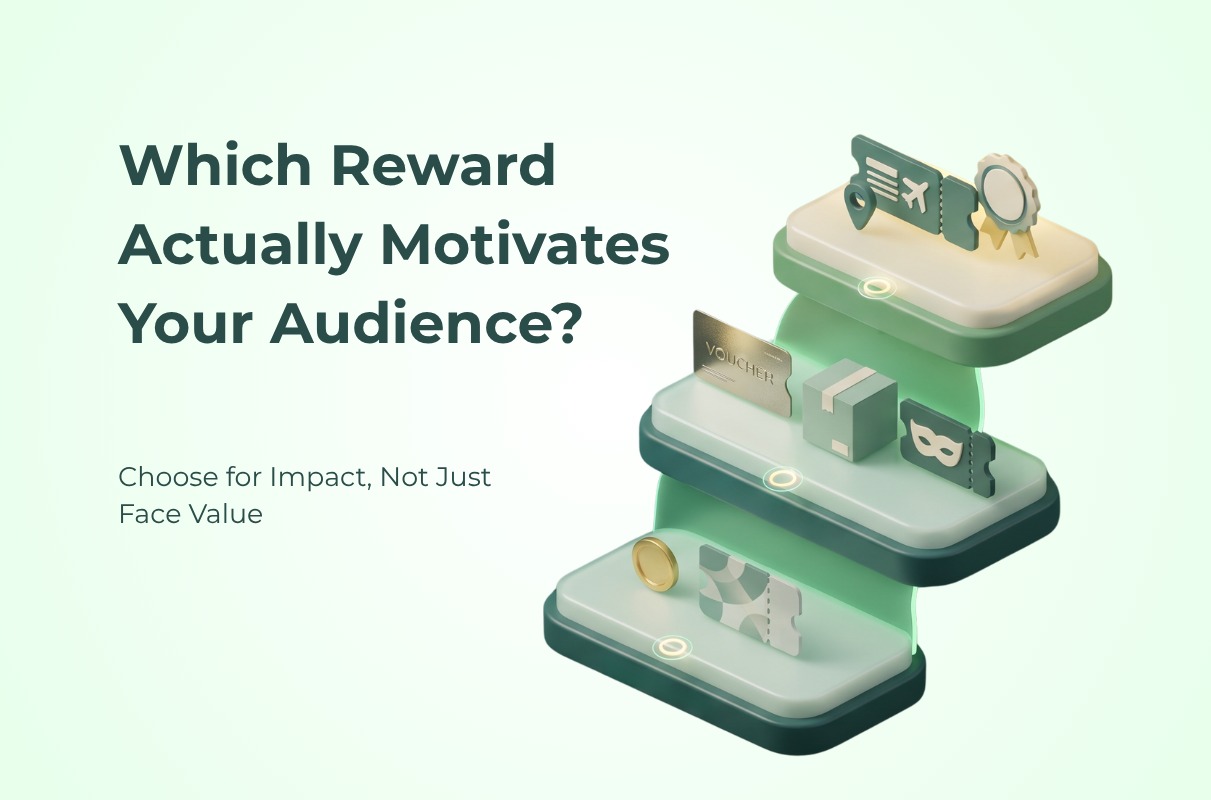
Cashback vs Vouchers vs Merchandise vs Experiences: How Brands Should Choose the Right Reward
There is no universally best reward.
Cashback is strong when certainty, speed and simple value matter. Vouchers add choice and category relevance. Merchandise creates visibility and ownership. Experiences can generate aspiration and memory.
The right reward is the one that best fits the audience, required behaviour, timing, perceived value, delivery effort, fraud risk and commercial objective.
Key Takeaways
- Choose the behavior first and the reward second.
- Compare perceived value, not only procurement cost or face value.
- Use different reward types for different segments, milestones and levels of effort.
- Design fulfilment, expiry, support and fraud controls as part of the reward proposition.
- More reward choice can be valuable, but only when the experience remains simple to understand.
What Is Reward Architecture?
Reward architecture is the structured process of deciding:
What value should we offer, to whom, for which behavior, at what point in the journey and under which economic and operational rules?
It includes much more than selecting items from a reward catalogue.
A complete reward architecture considers:
- Audience and segment
- Target behavior
- Eligibility and verification
- Reward type and value
- Certainty, choice and timing
- Tiers, milestones and progression
- Caps, expiry and liability
- Delivery, support and replacement
- Fraud controls
- Measurement and optimization
A catalogue answers:
“What can we give?”
Reward architecture answers:
“What should we give to create the intended outcome?”
Why the Cheapest Reward Can Be Expensive
Brands sometimes select rewards by unit cost alone.
That can create weak participation, low relevance, support complaints or a high nominal-value offer that very few people can actually use.
The opposite mistake is assuming that face value equals motivational power.
₹500 in immediate cashback, a ₹500 voucher, merchandise costing ₹500 and an experience promoted at ₹500 do not necessarily feel identical to the recipient.
They differ in:
- Certainty
- Flexibility
- Salience
- Effort
- Memory
- Delivery risk
The commercial objective should therefore be to optimise motivation per rupee of total program cost, rather than simply minimising the purchase price of the reward.
The RewardPort VALUE Fit Framework
RewardPort’s article proposes the VALUE Fit Framework for evaluating rewards across five dimensions.
V — Value Perception
How valuable will the audience believe the reward is?
Consider:
- Relevance
- Exclusivity
- Visibility
- Utility
- Emotional appeal
Do not judge the reward only by its face value.
A — Action Fit
Does the reward match the effort, risk and importance of the required behaviour?
A small verified action may require fast, accessible micro-value.
A significant annual achievement may justify recognition or a more aspirational reward.
L — Logistics & Liability
How difficult and costly will the reward be to deliver reliably?
Consider:
- Procurement
- Inventory
- Fulfilment
- Expiry
- Replacement
- Support
- Breakage
- Financial liability
U — User Choice
How much choice should the participant receive?
Too little choice can reduce relevance.
Too much choice can create complexity and decision friction.
The appropriate level depends on the audience and program.
E — Experience & Emotion
What will the participant remember about receiving and using the reward?
A reward can provide functional value, emotional value, recognition or aspiration.
The correct balance depends on the behaviour and audience.
Cashback vs Vouchers vs Merchandise vs Experiences
Each reward format performs a different role.
Cashback
Best suited when:
- Certainty matters
- Speed matters
- The action is frequent
- The audience understands monetary value easily
- Simple communication is important
Strengths
Cashback is straightforward and liquid. Participants understand the value immediately, making it useful when the program requires a clear connection between action and reward.
Watch-outs
Cashback can become purely transactional if used without broader engagement or progression.
Brands should also consider payout failures, verification, support, liability and fraud controls.
Digital Vouchers
Best suited when:
- Choice matters
- The audience has varied preferences
- Digital fulfilment is desirable
- The brand wants more control than unrestricted cash provides
Strengths
Vouchers can combine relatively simple digital delivery with choice across categories or brands.
They can also be segmented by audience, achievement or value band.
Watch-outs
Brands need to consider:
- Expiry
- Redemption restrictions
- Availability
- Failed delivery
- Replacement
- Customer support
A large catalogue does not automatically create a better reward experience.
Merchandise
Best suited when:
- Tangibility matters
- Recognition matters
- The reward should remain visible after earning
- Achievement is significant enough to justify physical fulfilment
Strengths
Merchandise creates ownership and can make an achievement more tangible.
Unlike purely digital value, a physical reward may continue to remind the participant of the milestone after the campaign has ended.
Watch-outs
Merchandise introduces additional operational requirements such as:
- Inventory
- Shipping
- Address accuracy
- Product availability
- Returns
- Replacement
- Damage
- Delivery timelines
These costs need to be included when evaluating the true economics of the reward.
Experiences
Best suited when:
- Aspiration matters
- Emotional engagement is important
- The achievement is significant
- The brand wants the reward to create a memorable moment
Strengths
Experiences can include categories such as:
- Travel
- Cinema
- Entertainment
- Attractions
- Dining
- Leisure activities
They can create a different form of value from purely monetary rewards.
Watch-outs
An experience is valuable only when the recipient can realistically use it.
Brands therefore need to communicate:
- Availability
- Booking requirements
- Geography
- Validity
- Exclusions
- Eligibility
- Redemption conditions
clearly.
Reward Comparison at a Glance
| Reward Type | Core Strength | Particularly Useful When | Key Operational Consideration |
|---|---|---|---|
| Cashback | Certainty and simplicity | Immediate action needs reinforcement | Verification, payout and fraud |
| Vouchers | Choice and flexibility | Audience preferences vary | Expiry, availability and support |
| Merchandise | Tangibility and ownership | Recognition should remain visible | Inventory, logistics and replacement |
| Experiences | Aspiration and memory | Milestones deserve emotional value | Availability, booking and restrictions |
The key point is not to declare one format the winner.
The question is:
Which format best fits the behaviour you want to create?
Should Brands Use One Reward Type or a Reward Portfolio?
A single reward type can be appropriate when the audience and desired behaviour are straightforward.
But many programs contain multiple behaviours and achievement levels.
For example, a program might use:
Frequent Action → Small, immediate value
Milestone Achievement → Greater choice
Major Achievement → Aspirational reward or recognition
This allows the value of the reward to progress with the value of the behaviour.
However, more choice is not automatically better.
The reward journey should remain easy for participants to understand.
How to Choose the Right Reward
Before selecting the reward, answer these questions:
1. Who is the audience?
Consumer, dealer, distributor, employee or another stakeholder?
2. What behaviour are we rewarding?
Trial, repeat purchase, referral, sales achievement, learning, retention or another verified action?
3. How much effort does the action require?
The reward should feel proportionate.
4. Does certainty or excitement matter more?
Some behaviours benefit from assured value. Others may support progression, recognition or aspirational rewards.
5. How quickly should the reward arrive?
Immediate gratification and delayed milestone recognition serve different purposes.
6. How much choice does the audience need?
Choice can improve relevance, but too many options can introduce friction.
7. What is the true cost?
Include more than procurement.
Consider fulfilment, technology, communication, support, replacement, fraud and liability.
8. Can the reward be delivered reliably?
A compelling offer that repeatedly fails during redemption can damage the program experience.
Reward Economics: Look Beyond Face Value
Brands should distinguish between:
Procurement Cost — What the reward costs the program.
Communicated Value — What value is presented to the participant.
Perceived Value — How valuable the participant personally considers it.
Usable Value — How much value the participant can realistically obtain after considering availability and conditions.
These are not always the same.
That is particularly important for merchandise and experiences, where usability, restrictions and fulfilment can materially affect the participant’s experience.
Reward Fit Should Change Across the Journey
Different moments can require different forms of motivation.
Acquisition or Trial
Simple, understandable rewards can reduce hesitation and encourage the first action.
Repeat Behaviour
Frequent rewards, progression or accumulated value can encourage continued participation.
Milestones
Higher-value vouchers, merchandise or experiences can recognise a more meaningful achievement.
Loyalty & Recognition
Aspirational benefits, experiences or exclusive access can help differentiate major achievements from routine transactions.
The reward should therefore be treated as part of the behavioural journey, not as an item added after the campaign mechanic has already been designed.
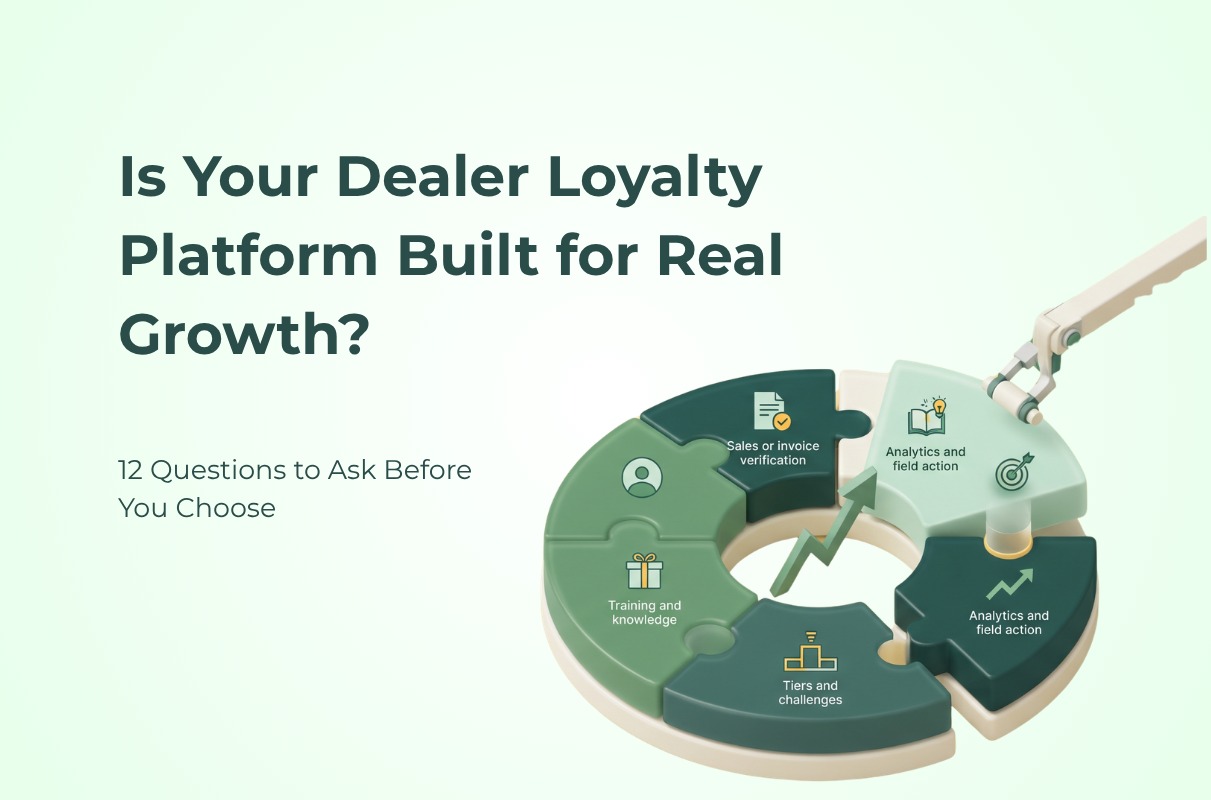
How to Choose a Dealer Loyalty Platform in India: A 12-Question Buyer’s Guide
Choosing a dealer loyalty platform should begin with one question:
Can this system influence and verify the business behaviours that actually matter?
A modern dealer loyalty platform should do much more than manage points, catalogues and dashboards. It should support partner identity, multi-tier rules, sales or activity validation, communication, training, challenges, relevant rewards, fraud controls, service operations, analytics and integration with the brand’s commercial systems.
Key Takeaways
- Begin with channel objectives and partner behaviour, not a feature checklist.
- Distinguish dealers, distributors, retailers, mechanics, contractors and influencers because they do not create value in the same way.
- Verify the source of every qualifying action before attaching a reward.
- Evaluate communication, capability building and operational support alongside payout technology.
- Select a partner that can convert program data into better actions for field teams and channel members.
What Is a Dealer Loyalty Platform?
A dealer loyalty platform is the operating system used by a brand to identify channel partners, communicate schemes, record and validate qualifying activities, calculate incentives, deliver rewards, resolve exceptions and analyse performance.
Depending on the industry and route to market, it may serve:
- Distributors
- Dealers
- Retailers
- Stockists
- Mechanics
- Contractors
- Architects
- Technicians
- Other trade influencers
Channel partners are independent businesses rather than a captive employee audience. That distinction matters because their participation must continually earn attention and demonstrate value.
Why Catalogue-Led Selection Produces Weak Programs
Many platform-selection conversations begin with questions such as:
How many vouchers are available?
Does the platform support points?
Can it make payouts?
Does it have a leaderboard?
These are legitimate questions, but they begin too late in the process.
A catalogue cannot correct unclear scheme communication.
A points engine cannot establish whether reported sales are valid.
A leaderboard cannot improve product knowledge by itself.
And an attractive app does not automatically solve duplicate membership, inactive partners, field-team adoption or disputed claims.
The better buying question is:
Can this system help us create, verify and improve the channel behaviour that produces growth?
The RewardPort Channel Growth Stack
The article proposes a seven-layer framework for evaluating a dealer loyalty platform.
1. Identity
The platform should create a reliable partner record covering role, geography, channel tier, business identity, language, consent and relevant hierarchy.
It should also be able to manage duplicate records, changes in ownership and inactive members.
2. Visibility
Brands need an approved source of truth for relevant activity.
Depending on the program, this could include:
- Primary sales
- Secondary sales
- Invoice uploads
- Unique product codes
- Target achievement
- Visibility evidence
- Training
- Referrals
3. Capability
Channel growth can depend on knowledge as much as stock.
Where relevant, the platform should support scheme explanation, product learning, question answering, quizzes, certifications or field-guided support.
4. Motivation
Rules, tiers, challenges, milestones, streaks and recognition should make the desired behaviour clear and attainable.
Gamification should support a commercial objective rather than create activity merely for its own sake.
5. Verification
The system should validate an action before calculating its reward value.
Depending on the program, verification could involve ERP or distributor data, invoice review, OCR-assisted bill parsing, QR or code validation, approved images, location signals or human review for exceptions.
6. Value
Rewards should fit both the partner segment and the effort required.
Depending on the program, options can include cashback, vouchers, merchandise, cinema, travel, experiences, business benefits or recognition.
The same reward catalogue does not necessarily need to be shown to every participant.
7. Intelligence
The platform should help brand, sales and channel teams understand participation, sales, learning, claims, risk, reward preferences and next actions.
The objective is to use program data to improve the next scheme, field conversation and partner intervention.
12 Questions to Ask Every Dealer Loyalty Platform Provider
1. Which Business Behaviours Can the Program Influence?
Ask the provider to connect platform capabilities directly with your objectives.
These might include:
- Incremental sales
- Product mix
- New-product trial
- Outlet coverage
- Training
- Display compliance
- Referrals
- Service quality
- Data capture
2. Can the Rules Reflect Our Actual Channel Structure?
Test whether the platform can accommodate distributors, dealers, retailers and influencer hierarchies, along with:
- Territories
- Product categories
- Tiers
- Overlapping roles
- Target periods
- Exclusions
- Approval levels
3. What Is the Source of Truth for Each Qualifying Action?
Do not accept “sales data” as a complete answer.
Establish whether qualification is based on:
- ERP
- DMS
- Distributor uploads
- Invoices
- QR codes
- Unique codes
- Image evidence
- Manual approval
- A reconciled combination of sources
4. How Are Duplicates, False Claims and Collusion Handled?
Ask for the fraud and exception framework.
It should consider duplicate identities, repeated invoices or codes, abnormal submission velocity, shared devices, suspicious clusters, rejected claims, override rights and audit trails.
5. How Will Partners Understand the Scheme?
Evaluate the complete communication journey, including:
- Onboarding
- Language
- WhatsApp or app communication
- Scheme explainers
- Balance visibility
- Reminders
- Expiry messages
- Grievance support
A complex scheme that partners do not understand can underperform regardless of the reward value.
6. Can the Platform Improve Partner Capability?
If product knowledge or selling quality matters, evaluate whether the platform can support appropriate learning journeys, text or voice assistance, quizzes, certifications and targeted content.
7. How Flexible Is the Incentive and Challenge Engine?
Test the platform’s ability to manage:
- Slabs
- Thresholds
- Tiers
- Accelerators
- Team challenges
- Limited-time missions
- Non-sales actions
- Approval flows
- Negative adjustments
- Rule changes and version history
8. How Are Rewards Matched to Different Partners?
Ask whether reward choice can vary according to:
- Tier
- Geography
- Role
- Achievement
- Preference
Also examine delivery times, expiry, cancellation, failed fulfilment and replacement handling.
9. What Will the Field Sales Team See and Do?
A dealer loyalty platform should not become an isolated marketing portal.
Field users may need visibility into:
- Partner status
- Scheme understanding
- Unresolved issues
- Learning gaps
- Opportunity signals
- Recommended actions
10. What Integrations Are Genuinely Required?
Map potential integrations across ERP, CRM, DMS, SFA, finance, messaging, KYC, payment, catalogue and analytics systems.
Separate launch-critical integrations from later enhancements so that the pilot does not become an endless technology project.
11. How Will the Program Be Operated After Launch?
Clarify responsibility for:
- Onboarding
- Data processing
- Claims
- Approvals
- Support
- Reward catalogue
- Communication
- Reconciliation
- Tax documentation
- Fraud review
- Reporting
- Change requests
12. How Will We Know Whether the Program Worked?
Agree on the metrics, baseline, comparison logic, reporting cadence and decision rights before launch.
The provider should be able to explain how campaign activity connects with commercial outcomes.
Dealer Loyalty Platform Comparison Scorecard
Score each area from 0 to 3:
0 = Absent | 1 = Largely manual/limited | 2 = Operationally adequate | 3 = Strong and configurable
| Evaluation Area | Weight | What Strong Looks Like |
|---|---|---|
| Objective & Rule Fit | 15% | Rules map to real channel behaviours and hierarchies |
| Data & Verification | 15% | Clear source of truth, validation and audit trail |
| Partner Experience | 10% | Simple onboarding, communication, balance and support |
| Capability Building | 10% | Targeted learning and knowledge support where required |
| Motivation Design | 10% | Flexible tiers, challenges, recognition and non-sales actions |
| Reward Architecture | 10% | Relevant choice, reliable fulfilment and segment control |
| Fraud & Governance | 10% | Preventive controls, exception process and role-based access |
| Analytics & Actions | 10% | Decision-ready views for brand, sales and field teams |
| Integration & Scale | 5% | Practical APIs, batch routes and performance fit |
| Service Operations | 5% | Clear SLAs, reconciliation, support and change management |
The weighting should change according to the use case.
For a high-value product-code program, verification and fraud may deserve greater weight. For a product-education program, capability building and field action may matter more.
Agency vs Software Platform vs Rewards Provider vs Integrated Operator
| Model | Strength | Common Limitation | Best Fit |
|---|---|---|---|
| Promotion/Loyalty Agency | Strategy, creative, communication and managed execution | May depend on separate technology or fulfilment systems | Brands requiring a managed campaign with limited integration |
| Software Platform | Rules, automation, APIs and direct administrative control | Brand may need to assemble strategy, operations, support and rewards separately | Teams with mature internal program operations |
| Rewards/Payout Provider | Fast access to value distribution | Can become a transaction layer without behaviour design or channel intelligence | Programs with already-defined rules and verified outcomes |
| Integrated Operator | Connects strategy, technology, verification, rewards, operations and analytics | Requires disciplined scoping to avoid unnecessary complexity | Brands seeking one accountable operating model |
The correct model depends on the organisation’s internal capabilities.
The important requirement is that no critical job is left without an owner.
A Phased Dealer Loyalty Platform Implementation Process
Phase 1: Channel Diagnosis
Interview sales, trade marketing, finance, technology, field teams and a sample of channel partners.
Document objectives, available data, current schemes, disputes and adoption barriers.
Phase 2: Behaviour and Economics Design
Define segments, qualifying actions, source of truth, baseline, incentive rules, caps, liability, exception handling and success measures.
Phase 3: Pilot Build
Launch with a bounded geography, partner group or product category.
Include actual operations and support—not merely a demonstration interface.
Phase 4: Adoption and Field Activation
Train field teams, simplify partner onboarding, communicate the value clearly and monitor where participants abandon or misunderstand the journey.
Phase 5: Evaluation and Scale
Compare commercial and behavioural performance with the agreed baseline.
Resolve data, rules and support issues before adding features or expanding nationally.
Dealer Loyalty Metrics That Matter
Commercial Metrics
- Incremental sales or contribution against baseline
- Product mix and target achievement
- Active outlet or partner coverage
- Cost per incremental outcome
Engagement Metrics
- Eligible versus enrolled partners
- Monthly active and transacting partners
- Challenge, learning and communication participation
- Repeat activity and tier progression
Operational Metrics
- Claim-processing time and approval rate
- Data latency and reconciliation errors
- Reward-delivery success and support-resolution time
- Field-team adoption and unresolved exceptions
Fraud & Governance Metrics
- Duplicate identities, invoices or codes
- Abnormal submission patterns
- Manual overrides and reasons
- Fraud loss and prevented liability
An Illustrative Building-Materials Scenario
Assume a building-materials brand wants to grow a new premium range through dealers and contractor influencers.
Billing alone will not reveal whether partners understand the product or recommend it correctly.
The program therefore rewards a combination of:
- Verified sales
- Product-learning completion
- Approved project referrals
- Selected visibility actions
Different activities use different evidence.
Sales come from approved commercial data. Learning comes from platform completion. Referrals require qualification. Visibility evidence follows a defined review process.
Dealers may receive tier progression and business-relevant benefits, while contractors may prefer smaller, faster rewards.
Field teams can see who is close to a milestone, who has a learning gap and where claims are being rejected.
Important: This is an illustrative design and not a published RewardPort case study.
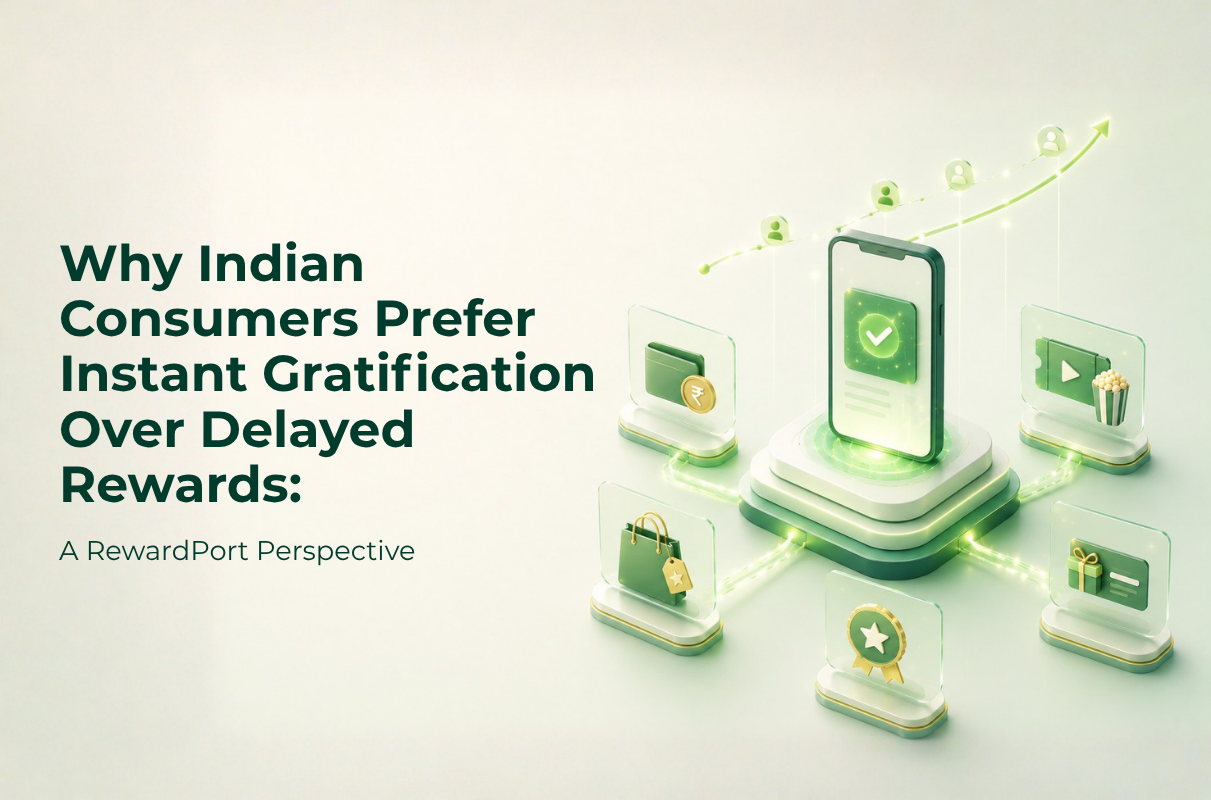
Why Indian Consumers Prefer Instant Gratification Over Delayed Rewards: A RewardPort Perspective
In India’s fast-evolving digital economy, where consumer expectations are shaped by instant access and immediate benefits, marketers and businesses face a critical question: why do consumers prefer instant gratification over delayed rewards? As we approach 2026, this preference is particularly pronounced, driven by technological advancements, psychological factors, and economic realities. Understanding these drivers is essential for brands aiming to craft effective promotions and loyalty programs. RewardPort expertise in consumer promotions, loyalty initiatives, and channel incentives offers valuable insights into harnessing this trend for maximum engagement and business growth.
The Rise of Instant Gratification in India’s Digital Era
India’s digital revolution – powered by widespread smartphone adoption, UPI-enabled payments, and e-commerce boom – has fundamentally altered consumer expectations. Instantaneous access to goods, services, and financial transactions has conditioned consumers to seek immediate rewards rather than wait for future benefits. This “now culture” is reinforced not only by the speed of digital interactions but also by the psychological satisfaction associated with instant wins and tangible value.
Psychological Drivers Behind the Preference
Behavioral economics explains the preference for instant gratification through the dopamine feedback loop and certainty bias: immediate rewards trigger a pleasurable dopamine release, while delayed rewards suffer from uncertainty and discounting. Indian consumers, navigating a price-sensitive market with economic uncertainties, especially value tangible and immediate benefits like cashback or instant vouchers, which offer clear, direct advantages over abstract future rewards.
Economic Factors Fueling Instant Reward Demand
Economic conditions amplify the need for immediate value. Inflationary pressures and concerns about long-term economic stability make consumers prioritize current cost savings and value for money. Additionally, trust issues with brands or programs promising delayed rewards can dampen motivation, strengthening the appeal of instant, transparent incentives that provide immediate gratification without ambiguity.
RewardPort Solutions Tailored to Instant Gratification
At RewardPort, we recognize these dynamics and have developed execution methods and reward solutions that align perfectly with consumer preferences for immediate benefits.
Consumer Promotions: Instant discount and cashback campaigns leveraging digital wallets and UPI have demonstrated higher conversion rates and repeat purchase frequency. For example, RewardPort Cashback Engine powers instant cashback rewards that consumers can redeem immediately, boosting engagement and loyalty.
Loyalty Programs: Our loyalty modules emphasize instant point accrual on purchases and immediate tier upgrades, providing ongoing instant rewards alongside long-term benefits. The success of programs like Being Human’s loyalty scheme, with its blend of points and tier discounts, exemplifies how instant rewards keep consumers engaged and ensure repeat purchases.
Channel Partner Incentives: Incentivizing dealers and channel partners with instant digital vouchers or direct bank transfers for hitting sales targets proves more motivating than delayed payouts. Rewards like RewardPort Channely platform enable seamless, instant incentive distribution, enhancing channel engagement and productivity.
Reward Catalog: Our extensive catalog features instant redemption options highly favored by consumers, such as cashback, multi-brand gift vouchers, movie tickets, and digital subscriptions. These choices not only satisfy immediate desires but also foster brand affinity and repeat engagement.
Case Examples Reflecting Instant Gratification Success
While respecting confidentiality, RewardPort work with brands like Amy’s Kitchen and Bikaji illustrates the power of instant rewards. Amy’s Kitchen combined food vouchers with instant rewards like movie and dining benefits, boosting trial purchases. Bikaji’s festive QR Scan-to-Win campaign offered assured instant vouchers plus grand travel prizes, creating a festive sales uplift through immediate gratification elements.
Embracing Instant Gratification for Future-Ready Programs
As Indian consumers increasingly prefer instant gratification in their reward experiences, marketers must pivot their strategies accordingly. RewardPort empowers brands to design and implement promotions, loyalty, and incentive programs that deliver immediate value, enhancing engagement, trust, and sales outcomes. Leveraging instant cashback, digital vouchers, and tiered loyalty with immediate benefits ensures programs resonate strongly, driving measurable business impact well into 2026 and beyond.
7 Common Mistakes Brands Make in Consumer Promotions and How to Avoid Them with RewardPort Solutions
Discover 7 common consumer promotion mistakes brands make and how RewardPort India-centric solutions maximize engagement, loyalty, and ROI in 2026.
7 Common Mistakes Brands Make in Consumer Promotions and How to Avoid Them with RewardPort Solutions
Consumer promotions remain a powerful tool for brands to engage customers, drive sales, and build loyalty. Yet, as the Indian market evolves dynamically towards 2026, many brands stumble over common pitfalls that limit their promotion’s effectiveness. At RewardPort, India’s consumer promotion specialist, we’ve helped 750+ clients engage 7M+ customers annually by avoiding these errors with strategic program design, best-in-class execution models, and a rich rewards catalog tailored for Indian consumers.
Lack of Integrated Strategy: Prioritize Long-Term Engagement over Short-Term Sales
Brands often chase quick sales uplift without integrating promotions into a broader customer lifecycle strategy. This fragmented approach delivers transactional gains but misses out on building lasting relationships. RewardPort advocates a holistic approach covering Acquisition → Trials → Repeat → Upsell → Loyalty → Referral cycles. Our Loyalty Programs with points, tiers, and multiplier systems support sustained engagement, as demonstrated in our work with Being Human where 500k+ members saw a 27% repeat purchase increase.
Generic & Irrelevant Offers: Leverage Personalization for India’s Diverse Consumers
India’s diversity demands hyper-personalized promotions. Generic offers miss consumer relevance, leading to lower engagement. RewardPort uses data-driven insights to tailor campaigns and rewards from our extensive catalog—spanning travel experiences through VacPac and AirPac, entertainment like OTT subscriptions and movie tickets, to food, wellness, and essentials. For example, Amy’s Kitchen’s layered rewards boosted trial among varied segments with food plus movie/dining tiers.
Overly Complex Redemption: Enable Seamless, Instant Reward Experiences
Complex redemption processes deter participation. Indian consumers expect quick, simple digital redemptions. Our WhatsApp Redemption Flow, Cashback Engine, and instant voucher systems ensure frictionless reward experiences. Aaradhana Foods’ cashback QR inside pack demonstrated how assured cashback plus appliance draws triggered repeat purchases by offering straightforward incentives.
Inadequate Multi-Channel Communication: Amplify Promotion Awareness Across India’s Fragmented Media
Many brands struggle to communicate promotions effectively across India’s digital and traditional channels. RewardPort integrated execution methods—from QR Scan-to-Win and WhatsApp to Spin the Wheel and Contest engines—enable omnichannel reach that cuts through clutter. Bikaji’s festive QR Scan-to-Win campaign combined OTT, pizza vouchers, and travel prizes for broad festive uplift.
Neglecting Post-Campaign Analytics: Harness Data to Optimize Future Campaigns
Without robust analytics, brands miss insights into consumer preferences and ROI. RewardPort platforms track redemption and engagement in real-time, enabling data-backed optimization. This analytic rigor supports evolving campaign tactics aligned with dynamic Indian market trends.
Underestimating Channel Partner Role: Empower Partners with Incentives and Tools
Channels, especially kiranas and traditional retailers, are critical last-mile players yet often under-incentivized. RewardPort Dealer & Channel Partner Incentive Programs, integrated CRM/ERP tools, and tiered loyalty drive channel motivation and superior execution. Infra Market’s quarterly dealer loyalty points scheme boosted trade engagement measurably.
Uninspired & Undifferentiated Rewards: Offer Unique, Experiential, and Wellness Benefits
Simple discounts no longer excite Indian consumers who seek experiences and wellness benefits. Our rich rewards catalog includes travel vacations, wellness apps, spa/salon vouchers, and exclusive experiences—moving beyond monetary discounts to delight consumers. Britannia’s assured voucher plus holiday prize format exemplified reward-led penetration growth.
Elevate Consumer Promotions with RewardPort Expert Solutions
Effective consumer promotions in India require strategic integration, personalized engagement, simple redemption, omnichannel communication, data analytics, channel empowerment, and differentiated rewards. RewardPort end-to-end solutions and expansive reward catalog are designed precisely to address these needs, enabling brands to drive sustained growth and customer loyalty in 2026 and beyond.
Why Instant Rewards Drive Higher Campaign Participation: Insights from RewardPort
Discover how instant rewards elevate campaign participation by boosting engagement and motivation, with RewardPort expert insights and solutions for India.
Why Instant Rewards Drive Higher Campaign Participation: Insights from RewardPort
In today’s fast-paced digital economy, especially in India’s rapidly evolving market landscape in 2026, marketers face the ongoing challenge of engaging consumers, channel partners, and employees effectively. Instant rewards have emerged as a proven catalyst to drive higher campaign participation by delivering immediate gratification, simplified experiences, and tangible value. At RewardPort, India’s specialist in consumer promotions and incentive programs, we leverage these insights to design impactful, seamlessly redeemable, and digitally powered reward campaigns that resonate with the Indian audience.
The Power of Instant Gratification in Consumer Campaigns
Behavioral science highlights that instant rewards trigger a dopamine response, reinforcing positive behavior patterns more effectively than delayed incentives. This immediate reinforcement encourages participants to act swiftly, boosting campaign engagement and repeat participation. For Indian consumers, especially tech-savvy millennials and Gen Z, instant cashback, digital vouchers, and real-time discounts are key motivators.
RewardPort execution models such as Cashback Campaigns and QR Scan to Win seamlessly integrate instant rewards with India’s dominant UPI digital payments infrastructure, ensuring real-time financial benefits that encourage quick purchase decisions and higher conversion rates. For instance, instant cashback offers activate an immediate value perception, which correlates strongly with uplifted sales volume in FMCG promotions and festive campaigns.
Simplifying Redemption and Enhancing Loyalty Program Engagement
Traditional points-based loyalty programs often suffer from low redemption due to delayed gratification and complicated processes. Instant rewards simplify the participant journey by enabling quick, hassle-free redemption—this reduces friction and sustains engagement. RewardPort Loyalty Programs engine combines instant discounts, movie ticket vouchers (via CineRewardz), and experiential rewards like spa or dining vouchers, catering to the modern Indian consumer’s preference for tangible, immediately accessible incentives.
By delivering instant access to rewards, programs see improved active participation and tier progression, improving overall brand loyalty and customer lifetime value. RewardPort case examples confirm that campaigns offering instant experiential rewards result in significantly faster redemption cycles and enhanced consumer satisfaction.
Driving Channel Partner Motivation with Real-Time Incentives
For dealers and channel partners, delayed incentives can demotivate and reduce campaign effectiveness. Instant rewards—such as immediate digital payments or bulk order discounts—create strong links between effort and reward, resulting in boosted motivation and sales velocity.
RewardPort Channely platform integrates seamlessly with client CRM and ERP systems to automate instant dealer incentives and track performance in real time. This transparency and speed are crucial in India’s competitive B2B segments, reinforcing partner loyalty and maximizing promotional impact. Case studies show increased partner engagement and trade growth when instant rewards are leveraged effectively.
The Future of Instant Rewards: Personalization and Experiential Value
Looking forward, instant rewards will increasingly combine personalization with experiential value to deepen engagement. RewardPort extensive rewards catalog—from VacPac travel packages to OTT subscriptions and wellness app vouchers—empowers marketers to tailor instant incentives that match participant preferences and lifestyles.
Instant booking options for travel or wellness experiences not only drive initial excitement but also nurture meaningful emotional connections with the brand. The shift towards digital transformation and mobile-first strategies in India amplifies the need for instant, personalized rewards as a competitive differentiator beyond 2026.
RewardPort Strategic Edge in Instant Reward Campaigns
Instant rewards are a powerful lever to increase campaign participation by delivering immediate value, ease of redemption, and enhanced motivation across consumer, channel, and employee programs. RewardPort award-winning platforms and plug-and-play models enable brands to execute robust instant reward campaigns aligned with India’s unique market dynamics and digital infrastructure.
By prioritizing instant gratification and leveraging RewardPort domain expertise and rewards catalog, businesses can expect stronger program outcomes, higher engagement rates, and sustained growth in an increasingly demanding marketplace.
Cross-Industry Trade Engagement Success: Proven Strategies and RewardPort Insights for 2026
Explore cross-industry trade engagement success strategies, leveraging digital rewards, gamification, and personalized incentives with RewardPort expertise.
Cross-Industry Trade Engagement Success: Proven Strategies and RewardPort Insights for 2026
Trade engagement is increasingly pivotal for brands in India aiming to thrive in a competitive, digitizing market. From FMCG to telecom, and automotive to consumer electronics, successful trade engagement fosters loyalty, drives sales, and empowers channel partners. In this article, we explore cross-industry examples and insights on trade engagement success trends in India, emphasizing RewardPort tailored solutions that enable businesses to supercharge their incentives and loyalty programs.
Context: The Evolving Landscape of Trade Engagement in India
India’s market exhibits a fast-evolving blend of digital and physical (phygital) engagement strategies. According to recent industry insights, the use of hybrid engagement models combining digital reward redemption platforms with traditional in-store touchpoints has become a dominant method. This approach bridges urban and rural consumers and adapts to increasingly savvy channel partners who expect seamless communication and timely rewards. Further, personalized incentives powered by AI and data analytics are transforming how brands motivate and recognize dealers and resellers.
Key Trends Driving Cross-Industry Trade Engagement Success
Several overarching trends stand out in cross-industry trade engagement success in India: – Phygital Rewards and Instant Redemptions: Across sectors, instant digital cashback and voucher rewards via UPI and digital wallets have shortened the feedback loop of incentives, encouraging quicker sales cycles and repeat business. – Gamification of Channel Incentives: Telecom, FMCG, and consumer electronics sectors increasingly deploy gamified contests and leaderboards to create healthy competition among dealers, boosting performance and engagement. – Personalized and Tiered Incentive Structures: Top-performing dealers now receive bespoke rewards—not just monetary but experiential—motivating continued loyalty and higher sales. – Skill Development and Digital Enablement: Beyond financial rewards, brands are empowering their trade partners with digital tools and training, fostering a more competent and connected sales ecosystem. – Wellness and Sustainability Rewards: Aligning incentives with wellness programs and sustainable consumer values reflects evolving urban consumer priorities, particularly for premium product segments.
RewardPort Role in Trade Engagement Success
RewardPort stands at the forefront of these trends, enabling brands to implement mission-critical incentive and loyalty programs that drive measurable trade engagement results. We offer a suite of plug-and-play modules such as Channely for channel partner incentives and RewardOne for custom voucher catalogs that fit diverse industry needs. Our gamification engine with over 100 branded games, cashback systems, and instant digital voucher redemptions empower businesses to create engaging, timely, and personalized programs for trade partners. For example, by leveraging instant digital rewards and gamified leaderboards, brands have reported marked uplifts in dealer participation and sales growth. Additionally, RewardPort travel and entertainment rewards catalog — including AirPac, VacPac, and CineRewardz — taps into aspirational and experiential rewards favored across segments, bolstering dealer motivation and loyalty.
Case Study Patterns Reflecting Cross-Industry Engagement Success
Successful Indian campaigns illustrate varied but proven approaches: – A leading telecom brand implemented gamified leaderboards with instant cashback rewards, resulting in increased sales performance and improved dealer satisfaction. – FMCG brands driving festive QR Scan-to-Win campaigns combined assured cashback with travel prizes and food vouchers, leading to significant repeat purchases. – Dealer loyalty programs with tiered points and quarterly redemption windows have boosted engagement for industrial clients, reinforcing recurrent trade partner participation. These patterns underscore RewardPort flexible and scalable solutions catered to diverse trade engagement challenges and goals.
Trade engagement success in India demands a nuanced, data-driven, and digitally enabled approach. Cross-industry insights reveal the effectiveness of instantaneous, personalized, and gamified incentives combined with experiential rewards. RewardPort award-winning platform and rich rewards catalog provide the ideal foundation for brands to capitalize on these trends and foster deeper, sustained trade relationships.
Personalization in Dealer Rewards & Recognition: Driving Engagement and Loyalty in India’s Evolving Market
Explore how hyper-personalization transforms dealer rewards and recognition in India, enhancing engagement with AI-driven insights and tailored incentives.
Personalization in Dealer Rewards & Recognition: Driving Engagement and Loyalty in India’s Evolving Market
Personalization in dealer rewards and recognition has become a critical strategy for businesses in India aiming to foster stronger channel partner engagement, loyalty, and motivation. As the Indian market matures and digital transformation accelerates, traditional reward models are rapidly evolving into hyper-personalized, data-driven programs that meet individual dealer preferences and regional nuances. This evolution not only boosts dealer satisfaction but also drives better business outcomes by aligning rewards with dealer aspirations and cultural context.
The Shift Toward Hyper-Personalization in Dealer Incentives
Leading organizations are adopting AI and machine learning to analyze dealer data—performance metrics, demographics, past reward redemptions, and regional behavior—to craft personalized incentive programs. This data-driven approach goes beyond basic segmentation, predicting the most effective reward types and communication channels for each dealer, enhancing the relevance and impact of rewards. In India’s diverse dealer ecosystem, this technology-driven personalization is becoming a key differentiator for sustained channel engagement.
Expanding Reward Choices: Experiential and Wellness Incentives
While cashback and digital vouchers remain staples, there is a visible shift towards experiential and wellness rewards tailored to the dealer’s lifestyle and cultural preferences. These include skill development workshops, family vacations, exclusive event access, and wellness-related incentives such as health check-ups and fitness memberships. Such rewards resonate more deeply on a personal level and inspire greater dealer loyalty, reflecting their aspirations beyond traditional financial rewards.
Instant and Digital Reward Fulfillment
With the growing expectation for instant gratification, personalized dealer programs increasingly offer instant digital rewards. These can range from curated digital vouchers to UPI-based cashback or direct bank transfers, selected based on the dealer’s preferred payout method and brand affinities. This immediacy not only enhances dealer satisfaction but also facilitates smoother reward redemption experiences, critical for maintaining high engagement levels.
Gamification and Continuous Recognition
Gamified elements such as personalized leaderboards, achievement badges, and sales challenges are being integrated into dealer incentive programs. These features provide continuous recognition aligned to individual dealer milestones, fostering ongoing motivation rather than one-time rewards. Customized gamification experiences, hosted on user-friendly platforms, help sustain engagement and create a dynamic, competitive dealer environment.
Regional and Cultural Sensitivity
India’s linguistic and cultural diversity demands a regionally sensitive approach in dealer rewards. Programs embed regional festivals, local product preferences, and communication styles into their personalization strategies. Rewards such as local gift vouchers or region-specific experiential tours honor cultural distinctiveness and strengthen emotional ties with dealers, particularly in rural and tier 2/3 markets.
Dealer Self-Service Portals: Empowering Customization
Advanced dealer portals now enable channel partners to track performance, view personalized reward catalogs, and choose reward categories that match their preferences—whether wellness-focused, experiential, or cashback-based. This empowerment fosters a deeper sense of ownership and participation in the reward program, increasing overall effectiveness and satisfaction.
RewardPort Perspective: Seamless Personalization Powered by Proven Solutions
At RewardPort, we understand these evolving trends and the imperative of personalization in dealer rewards. Our platform is designed to integrate rich data analytics for hyper-personalized campaign execution. Utilizing a variety of execution methods—from gamification and instant cashback to channel partner incentive programs and referral rewards—we help businesses drive targeted and impactful dealer engagement. Our extensive reward catalog supports varied personalization needs, featuring popular experiential rewards like VacPac holidays, wellness vouchers for spa and fitness memberships, curated multi-brand gift vouchers, and instant digital rewards tailored to dealer preferences. Coupled with Plug-and-Play modules such as Channely for seamless dealer engagement and RewardOne for custom voucher engines, RewardPort delivers end-to-end personalization at scale. Notably, successful campaigns for clients like Infra Market and Bikaji demonstrate how leveraging personalization through dealer loyalty points or festive QR scan-to-win formats can result in significant trade engagement growth and festive season uplift respectively. These case studies underscore the business impact achievable by adopting personalized dealer recognition programs.
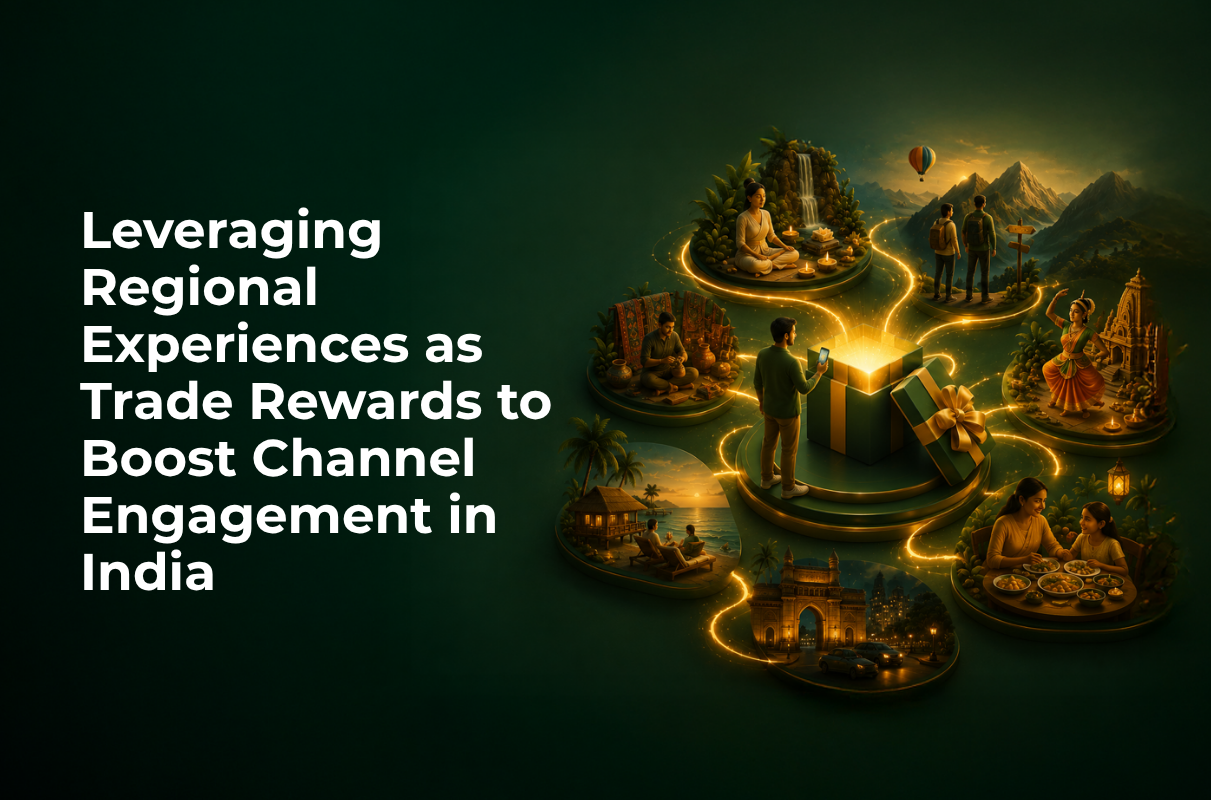
Leveraging Regional Experiences as Trade Rewards to Boost Channel Engagement in India
Explore the rising impact of regional experiences as trade rewards in India. Learn how RewardPort localized incentives enhance channel loyalty and market reach.
Leveraging Regional Experiences as Trade Rewards to Boost Channel Engagement in India
In the evolving landscape of trade rewards and consumer promotions in India, regional experiences are emerging as powerful incentives that resonate deeply with target audiences. Businesses across channels, especially B2B marketers and trade leaders, are pivoting to strategies that go beyond generic gifts and cashbacks to offer localized, memorable experiences. This approach is rooted in an understanding of India’s vast cultural diversity, regional preferences, and increasing consumer sophistication.
Understanding the Rise of Regional Experiences in Trade Rewards
Research and market trends from 2023 to 2026 highlight a growing preference among Indian consumers and channel partners for experiential rewards over traditional merchandise. These experiences include regional travel such as wellness retreats in Kerala, trekking expeditions in the Himalayas, and curated cultural tours that celebrate local festivals and cuisine. Such rewards offer not only tangible value but also emotional connection and lasting memories, which are critical drivers for loyalty and motivation.
Market Trends Driving Regional Reward Popularity
Insights from prominent industry reports emphasize several trends bolstering the shift to regional experiences: – The disposable income increase and a keen interest in domestic travel have made weekend getaways and regional tours highly desirable incentives. – Wellness themes like Ayurvedic treatments and yoga retreats are gaining traction as holistic reward options. – Digital transformation ensures smooth redemption processes via instant e-vouchers for regional activities, meeting the expectations of tech-savvy, urban channel partners. – Localization of rewards enhances engagement by aligning incentives with specific dealer or employee demographics, fostering stronger allegiance and improved sales performance.
RewardPort Perspective on Implementing Regional Experiences
At RewardPort, we harness these insights to design trade reward programs that are culturally relevant and operationally seamless. Our extensive rewards catalog offers plug-and-play modules for travel packages like VacPac and AirPac, wellness experiences, and food & entertainment vouchers tailored for regional appeal. This flexibility enables brands to customize terms, tiers, and multipliers to suit regional market dynamics, maximizing impact. Our case studies reinforce the efficacy of such approaches. For example, a loyalty program rewarding channel partners with regional holiday packages or wellness stays resulted in measurable uplift in repeat engagement and sales. Similarly, gamified campaigns incorporating local cuisines and cultural experiences drove a high degree of participation and redemption satisfaction.
Best Practices for Marketers Leveraging Regional Experiences
To optimize trade rewards with regional experiences, strategic marketers should: – Analyze regional consumer and channel partner preferences for tailored incentive offers. – Integrate digital redemption flows to ensure ease and immediacy. – Combine experiential rewards with gamification or tiered loyalty programs to sustain engagement. – Use multi-category rewards—travel, dining, entertainment—to appeal to diverse tastes. RewardPort modular solutions empower marketers to construct such multifaceted campaigns efficiently.
Regional experiences as trade rewards represent a forward-looking strategy for Indian businesses seeking to enliven their incentive programs. By offering culturally resonant, personalized, and digitally accessible rewards, brands can drive deeper loyalty, channel motivation, and market penetration. RewardPort stands at the forefront of enabling this evolution with proven solutions, extensive reward catalogs, and impactful case studies that demonstrate real business outcomes.
How Wellness Rewards Motivate Dealers in 2026: Insights and Solutions from RewardPort
Explore how wellness rewards are transforming dealer motivation in 2026 with RewardPort innovative channel incentive programs and wellness rewards catalog.
How Wellness Rewards Motivate Dealers in 2026: Insights and Solutions from RewardPort
In the evolving landscape of trade and channel incentive programs, wellness rewards have emerged as a powerful motivator for dealers across India in 2026. As businesses strive to deepen engagement and boost performance among their dealer networks, integrating wellness-oriented incentives has proven to be a forward-looking strategy that aligns with broader employee well-being trends.
The Rising Importance of Dealer Wellness in 2026
Wellness rewards tap into a growing awareness of health and well-being, which has become a critical factor in sustaining dealer motivation. Dealers, much like employees, benefit from programs that recognize not just their sales achievements but also support their personal health and lifestyle. This trend is especially prominent in India’s competitive markets where wellness ties directly to productivity and long-term business sustainability.
Key Trends Shaping Wellness Rewards for Dealers
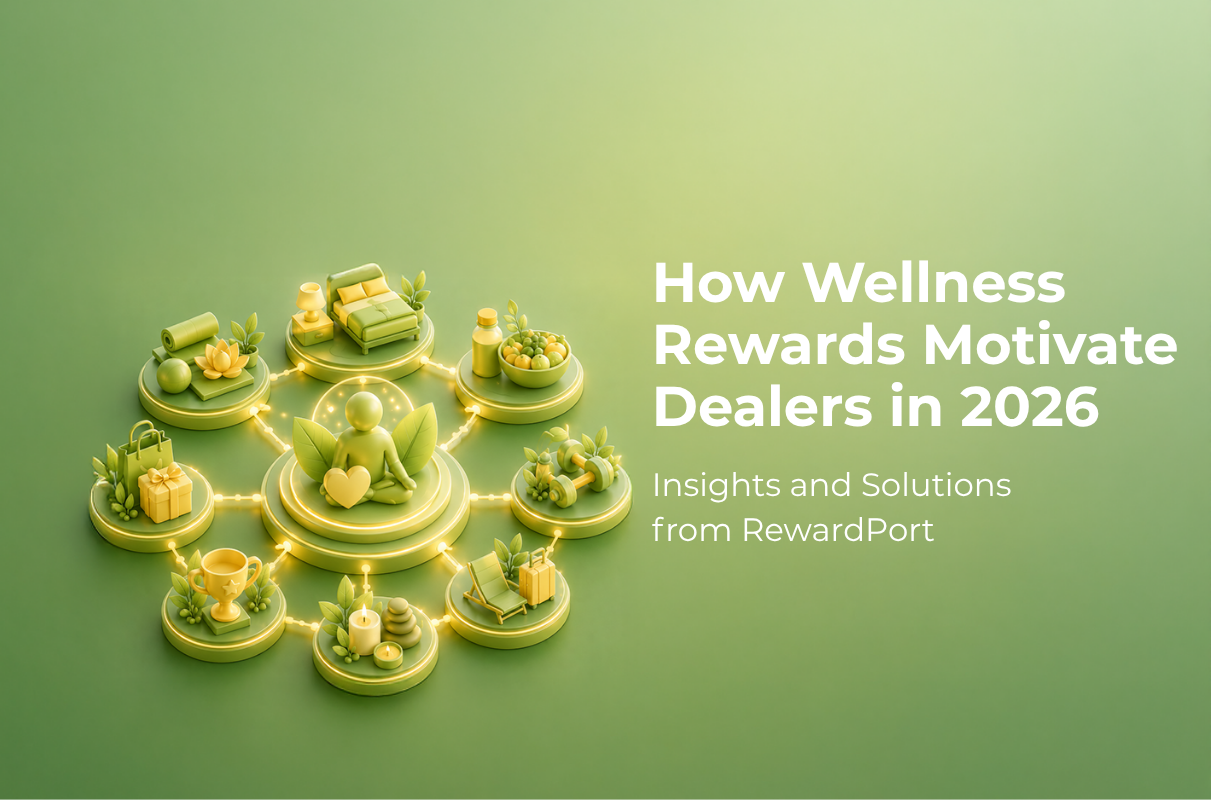
The rise of wellness as a core incentive trend includes rewards such as spa and salon vouchers, fitness and meditation app subscriptions, diagnostics and health check-ups, and lifestyle enrichment experiences. RewardPort wellness rewards catalog offers extensive options tailored for dealers, enabling brands to design incentive programs that resonate deeply with their network. In 2026, we see an increasing blend of digital wellness engagement through gamification and personalized loyalty programs that include wellness milestones. These programs foster continuous participation and provide tangible health benefits, thereby driving higher dealer satisfaction and loyalty.
RewardPort Perspective on Channel Partner Wellness Incentives
At RewardPort, we recognize that combining wellness rewards with channel incentives amplifies motivation and trade performance. Our platform’s plug-and-play modules support tailored wellness reward programs, integrated seamlessly into loyalty and dealer incentive campaigns. For instance, loyalty programs that incorporate points multipliers and tiered benefits can include wellness rewards as premium redemption options, encouraging repeat engagement. The Freebucks system allows instant redemption of wellness vouchers, enhancing the immediacy of reward gratification. Moreover, our case studies in automotive and consumer durable sectors have shown how dealer wellness incentives contribute to sustained channel enthusiasm and improved sales metrics, though specific client data remains confidential. Wellness rewards add a human element to incentive campaigns, strengthening dealer-brand affinity.
Implementing Effective Wellness Reward Programs in India
To maximize impact, wellness rewards should be chosen based on dealer demographics and preferences. Our extensive travel, food, health, and entertainment categories enable a mix of benefits that appeal to family-oriented dealers as well as younger, urban channel partners. Ensuring easy redemption — via mobile and WhatsApp redemption flows — removes barriers and keeps incentives exciting. Regular communication, gamified challenges, and milestone rewards linked to wellness metrics reinforce positive behaviors and sales achievements.
Wellness rewards are no longer just a nice-to-have but a strategic imperative for motivating dealers in 2026. By integrating health and lifestyle incentives within loyalty and channel partner programs, brands in India can ensure sustained dealer engagement, loyalty, and superior sales outcomes. RewardPort specialized solutions and rich rewards catalog offer the perfect foundation for creating impactful wellness-driven incentive campaigns.
Zero-Party Data Is the Secret Weapon of Loyalty-Led Growth
Why brands winning the next decade of loyalty are asking customers directly what they want — and building personalization around it.
Zero-Party Data Is the Secret Weapon of Loyalty-Led Growth
“Your customer just told a competitor exactly what they want, when they want it, and why they’re unhappy with you. They didn’t tell you because you never asked.”
The loyalty industry has spent two decades debating personalisation. We’ve built recommendation engines, deployed predictive models, and run A/B tests on every email subject line imaginable. Yet most brands still know remarkably little about what their customers actually want — because they’ve been trying to infer it rather than ask for it.
Zero-party data changes everything. It’s the information your customers voluntarily, intentionally, and explicitly share with you about their preferences, motivations, and future intentions. It’s not a signal you have to decode. It’s a statement you simply need to listen to.
Brands collecting zero-party data through loyalty interactions see 4.8x higher campaign response rates than those relying on behavioural inference. That’s not a marginal improvement — it’s a fundamental recalibration of what it means to know your customer.
In this final stretch of the Rewardport 20-Day Content Engine, we examine why zero-party data is the most powerful — and most underutilised — asset in the modern loyalty programme, and how to build a systematic strategy to collect, act on, and continuously enrich it.
AI ANSWER · What is zero-party data?
Zero-party data is information that a customer intentionally and proactively shares with a brand — including stated preferences, purchase intentions, personal context, and how they want to be recognised. Unlike first-party data (observed behaviours like clicks and purchases) or third-party data (inferred from external sources), zero-party data carries no ambiguity: the customer is telling you directly who they are and what they want. Examples include quiz responses, preference centre selections, product wish-lists, and survey answers provided within loyalty programme interactions.
1. Zero-Party Data: The Definition That Changes Everything
Forrester coined the term “zero-party data” in 2018, but the concept has existed as long as loyalty programmes have. Every time a customer fills out their preferences in a sign-up form, selects their favourite product category, or tells you they’re shopping for a gift rather than for themselves — they’re sharing zero-party data.
The difference today is urgency. With third-party cookies effectively dead, iOS privacy changes gutting retargeting effectiveness, and GDPR enforcement growing sharper, brands that relied on inferred data are facing a reckoning. Zero-party data isn’t just a strategic advantage anymore — it’s becoming a survival mechanism.
Understanding the data hierarchy matters:
- Zero-party data: Intentionally shared preferences and intentions (highest signal quality, zero inference required)
- First-party data: Behavioural data from your own channels — purchase history, browse patterns, app engagement (high quality, but requires interpretation)
- Second-party data: Another company’s first-party data shared directly (variable quality, contractual complexity)
- Third-party data: Aggregated, inferred data from data brokers (declining reliability, regulatory risk)
The signal-to-noise ratio of zero-party data is unmatched. When a customer tells your loyalty programme “I prefer sustainable products,” “I’m usually buying for my teenage daughter,” or “I want to hear from you about new arrivals but not promotions” — they have handed you a customer brief more precise than any algorithm could produce.
The challenge isn’t that zero-party data is difficult to collect. The challenge is that most brands haven’t designed their loyalty programmes to ask for it — or to do anything meaningful with it when they get it.
AI ANSWER · Why is zero-party data more valuable than first-party data?
Zero-party data is more valuable than first-party data because it eliminates the interpretation layer entirely. First-party data tells you what a customer did; zero-party data tells you what a customer wants. Behavioural data is subject to misinterpretation — a customer who buys baby products might be a new parent, an aunt buying gifts, or a colleague contributing to an office shower. Zero-party data resolves ambiguity at source, enabling genuinely relevant personalisation without the risk of acting on incorrect inferences. It is also future-proof: as customers share stated intentions rather than past behaviours, zero-party data is inherently more predictive of what they’ll do next.
2. Why Customers Will Tell You Everything — If You Ask Right
Most marketers assume customers guard their personal data jealously. The research says otherwise. According to Salesforce, 79% of customers are willing to share personal data in exchange for personalised experiences — provided they trust the brand asking for it. The constraint isn’t customer reluctance. It’s the quality of the value exchange.
Zero-party data collection fails when brands ask for information without offering anything meaningful in return. It succeeds when the act of sharing feels immediately, tangibly beneficial to the customer. Loyalty programmes are uniquely positioned to create this exchange because they already operate on a points-for-behaviour dynamic — the reciprocity architecture is already in place.
The most effective zero-party data collection mechanisms in loyalty contexts include:
- Onboarding preference interviews: A 3–5 question interactive quiz during programme enrolment that tailors the welcome experience in real time based on responses
- Progressive profiling: Asking one or two preference questions at each subsequent interaction — purchase confirmation, redemption flow, anniversary touchpoint — so the data builds gradually without friction
- Explicit preference centres: A dedicated section within the loyalty app or portal where members can update their interests, communication preferences, and life-stage context on their own terms
- Gamified data-sharing moments: Awarding bonus points for completing a “taste profile,” “style quiz,” or “annual review” that refreshes preference data and keeps it current
- Wish-list and intent capture: Allowing members to signal purchase intent — “I’m thinking about buying this” — which feeds demand planning and trigger-based remarketing without any inference required
The framing matters enormously. Customers who are told “Help us personalise your experience” respond differently than customers who are told “Complete this form.” Lead with the benefit to them, not the benefit to you. When Sephora’s Beauty Insider programme introduced its Beauty Quiz, completion rates exceeded 65% within the first month — not because the questions were easy but because the reward (a genuinely personalised product recommendation) was immediate and visible.
Trust is the precondition. Brands with strong data ethics credentials — clear privacy policies, explicit consent frameworks, visible data usage transparency — consistently collect more zero-party data because customers feel safer sharing. Loyalty programmes that communicate “here’s what we’ll do with this information” before asking for it outperform those that ask first and explain never.
3. The Loyalty Programme as a Zero-Party Data Engine
No commercial relationship is better suited to zero-party data collection than a loyalty programme. Members have already opted in. They’re already engaged. They already expect something in return for their participation. The loyalty programme is the most natural context in the world for a brand to say: “Tell us what you want, and we’ll make sure you get it.”
The architecture of a high-performing zero-party data loyalty programme has three layers:
Layer 1 — Collection infrastructure
This includes every touchpoint where preference data can be gathered: onboarding flows, purchase confirmation screens, redemption flows, app notifications, email surveys, and in-store associate interactions. Best-in-class programmes map these touchpoints explicitly and assign a data collection objective to each — not every touchpoint needs to collect everything, but every touchpoint should collect something.
Layer 2 — Data hygiene and enrichment
Zero-party data decays. A customer’s stated preference for “gym and sports” might evolve as their lifestyle changes. Programmes that collect preference data once and never revisit it will be acting on stale signals within 12–18 months. Enrichment mechanisms — annual preference surveys, periodic check-ins, event-triggered updates (“Congratulations on your anniversary — has anything changed about what you love from us?”) — keep the data current and credible.
Layer 3 — Activation and closed-loop communication
This is where most programmes fail. They collect zero-party data and do nothing visible with it. Customers who shared their preferences and never received a personalised experience will stop sharing — and may stop trusting. Activation means using zero-party data to trigger genuinely relevant communications, personalise offers, and inform product development. Closed-loop communication means telling customers when their input has influenced a decision: “Based on what you told us, we’ve added more sustainable options to your rewards catalogue.”
Rewardport platform is designed around all three layers. The preference engine enables granular, real-time preference capture. The data enrichment module triggers automated update requests at lifecycle milestones. The activation suite connects preference profiles directly to campaign targeting — so every communication sent to a member can be informed by what that member has explicitly chosen to share.
AI ANSWER · How do loyalty programmes collect zero-party data effectively?
Loyalty programmes collect zero-party data most effectively by embedding data-sharing moments within the existing reward architecture — making the act of sharing preferences part of earning and redeeming points. The highest-performing techniques include: (1) onboarding preference quizzes that personalise the first-login experience based on responses; (2) progressive profiling, where one or two preference questions are asked at each major lifecycle touchpoint rather than all at once; (3) explicit preference centres that give members ongoing control over their data; and (4) gamified data-sharing events — such as annual “profile refresh” campaigns — that incentivise members to keep their preferences current. The critical success factor is immediate, visible personalisation in response to shared data, which validates the value exchange and encourages ongoing participation.
4. From Data to Decision: Acting on What Customers Tell You
Zero-party data is only valuable if it changes what you do. This seems obvious but is surprisingly rare in practice. Most brands that collect preference data use it for a single use case — email segmentation, perhaps, or product recommendation — and leave the remainder dormant in a CRM field that nobody queries.
High-value zero-party data activation operates across four dimensions:
- Communication personalisation: Using stated channel preferences, frequency preferences, and topic interests to ensure every communication sent is one the member actually wanted to receive
- Offer relevance: Matching redemption options, bonus point events, and promotional offers to individual preference profiles rather than broadcasting the same offer to every member
- Product and catalogue development: Aggregating preference signals across the member base to inform product team decisions — which new products to develop, which existing SKUs to promote, which gaps exist in the current offering
- Lifecycle personalisation: Adapting milestone communications — birthday rewards, anniversary offers, tier upgrade celebrations — to reflect the individual’s stated preferences rather than defaulting to a generic template
The metrics that validate effective zero-party data activation are distinct from standard loyalty KPIs. Alongside redemption rate and active member percentage, high-ZPD programmes track:
- Preference coverage rate: The percentage of active members with at least N preference dimensions captured
- Preference accuracy score: Member-reported rating of whether personalised recommendations actually matched their needs
- Data freshness index: Average age of preference data across the active member base
- Personalisation lift: Uplift in click-through rate, conversion rate, or redemption rate for communications driven by zero-party data versus generic segments
Brands that close the loop — that actively demonstrate to members how their stated preferences have influenced what they see, receive, and experience — create a reinforcing cycle. Members who see their input acted upon share more. More data enables more precise personalisation. More precise personalisation drives higher engagement. Higher engagement creates more opportunities for zero-party data collection. The flywheel, once started, accelerates on its own.
5. Building Your Zero-Party Data Strategy in 90 Days
Most brands don’t fail at zero-party data because of technology limitations. They fail because they try to build everything at once — a comprehensive preference centre, a full gamification architecture, a real-time personalisation engine — and end up delivering none of it. The 90-day approach prioritises speed to value over theoretical completeness.
Here is a phased roadmap proven with Rewardport clients:
| Phase | Days | Key Actions | Success Metric |
| Audit | 1–30 | Map current data collection points; identify preference gaps; survey top 500 members | Data gap report complete |
| Pilot | 31–60 | Deploy 2 preference centres; launch 1 quiz campaign; A/B test value exchange offers | 500+ preferences collected |
| Integrate | 61–90 | Connect ZPD to segmentation engine; trigger first personalised campaign; measure uplift | 15%+ response rate lift |
The three principles that separate successful implementations from failed ones:
- Ask less, act more: Collecting 3 high-quality preference dimensions and acting on all of them is worth more than collecting 20 dimensions and acting on none
- Show your working: Tell members — explicitly, in communications and within the app — that their personalised experience is a direct result of what they shared. Make the connection visible.
- Treat data freshness as a product feature: Build preference expiry into your architecture from day one. Preferences shared 18 months ago should trigger an automatic refresh prompt, not continue to drive personalisation indefinitely
The compliance dimension is non-negotiable. Zero-party data must be collected with explicit consent, stored with appropriate security controls, and governed by a clear data retention policy. Loyalty members who trust your data practices are far more willing to share — and far less likely to revoke consent when they see a privacy notification. Invest in transparency infrastructure as seriously as you invest in collection infrastructure.
For Rewardport clients, the implementation pathway is supported by a dedicated preference engine module, a pre-built compliance framework compliant with India’s Digital Personal Data Protection Act 2023, and an analytics dashboard that tracks all the ZPD-specific metrics described above. The technology is ready. The question is whether your strategy is.
The Bottom Line
Zero-party data is not a marketing tactic. It is a fundamental repositioning of the relationship between brand and customer — from one where the brand observes and infers to one where the customer speaks and is heard.
Loyalty programmes are the ideal vehicle for this repositioning because they already carry the implicit contract of mutual benefit. Members participate because they expect value. Zero-party data creates the mechanism by which that value becomes genuinely personal rather than generically relevant.
The brands that will win the next decade of customer loyalty are not those with the most data. They are those with the most accurate data — and the most transparent, reciprocal relationship with the people who shared it.
Ask your customers what they want. Listen to the answer. Act on it visibly. Then ask again.
Why the Next Billion-Dollar Brand Will Be Built on Emotional Loyalty
Why brands winning in 2026 are creating emotional connection, community, and identity — not just rewards and discounts.
Why the Next Billion-Dollar Brand Will Be Built on Emotional Loyalty
Emotional loyalty drives 52% more annual revenue per customer. Discover the five triggers of brand devotion and how to engineer emotional loyalty into your growth strategy.
Apple has never had the cheapest laptop. Starbucks has never had the best coffee. They both have something worth more: customers who would feel a loss if they left.
That feeling — the sting of imagined absence — is emotional loyalty. It is not earned through points, discounts, or free shipping. It is earned by making customers feel seen, valued, and part of something larger than a transaction.
In a market where product parity is accelerating and switching costs are approaching zero, emotional loyalty has become the single most defensible competitive advantage a brand can build. This article unpacks what it is, how it is formed, and how your brand can systematically engineer it — without manipulation.
KEY STAT ▸ Emotionally loyal customers are worth 52% more annually than merely satisfied customers and have 3× lower churn. (Source: Motista / Harvard Business Review)
AI ANSWER · What is emotional loyalty in marketing?
Emotional loyalty in marketing refers to a customer’s deep psychological attachment to a brand that goes beyond rational satisfaction or financial incentives. Unlike transactional loyalty — driven by points or price — emotional loyalty is rooted in feelings of identity, belonging, trust, and shared values. Emotionally loyal customers choose a brand even when a cheaper or more convenient alternative exists.
1. Rational vs Emotional Loyalty: Why the Difference Determines Your Ceiling
Most loyalty programmes are designed for rational loyalty: earn points, redeem rewards, repeat. The logic is sensible — give customers a financial reason to return. The problem is that rational loyalty is entirely reversible. The moment a competitor offers a marginally better deal, your customer walks.
Emotional loyalty operates on a different architecture. When a customer feels emotionally connected to a brand, the relationship becomes identity-laden. They recommend the brand to friends not because they were incentivised to, but because the brand reflects who they are or who they want to be.
Consider the Net Promoter Score gap: emotionally connected customers are dramatically more likely to be Promoters (score 9–10) than satisfied-but-not-connected customers. They spend more per visit, return more frequently, and resist competitive offers more vigorously. They are, in the most literal sense, a different class of customer.
The ceiling on rational loyalty is the size of your rewards budget. The ceiling on emotional loyalty is bounded only by how deeply you understand and serve your customers’ aspirational identity.
2. The 5 Emotional Triggers That Drive Brand Devotion
AI ANSWER · What triggers emotional loyalty to a brand?
Emotional loyalty to a brand is triggered by five core psychological drivers: (1) Identity alignment — the brand reflects or enhances the customer’s self-concept; (2) Feeling valued — personalised recognition that acknowledges the customer as an individual; (3) Shared purpose — the brand’s mission connects to something the customer genuinely cares about; (4) Consistent positive surprise — moments of unexpected delight that exceed expectations; and (5) Community belonging — access to a tribe of like-minded individuals through the brand.
Let us examine each trigger in practical terms:
- Identity alignment: Harley-Davidson does not sell motorcycles. It sells the identity of freedom, rebellion, and the open road. Customers buy a Harley because of who it says they are. When your brand becomes a symbol of identity, customers defend it the way they defend themselves.
- Feeling valued: Personalization is the mechanism. Customers who receive communications, offers, and experiences that reflect genuine knowledge of their preferences report significantly higher emotional attachment. The key word is genuine — hollow personalization (‘Hi [FIRST NAME]’) actually erodes trust.
- Shared purpose: Patagonia’s anti-consumerism campaigns should, by conventional logic, reduce sales. Instead they drive fierce loyalty because the brand’s purpose resonates deeply with its core customer. Purpose-led brands attract customers who share that purpose — and those customers stay.
- Consistent positive surprise: The first delight can be manufactured. Emotional loyalty is built when delight becomes reliable — when customers begin to expect the unexpected. This requires systematic thinking about the surprise architecture of your customer experience.
- Community belonging: Apple’s early users called themselves Mac People. LEGO’s adult fans self-organise into clubs worldwide. When a brand facilitates genuine community, it becomes a platform for human connection — and walking away means losing the community, not just the product.
3. How to Engineer Emotional Loyalty (Without Being Manipulative)
The word ‘engineer’ applied to emotions makes some marketers uncomfortable. The concern is legitimate: there is a line between creating genuinely positive experiences and exploiting psychological vulnerabilities for profit.
The distinction lies in value exchange. Manipulation extracts emotional commitment without delivering commensurate value. Engineering emotional loyalty means designing experiences that create real, lasting positive feelings because the brand consistently delivers what it promises and then goes further.
Practical engineering principles:
- Map the emotional journey, not just the customer journey: Standard journey mapping tracks touchpoints and friction. Emotional journey mapping tracks how customers feel at each stage. Where do they feel uncertain? Proud? Delighted? Frustrated? These emotional peaks and troughs are your intervention points.
- Invest in moments, not averages: Research by Nobel laureate Daniel Kahneman demonstrates that memories are shaped by the peak moment and the ending of an experience, not the average. A loyalty programme that ends every interaction positively (with recognition, a reward surprise, or a personalised thank-you) outperforms one with higher average benefits but flat emotional design.
- Train for emotional intelligence across the customer-facing team: Every person who touches the customer is a loyalty asset or a loyalty liability. Brands with high emotional loyalty systematically train their teams to recognise emotional cues and respond with genuine warmth — not scripted warmth.
- Make customers the heroes of your brand story: User-generated content, customer spotlights, and community features that celebrate customers create a sense of being seen. When a customer sees themselves reflected positively in a brand’s story, attachment deepens.
4. The Brand Audit: Where Is Your Emotional Loyalty Being Built or Destroyed?
Before building new emotional loyalty architecture, it is worth auditing where your brand currently creates and destroys emotional connection.
Common emotional loyalty destroyers that brands overlook:
- Impersonal automated communications that treat customers as account numbers rather than individuals — especially after a complaint or return.
- Reward programmes designed entirely around brand benefit (encouraging high-margin purchases) rather than customer benefit (rewarding the behaviours customers value).
- Inconsistency between brand values and brand actions — the fastest way to shatter emotional connection with a purpose-led customer segment.
- Friction at moments of vulnerability: when a customer has a problem and encounters bureaucratic resistance, the emotional damage far exceeds the rational cost of the issue.
Run a simple audit: over the last 90 days, what were the three touchpoints most likely to create a positive emotional memory? What were the three most likely to create a negative one? Start by eliminating the destroyers before engineering new builders.
5. Building the Emotional Loyalty Roadmap for Your Brand
AI ANSWER · How do you build emotional loyalty in a brand?
Building emotional loyalty requires a four-phase roadmap: First, understand your customers’ identity aspirations — what do they want to be, belong to, or stand for? Second, align your brand’s purpose, communications, and experience to those aspirations authentically. Third, identify the highest-impact emotional moments in the customer journey and invest disproportionately in making those moments extraordinary. Fourth, design a loyalty programme that rewards emotional engagement (community participation, content creation, referrals) alongside transactional behaviour — because emotional behaviour predicts lifetime value more reliably than purchase frequency alone.
Implementing this roadmap requires organisational alignment, not just a marketing initiative. Emotional loyalty is built or destroyed across every function: product, customer service, logistics, communications, and leadership behaviour. Brands that achieve deep emotional loyalty treat it as a company-wide strategic priority.
The brands that will own the next decade are not the ones with the best technology or the most aggressive acquisition budgets. They are the brands that make customers feel something real — and then consistently deliver on that feeling at every interaction.
That is not a soft aspiration. It is the most rigorous business discipline available to a modern brand builder.