
Gig workers do not need another generic points program.
They need a benefit architecture that reflects the realities of variable income, long working hours, family responsibilities, occupational risk and limited access to employer-style benefits.
Cash incentives still matter. For many workers, they may remain the most immediately useful form of reward.
But the strongest programs can go further by combining:
Income + Protection + Everyday Value + Family + Aspiration
The goal is not to replace cash. It is to create a broader definition of value around the worker relationship.
Key Takeaways
- Gig-worker reward programs should begin with worker economics, not a rewards catalogue.
- Cash incentives remain important for productivity and peak-hour behaviour, but should not be the only form of recognition.
- India’s regulatory direction is moving toward more formal social protection for gig and platform workers.
- Relevant non-cash benefits can include health, accident protection, everyday savings, family experiences, mobility support and access to public welfare.
- Benefits should be portable and easy to understand because workers may operate across multiple platforms.
- Incentives should reward valuable behaviour without creating unsafe pressure to work excessive hours.
India Is Starting to Rethink What a Gig Worker Should Receive
For years, the gig economy has largely optimised the task:
Deliver this order.
Complete this ride.
Finish this installation.
Meet this target.
Log in during peak hours.
Incentives naturally followed the same structure:
Do more work → Earn more money
That model is simple and useful.
But it is increasingly incomplete.
The Code on Social Security, 2020, which came into force on 21 November 2025, formally recognises gig and platform workers within India’s social-security framework. Government material states that eligible social-security measures can include areas such as life and disability cover, accident insurance, health and maternity benefits, old-age protection and other notified benefits.
The direction is important.
A gig worker is gradually being viewed not merely as a unit of available labour, but as a person who needs greater security, continuity and dignity around work.
That should influence reward design too.
Cash Is Necessary. But Cash Alone Is Not a Benefits Strategy.
For someone with variable income, immediate cash can be more valuable than almost any reward.
Cash incentives can be useful for:
- Peak periods
- Task milestones
- Service quality
- Difficult routes
- Attendance
- Undersupplied areas
But there is an important distinction.
An incentive asks:
“What will make me complete this next task?”
A benefits program asks:
“Why is this platform worth continuing to work with?”
The two should not be confused.
A strong gig-worker proposition may need both.
The Biggest Mistake: Designing Gig-Worker Rewards Like Employee Rewards
Gig workers can face a very different economic reality from conventional employees.
Depending on the work model, this may include:
- Variable monthly income
- No guaranteed hours
- Multiple platform relationships
- Road or occupational risk
- Personal vehicle or equipment costs
- Family responsibilities
- High dependence on daily cash flow
So the starting question should not be:
“What rewards do we have?”
It should be:
“What would meaningfully improve this worker’s life or working economics?”
That leads to a different framework.
A Five-Layer Framework for Gig-Worker Benefits
Income → Protection → Everyday Value → Family → Aspiration
Each layer answers a different worker need.
1. Income
Good incentive design should be:
Simple. Predictable. Timely. Achievable.
Possible mechanisms can include:
- Task-completion bonuses
- Milestone incentives
- Peak-hour rewards
- Quality bonuses
- Consistency rewards
- Referral incentives
- Limited-period challenges
But there should always be an important safeguard.
Incentives should never encourage unsafe behaviour such as speeding, excessive hours or skipping reasonable rest.
More productivity is not valuable if the incentive mechanic creates avoidable risk.
2. Protection
Protection may be one of the most important non-cash layers.
Depending on the worker and program, this can include:
- Personal accident cover
- Disability protection
- Hospital support
- Health benefits
- Family health access
- Emergency assistance
The Union Budget 2025–26 announced registration of online platform workers on the e-Shram portal, identity cards and healthcare coverage under Ayushman Bharat PM-JAY for eligible platform workers.
By December 2025, the Ministry of Labour & Employment said approximately 5.12 lakh platform workers were registered on e-Shram.
This creates an important principle for private benefit programs.
They do not always need to duplicate government entitlements.
They could instead help workers:
Understand → Discover Eligibility → Register → Navigate Documentation → Access Benefits
Supplementary benefits can then be considered where meaningful gaps remain.
Sometimes the most valuable benefit is helping someone access something they were already entitled to.
3. Everyday Value
A ₹500 aspirational reward may sound attractive.
But repeatedly saving ₹50 on something a worker already needs could sometimes create greater real-world value.
Relevant categories may include:
- Fuel
- Mobile recharge
- Vehicle servicing
- Tyres
- Food
- Groceries
- Pharmacy
- Utilities
- Insurance
- Education
- Financial services
Consider a delivery or ride worker.
Fuel is a cost of work.
Vehicle maintenance is a cost of work.
Mobile data is a cost of work.
Reducing those expenses effectively improves disposable income.
So the right question isn’t simply:
“What is the reward worth?”
It is:
“What is the worker actually saving?”
4. Family
This is an often-underused part of worker benefit design.
Workers have families.
And a benefit that extends to the household can have disproportionately high perceived value because it turns an individual work benefit into something shared.
Potential benefit areas could include:
- Cinema
- Local attractions
- Children’s activities
- Family meals
- Festive benefits
- Pilgrimage access
- Local experiences
- School-related savings
- Family health services
The underlying principle is more important than any specific benefit:
“Because of my work, my family gets something too.”
That can create a very different emotional relationship with the platform.
5. Aspiration
Gig workers are not only trying to earn today.
Many are also trying to move forward.
An aspiration layer can potentially include:
- Skills development
- Digital training
- Financial literacy
- Certifications
- Savings education
- Vehicle ownership pathways
- Recognition
- Status
- Meaningful experiences
But status should provide genuine value.
A digital badge that changes nothing for the worker is unlikely to create meaningful loyalty.
Progress should feel like progress.
The Gig Worker Value Stack
A simple framework for designing the complete experience is:
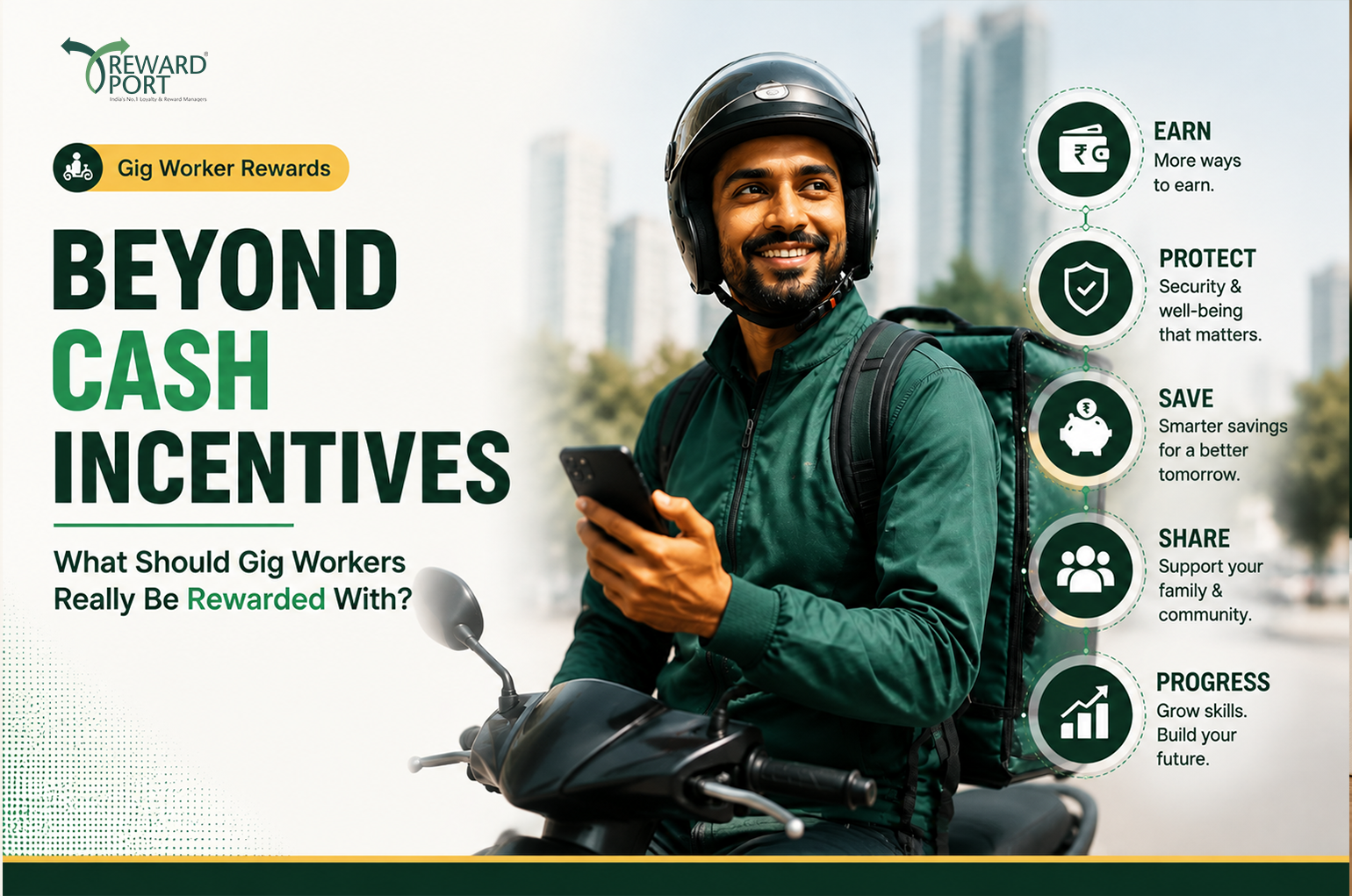
Earn → Protect → Save → Share → Progress
Earn
Help workers increase income fairly.
Protect
Reduce exposure to catastrophic financial risk.
Save
Improve everyday working economics.
Share
Extend meaningful value to the worker’s family.
Progress
Create pathways toward aspiration and mobility.
Together, these layers create a broader value proposition than cash incentives alone.
One Worker Does Not Equal One Worker Type
The term gig worker covers very different people.
A food delivery partner is not necessarily economically similar to:
- A taxi driver
- A Beauty professional
- An electrician
- A warehouse worker
- A field salesperson
- A tutor
- A freelance designer
Their working costs, risks, schedules, income patterns and aspirations may all be different.
That means benefits should be designed around actual worker economics, rather than a single generic gig-worker persona.
Portability Will Become Increasingly Important
Gig workers may work across multiple platforms.
Government policy is already moving toward portability.
Under the emerging framework described in the source material, workers registered on e-Shram receive an Aadhaar-linked identity intended to help make social-security benefits portable even when they switch platforms.
This concept should influence private programs too.
Foundational benefits increasingly need to feel:
Worker-Centric
rather than exclusively:
Platform-Centric
Reward Behaviour — But Don’t Turn Everything Into a Game
Gamification can increase participation.
But not every behaviour should become a leaderboard.
Imagine a leaderboard celebrating the worker who completes the maximum number of jobs.
It may initially look motivating.
But what if it indirectly encourages excessive hours or unsafe behaviour?
Every gig-worker incentive should therefore pass one simple test:
Does this mechanic encourage the behaviour we want without creating a behaviour we don’t want?
Useful behaviours to recognise could include:
- Service quality
- Training completion
- Safety
- Documentation compliance
- Reliability
- Retention
- Referrals
Not just volume.
Recognition Should Be More Human
Platforms can easily reduce workers to dashboards and performance metrics.
Recognition provides an opportunity to do something different.
Milestones can acknowledge genuine achievement:
One year with the platform.
1,000 successful jobs.
100 five-star reviews.
Safety milestone achieved.
Training certification completed.
These milestones could trigger appropriate recognition, family benefits, status or experiences.
The important idea is to recognise the person behind the metric.
Six Questions Companies Should Ask Before Designing a Program
1. Who exactly are the workers?
Understand the worker segments rather than treating everyone identically.
2. What creates financial pressure?
Identify the everyday costs that affect the worker’s economics.
3. Which risks matter most?
Consider occupational, health, accident and income-related risks relevant to the worker group.
4. What benefits already exist?
Understand existing government, platform or third-party support before adding another layer.
5. What behaviour is the platform trying to improve?
Define the desired outcome before choosing the incentive.
6. What benefit produces the highest perceived value per rupee?
Optimise for usefulness, not catalogue size.
A ₹1,000 Reward Budget Can Be Used Very Differently
A simple ₹1,000 voucher can be useful.
But its impact may be short-lived.
The same theoretical budget could potentially be distributed across several forms of value, such as:
Protection Contribution + Fuel/Recharge Savings + Family Experience + Recognition + Government-Benefit Navigation
The exact economics will differ by program and worker segment.
The principle is:
Maximise actual utility, not simply the number of benefits offered.
How Should Success Be Measured?
The success of a gig-worker benefit program should not be measured only by how many rewards were distributed.
Worker Metrics
- Retention
- Satisfaction
- Benefit adoption
- Savings
- Protection enrolment
- Training completion
- Family-benefit usage
Platform Metrics
- Availability
- Quality
- Customer satisfaction
- Referral rate
- Attrition
- Training compliance
Safety Metrics
- Working hours
- Accident incidents
- Safe-driving behaviour
- Fatigue-related patterns
Economic Metrics
- Benefit cost per active worker
- Retention value
- Incremental productivity
- Recruitment savings
- Referral acquisition cost
Ultimately, the question is:
Did the benefits make working with the platform meaningfully better?
What Companies Should Not Do
- Do not disguise earnings as rewards.
- Do not create impossible targets.
- Do not encourage unsafe productivity.
- Do not offer benefits workers cannot realistically use.
- Do not make access unnecessarily complicated.
A rewards program should improve the worker relationship, not create another layer of friction or pressure.
India’s gig economy is becoming more formal.
Social-security regulation is expanding. Healthcare access and portable identities are becoming increasingly important parts of the conversation.
The old question was:
“How much should we pay per task?”
That will always matter.
But companies increasingly need to answer another question:
“What is the total value of working with us?”
A useful model is:
Earn → Protect → Save → Share → Progress
Cash helps workers today.
Protection reduces tomorrow’s risk.
Savings improve everyday economics.
Family benefits make work feel more meaningful.
Aspiration gives workers a reason to believe the relationship can lead somewhere.
That is a much broader—and potentially more useful—definition of reward than simply paying another bonus.
Frequently Asked Questions
What is a gig-worker rewards program?
A gig-worker rewards program is a structured approach to recognising and supporting workers based on relevant behaviours, milestones or needs. It can combine monetary incentives with protection, everyday savings, family benefits and aspirational opportunities.
Should gig-worker rewards replace cash incentives?
No. Cash remains highly important, particularly for workers with variable income. Non-cash benefits should complement rather than replace fair and transparent earnings or incentives.
What non-cash benefits may be useful for gig workers?
Depending on the worker segment, useful benefits may include accident or health protection, fuel or recharge savings, vehicle-related support, family experiences, training, financial education and other practical benefits.
Why are family benefits relevant for gig workers?
Family-oriented benefits extend the perceived value of work beyond the individual worker. They can make recognition more meaningful by allowing the worker's household to benefit too.
How can companies avoid unsafe incentive structures?
Programs should evaluate whether targets or competitions could encourage speeding, excessive hours, fatigue or other unsafe behaviour. Safety and reasonable working behaviour should be considered alongside productivity.
How should gig-worker reward programs be measured?
Companies can evaluate worker retention, satisfaction, benefit adoption, safety, quality, referrals, training participation and the economics of the benefits program rather than focusing only on reward redemption.