
How Should FMCG Brands Design Consumer Promotions for Quick Commerce?
By Javed Akhtar, Founder & CEO, RewardPort
How are consumer promotions different on quick-commerce platforms?
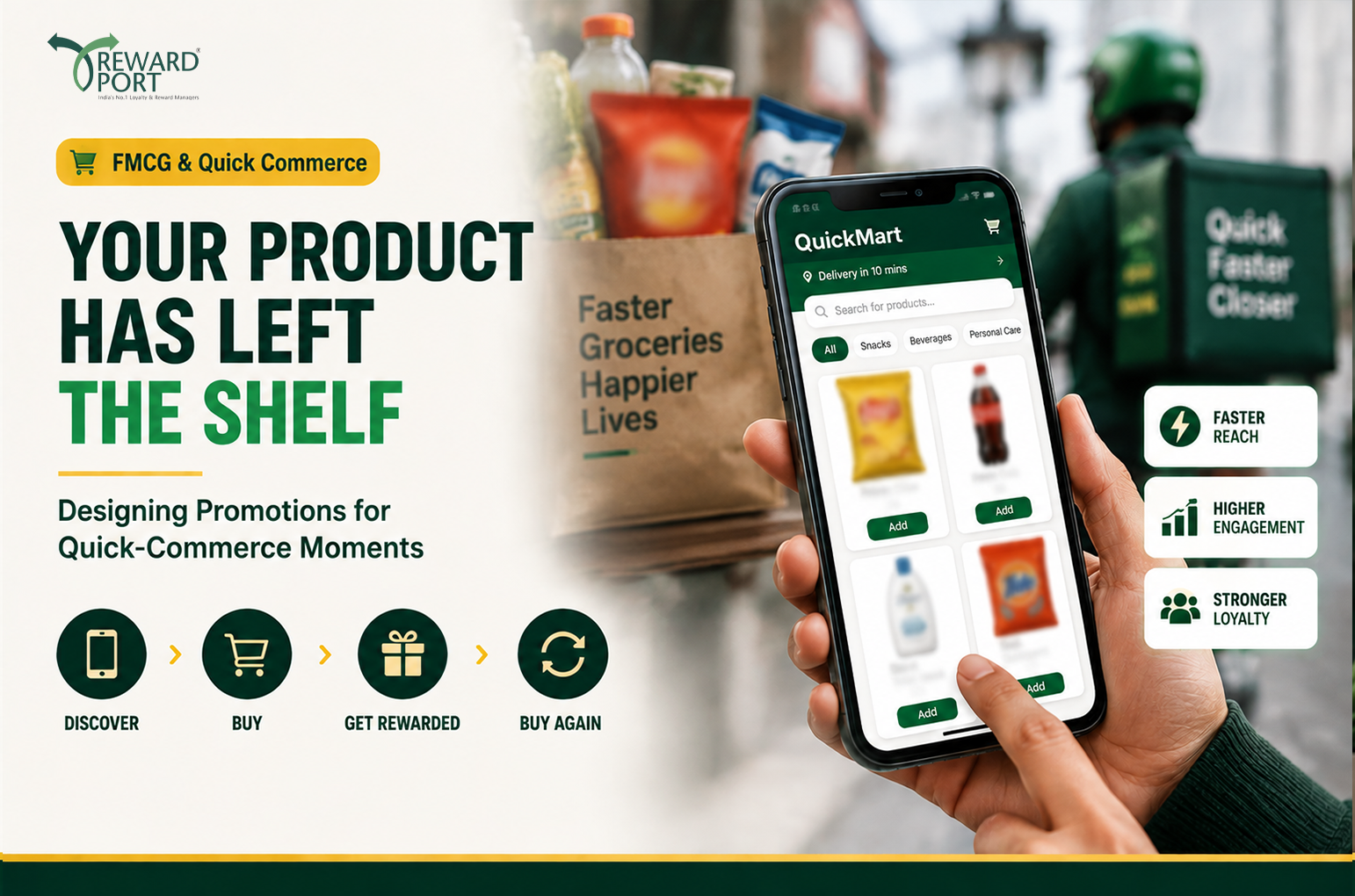
Direct answer: Quick-commerce promotions must win attention on the first screen, fit a short and specific shopping mission, communicate value within a small product tile, remain available at the shopper’s location and continue after delivery through the pack or a permission-based digital journey.
Speed changes discovery, conversion, fulfilment and measurement. It should also change promotion design.
Key takeaways
- Quick commerce compresses product discovery and purchase into minutes.
- A promotion that is invisible in the search result is invisible when it matters.
- Assortment, inventory and promotion design must work together at the micro-market level.
- The platform may drive the sale, but the delivered pack can begin the brand relationship.
- Brands should measure the complete journey from visibility to verified repeat purchase.
Quick commerce did not just speed up delivery
It sped up deciding.
That changes everything.
In a supermarket, a promotion can interrupt a shopper in the aisle. The pack, shelf strip, promoter or end-cap can create the moment.
In quick commerce, the shopper may arrive with a specific mission:
- the milk has finished;
- guests have arrived;
- the child needs a snack;
- the detergent is running out;
- the match starts in 20 minutes; or
- someone suddenly wants ice cream.
The mission is immediate.
The decision window is small.
The screen is crowded.
Your product does not have an aisle.
It has a tile.
How fast is quick-commerce shopping in India?
Bain and Flipkart’s How India Shops Online 2026 estimates that Indian quick commerce reached $10 billion to $11 billion in gross merchandise value in 2025 after doubling annually over the previous two years.
The more important insight for promotion design is behavioral.
Bain describes quick-commerce sessions as typically lasting less than five minutes, compared with more than ten minutes for traditional e-retail.
It reports roughly eight times higher visit-to-order conversion, greater search-led sales, fewer product pages viewed and a stronger role for top-up missions and small packs.
This is not browsing with faster delivery.
It is high-intent shopping with compressed consideration.
WPP Media and Meta’s January 2026 India report adds another signal. It says quick commerce accounted for 45% of festive shopping among the consumers studied, with 91% awareness and more than half reporting use in the preceding week.
The numbers will vary by category, city and study.
The direction is clear.
Quick commerce is becoming both a shelf and a media channel.
Why does the traditional on-pack promotion model need to change?
Because the shopper may choose the product before seeing the pack.
A physical pack can still carry a powerful QR code, unique code or reward message. But on quick commerce, it often becomes visible only after the purchase.
That means the promotion now has two jobs:
- Win the purchase before delivery.
- Build the relationship after delivery.
Many campaigns do one and forget the other.
A platform-funded discount may win the basket but create no direct brand relationship.
An on-pack reward may build engagement but fail if the product tile never communicates that the offer exists.
The promotion has to travel across both environments.
Traditional retail promotion versus quick-commerce promotion
| Decision factor | Traditional retail | Quick commerce |
|---|---|---|
| Discovery | Aisle, shelf, display, promoter | Search, first screen, recommendation, sponsored placement |
| Decision window | Longer physical browsing | Often a short, mission-led session |
| Promotion surface | Pack and point of sale | Product tile, product page, basket and delivered pack |
| Assortment | Store or chain level | Dark-store and micro-market availability |
| Measurement | Often delayed and aggregated | Potentially faster, more granular and location specific |
| Brand relationship | Retailer, pack and brand can all influence it | Platform owns the purchase interface; the pack can create the direct post-purchase connection |
The RewardPort FAST Promotion Framework
A quick-commerce consumer promotion should pass four tests.
F: First-screen clarity
The product and promotion must make sense before the shopper opens the product page.
The product tile should communicate one useful promise:
- assured cashback;
- extra quantity;
- a relevant bundle;
- buy two and unlock a benefit;
- trial reward on a new variant; or
- a clear post-purchase experience.
Do not make the shopper decode a campaign.
Use a short benefit, legible imagery and a precise condition.
Then ensure the product page contains the complete terms without hiding the basic mechanic.
A: Assortment and action fit
Quick-commerce missions are not identical.
A 10 pm indulgence purchase is different from a morning replenishment.
An emergency need is different from a planned stock-up.
A ₹10 trial pack serves a different job from a family bundle.
Match the SKU, pack size and reward to the mission.
Bain specifically recommends micro-market assortment and mission-led pricing and marketing.
A national promotion that ignores local availability can spend on visibility for a product the nearest dark store cannot deliver.
S: Speed-matched value
A ten-minute shopping promise followed by a seven-day reward journey feels broken.
The promotional experience should respect the speed that attracted the shopper.
Where verification permits, deliver an assured benefit quickly.
Show claim status clearly.
If a larger reward requires validation, acknowledge the action instantly and state the exact timeline.
Speed does not always mean cashback.
It means reducing uncertainty.
An instant confirmation, progress marker, voucher, movie benefit or choice of rewards can also fit the moment.
T: Traceable next action
The sale is not the end.
It is the first verified signal.
Use the delivered pack, insert, QR code or consented WhatsApp journey to create an appropriate direct relationship.
The consumer can validate the purchase, receive the benefit, indicate a preference or see progress toward a repeat-purchase milestone.
The next action must be useful, permission-based and measurable.
FAST means: First-screen clarity, Assortment and action fit, Speed-matched value and a Traceable next action.
What are the five promotion moments on quick commerce?
- Inspiration — Social, creator, search or retail media creates the need.
- First screen — The shopper sees a product tile, ranking, badge, price and availability.
- Basket — Bundles, thresholds, combinations and recommendations shape the order.
- Doorstep — The physical product arrives and the pack becomes visible.
- Direct relationship — A QR, code or permission-based message connects the verified action to reward, learning and repeat purchase.
A complete quick-commerce promotion assigns a job to every relevant moment.
Not every campaign needs activity across all five.
But every campaign should know where discovery starts, where the choice is made and where the brand relationship continues.
How should FMCG brands build a quick-commerce promotion?
- Choose the shopping mission. Replenishment, emergency, trial, indulgence, occasion or planned basket.
- Define one primary behavior. Trial, switch, add another product, buy a bundle, repeat or refer.
- Select the right SKU and geography. Confirm local inventory and pack relevance.
- Write the tile-level promise. Make it understandable at thumbnail size.
- Design the basket mechanic. Decide whether the action involves a threshold, combination, quantity or product variant.
- Connect the delivered pack. Use QR, unique code, receipt or another suitable proof.
- Deliver value at channel speed. Minimize delay and uncertainty.
- Create the next action. Show progress, replenishment timing, referral or a relevant follow-on benefit.
- Measure the whole loop. Do not stop at platform orders or code scans.
What would a quick-commerce promotion look like in practice?
Illustrative scenario: A snack brand wants to win evening group occasions, not simply discount single packs.
It creates a “Movie Night in 15 Minutes” bundle for selected city catchments.
The product tile communicates the bundle and assured benefit clearly.
The platform basket combines two snack products and a beverage at an occasion-relevant price.
After delivery, the consumer scans a unique code on the pack.
A simple WhatsApp journey validates participation and unlocks a movie or entertainment benefit.
The confirmation then offers progress toward another occasion reward after a second verified purchase within a defined period.
The campaign measures:
- first-screen impression to product-page or add-to-cart rate;
- bundle attach rate;
- order conversion and average basket;
- availability and out-of-stock loss by micro-market;
- unique-code activation;
- reward delivery and use;
- purchase number two; and
- cost per incremental occasion purchase.
This is an illustrative scenario, not a RewardPort client case study.
Why is inventory part of promotion performance?
Because an unavailable product cannot convert, regardless of media or reward quality.
Quick-commerce inventory is hyperlocal.
A campaign can be live nationally while the promoted SKU is absent from relevant dark stores.
Track availability beside media and promotion metrics.
Pause or redirect spend where stock is unavailable.
Treat out-of-stock impressions as a combined marketing and supply problem, not only an operations problem.
Should brands offer the same promotion on every platform?
No. Keep the objective consistent, but adapt the mechanic to the platform, mission and available inventory.
A universal national promise may be useful for simplicity.
The displayed SKU, basket combination, time window and reward presentation can still vary by platform or location.
Any variation should remain fair, transparent and operationally manageable.
Do on-pack QR promotions still matter in quick commerce?
Yes. They become more important after delivery because they can connect the platform purchase to a direct, permission-based brand journey.
The QR code should not merely open a generic form.
It should recognize the campaign, explain the value, validate the action with minimal friction and give the consumer a clear reason to continue.
Should the reward be instant?
The acknowledgement should be instant. The reward should be delivered as quickly as verification and risk permit.
For a low-value assured benefit, near-instant fulfilment may be appropriate.
For a higher-value claim, the consumer should immediately receive confirmation, status visibility and a credible timeline.
How can quick-commerce promotions create first-party data?
Ask for a direct interaction after purchase and collect only the data needed to provide value or improve a defined decision.
Use clear consent.
Explain why information is being requested.
Connect the data to reward delivery, preference, replenishment, service or another visible benefit.
Do not convert every scan into a long questionnaire.
Which metrics matter most?
Brands should look beyond platform orders and measure the full promotion journey.
Important metrics include:
- First-screen visibility and search share
- Product-tile click or add-to-cart rate
- Basket conversion and attach rate
- Average order value or units per order
- Availability and out-of-stock rate by micro-market
- Platform promotion cost per incremental order
- Verified pack activation rate
- Reward delivery time and success rate
- Repeat purchase within the relevant consumption window
- Cost per incremental repeat purchase
- Duplicate, rejected and suspicious claims
Consent, opt-out and support-contact rates
What is the biggest quick-commerce promotion mistake?
Treating quick commerce as a delivery channel instead of a compressed decision environment.
The winning promotion is not simply the loudest discount.
It is the one that:
- matches the mission;
- wins the first screen;
- is actually available;
- delivers value at the speed expected; and
- turns the delivered product into a measurable next relationship.
Where RewardPort fits
RewardPort can help brands connect quick-commerce promotion design with the post-purchase engagement layer.
This may include:
- campaign mechanics;
- QR and unique codes;
- receipt or invoice validation;
- WhatsApp journeys;
- UPI cashback;
- vouchers;
- merchandise;
- cinema rewards;
- travel and experiences;
- fraud controls;
- fulfilment; and
- reporting.
The goal is not to replace the platform relationship.
It is to make the promotion work harder across the full journey:
First screen to basket. Basket to pack. Pack to repeat purchase.
Planning an FMCG promotion for quick commerce?
RewardPort can help map the offer across the FAST framework and the five promotion moments.
Your Consumer Promotion Is Not an Offer Until It Changes Behaviour
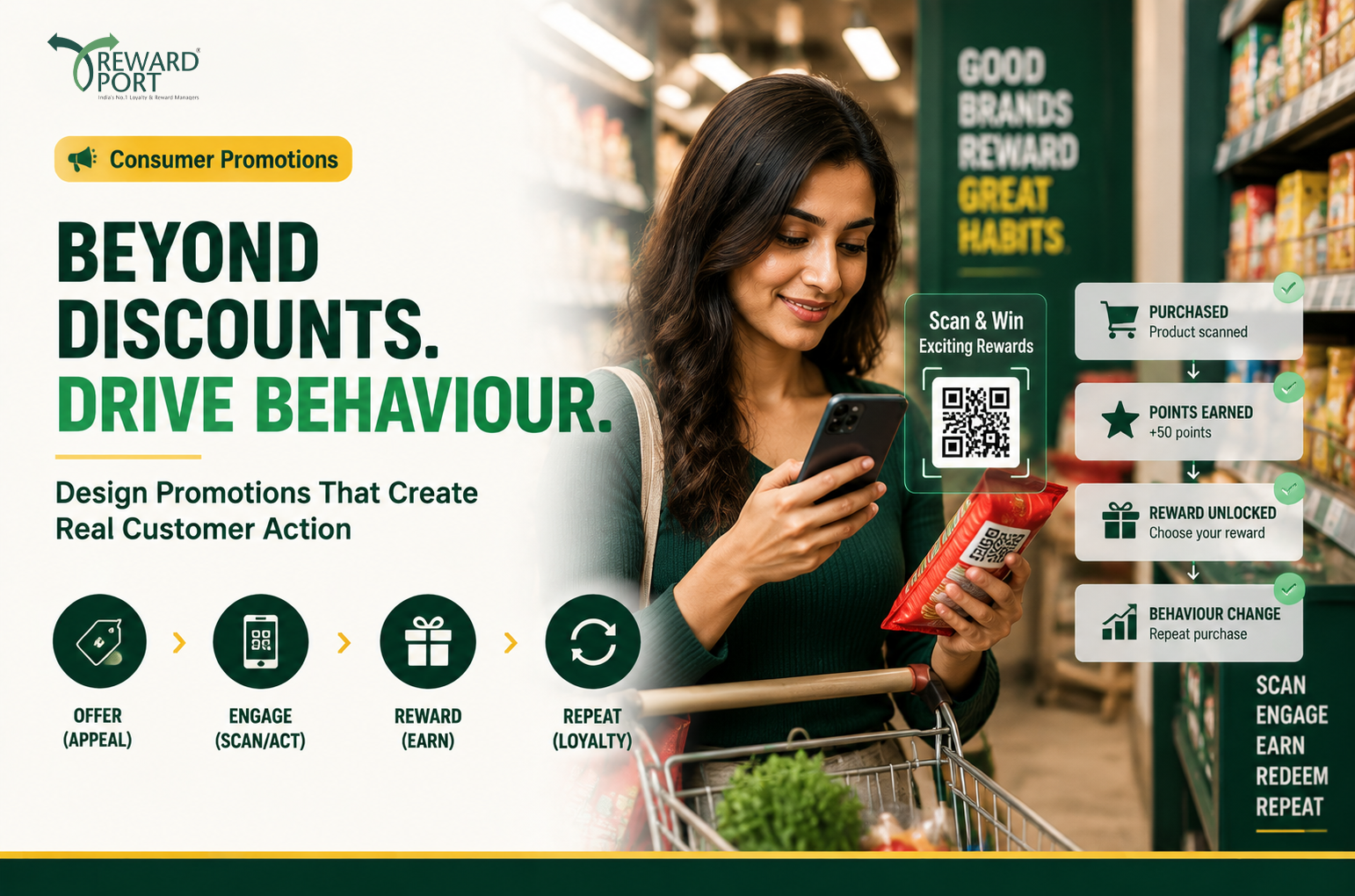
An effective consumer promotion targets one valuable behavior, offers a reward the audience wants, explains the mechanics instantly, makes participation easy, verifies the qualifying action and creates a measurable next step.
A discount can be part of the offer, but price reduction alone does not prove that the promotion created incremental demand, useful customer intelligence or repeat behavior.
Five Things to Remember
- The reward is not the offer. The complete value exchange is the offer.
- If you cannot name the behavior, you cannot measure the promotion.
- Higher perceived value does not always require a higher cash cost.
- Friction, delay and doubt quietly destroy response.
- The best promotion makes the next customer action easier to predict.
Most Promotions Are Spreadsheets Wearing Confetti
A budget gets approved.
A reward gets selected.
A red banner says “WIN”.
A QR code gets added to the pack.
Then everybody waits for redemption numbers.
That is not promotion strategy.
It is campaign assembly.
The missing question is the one that should have come first:
What exactly should the consumer do differently because this offer exists?
Try the brand?
Switch from a competitor?
Buy a new variant?
Increase the basket?
Purchase again sooner?
Refer someone?
Upload a bill?
Return after lapsing?
If the answer is “buy more”, the thinking is not finished.
What Is a Consumer Promotion?
A consumer promotion is a time-bound value exchange designed to trigger, verify and measure a specific consumer action.
The value might be cashback, a voucher, merchandise, a movie, travel, an experience, extra product, access, recognition or a chance to win.
But the reward is only one part.
The complete promotion includes:
- The target audience
- The behavior to be changed
- The qualifying action
- The value offered
- The entry and verification method
- The time window
- The fulfilment experience
- The next desired action
- The measurement plan
Remove any of those pieces and the offer becomes weaker.
Is a Discount the Same as a Consumer Promotion?
No. A discount changes the price. A consumer promotion should change behavior.
A discount may be the correct tool.
Capgemini Research Institute’s 2026 global consumer study, which included India, found that 75% of surveyed consumers considered fixed money-off deals the most effective promotion format, ahead of percentage discounts and buy-one-get-one offers.
So discounts work.
But that is not the same as saying every discount creates incremental growth.
Nielsen IQ states that nearly half of promotional sales can come from purchases that would have occurred without the promotion.
The danger is simple: a brand can give away margin and call the resulting volume “success”, even when the customer was already going to buy.
Discounting is easy to launch. Incremental behavior is harder to design.
The RewardPort PROMO Test
Before approving any consumer promotion, test five parts.
P: Precise Behavior
Choose one primary action.
Not awareness plus trial plus repeat plus referral plus data capture plus loyalty.
One primary action.
Everything else is secondary.
When the action is precise, the audience, mechanic, reward and measurement become easier to design.
R: Relevant Value
The consumer must believe the reward is worth the action.
That does not mean offering the most expensive reward.
A small instant cashback can beat a large but doubtful prize.
A cinema benefit can feel more memorable than the same procurement value in cash.
An experience can create aspiration.
Extra product can work when utility matters most.
Relevance depends on the person, the behavior, the category and the moment.
O: Obvious Mechanics
The consumer should understand the promotion in seconds.
What do I do?
What do I get?
When do I get it?
What could disqualify me?
If the front of the campaign needs a paragraph of legal copy to explain the basic action, the mechanic is too complicated.
M: Measurable Action
The qualifying action must leave evidence.
That could be:
- A unique code
- QR scan
- OTP
- Invoice
- Receipt image
- Transaction record
- Referral ID
- Another approved operational signal
Verification protects the budget.
It also protects the learning.
Bad evidence creates bad conclusions.
O: Ongoing Next Step
Do not let fulfilment end the relationship.
After the reward, what should happen?
- Show progress toward purchase number two.
- Offer a relevant cross-sell.
- Invite a referral.
- Ask one useful preference question.
- Move the participant into a replenishment journey.
A campaign that ends at payout has purchased an action.
A campaign that learns and continues has started building an asset.
The Consumer Promotion Action Equation
Action Strength =
(Perceived Value × Clarity × Trust) ÷ (Effort + Delay + Doubt)
This is a design diagnostic, not an audited financial formula.
Its job is to force better questions.
Perceived Value
Does the benefit feel worthwhile to this audience?
Clarity
Can a consumer understand the promise quickly?
Trust
Does the offer feel genuine, fair and achievable?
Effort
How many steps, fields, uploads and follow-ups are required?
Delay
How long until the consumer receives value?
Doubt
Are the odds, exclusions, eligibility or fulfilment uncertain?
Brands usually try to improve response by increasing the reward.
Often, the cheaper move is to reduce the denominator.
Remove two fields.
Explain the rule better.
Deliver the reward faster.
Make eligibility visible.
Show claim status.
Reduce doubt.
You may not need a bigger prize.
You may need a better offer.
How Do You Build a Consumer Promotion Backwards?
1. Name the Behavior
Write the primary action in one sentence.
2. Estimate the Economic Value
Determine what an incremental action is worth and how much can responsibly be invested.
3. Select the Audience
Separate likely responders from people who would act anyway.
4. Choose the Value Architecture
Match cashback, merchandise, vouchers, cinema, travel or experiences to the audience and effort.
5. Strip Away Friction
Remove every step that does not improve verification, compliance or experience.
6. Define Proof
Select the right validation method and fraud controls.
7. Set Urgency Honestly
Use a clear time window without manufactured pressure or hidden conditions.
8. Design the Next Action
Decide what the participant sees after fulfilment.
9. Measure Incrementality
Compare against a baseline, control or other credible reference where feasible.
What Does a Weak Promotion Look Like?
Illustrative example:
A beverage brand launches “Scan and Win”.
The pack does not say what most people can receive.
Registration asks for seven fields.
The reward arrives days later.
Every purchase gets the same treatment.
The brand reports scans and redemptions.
Technically, it worked.
Commercially, nobody knows.
What Does a Stronger Version Look Like?
The same brand wants consumers to try a new low-sugar variant.
The pack makes one promise:
Try it. Scan it. Get an assured reward now.
The unique code verifies purchase.
The consumer gives only the information needed for delivery and consent.
The first action earns an immediate micro-reward.
The confirmation screen shows progress toward a more memorable benefit after a second verified purchase within a sensible period.
The brand measures:
- Verified trial of the new variant
- Conversion to purchase number two
- Time between purchases
- Reward delivery success
- Duplicate or suspicious claims
- Cost per incremental trial
- Cost per incremental repeat purchase
Same category.
Same QR technology.
Very different offer.
This example is illustrative and is not presented as a RewardPort client case study.
Should Every Promotion Offer Cashback?
No.
Use cashback when liquidity, certainty and speed are the strongest value drivers.
Cashback is excellent when the consumer wants immediate, universally understood value.
It is weaker when the brand needs aspiration, memory, discovery, status or a reward whose perceived value can exceed its delivery cost.
The right question is not:
“Is cashback good?”
It is:
“What form of value best reinforces this action?”
Are Assured Rewards Better Than Contests?
Neither is universally better.
Assured rewards improve certainty.
Contests can increase excitement and prize scale.
Use an assured benefit when broad participation and trust matter.
Use a contest when the audience accepts chance and the prize can create disproportionate attention.
Hybrid structures can combine an assured base benefit with a transparent chance to win something larger.
Always make odds, eligibility, dates and claim rules clear and compliant.
How Large Should the Promotional Reward Be?
Large enough to make the action feel worthwhile, but smaller than the expected economic value of the incremental behavior.
Start with the value of the desired action, not a competitor’s reward.
Then test:
- Perceived value
- Response
- Fulfilment cost
- Fraud exposure
- Unit economics
A high reward can attract participation while destroying unit economics or attracting the wrong behavior.
Why Do Consumers Abandon Promotion Journeys?
Most abandonment comes from:
- Low perceived value
- Confusing mechanics
- Excessive effort
- Slow fulfilment
- Lack of trust
Track drop-off at each step.
If scans are high but registrations are low, the form or promise may be weak.
If approvals are high but redemptions are low, fulfilment may be failing.
Diagnose the step. Do not blame the consumer.
How Should Consumer-Promotion Fraud Be Controlled?
Match verification strength to the reward value and abuse risk.
Controls can include:
- Unique-code validation
- OTP
- Invoice or receipt parsing
- Duplicate detection
- Velocity limits
- Device or account signals
- Time rules
- Manual review for exceptions
Do not add so much control that genuine participants cannot complete the journey.
What Are the Most Important Consumer-Promotion Metrics?
Measure:
- Incremental sales or actions, not only total promotional sales
- Verified participation rate
- Cost per incremental action
- Purchase number two or repeat-action rate
- Completion and drop-off by journey step
- Reward delivery time and success rate
- Redemption or utilization rate
- Duplicate, rejected and suspicious claim rates
- Support contacts and complaints
- Useful consented first-party data captured
Does a One-Off Consumer Promotion Create Loyalty?
Not by itself.
A one-off promotion can recruit, reactivate or trigger trial.
Loyalty requires repeated value and repeated preference.
A smart promotion can become the first step in a loyalty journey when the brand recognizes the participant, learns from the action and designs a relevant next interaction.
The Final Test
Before you approve the next consumer promotion, remove the logo from the presentation.
Remove the celebrity.
Remove the campaign name.
Remove the confetti.
Now read the offer.
Is the action precise?
Is the value relevant?
Are the mechanics obvious?
Can the action be measured?
Does it create a next step?
If yes, you have a promotion.
If not, you have decoration.
Where RewardPort Fits
RewardPort helps brands design and operate consumer promotions around measurable behavior.
The execution can combine:
- On-pack or digital mechanics
- QR and unique codes
- WhatsApp journeys
- OTP
- Bill or invoice parsing
- UPI cashback
- Vouchers
- Merchandise
- Cinema
- Travel
- Experiences
- Fulfilment
- Fraud controls
- Reporting
The objective is simple:
Do not merely distribute rewards.
Build an offer that earns the right action and improves the next one.
Planning a consumer promotion?
RewardPort can review the offer using the PROMO Test before the campaign goes live. Speak with RewardPort.
How to Reduce Drop-Off in Consumer Promotions: Strategies for Indian Businesses
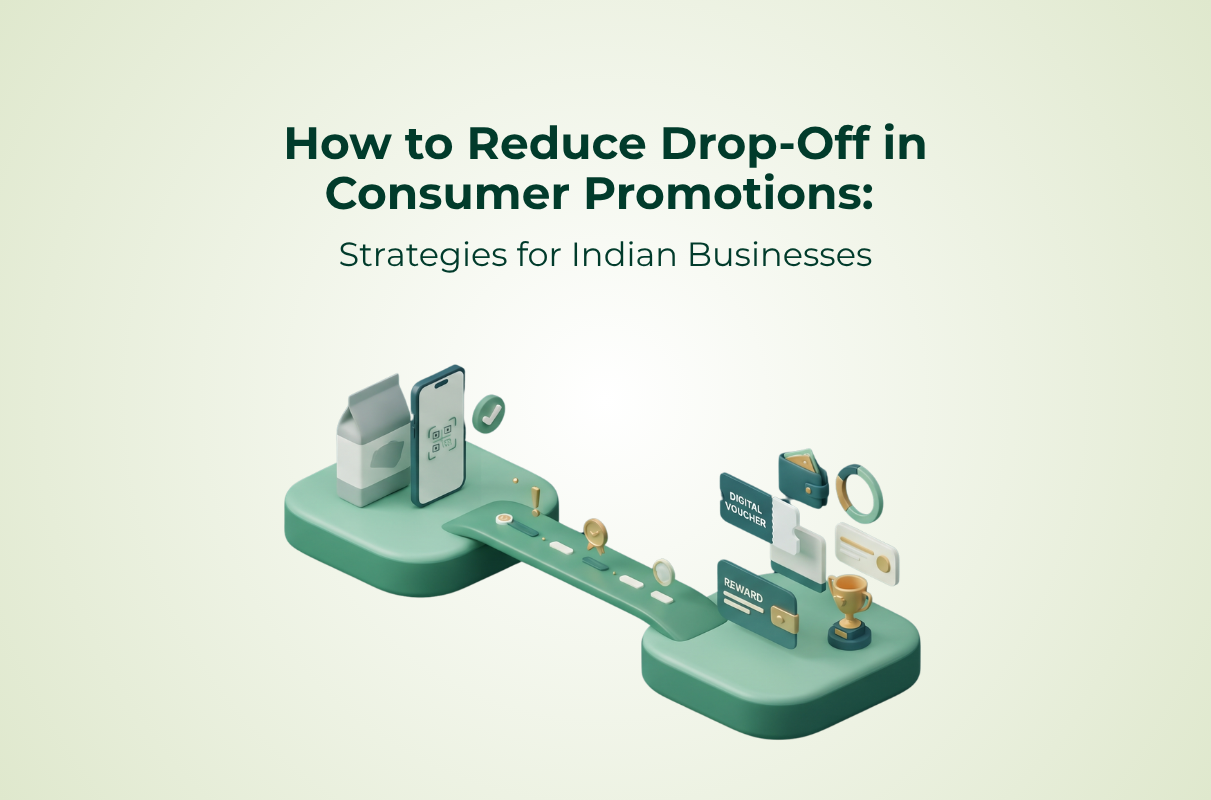
In India’s dynamic market landscape, reducing drop-off in consumer promotions is crucial for brands seeking to maximise participation, engagement, and ultimately sales. Despite rising demand for innovative promotional campaigns, many brands face challenges with consumer drop-off—where prospects abandon the promotion before completing the intended action. This article explores why reducing drop-off matters, current market trends in India, and actionable strategies supported by RewardPort expertise and solutions to enhance campaign effectiveness in 2026 and beyond.
Understanding Consumer Drop-Off in Promotions: Market Context and Behaviour
Consumer drop-off refers to the loss of participants at various stages of a promotional funnel, such as during entry, validation, or reward redemption. In India, this issue is influenced by diverse factors including digital literacy, payment preferences, regional language barriers, and trust in promotion authenticity.
Research shows that Indian consumers increasingly expect seamless digital experiences with instant gratification options such as digital vouchers, cashback, and gamified rewards. However, complex entry processes, delayed gratification, and limited reward relevance are common causes of drop-off.
Emerging Trends Shaping Consumer Promotions in 2026
By 2026, consumer promotions in India are embracing key trends to tackle drop-off:
- Instant Gratification: Immediate rewards like cashback, multi-brand vouchers, and digital coupons help maintain enthusiasm and reduce churn.
- Gamification: Interactive games and scratch cards engage consumers more deeply, creating entertainment value alongside promotional impact.
- Localized Engagement: Campaigns tailored linguistically and culturally connect better and cut drop-off due to comprehension gaps.
- Omnichannel Access: Combining digital, retail, and mobile touchpoints ensures consumers can participate effortlessly regardless of preferred platform.
- Reward Personalization: Offering relevant rewards such as travel vouchers, entertainment passes, or essential services keeps consumers motivated to complete participation.
Practical Implications for B2B Marketers and Channel Leaders
For marketers and sales leaders in India, reducing drop-off is directly linked to improved campaign ROI, higher repeat purchase rates, and stronger channel partner activation. Simplifying promotional processes and choosing execution methods aligned with target demographics are essential. Moreover, tracking participation at every touchpoint provides insights to identify friction points and iterate quickly.
RewardPort Perspective and Solutions to Reduce Drop-Off
RewardPort leverages deep market expertise and digital technology to help Indian businesses reduce drop-off in consumer promotions through:
- Plug-and-Play Campaign Modules: Instant-win scratch cards, QR scan-to-win, and WhatsApp-based entry methods enhance user convenience and speed of engagement.
- Rich Reward Catalogue: Multi-brand vouchers, cashback options, travel and entertainment rewards deliver relevant choices that resonate with diverse audiences.
- Gamification Engine: Over 100 branded games that boost fun and sustained participation.
- Instant Redemption Platforms: Freebucks points system and RewardOne voucher engine ensure hassle-free, real-time reward fulfilment.
- Advanced Analytics and Tracking: Monitor drop-off trends and participation metrics to refine targeting and campaign design.
Verified RewardPort Case Study Insights
One notable RewardPort-led campaign combined a gift-with-purchase promotion using branded scratch cards rewarding movie tickets instantly. This approach reduced drop-off significantly by merging familiar consumer habits with instant gratification rewards, driving increased participation and sales uplift. Similarly, channel partner incentive programs integrating easy redemption travel rewards saw better engagement and redemption rates, underscoring the impact of personalized, accessible rewards.
Implementing a Drop-Off Reduction Framework
Businesses can adopt a stepwise approach:
- Map User Journeys: Identify drop-off points in the promotional funnel.
- Simplify Entry Mechanisms: Use QR codes, WhatsApp participation, or receipt uploads to lower barriers.
- Leverage Gamification: Include engaging games and contests to maintain interest.
- Offer Instant Rewards: Prioritize digital vouchers, cashback, and instant-win campaigns.
- Utilize Analytics: Continuously monitor and optimise using data-driven insights.
- Customize Rewards: Ensure rewards align with consumer preferences and regional nuances.
Reducing drop-off in consumer promotions is a strategic imperative for Indian businesses aiming to maximise campaign participation, engagement, and sustained customer loyalty. By adopting instant gratification, gamification, personalized rewards, and seamless digital experiences—backed by RewardPort advanced platforms and diverse reward catalogue—brands can significantly lower drop-off rates and boost promotional success in 2026 and beyond.