
India’s Festive Discount War Has a Problem: Everyone Is Giving More. Few Are Getting More Behaviour Back.
India’s festive season is becoming bigger, faster and more complex.
But for brands, the central promotion question has not changed:
What behaviour are we buying with the incentive?
A discount can trigger a transaction. A well-designed promotion can do considerably more.
It can encourage trial, increase basket size, capture first-party data, influence repeat purchase, activate retailers, generate referrals and create a measurable reason for the customer to come back.
That distinction matters even more when almost everyone is offering a deal.
The short answer: What should brands do differently this festive season?
Brands should stop treating the festive promotion as a single discount event.
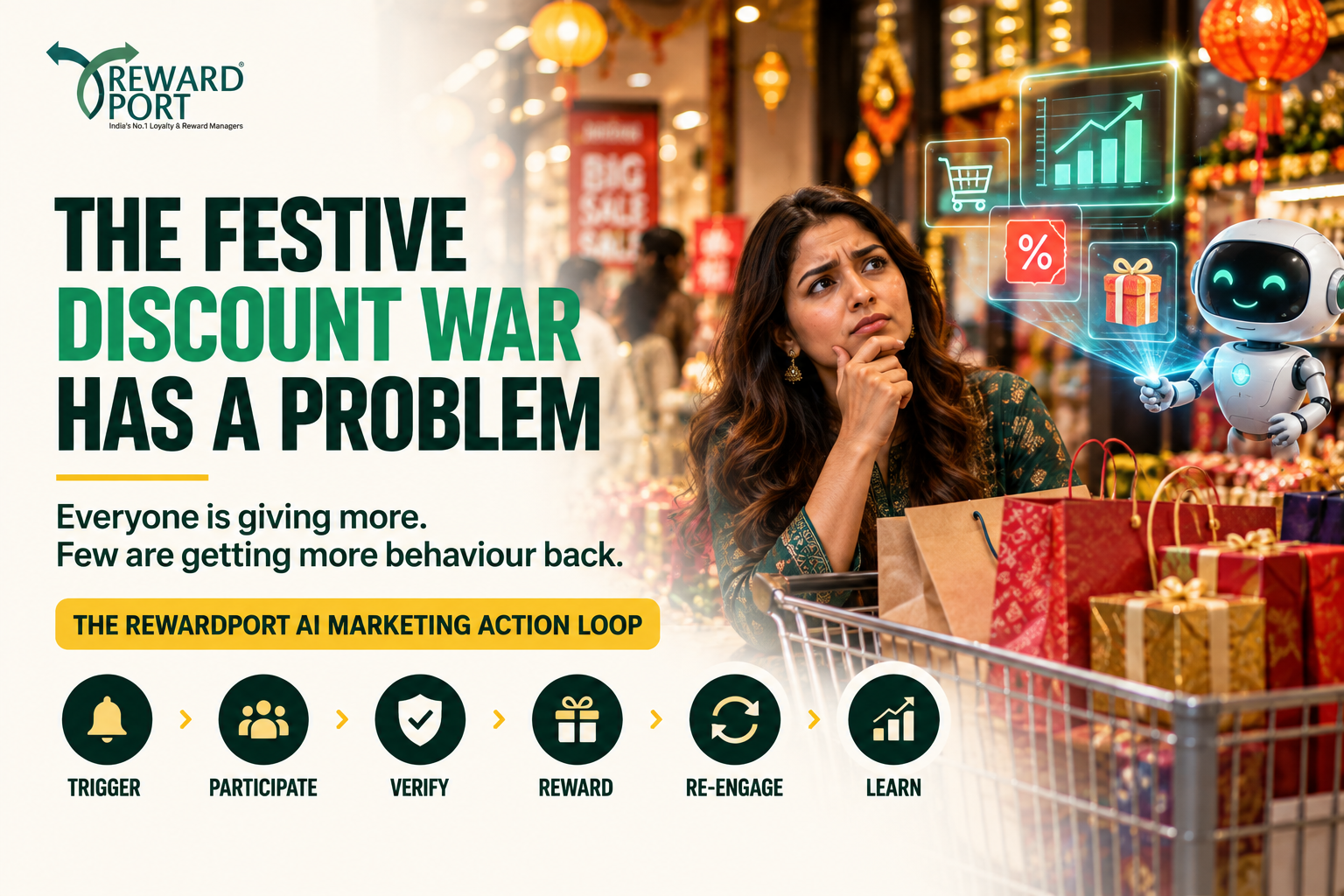
A stronger model connects six stages:
Trigger → Participate → Verify → Reward → Re-engage → Learn
The promotion should begin with the behaviour the business wants to influence, not with the reward it wants to give away.
That could mean:
- Getting a new customer to try the product
- Encouraging an existing buyer to purchase again
- Increasing basket size
- Activating a retailer
- Generating a referral
- Driving registration after purchase
The incentive then becomes the mechanism, not the strategy.
Five things marketers should know about festive promotions in 2026
- Indian festive shoppers are researching across more touchpoints before buying.
- At the same time, spontaneous festive purchases remain significant.
- AI is becoming part of product discovery and purchase decision-making.
- A generic discount is increasingly easy for competitors to replicate.
- The most valuable promotion may therefore be one that creates both a transaction and a reusable customer signal.
Google’s September 2026 India festive research says nine in ten Navratri/Diwali purchasers researched before buying, while shoppers averaged 8.3 search-engine searches and 7.7 online videos during their shopping journey. Yet 70% also reported making a spontaneous festive purchase.
That combination is important.
The Indian festive customer can be highly considered and highly impulsive at the same time.
A promotion has to work in both moments.
India is certainly not running out of discounts
Look at the major festive platforms.
Amazon’s Great Indian Festival includes card discounts, cashback offers, Prime benefits, rapid delivery and multiple category-level discounts. Amazon is also integrating AI-powered shopping tools into the purchase journey.
Source:
https://www.aboutamazon.in/news/retail/amazon-great-indian-festival-2026-deals
Flipkart’s Big Billion Days also continues to build large-scale festive shopping momentum with its festive campaigns and offers.
Source:
https://stories.flipkart.com/
There is nothing inherently wrong with discounting.
Price remains one of the strongest reasons to act.
But the strategic problem for an individual brand is obvious:
If everybody is offering discounts and cashback, how much of the customer relationship actually belongs to the brand?
A discount can win the transaction.
It does not automatically win the next transaction.
The real problem is not discounting. It is discounting without an objective.
Promotions often begin in the wrong place.
The conversation starts with:
“What should we give?”
₹50 cashback?
A voucher?
A free product?
A contest?
Movie tickets?
A holiday?
That reverses the logic.
The first question should be:
“What behaviour do we want to change?”
Consider how different the answer becomes.
If the objective is trial, an instant low-friction reward may make sense.
If it is repeat purchase, the second reward should probably depend on another verified purchase.
If it is basket growth, the mechanic could unlock progressively better value as spend increases.
If the objective is referral, the reward should follow successful acquisition, not simply sharing a link.
If the objective is dealer activation, incentives might depend on billing, learning, display compliance or sell-out rather than merely enrolment.
Same festive period.
Completely different promotion architecture.
The Festive Behaviour Loop
A practical way to build a modern festive promotion is through six connected stages.
1. Trigger
What exactly are you asking the customer to do?
Examples might include:
- Buy a specific SKU
- Buy two instead of one
- Spend above a threshold
- Try a new variant
- Scan the pack
- Upload an invoice
- Refer another customer
- Register the product
- Make another purchase within 30 days
The more precise the behaviour, the easier it becomes to design the incentive and measure success.
2. Participate
Make joining the promotion as easy as the behaviour permits.
For many Indian campaigns this could involve:
- QR code
- Microsite
- WhatsApp journey
A customer might:
Scan → WhatsApp opens → OTP verifies → Purchase details submitted → Reward unlocked
There is no universal ideal flow.
A ₹20 impulse reward should not require six screens and a lengthy form.
A high-value promotion involving expensive products may legitimately need stronger verification.
Friction should match risk.
3. Verify
This may be the least glamorous part of a campaign, but increasingly one of the most important.
Did the qualifying behaviour genuinely happen?
Verification might involve:
- QR code
- OTP
- Unique code
- Invoice
- OCR
- Transaction record
- Serial number
- Approved channel data
Without verification, brands may know that someone participated.
They may not know whether the desired commercial action occurred.
4. Reward
Now ask what kind of value best fits the customer and behaviour.
Cashback is one option.
It is not the only one.
Depending on audience, campaign economics and objective, a reward architecture might include:
- UPI cashback
- Vouchers
- Merchandise
- Cinema
- OTT
- Travel
- Experiences
- Club benefits
- Sweepstakes
- Milestone rewards
- Instant wins
The key consideration is not simply the rupee cost of the reward.
It is the perceived value relative to the behaviour being requested.
5. Re-engage
This is where many promotions unnecessarily end.
Customer participates.
Reward is delivered.
Campaign closes.
But the first verified interaction can be the beginning of the next one.
For example:
Purchase 1 → Instant reward → Second-purchase challenge → Milestone → Referral → Reactivation
Instead of one festive transaction, the brand begins creating a behaviour sequence.
6. Learn
The final stage is intelligence.
Brands should understand:
- Which SKU generated participation?
- Which reward drove stronger response?
- Which consumers purchased again?
- Where was fraud concentrated?
- Which retail locations produced engagement?
- Did a higher-value reward materially alter behaviour?
- Which customers should receive the next offer?
A promotion should ideally finish with more knowledge than the brand had when it started.
That knowledge becomes the input to the next campaign.
From festive promotion to festive behaviour system
Traditional festive promotion:
- Start with an offer
- Give everyone the same incentive
- Count redemptions
- Campaign ends after fulfilment
- Focus on reach and participation
- Data sits in a campaign report
Behaviour-led festive promotion:
- Start with a business behaviour
- Match incentive to objective or audience
- Verify qualifying behaviour
- Trigger a next action
- Measure incremental commercial behaviour
- Use data to inform the next intervention
This does not mean every promotion needs to become complicated.
The customer experience can remain extremely simple.
The sophistication belongs behind the scenes.
The next opportunity: consumer promotion and channel promotion should talk to each other
Consumer campaigns and retailer schemes are frequently planned as two separate activities.
But both sides are influencing the same sale.
Imagine a packaged-goods brand launching a festive SKU.
The consumer promotion might reward:
Purchase → Scan → Verified participation → Reward
At the same time, the retailer program could reward:
Stocking → Display compliance → Product learning → Verified sale → Milestone incentive
Now the brand can potentially see demand from both directions.
The consumer layer creates pull.
The channel layer strengthens availability, visibility and advocacy.
AI makes this architecture more interesting
The festive shopper is increasingly using AI in the purchase journey.
Google reports that Indian shoppers who used AI platforms or AI features during Navratri/Diwali shopping used generative AI chatbots during their journey. Among those users, AI helped many shoppers make decisions and shorten decision-making time.
Brands increasingly face customers whose decisions are assisted by software.
That makes better offer design, product information and customer data more important.
AI can also support promotions by helping brands:
- Interpret uploaded invoices
- Detect anomalies
- Identify participation patterns
- Answer promotion questions
- Recommend next-best actions
- Analyse campaign data
- Identify retailer engagement opportunities
- Personalise follow-up journeys
The important point is that AI should improve the promotion system.
It should not merely write the promotion headline.
A ₹50 cashback is not automatically a ₹50 marketing idea
Suppose two campaigns have the same funded reward cost.
Campaign A
Buy product.
Receive ₹50.
Campaign B
Buy product.
Scan QR.
Verify purchase.
Choose between movie, voucher, cashback or experience benefit.
Complete another purchase within 30 days to unlock additional value.
Strategically, they are purchasing different things.
Campaign A primarily incentivises one purchase.
Campaign B may generate a verified customer relationship, reward preference data and a reason for a second interaction.
That is why promotion ROI cannot be assessed simply by looking at how many rewards were redeemed.
What should brands measure?
Commercial
- Incremental units sold
- Incremental revenue
- Basket-size change
- Repeat purchase
- Cost per incremental action
Engagement
- Participation rate
- Completion rate
- Reward selection
- Referral completion
- Repeat engagement
Operational
- Verification success
- Fulfilment time
- Support queries
- Channel participation
Risk
- Duplicate claims
- Invalid invoices
- Suspicious code activity
- Reward abuse
Intelligence
- Verified first-party profiles created
- Identifiable repeat purchasers
- Reward preferences
- Geography and channel patterns
A campaign with one million scans is not necessarily more successful than one with 200,000.
The question is what those scans represented.
Five festive promotion designs worth considering
1. The repeat-purchase festive challenge
Purchase once and receive an instant benefit.
Purchase again within a defined period to unlock a stronger reward.
Best suited for: FMCG, food, beverages, personal care and repeat-purchase categories.
2. The festive reward wallet
Each qualifying purchase adds value or unlocks another benefit.
The customer has a reason to continue participating during the season.
3. The experience unlock
Use a transaction to unlock access to a higher perceived-value benefit such as movies, entertainment, travel or experiences.
4. Consumer + retailer twin promotion
Reward the consumer for verified purchase while simultaneously giving participating retailers goals around visibility, knowledge or sell-out.
5. Festive purchase to post-festive loyalty
Use the festive offer to acquire the customer, but reserve part of the value for an action in November or December.
How RewardPort fits into this model
RewardPort’s role in consumer promotions spans the infrastructure required to connect these stages:
- QR and on-pack campaigns
- WhatsApp journeys
- OTP and purchase verification
- Invoice and OCR-based validation
- Cashback
- Gamification
- Multiple reward categories
The more important principle, however, is not the technology itself.
It is the sequence:
Objective → Behaviour → Verification → Reward → Measurement → Next Action
A festive promotion should therefore not be viewed simply as a seasonal giveaway.
Done properly, it becomes a measurable demand loop.
The festive opportunity is bigger than the festive offer
Festive marketing will always contain deals.
Customers expect them.
The opportunity for brands is to stop treating the deal as the entire campaign.
The strongest promotion architecture starts by asking:
What do we want the customer or channel partner to do differently?
Then:
Can we make that behaviour easy?
Can we verify it?
Can we reward it appropriately?
Can we create a reason for another action?
Can what we learn make the next intervention better?
The festive brands that answer those questions are doing more than giving customers a better deal.
They are using the festive season to build a better growth system.