
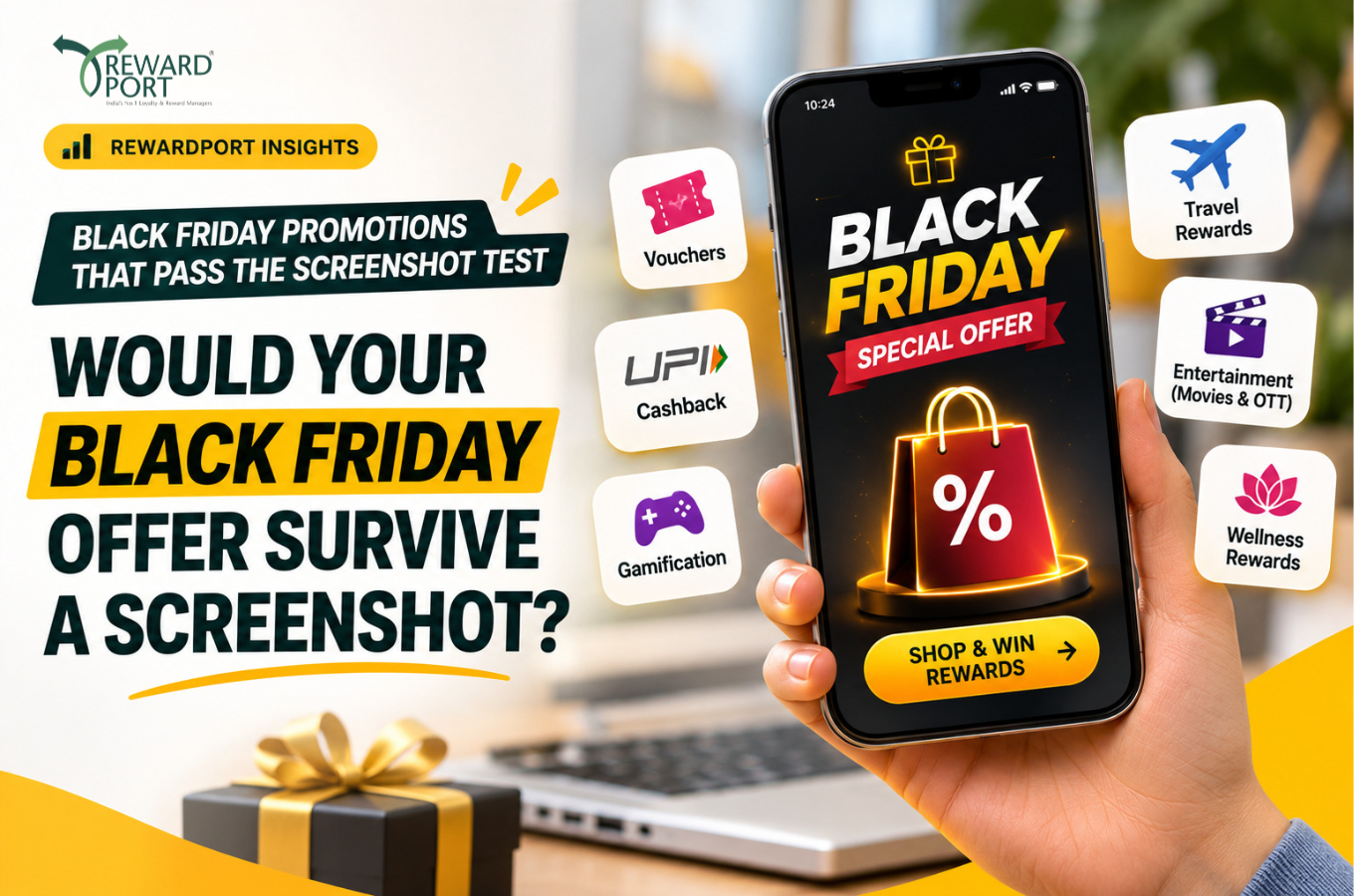
Would Your Black Friday Offer Survive a Screenshot?
A shopper takes a screenshot of your Black Friday banner and sends it to a friend.
“Is this a good deal?”
Her friend replies, “On what?”
There goes the first half of the media budget. The second half is currently looking for the asterisk.
The screenshot is a useful place to start because it travels without your landing page, your brand film or the nice person on the chat widget. It contains exactly what a shopper saw and almost none of what the campaign team meant.
In November 2026, Boston Consulting Group reported that 54% of respondents in its year-end sales study trusted advertised prices at these events. The study surveyed 10,220 adults across ten markets in Europe, North America and Australia. The finding gives us a reason to examine how a shopper verifies value before asking how to make the number on the banner bigger. BCG’s 2026 year-end sales study
One pair of headphones and three offers
Imagine a $100 pair of wireless headphones with a $55 variable cost before the promotion. We can spend up to $10 per qualifying shopper on the offer itself. We can make the discount immediate, put an extra benefit alongside the purchase or save the incentive for the next order. Any incremental programme fees, delivery costs or support costs must be included in the relevant arm. These are illustrative numbers.
| What the shopper sees | Offer cost to the brand | When it earns its place |
| Pay $90 today. | $10 on each qualifying order. | Test it when immediate conversion is the goal and price is a credible barrier. |
| Pay $100 and get two cinema tickets. | Assume $10 for both tickets, including fulfilment. | Test it when the audience values the experience and can actually book it. |
| Pay $100 and get $10 off an eligible next order within 45 days. | Up to $10 per customer, depending on redemption, before any fees. | Test it when the brand sells something customers are likely to need again within that window. |
The cinema tickets are where the conversation gets interesting. Two tickets in a city with good cinema coverage can feel like a Friday night already sorted. Two tickets with no convenient venues, narrow time slots and a long booking flow can feel like homework with popcorn.
The $10 credit has a different problem. A headphone buyer may be done shopping in the category for months. The offer becomes more credible if there is a natural next purchase, such as a compatible travel case, and the terms let the customer use it on that purchase. Check the price of that case before you print the offer. A $10 reward that requires a $90 order will have a very different audience.
Give the offer the screenshot test
First, crop the offer to the size of a phone screen. Then hand it to someone who did not work on it. Ask them to answer four questions without opening a second page.
- What do I pay today?
- What exactly do I get and when?
- What might make me ineligible?
- If I have to claim it, what is the first step?
Put material constraints where the shopper makes the choice. A cinema reward may depend on location, participating venues and booking windows. A future credit may depend on a minimum spend. If the gift can run out, say so up front. Use a short terms link for detail and keep the condition that changes the offer next to the promise.
Run the same test with customer support. If a service agent needs a spreadsheet to answer “Can I use this on Saturday?”, the shopper is probably going to need help too.
Make the decision on contribution
At 100 orders, the headphones generate $4,500 in contribution before any offer cost or other costs excluded from this simplified example. A $10 markdown brings that to $3,500 on the same 100 orders. The assured gift has the same simplified contribution at that volume if all 100 gifts cost $10 each to deliver. A next-order credit needs a longer measurement window because the first and second order both matter.
Use comparable audiences, stores or regions, with a control group where feasible. Keep product availability, placement, shipping and timing as similar as possible. Compare contribution per eligible shopper across groups by subtracting variable product costs, incremental fulfilment, reward costs and any extra support or media spend from net sales after discounts. Subtract only costs that are still outside net sales so a redeemed credit is counted once. Read the immediate offers at the close of the sale and read all arms again after the future reward has had time to expire and returns have settled.
The main question is how many purchases the offer added, how much contribution they generated and what happened after the rush. A credit redeemed by customers who were already going to reorder can post a lovely redemption rate while quietly paying for sales the brand would have had anyway. A comparison group is what helps separate those outcomes.
Track claim completion and fulfilment exceptions alongside contribution. Check how often customers qualify but fail to receive the reward, how many contact support and how many attempts are duplicates. Every one of those numbers can explain why an attractive offer underperforms.
If you’re planning a promotion around a margin target, bring one product, one audience and one budget to the discussion. RewardPort can help map the offer, the claim process and the measurement plan before the banner goes live. RewardPort sales promotions
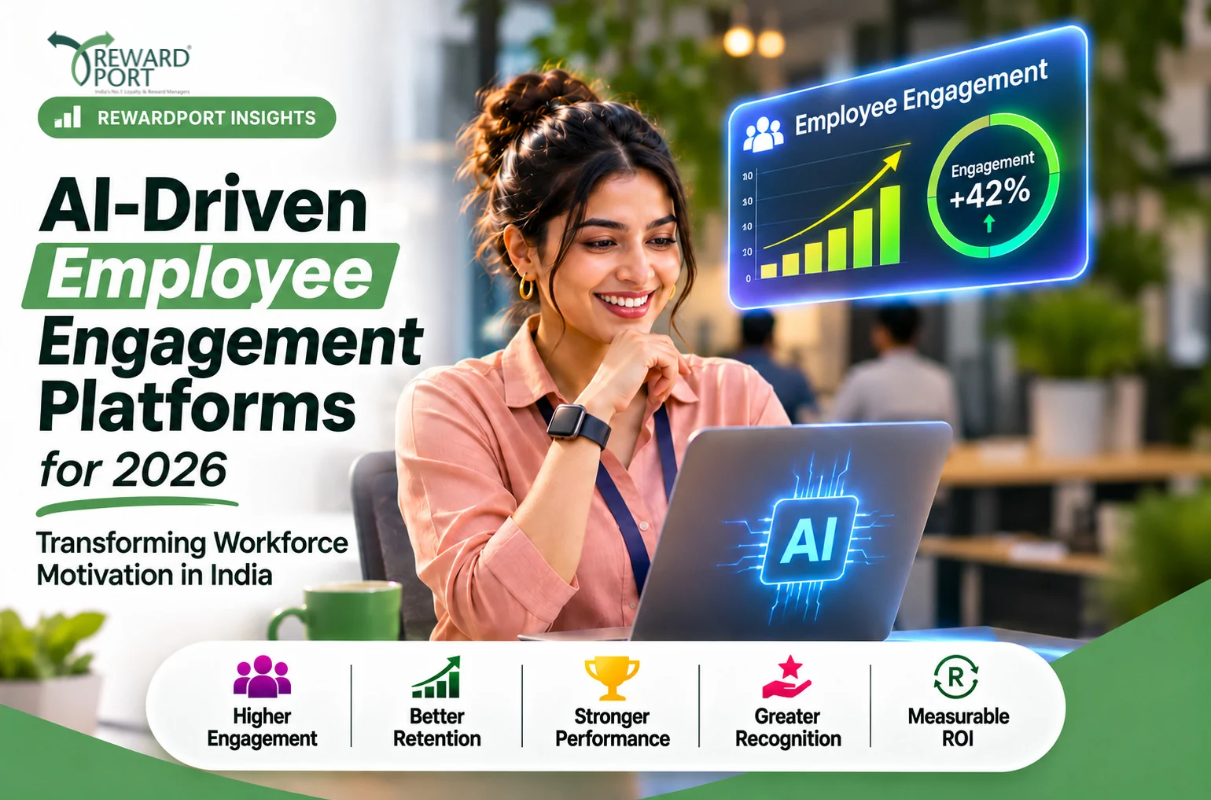
AI-Driven Employee Engagement Platforms for 2026: Transforming Workforce Motivation in India
In today’s rapidly evolving Indian business landscape, employee engagement has become a pivotal factor for organisational success. By 2026, AI-driven employee engagement platforms will redefine how companies motivate their workforce, combining cutting-edge technology with hyper-personalisation to deliver impactful rewards and incentives. Indian businesses, from startups to multinational corporations, must embrace these advancements to enhance employee satisfaction, retention, and productivity.
Market Context: India’s Digital and Workforce Evolution
India’s workforce is one of the largest and youngest globally, characterised by diversity in culture, language, and preferences. At the same time, India is witnessing unprecedented digital transformation driven by government initiatives, widespread smartphone adoption, and a mature digital payment ecosystem powered by UPI. These factors make India a fertile ground for deploying AI-enabled engagement platforms that blend technology with cultural and regional insights.
From HR leaders to sales teams and trade marketers, businesses are increasingly looking for engagement solutions that go beyond one-size-fits-all approaches. AI’s ability to collect and analyse granular employee data enables personalised incentives aligned with individual motivations and business goals.
Emerging Trends in AI-Driven Employee Engagement for 2026
Several trends are shaping the future of employee engagement in India:
- Hyper-Personalisation: AI platforms tailor reward schemes according to individual employee preferences and performance metrics. Personalized incentives—ranging from lifestyle vouchers to wellness experiences—are boosting participation and satisfaction.
- Predictive Analytics for Proactive Engagement: AI identifies early signs of disengagement or churn among employees and channel partners, enabling targeted retention campaigns before issues escalate.
- Gamification and Instant Rewards: Leveraging India’s digital payment infrastructure, AI powers gamified experiences that offer instant gratification through digital vouchers, UPI cashback, and interactive challenges.
- Experiential and Wellness Rewards: AI curates personalised experiential rewards such as skill-building workshops, travel, and wellness programs that align with employee well-being and preferences.
- Generative AI for Scaled Personalisation: AI-driven content creation tools help brands maintain consistent yet locally relevant communication, from customised training modules to motivational campaigns.
Implications for B2B Marketers, HR Leaders, and Channel Heads
These evolving AI capabilities offer strategic advantages for multiple stakeholders:
- HR and loyalty managers gain insights to design targeted employee rewards and recognition programs that increase morale and loyalty.
- Trade and sales leaders can deploy AI-powered gamification and instant digital rewards to activate channel partners and frontline teams more effectively.
- Marketers can leverage predictive analytics to tweak engagement campaigns in real-time, ensuring optimal ROI on incentive spends.
RewardPort’s Perspective on AI-Driven Employee Engagement Solutions
RewardPort’s expertise in designing comprehensive employee rewards and engagement programs aligns perfectly with the demands of 2026 AI-driven solutions. Our platform integrates advanced gamification, UPI-based instant cashback, multi-brand digital vouchers, experiential rewards, and wellness incentives, all underpinned by a robust reward fulfilment and analytics engine.
We understand the critical need for rapid, personalised, and culturally nuanced engagement tactics that deliver measurable ROI. Our solutions facilitate seamless integration with AI-enabled platforms, helping HR and channel leaders to execute campaigns that resonate with India’s diverse workforce.
Verified RewardPort Case Study Learnings
While specific AI-driven employee engagement campaigns are continually evolving, RewardPort’s proven track record in employee incentive programs and gamified engagement offers valuable lessons:
- In a large-scale employee incentive program, RewardPort’s gamification engine combined with instant digital reward fulfilment significantly boosted participation and motivation levels.
- Our multi-brand voucher solutions enabled customization suitable for diverse employee segments, ensuring higher redemption rates and satisfaction.
- Integration of digital cashback and mobile-based reward redemption enhanced real-time gratification, a vital factor in India’s digital-first culture.
Practical Recommendations for Implementing AI-Driven Engagement Platforms
To successfully leverage AI-driven employee engagement platforms by 2026, Indian businesses should:
- Invest in Data Integration: Aggregate employee data across HR, sales, and distribution channels to enable effective AI-driven personalisation.
- Choose Flexible Reward Options: Incorporate diverse reward categories including digital vouchers, experiential rewards, wellness benefits, and instant UPI cashback.
- Prioritise Gamification and Instant Rewards: Use gamified campaigns and ensure reward fulfilment is immediate to sustain motivation and participation.
- Leverage Predictive Analytics: Continuously monitor engagement data to identify disengagement signals and take proactive retention steps.
- Partner with Specialists: Work with platforms like RewardPort that combine technology expertise with in-depth understanding of Indian market nuances and preferences.
In 2026 and beyond, AI-driven employee engagement platforms represent a transformative opportunity for Indian businesses to elevate workforce motivation and retention. By combining AI-enabled personalisation, gamification, and instant gratification with RewardPort’s comprehensive reward solutions, companies can unlock unprecedented engagement levels, align incentives with business objectives, and drive measurable performance outcomes.
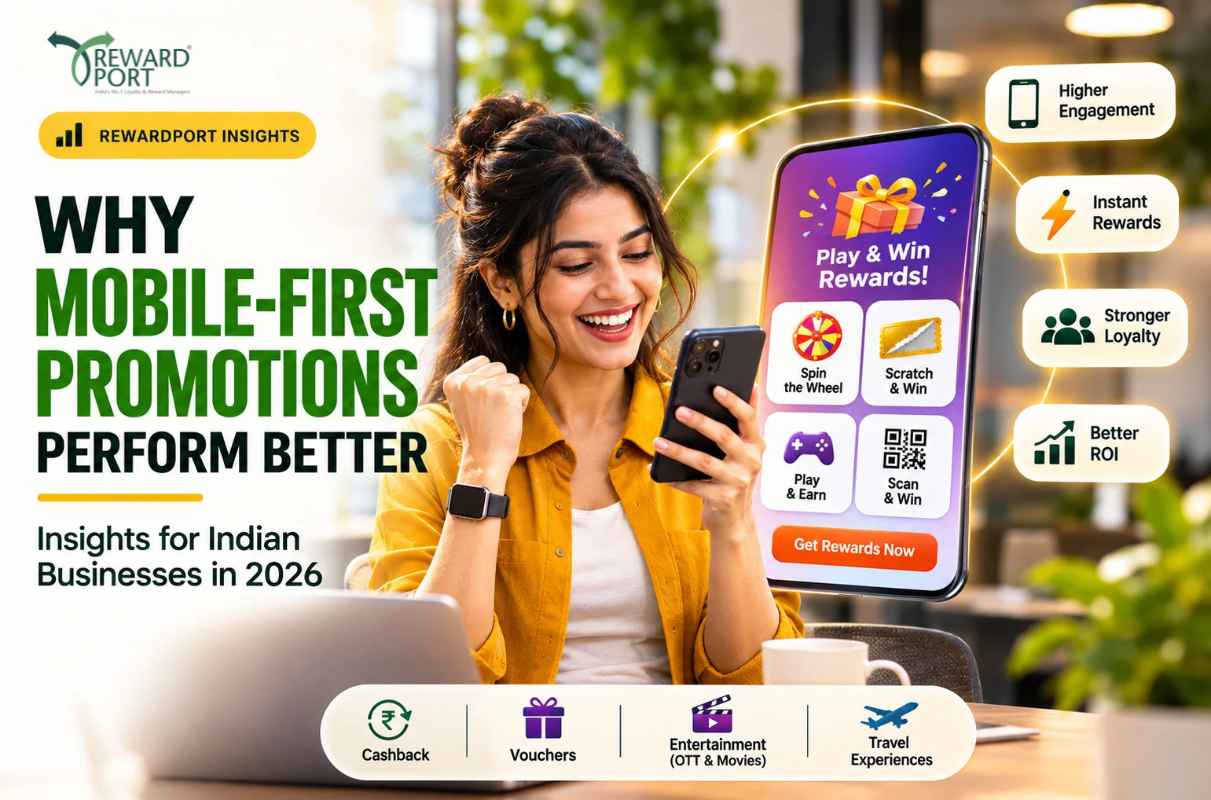
Why Mobile-First Promotions Perform Better: Insights for Indian Businesses in 2026
In an increasingly digital world, mobile-first promotions have become a critical strategy for Indian businesses aiming to engage consumers, channel partners, and employees effectively. By 2026, the mobile device will be the primary gateway to brand interaction, making mobile-first approaches essential for driving participation, repeat purchases, and measurable business outcomes. This article explores why mobile-first promotions perform better and how RewardPort expertise and solutions are uniquely positioned to help brands unlock their full potential.
Market Context and Consumer Behaviour in India
India’s rapid smartphone penetration, currently exceeding 80% of internet users, coupled with affordable data plans, has shifted consumer behavior decisively toward mobile engagement. Mobile devices are not just communication tools but influential channels for shopping, entertainment, and loyalty interaction. By 2026, over 75% of consumer promotional interactions in India are projected to occur via mobile platforms. This shift demands that marketers optimize campaigns for mobile-first delivery to capture attention and drive action efficiently.
Emerging Trends Driving Mobile-First Promotions in 2026
Several trends underline the growing dominance of mobile-first promotions, including the rise of instant gratification campaigns, gamification integration, and the use of QR codes and UPI-based digital rewards. The Indian market’s appetite for convenient, engaging, and immediate rewards experiences favors mobile-centric formats such as scratch & win, spin-the-wheel, and WhatsApp-based redemption flows. Additionally, data-driven personalisation powered by mobile interactions enables more relevant and rewarding experiences, increasing loyalty and channel push outcomes.
Implications for B2B Marketers, Trade Marketers, and HR Leaders
For brand managers and trade marketers, mobile-first promotions facilitate seamless consumer engagement from acquisition to repeat purchase and loyalty. Channel leaders benefit from easy-to-use mobile incentive programs that integrate with CRM and ERP systems, enhancing dealer and distributor motivation and compliance. HR leaders and sales incentive managers find mobile-first platforms highly effective for employee rewards and recognition, sustaining motivation through instant digital rewards and gamification. The reduced friction in reward redemption on mobile devices significantly improves participation and ROI.
RewardPort Perspective and Solution Approach
RewardPort leverages mobile-first promotions by integrating digital rewards and gamification engines tailored for mobile devices, providing an end-to-end solution that spans consumer promotions, loyalty programs, and channel incentives. Our digital rewards catalogue includes multi-brand vouchers, cashback offers, entertainment subscriptions like OTT and movie tickets, and experiential travel rewards curated for instant mobile redemption. Solutions such as Freebucks, RewardOne, and Gamification Engine enable brands to launch engaging, reward-driven campaigns that deliver measurable participation and loyalty uplift across mobile platforms.
Verified RewardPort Case Study Learnings
One notable RewardPort success involved a consumer promotion using mobile-based scratch & win combined with assured digital vouchers and a grand prize draw. This campaign saw a significant uplift in trial and repeat purchase metrics, validating mobile-first engagement’s effectiveness. Channel incentive programs employing RewardPort Channely platform also demonstrated higher dealer participation and quarterly redemption rates through seamless mobile access. Furthermore, employee reward programs using instant digital redemption boosted motivation and performance via mobile interfaces, reinforcing the mobile-first advantage.
Practical Recommendations for Implementation
Adopting a mobile-first promotions strategy requires careful alignment of campaign formats with audience preferences and behavioural triggers. Embrace instant gratification models such as scratch & win and spin-the-wheel on mobile. Prioritise digital rewards that are easily redeemable on phones, like cashback, food vouchers, and entertainment passes. Integrate gamification to enhance engagement depth and frequency. Ensure backend systems support mobile-friendly analytics for real-time tracking and optimisation. Partnering with RewardPort can accelerate these capabilities leveraging proven technology platforms and diverse reward catalogues designed for India’s dynamic mobile audience.
Mobile-first promotions represent a decisive advantage for Indian businesses in 2026 and beyond by driving deeper consumer engagement, channel partner motivation, and employee participation. Optimising promotions for mobile platforms enhances convenience, personalisation, and instant gratification, all critical to sustained business growth. RewardPort comprehensive solutions empower brands to harness the full power of mobile-first promotions, translating into measurable improvements in loyalty, sales, and ROI.
Non-Monetary Recognition That Employees Truly Value: Strategies for Indian Businesses in 2026
In 2026, Indian businesses face an evolving employee engagement landscape where non-monetary recognition takes centre stage. Recognizing employees beyond financial rewards drives motivation, loyalty, and productivity effectively. This article explores why non-monetary recognition matters, current trends shaping it in India, and how RewardPort expertise can help organisations implement impactful programs.
Understanding the Market Context and Employee Expectations in India
Employee recognition in India is rapidly transitioning from traditional monetary incentives to meaningful, personalised, and experiential acknowledgments. With 58% of Indian employees expressing a preference for recognition that offers personal growth, work-life balance acknowledgment, or social appreciation, businesses must rethink reward strategies. Additionally, the rise of millennial and Gen Z workforce segments demands innovative approaches that are instant, digital, and culturally relevant.
Emerging Trends in Non-Monetary Recognition for 2026
The trends shaping employee recognition in 2026 include increased use of gamification, digital reward platforms, and experiential rewards. Instant gratification combined with recognition fosters engagement. Indian companies are incorporating multi-brand vouchers, wellness rewards, and entertainment experiences to meet varied employee preferences. Rewards that promote career development, health, and social status—such as spa treatments, subscriptions to fitness apps, travel experiences, and movie tickets—are gaining traction.
Practical Implications for HR and Channel Leaders
HR leaders and channel program managers must design recognition frameworks blending non-monetary rewards with strategic business goals. Tailoring programs to motivations such as achievement, belonging, and growth increases participation. Recognising dealer and channel partner contributions through experiential or multi-brand rewards deepens business alliances. Digital reward fulfilment and analytics enable real-time tracking and improved campaign ROI.
RewardPort Perspective and Solution Approach
RewardPort specialises in crafting employee rewards and recognition programs that leverage digital reward platforms, gamification, and diverse reward catalogues suited to Indian workforce preferences. Our solutions incorporate instant redemption features with multi-category vouchers encompassing entertainment, wellness, and travel. This approach supports engagement at scale with easy administration and transparent analytics, empowering HR and sales leaders.
Verified RewardPort Case-Study Insights
A leading consumer goods company worked with RewardPort to implement a points-based employee recognition program combining wellness vouchers, movie tickets, and digital fulfilment. The campaign saw a significant uplift in participation rates and daily active users engaging with the platform, demonstrating the appeal of non-monetary recognition tied to lifestyle benefits. Another channel incentive program utilised RewardPort Travel Club rewards, resulting in stronger dealer loyalty and quarterly performance enhancement without direct cash pay-outs.
Implementation Recommendations for Non-Monetary Recognition Programs
To implement effective non-monetary recognition in 2026, start by segmenting your workforce or channel partners to personalise rewards. Use gamification to make recognition fun and habitual. Integrate digital redemption platforms that offer instant rewards and a catalog with diverse options aligning with employee lifestyles. Leverage analytics for continuous optimization and transparency. Combine experiential, wellness, entertainment, and multi-brand vouchers to cater to varied employee aspirations and ensure sustained program success.
Non-monetary recognition is a powerful driver of employee motivation and loyalty in Indian businesses today and beyond 2026. Embracing this approach through well-designed RewardPort solutions can transform workplace culture, enhance participation, and deliver measurable business impact. For HR leaders and channel marketing teams aiming to energise their workforce sustainably, prioritising non-monetary recognition is essential.
Why Digital Rewards Are Becoming the Preferred Incentive in India: A 2026 Perspective
In the dynamic Indian market, businesses across sectors are increasingly adopting digital rewards as a core incentive strategy. This shift is driven by evolving consumer behaviours, accelerated digital adoption, and the operational advantages digital incentives offer. For brand managers, loyalty professionals, channel marketing teams, and HR leaders, understanding this trend is vital to crafting successful campaigns that drive participation, retention, and measurable ROI.
Market Context and Consumer Behaviour in India
India’s rise as a digital economy has been fueled by the widespread adoption of UPI-based payments and mobile internet penetration, especially in Tier 2 and Tier 3 cities. Consumers today expect instant gratification—an immediacy that digital rewards perfectly deliver. NCRI’s annual reports and Deloitte India’s Future of Loyalty research (2023) highlight that consumers prefer instant, flexible reward options they can redeem seamlessly across popular digital platforms.
Furthermore, digital rewards remove traditional logistical challenges associated with physical gifts, enabling brands to reach and incentivize consumers and channel partners across diverse geographies. This accessibility not only maximizes reach but significantly enhances participation rates.
Emerging Trends Shaping 2026 and Beyond
Several key trends are influencing the shift toward digital rewards:
- Personalization and Choice: Offering consumers and channel partners a choice of rewards—from e-vouchers and cashback to experiential and wellness benefits—increases engagement by catering to individual preferences.
- Data-Driven Campaigns: Digital rewards enable brands to gather rich analytics on redemption patterns and preferences, allowing for timely campaign optimizations and better customer insights.
- Scalability and Cost Efficiency: Digital incentives drastically reduce administrative and logistics overheads, enabling large-scale campaigns with consistent reward fulfilment and tracking.
- Growth in Experiential and Wellness Rewards: Consumers increasingly seek rewards that enhance lifestyle and well-being, such as OTT subscriptions, fitness app memberships, and wellness kits.
Implications for B2B Marketers and Channel Leaders
For trade marketers and channel leaders, digital rewards offer an effective mechanism to motivate dealers, distributors, and sales teams across dispersed geographies. Instant, multi-brand vouchers and cashback rewards can be tailored to cater to varied stakeholder preferences, driving higher channel activation and loyalty.
HR leaders benefit from streamlined employee reward and recognition programs that leverage digital gift vouchers and experiential rewards—enhancing motivation and retention, particularly among the tech-savvy workforce.
RewardPort Approach to Digital Rewards
RewardPort supports these market needs through a comprehensive suite of digital reward solutions tailored to Indian businesses. Our platform facilitates consumer promotions with instant cashback and e-voucher delivery, supports channel partner incentives with multi-brand vouchers and Travel Club rewards, and empowers employee recognition with personalized digital gifts.
We also employ gamification engines and instant gratification campaigns to enhance engagement, making reward participation enjoyable and rewarding. Our analytics tools provide crucial insights for clients to monitor performance and optimize their incentive programs effectively.
Verified RewardPort Case Study Learnings
While specific client names cannot be disclosed, RewardPort has enabled multiple successful campaigns leveraging digital rewards. For instance, a festive QR Scan-to-Win campaign featuring OTT, pizza, and travel vouchers significantly uplifted repeat purchases and brand engagement among youth segments. Similarly, dealer incentive programs using multi-brand digital vouchers and cashback rewards have boosted channel partner motivation, resulting in measurable sales performance improvements.
Practical Recommendations for Implementing Digital Rewards
To harness the full potential of digital rewards, businesses should:
- Leverage data analytics to personalise reward options and campaign timing.
- Incorporate instant redemption features to meet consumer expectations of immediacy.
- Utilise multi-brand and experiential rewards to cater to diverse participant interests.
- Deploy gamification elements to enhance engagement and sustain interest.
- Integrate rewards seamlessly with digital payment platforms to simplify fulfilment and tracking.
Adopting digital rewards is no longer a choice but a strategic imperative for Indian businesses aiming to enhance consumer engagement, channel activation, and employee motivation in 2026 and beyond. Digital incentives offer unmatched advantages in personalization, accessibility, and operational efficiency, all of which contribute to measurable business outcomes. Embracing digital rewards enables brands to stay relevant in a fast-evolving market landscape and foster lasting loyalty.
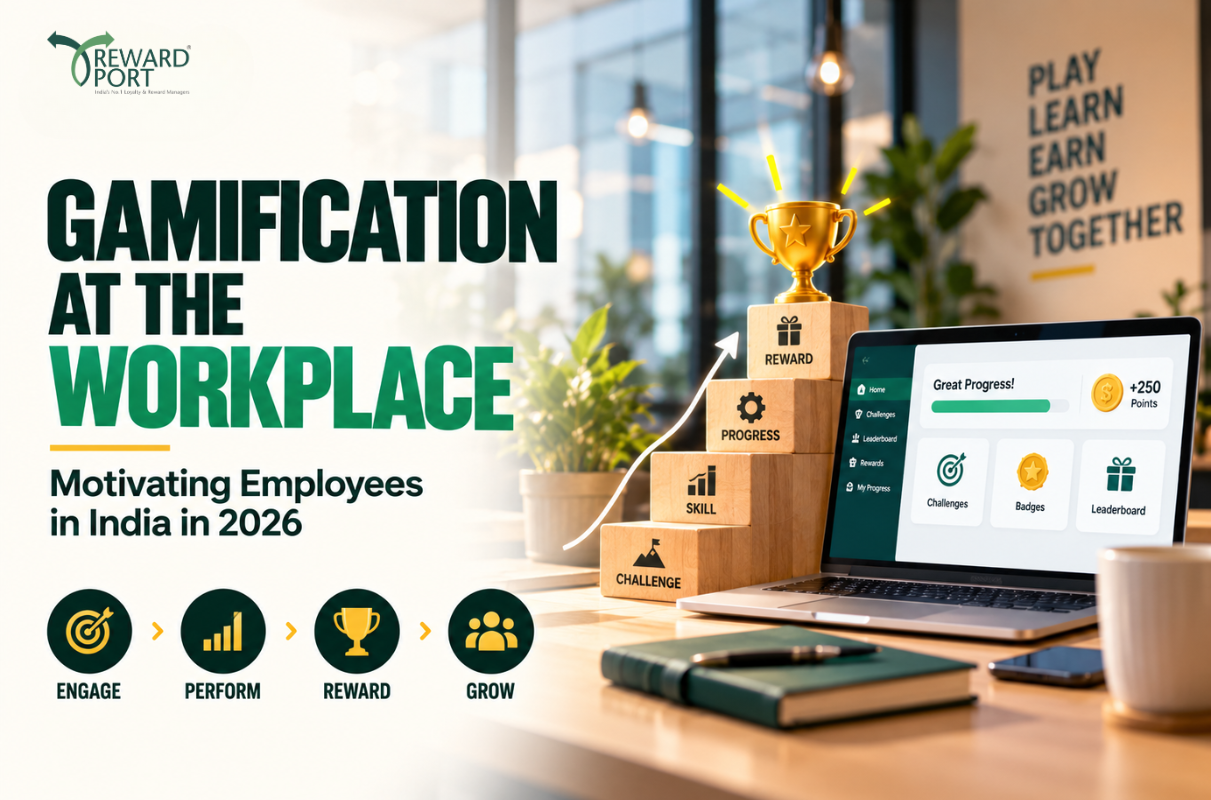
Gamification at the Workplace: Motivating Employees in India in 2026
In today’s dynamic work environment, Indian businesses face the dual challenge of engaging a predominantly young and digitally native workforce while adapting to hybrid and remote work models. Gamification at the workplace has emerged as a powerful tool in 2026, driving employee motivation, enhancing productivity, and fostering loyalty. Leveraging game mechanics such as points, badges, competitions, and instant rewards, organisations can inspire meaningful participation and deliver measurable business results.
Market Context and Industry Developments
The Indian gamification market is rapidly expanding, propelled by increasing digital adoption and a large millennial and Gen Z workforce eager for interactive and personalised work experiences. Companies across sectors are embracing gamification to combat disengagement, reduce attrition, and promote continuous learning. Hybrid work settings, prevalent in India’s evolving office culture, have intensified the need for gamified engagement platforms that help maintain connectedness across geographically dispersed teams.
Key Trends Driving Employee Motivation Through Gamification in 2026
Several important trends shape gamification strategies at Indian workplaces in 2026:
- AI-Powered Personalisation: Advanced AI tailors challenges and rewards to individual employee preferences and performance, maximizing relevance and participation.
- Data-Driven Insights: HR leaders use analytics from gamified platforms to identify motivation drivers and skills gaps, enabling proactive interventions.
- Integration with Learning and Development: Gamified L&D modules encourage skill acquisition through interactive content, increasing retention and application.
- Channel Partner and Dealer Engagement: Sales and channel teams benefit from gamified leaderboards, tiered incentives, and instant recognition, supporting motivation and performance.
- Instant and Digital Rewards: The preference for instant gratification sees digital vouchers, cashback, and mobile-app-based rewards gaining popularity in India’s tech-savvy workforce.
- Experiential and Wellness Rewards: Non-monetary rewards such as exclusive experiences, wellness subscriptions, and team-building events offer memorable employee recognition.
- Customisable Reward Catalogues: Flexible reward options enable employees to choose incentives that resonate personally, boosting satisfaction and redemption rates.
Practical Implications for B2B Marketers, HR Leaders, and Channel Teams
For marketers and HR professionals, gamification presents an opportunity to transform engagement strategies. Trade marketers can apply gamified consumer promotion techniques internally to energise sales teams and channel partners. HR leaders can embed gamification in employee rewards and recognition programs to nurture motivation and reduce churn. Sales leaders benefit from tiered gamified incentives that drive healthy competition and improve sales performance.
RewardPort Perspective: Integrated Gamification Solutions for 2026
RewardPort specialises in delivering end-to-end gamification programs that combine proven consumer promotion tactics with employee and channel incentives. Our platform supports a wide range of gamified formats — including leaderboards, scratch & win, spin the wheel, and digital point accrual systems — tailored for workplace motivation.
We leverage our robust digital reward catalogue offering multi-brand vouchers, cashback, experiential rewards, and instant gratification campaigns to ensure high perceived value. Our solutions enable personalised reward selection and seamless fulfilment, reinforcing motivation with minimal administrative burden.
Verified RewardPort Case Study Insights
RewardPort collaboration with clients in various sectors has demonstrated how gamified incentives drive measurable uplifts in participation and motivation. For example, a channel incentive program using tiered points and instant rewards enhanced dealer engagement and contributed to increased sales activation. Similarly, employee incentive programs integrating digital rewards and personalized recognition led to sustained improvements in attendance and performance metrics.
Practical Recommendations for Implementing Gamification at the Workplace
To effectively motivate employees in 2026, organisations should:
- Start with clearly defined behavioural objectives aligned with business goals.
- Incorporate personalised challenges and rewards leveraging data insights and AI capabilities.
- Use a mix of instant gratification and experiential rewards from a curated catalogue to appeal to diverse employee preferences.
- Ensure gamification programs are integrated with existing HR and sales platforms for seamless tracking and analytics.
- Foster transparency and continuous communication to sustain engagement and healthy competition.
Gamification at the workplace is a transformative approach for motivating employees in India in 2026. By blending digital engagement techniques with personalised rewards and data-driven insights, businesses can boost participation, enhance loyalty, and drive measurable performance improvements. RewardPort expertise and integrated platform solutions provide a comprehensive toolkit to design, execute, and optimise these gamified employee motivation programs for sustained success.
Why Experience-Led Rewards Are Becoming Mainstream in India: Strategies for 2026 and Beyond
Indian businesses are witnessing a fundamental shift in consumer and partner expectations around rewards and incentives. As we move deeper into 2026, experience-led rewards are gaining unprecedented traction, reshaping loyalty programs, employee recognition, and channel incentives. This transformation offers Indian marketers a strategic advantage to foster deeper engagement, repeat purchase, and brand advocacy in a competitive market.
Market Context: The Indian Shift Towards Experience Over Materialism
Recent research and market observations reveal that Indian consumers, especially millennials and Gen Z, increasingly favour meaningful experiences over material rewards. Experiences that evoke emotions, create memories, and enhance personal growth hold distinct appeal. This penchant is echoed in emerging wellness trends, digital engagement, and social media dynamics.
For channel partners and employees, experiential incentives like exclusive events or tailored travel packages fuel motivation and loyalty beyond traditional cash or points systems. The competitive Indian market necessitates innovation beyond commoditized cashback offers to build authentic relationships and measurable performance uplift.
Emerging Trends in Experience-Led Rewards for 2026
The acceleration of technology and data analytics in India enables ultra-personalised reward journeys. Brands leverage AI to customise travel experiences, curated wellness packages, and entertainment options that align with individual preferences. Wellness-centric rewards, including fitness classes and meditation retreats, respond to growing post-pandemic health awareness.
Social currency generated by shareable experiences on digital platforms also amplifies organic marketing impact, crucial for youth-driven segments. Meanwhile, B2B engagement models see promise in skill-building workshops and incentive travel for partner loyalty and sales acceleration.
Practical Implications for Indian B2B Marketers and HR Leaders
B2B marketers, trade marketers, and HR leaders in India must rethink reward frameworks to incorporate experiences that resonate culturally and emotionally. Incentive travel clubs, wellness programs, and gamification strategies create intrinsic motivation layered with instant gratification mechanisms.
Channel marketing teams benefit from integrating digital rewards that offer choice and flexibility, such as multi-brand vouchers and experiential catalogues. Employee rewards programs with tiered experiential options reinforce engagement and retention, critical amidst talent market competition.
RewardPort’s Perspective: Delivering Experience-Led Rewards with Strategic Impact
At RewardPort, we see experience-led rewards as a vital catalyst for engagement across consumers, employees, and channel partners. Our solutions like Travel Club rewards, CineRewardz movie experiences, wellness packages, and gamification engines are designed to drive deeper emotional connections and measurable ROI.
We blend digital reward fulfilment technology with curated experiential catalogues, including travel, entertainment, and wellness, ensuring personalised and seamless customer journeys. Our channel incentive programs leverage skill development and exclusive industry events to activate stronger distributor and dealer performance.
Verified RewardPort Case Study Learnings
While respecting confidentiality, RewardPort campaigns integrating experiential rewards consistently show higher participation and repeat engagement than traditional cashback models. Wellness and entertainment rewards, when combined with gamification and instant digital redemptions, yield notable uplift in employee motivation and channel partner sales efforts.
For example, tiered loyalty programs with access to curated travel and entertainment rewards have boosted repeat purchase rates and dealer incentives in multiple sectors, reinforcing that experience-driven rewards are not only desirable but also strategically effective in India’s diverse market.
Recommendations for Implementing Experience-Led Rewards Effectively
- Leverage AI and analytics: Use data-driven insights to personalise reward options and predict what experiences resonate best with different audience segments.
- Balance instant gratification with aspirational rewards: Combine immediate incentives (e.g., digital vouchers) with long-term experiential benefits (e.g., exclusive travel packages) to sustain engagement.
- Integrate wellness and entertainment: Given India’s growing health awareness and entertainment consumption, include these categories prominently in your reward catalogues.
- Foster shareability: Design rewards and programs that encourage social media sharing to amplify brand reach organically.
- Align with business goals: Tailor experience-led rewards to directly support objectives like repeat sales, channel activation, employee retention, and brand advocacy.
Indian businesses adopting experience-led rewards are positioning themselves at the forefront of consumer and channel engagement innovation. These rewards translate into stronger emotional bonds, differentiated brand positioning, and measurable business outcomes including participation and performance uplift. By embedding experience-centric strategies into loyalty, incentive, and recognition programs, Indian marketers and HR leaders can unlock sustainable competitive advantage well into the future.
Employee Recognition & Engagement Trends for 2026: Insights for Indian Businesses
As India’s workforce evolves rapidly, understanding employee recognition trends 2026 is critical for Indian businesses aiming to enhance motivation, loyalty, and performance. In 2026, tailored rewards, instant gratification, and meaningful engagement are shaping workplace cultures and channel partnerships alike. Businesses that embrace these insights can differentiate their employee and partner experience, driving sustained growth.
Market Context: Indian Workforce and Business Environment
India’s workforce has grown increasingly diverse and digitally savvy, with 84% of employees now prioritizing work-life balance and wellness. The rise of digital payments and platforms, especially UPI, enables seamless reward delivery. Indian companies face competition not only for customers but also for talent and channel partner loyalty. Hence, employee and channel incentives must adapt to changing expectations characterized by personalization, speed, and purpose alignment.
Emerging Trends in Employee Recognition & Engagement for 2026
Several key trends are influencing recognition programs in India:
- Holistic and Personalized Well-being: Beyond financial rewards, organizations are focusing on physical, mental, and financial well-being. Personalized wellness programs and experiential rewards like mindfulness subscriptions and wellness retreats are becoming common.
- Digital-First and Instant Gratification: With high digital adoption, employees and partners expect instant, seamless reward experiences. Digital vouchers, instant cashback, and gamification drive engagement through mobile platforms.
- Data-Driven Personalization Using AI: Leveraging data analytics helps tailor rewards to individual preferences and performance, increasing relevance and impact.
- Experiential and Skill-Based Rewards: Travel, learning, and exclusive experiences foster deeper loyalty and growth opportunities, particularly among high performers and key channel partners.
- Purpose-Driven Engagement: Aligning recognition with company values and social impact initiatives resonates with younger employees and partners, enhancing emotional engagement.
Implications for B2B Marketers, HR, and Channel Leaders
To leverage these 2026 employee recognition trends, B2B marketers and HR leaders should:
- Integrate wellness-focused rewards to address holistic employee needs.
- Adopt digital platforms for instant reward delivery and real-time engagement tracking.
- Use AI and analytics to customize incentives, improving program relevance.
- Incorporate experiential and skill development rewards to enhance retention and motivation.
- Embed social purpose in recognition programs to connect with modern workforce values.
RewardPort Perspective and Solution Approach
RewardPort specializes in creating tailored employee and channel partner incentive programs that align perfectly with these emerging trends. Our robust digital rewards platform supports instant gratification with seamless redemption through UPI, multi-brand vouchers, cashback, and movie or travel experiences. We offer gamification engines to enhance participation and engagement.
Our reward catalog includes holistic wellness options, experiential gifts like travel packages and learning subscriptions, and purpose-driven rewards enabling CSR activity participation or charity donations as recognition. Leveraging robust analytics, clients receive actionable insights to refine programs continuously.
Verified RewardPort Case-Study Learnings
While specific client details are confidential, RewardPort deployment of digital, instant-reward programs combined with gamification has consistently uplifted participation rates and repeat engagement in employee and channel incentive programs across sectors like FMCG and financial services. Our clients have leveraged multi-brand vouchers and experiential rewards to sustain motivation and loyalty, particularly among key distributors and high-performing employees.
Practical Recommendations for Implementation
For Indian businesses aiming to implement effective recognition programs aligned to 2026 trends:
- Audit employee and partner preferences: Use surveys and data analytics to understand reward preferences and engagement drivers.
- Adopt digital reward platforms: Prioritize instant redemption options and mobile-friendly interfaces.
- Design holistic reward bundles: Combine wellness, experiential, and instant digital rewards.
- Embed gamification: Use games and tiered recognition to sustain interest and fun.
- Align programs with values: Incorporate CSR and sustainability recognition to resonate emotionally.
- Leverage analytics: Monitor participation and feedback for ongoing program optimization.
Understanding and embracing employee recognition trends 2026 is vital for Indian businesses seeking enhanced employee engagement and channel partner loyalty. By combining digital-first delivery, personalized rewards, experiential options, and purpose-driven recognition, firms can create compelling programs that motivate and retain talent. RewardPort advanced digital platforms, extensive reward catalog, and analytic capabilities empower organizations to implement these forward-looking strategies effectively, driving measurable business results.
How Gamification Improves Employee Engagement: Insights and Solutions for Indian Businesses
In a rapidly evolving Indian business landscape, keeping employees motivated and engaged remains a critical challenge for organisations. Gamification improves employee engagement by creating immersive, interactive experiences that stimulate participation, enhance learning, and foster loyalty. As Indian companies embrace digital transformation, leveraging gamified incentive programs is proving vital to employee retention and productivity in 2026 and beyond.
Market Context and Industry Developments in India
The Indian gamification market is experiencing strong growth, driven by the wider adoption of digital tools and a young workforce that values dynamic feedback and recognition. Indian businesses increasingly deploy gamified platforms to address disengagement, skill gaps, and turnover risks. Moreover, sectors like FMCG, automotive, and technology integrate gamification strategically for channel partner and dealer incentives, enriching sales activation and product knowledge.
Current and Emerging Trends Relevant to 2026
Several trends shape how gamification improves employee engagement moving forward. Instant gratification through digital rewards, such as UPI-linked vouchers and cashback, aligns well with India’s advanced digital payment ecosystem. The rise of experiential and wellness rewards complements monetary incentives, encouraging holistic employee well-being and sustained motivation. Additionally, companies focus on personalised, tiered gamification models that offer achievement badges, leaderboards, and challenges catering to diverse employee profiles.
Practical Implications for B2B Marketers and HR Leaders
For HR heads and business leaders, a gamified approach transforms engagement strategies into measurable business outcomes. Gamification drives higher employee participation rates, improves learning retention during training programs, and boosts the effectiveness of employee incentive schemes. Trade and channel marketing teams can similarly deploy gamified programs tailored for partner tiers, improving motivation and incentivising repeat sales through competitive elements and instant rewards.
RewardPort’s Perspective and Relevant Solution Approach
RewardPort specialises in gamification engines and employee incentive programs designed for the Indian market. Our platform supports a variety of branded digital games and contests, integrated seamlessly with instant digital rewards, including cashback, multi-brand vouchers, travel experiences, OTT subscriptions, and entertainment options. Our solutions cater to the entire employee journey: from onboarding incentives and skill-building games to recognition drives and wellness challenges.
Verified RewardPort Case-Study Learnings
While specific client names remain confidential, RewardPort’s experience across 11,000+ programs confirms that gamification significantly uplifts employee motivation and retention. Programs combining gaming elements with instant digital rewards and experiential prizes result in higher participation and repeat engagement. Digital reward fulfilment via mobile-friendly platforms reduces friction, enabling timely recognition and sustained interest.
Practical Recommendations and Implementation Framework
Implementing a successful gamified employee engagement program involves several steps:
- Define clear engagement objectives aligned to business goals such as improved sales performance or skill acquisition.
- Design interactive game formats like quizzes, spin-the-wheel, or contests that appeal to diverse employee segments.
- Integrate instant gratification rewards from RewardPort’s catalog, utilising cashback, vouchers, travel, and entertainment options suitable for your workforce.
- Leverage data analytics to track participation, reward redemption, and behavioural changes, enabling continuous optimisation.
- Ensure ongoing communication to maintain excitement and encourage peer recognition.
This framework helps Indian companies create engaging, scalable programs that foster a motivated and productive workforce in a digital-first environment.
As gamification improves employee engagement, Indian businesses stand to gain from higher motivation, reduced attrition, and enhanced performance across teams. RewardPort’s specialised gamification engines and digital reward offerings empower organisations to implement effective, innovative engagement strategies that resonate with today’s workforce and future trends. Prioritising gamified incentives ensures sustainable employee loyalty and measurable business impact in 2026 and beyond.
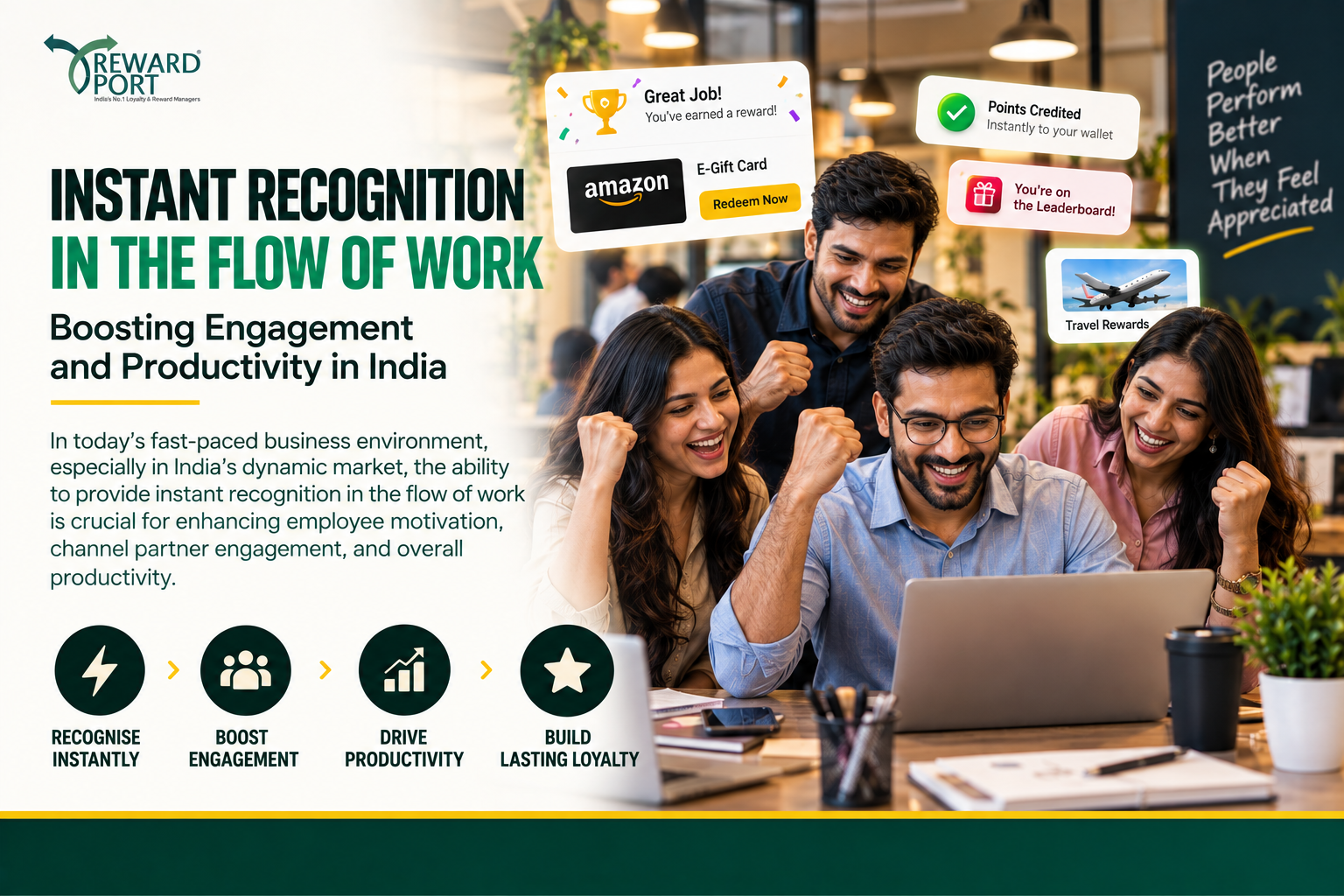
Instant Recognition in the Flow of Work: Boosting Engagement and Productivity in India
In today’s fast-paced business environment, especially in India’s dynamic market, the ability to provide instant recognition in the flow of work is crucial for enhancing employee motivation, channel partner engagement, and overall productivity. Indian businesses are increasingly adopting real-time reward and recognition systems that keep participants engaged and aligned with their organisational goals without disrupting daily workflows.
Market Context: Digital Transformation and Recognition in India
India’s rapid digitalisation, including widespread adoption of UPI payments and mobile technology, has paved the way for instant digital rewards. Businesses are leveraging these technologies to enable immediate gratification through cashback offers, digital vouchers, and experiential rewards delivered in real time. This shift is supported by evolving consumer expectations for personalised and instant rewards and the increasing use of AI-driven platforms for performance tracking and reward disbursement.
Current and Emerging Trends in Instant Recognition (2026 and Beyond)
By 2026, the integration of instant recognition within work processes is expected to deepen. Key trends include the gamification of rewards, with branded games and instant-win options creating engaging experiences. Real-time cashback and UPI-based rewards are becoming mainstream, particularly to motivate sales teams and channel partners in India’s competitive markets. There is also a growing emphasis on wellness and micro-experiences as instant rewards, reflecting a holistic approach to employee and partner engagement.
Implications for B2B Marketers, HR Leaders, and Channel Managers
Marketers and HR leaders must design recognition programs that deliver timely, meaningful rewards aligned with business objectives. For channel marketing teams, instant recognition through digital leaderboards and performance-triggered payouts can drive higher participation and sales activation. Employee reward programs that offer instant gratification increase motivation and reduce attrition, helping maintain a productive workforce even in hybrid or remote working models.
RewardPort Perspective and Relevant Solutions
RewardPort specialises in digital reward fulfilment and instant gratification campaigns that cater to these evolving needs. Our solutions include gamification engines with over 100 branded games, instant cashback campaigns integrated with UPI and wallet credits, and multi-brand digital vouchers that provide flexibility and instant redemption. We support channel partner incentives with CRM and ERP integrations ensuring seamless, real-time rewards. Additionally, our extensive reward catalogue offers experiential, travel, entertainment, and wellness rewards designed for instant recognition moments.
Verified RewardPort Case Study Learnings
While specific client names are confidential, RewardPort campaigns for leading Indian brands show notable increases in engagement and sales performance through instant rewards. For example, implementing instant cashback combined with gamified QR Scan-to-Win contests during festive seasons led to higher repeat purchases and channel push. Employee recognition programs utilising instant digital vouchers have also demonstrated improved participation and morale.
Practical Recommendations for Implementing Instant Recognition
- Leverage digital platforms and mobile integration to deliver rewards instantly within workflows.
- Use gamification to create fun, immediate recognition opportunities that motivate behaviours.
- Choose reward types relevant to the audience, such as instant cashback, multi-brand vouchers, or experiential rewards.
- Utilise AI and data analytics to personalise recognition and maximise impact.
- Incorporate instant recognition in channel incentives to boost partner motivation and sales.
Instant recognition in the flow of work is becoming indispensable for Indian businesses aiming to drive engagement, boost sales, and foster loyalty among employees and channel partners. By adopting digital rewards, gamification, and real-time gratification tools, organisations can create seamless, motivating experiences that align with 2026 forward-looking strategies. RewardPort expertise and solutions enable the practical deployment of instant recognition, ensuring measurable ROI and sustained business growth.
How Incentive Programs Improve Sales Team Performance: A 2026 Perspective
In a competitive and rapidly evolving Indian market, sales teams are crucial drivers of business success. Incentive programs improve sales team performance by motivating, engaging, and aligning sales efforts with organisational goals. For B2B marketers, HR leaders, and channel marketing teams, understanding how to design and implement effective incentive programs is key to sustaining growth and enhancing sales productivity in 2026 and beyond.
Market Context and Industry Developments in India
India’s dynamic economy, vast consumer base, and digital transformation continue to transform the sales landscape. Sales professionals face mounting pressure to deliver better results amidst changing consumer expectations and heightened competition. According to recent industry insights, 70% of Indian companies prioritise personalised employee engagement and rewards strategies to foster motivation and reduce turnover.
Furthermore, the rise of omnichannel retail and digital ecosystems has increased the complexity of sales operations, highlighting the need for robust incentive programs that cater to diverse sales roles, including channel partners and dealers. These programs must therefore be adaptive, data-driven, and seamless in their execution.
Emerging Trends Relevant to 2026
Looking forward, successful sales incentive programs in India will leverage data analytics, gamification, and digital rewards to provide instant gratification and sustained engagement. Key trends include:
- Gamification: Integrating game mechanics into incentive programs boosts participation and excitement among sales teams.
- Instant Digital Rewards: Offering instant multi-brand vouchers, cashback, or UPI-based rewards meets the expectations of a digitally savvy workforce.
- Personalisation and Tiered Rewards: Tailoring rewards to individual preferences and performance tiers motivates continuous improvement.
- Channel Partner Incentive Programs: Engaging dealers and distributors with specialised rewards drives channel sales activation.
Practical Implications for B2B Marketers and HR Leaders
Designing incentive programs requires a strategic approach that balances fun and achievable rewards with measurable business outcomes. Sales leaders should focus on clear performance metrics, transparent communication, and easy redemption processes. Channel marketing teams benefit from integrating dealer incentives aligned with broader brand goals to increase reach and loyalty.
HR leaders can use employee rewards and recognition schemes that reinforce company culture and boost morale. It is crucial to select reward categories relevant to Indian sales professionals such as entertainment vouchers, travel experiences, food and dining, and cashback options.
RewardPort Perspective and Solution Approach
RewardPort offers a comprehensive suite of solutions tuned to India’s market realities and sales incentive needs. Our sales incentive programs integrate gamification engines, instant rewards, and a wide reward catalogue including travel packages, movie and OTT subscriptions, multi-brand vouchers, and cashback rewards designed to resonate with diverse sales teams.
For channel partners, RewardPort dealer and distributor rewards programs with CRM/ERP integration enable seamless tracking and redemption, boosting channel engagement. Our digital reward fulfilment platform ensures rapid delivery and high participation rates, essential for sustained motivation.
Verified RewardPort Case-Study Learnings
While specifics of client campaigns are confidential, RewardPort experience across 11,000+ programs highlights that well-designed incentive strategies increase sales team engagement by 20-30% and improve repeat purchase rates through consistent motivation. Campaigns that combine gamification with instant multi-brand vouchers and cashback see higher ROI and repeat engagement.
Implementation Recommendations
To implement effective incentive programs, Indian businesses should:
- Define clear, measurable sales performance objectives aligned with business goals.
- Choose rewards from RewardPort extensive catalogue that appeal to your sales team’s preferences.
- Leverage gamification mechanics to maintain interest and participation.
- Ensure instant and seamless reward fulfilment using RewardPort technology platforms.
- Integrate channel partner incentives to broaden market impact.
- Use analytics to monitor participation, engagement, and ROI continuously.
Incentive programs improve sales team performance by driving motivation, engagement, and alignment with organisational goals. In 2026, Indian businesses must embrace innovative, data-driven, and digitally enabled incentive solutions to stay competitive. RewardPort expertise and comprehensive reward offerings empower sales leaders and channel marketers to unlock the full potential of their sales workforce, delivering measurable business outcomes and long-term loyalty.

How BFSI Brands Can Use Rewards to Drive Engagement in India’s Dynamic Market
In today’s fast-evolving Indian financial landscape, BFSI (Banking, Financial Services, and Insurance) brands face the critical challenge of engaging discerning consumers and channel partners alike. With heightened competition and digital transformation shaping customer expectations, integrating well-designed BFSI rewards programs has become essential to enhance engagement, drive loyalty, and boost sales performance by 2026 and beyond.
Market Context and Consumer Behaviour in India’s BFSI Sector
India’s BFSI sector is witnessing a digital-first revolution, accelerated by widespread UPI adoption, fintech innovation, and evolving consumer preferences. According to PwC India and FICCI’s India FinTech Report 2023, instant and seamless digital experiences now define consumer expectations. Customers seek rewards that are instantly gratifying, relevant, and accessible via digital channels.
Furthermore, hyper-personalization is becoming a cornerstone for BFSI loyalty programs. AI-driven data analytics enable brands to tailor rewards based on individual financial behaviour, life stages, and preferences, creating more meaningful and motivating incentives.
Emerging Trends in BFSI Rewards and Engagement for 2026
Several trends define the future of rewards in the BFSI sector:
- Instant Digital Rewards: Instant gratification through digital vouchers, cashback, and direct wallet credits aligns with India’s preference for quick, hassle-free transactions.
- Gamification: Engagement programs feature game mechanics such as quizzes, streak rewards, and challenges that encourage regular interaction and build financial literacy.
- Channel Partner Incentive Digitization: BFSI companies are adopting transparent, digital incentive platforms offering real-time tracking and instant payouts to motivate sales partners and agents effectively.
- Experience and Wellness Rewards: Premium experiences like travel packages and wellness-related rewards cater to aspirational and health-conscious consumers, enhancing brand differentiation.
Strategic Implications for B2B Marketers and Channel Leaders
BFSI marketers and channel leaders should focus on integrating multi-faceted rewards programs to address diverse stakeholder needs. Personalized loyalty solutions can deepen consumer ties, while channel incentives need to be transparent and immediate to maintain motivation among distributors and agents. Employee rewards and recognition complement external programs by fostering internal alignment and productivity.
RewardPort Perspective and Solutions for BFSI Engagement
RewardPort offers a robust suite of solutions tailored for BFSI brands aiming to maximize engagement:
- Consumer Promotions and Loyalty Programs: Designed with AI-powered personalization and data analytics to offer relevant rewards from categories including digital vouchers, travel experiences, entertainment, and wellness benefits.
- Channel Partner Incentive Programs: Featuring digital incentive platforms with real-time performance tracking and instant gratification, enabling BFSI organizations to energize their dealer and agent networks efficiently.
- Gamification Engine: Over 100 gamified modules help BFSI brands drive app engagement and encourage beneficial financial behaviours among customers.
- Digital Reward Fulfilment: Instant delivery of e-vouchers, cashback, and multi-brand rewards aligned with India’s preference for seamless, digital-first experiences.
Verified RewardPort Case Study Insights
While specific BFSI campaigns remain confidential, RewardPort expertise with financial services and similar sectors illustrates key learnings:
- A leading insurance brand leveraged gamification combined with instant digital cashback and wellness vouchers to increase app engagement by 30% over six months.
- A large retail bank’s channel incentive program implemented real-time tracking and instant reward disbursal, improving sales partner participation rates and reducing payout delays.
Recommendations for Implementing an Effective BFSI Rewards Program
For BFSI brands aiming to launch or refresh rewards programs in 2026, consider this framework:
- Data-Driven Personalization: Employ customer analytics to segment and tailor rewards effectively.
- Multi-Channel Engagement: Combine digital consumer promotions with dealer incentives and employee rewards for holistic impact.
- Instant Gratification: Ensure rewards are delivered immediately post-action to satisfy customer and partner expectations.
- Relevant Reward Catalogue: Include travel, entertainment, wellness, cashback, and multi-brand vouchers to suit varied preferences.
- Transparent Tracking and Reporting: Use digital platforms for real-time performance visibility among channels and internal stakeholders.
As BFSI brands in India navigate an increasingly competitive and digital future, deploying strategic BFSI rewards programs will be a key driver of customer and channel engagement. By embracing personalized loyalty, gamification, instant digital incentives, and transparent partner rewards, BFSI companies can forge stronger relationships, enhance retention, and achieve measurable growth through 2026 and beyond.