
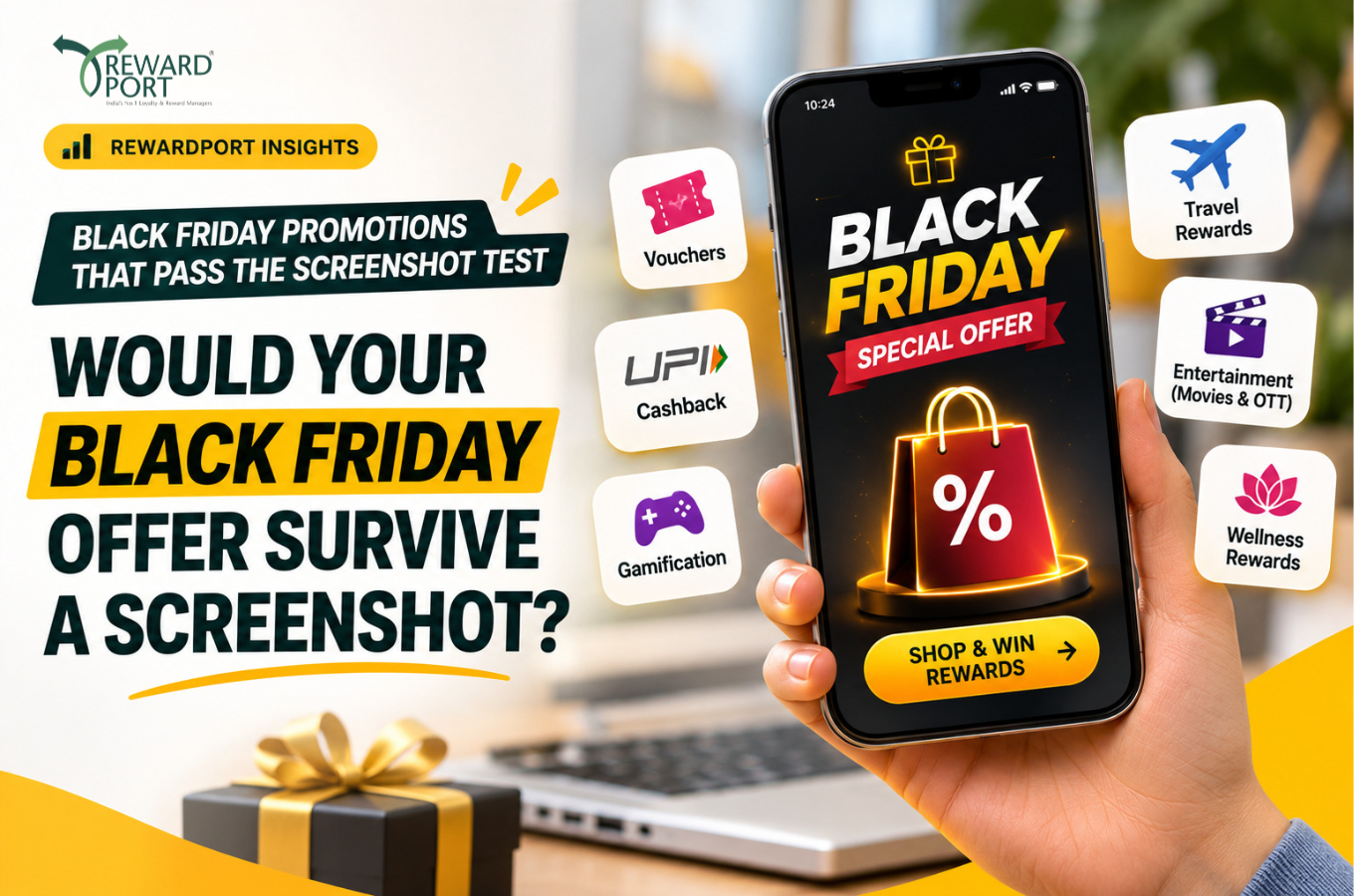
Would Your Black Friday Offer Survive a Screenshot?
A shopper takes a screenshot of your Black Friday banner and sends it to a friend.
“Is this a good deal?”
Her friend replies, “On what?”
There goes the first half of the media budget. The second half is currently looking for the asterisk.
The screenshot is a useful place to start because it travels without your landing page, your brand film or the nice person on the chat widget. It contains exactly what a shopper saw and almost none of what the campaign team meant.
In November 2026, Boston Consulting Group reported that 54% of respondents in its year-end sales study trusted advertised prices at these events. The study surveyed 10,220 adults across ten markets in Europe, North America and Australia. The finding gives us a reason to examine how a shopper verifies value before asking how to make the number on the banner bigger. BCG’s 2026 year-end sales study
One pair of headphones and three offers
Imagine a $100 pair of wireless headphones with a $55 variable cost before the promotion. We can spend up to $10 per qualifying shopper on the offer itself. We can make the discount immediate, put an extra benefit alongside the purchase or save the incentive for the next order. Any incremental programme fees, delivery costs or support costs must be included in the relevant arm. These are illustrative numbers.
| What the shopper sees | Offer cost to the brand | When it earns its place |
| Pay $90 today. | $10 on each qualifying order. | Test it when immediate conversion is the goal and price is a credible barrier. |
| Pay $100 and get two cinema tickets. | Assume $10 for both tickets, including fulfilment. | Test it when the audience values the experience and can actually book it. |
| Pay $100 and get $10 off an eligible next order within 45 days. | Up to $10 per customer, depending on redemption, before any fees. | Test it when the brand sells something customers are likely to need again within that window. |
The cinema tickets are where the conversation gets interesting. Two tickets in a city with good cinema coverage can feel like a Friday night already sorted. Two tickets with no convenient venues, narrow time slots and a long booking flow can feel like homework with popcorn.
The $10 credit has a different problem. A headphone buyer may be done shopping in the category for months. The offer becomes more credible if there is a natural next purchase, such as a compatible travel case, and the terms let the customer use it on that purchase. Check the price of that case before you print the offer. A $10 reward that requires a $90 order will have a very different audience.
Give the offer the screenshot test
First, crop the offer to the size of a phone screen. Then hand it to someone who did not work on it. Ask them to answer four questions without opening a second page.
- What do I pay today?
- What exactly do I get and when?
- What might make me ineligible?
- If I have to claim it, what is the first step?
Put material constraints where the shopper makes the choice. A cinema reward may depend on location, participating venues and booking windows. A future credit may depend on a minimum spend. If the gift can run out, say so up front. Use a short terms link for detail and keep the condition that changes the offer next to the promise.
Run the same test with customer support. If a service agent needs a spreadsheet to answer “Can I use this on Saturday?”, the shopper is probably going to need help too.
Make the decision on contribution
At 100 orders, the headphones generate $4,500 in contribution before any offer cost or other costs excluded from this simplified example. A $10 markdown brings that to $3,500 on the same 100 orders. The assured gift has the same simplified contribution at that volume if all 100 gifts cost $10 each to deliver. A next-order credit needs a longer measurement window because the first and second order both matter.
Use comparable audiences, stores or regions, with a control group where feasible. Keep product availability, placement, shipping and timing as similar as possible. Compare contribution per eligible shopper across groups by subtracting variable product costs, incremental fulfilment, reward costs and any extra support or media spend from net sales after discounts. Subtract only costs that are still outside net sales so a redeemed credit is counted once. Read the immediate offers at the close of the sale and read all arms again after the future reward has had time to expire and returns have settled.
The main question is how many purchases the offer added, how much contribution they generated and what happened after the rush. A credit redeemed by customers who were already going to reorder can post a lovely redemption rate while quietly paying for sales the brand would have had anyway. A comparison group is what helps separate those outcomes.
Track claim completion and fulfilment exceptions alongside contribution. Check how often customers qualify but fail to receive the reward, how many contact support and how many attempts are duplicates. Every one of those numbers can explain why an attractive offer underperforms.
If you’re planning a promotion around a margin target, bring one product, one audience and one budget to the discussion. RewardPort can help map the offer, the claim process and the measurement plan before the banner goes live. RewardPort sales promotions

How BFSI Brands Can Use Rewards to Drive Engagement in India’s Dynamic Market
In today’s fast-evolving Indian financial landscape, BFSI (Banking, Financial Services, and Insurance) brands face the critical challenge of engaging discerning consumers and channel partners alike. With heightened competition and digital transformation shaping customer expectations, integrating well-designed BFSI rewards programs has become essential to enhance engagement, drive loyalty, and boost sales performance by 2026 and beyond.
Market Context and Consumer Behaviour in India’s BFSI Sector
India’s BFSI sector is witnessing a digital-first revolution, accelerated by widespread UPI adoption, fintech innovation, and evolving consumer preferences. According to PwC India and FICCI’s India FinTech Report 2023, instant and seamless digital experiences now define consumer expectations. Customers seek rewards that are instantly gratifying, relevant, and accessible via digital channels.
Furthermore, hyper-personalization is becoming a cornerstone for BFSI loyalty programs. AI-driven data analytics enable brands to tailor rewards based on individual financial behaviour, life stages, and preferences, creating more meaningful and motivating incentives.
Emerging Trends in BFSI Rewards and Engagement for 2026
Several trends define the future of rewards in the BFSI sector:
- Instant Digital Rewards: Instant gratification through digital vouchers, cashback, and direct wallet credits aligns with India’s preference for quick, hassle-free transactions.
- Gamification: Engagement programs feature game mechanics such as quizzes, streak rewards, and challenges that encourage regular interaction and build financial literacy.
- Channel Partner Incentive Digitization: BFSI companies are adopting transparent, digital incentive platforms offering real-time tracking and instant payouts to motivate sales partners and agents effectively.
- Experience and Wellness Rewards: Premium experiences like travel packages and wellness-related rewards cater to aspirational and health-conscious consumers, enhancing brand differentiation.
Strategic Implications for B2B Marketers and Channel Leaders
BFSI marketers and channel leaders should focus on integrating multi-faceted rewards programs to address diverse stakeholder needs. Personalized loyalty solutions can deepen consumer ties, while channel incentives need to be transparent and immediate to maintain motivation among distributors and agents. Employee rewards and recognition complement external programs by fostering internal alignment and productivity.
RewardPort Perspective and Solutions for BFSI Engagement
RewardPort offers a robust suite of solutions tailored for BFSI brands aiming to maximize engagement:
- Consumer Promotions and Loyalty Programs: Designed with AI-powered personalization and data analytics to offer relevant rewards from categories including digital vouchers, travel experiences, entertainment, and wellness benefits.
- Channel Partner Incentive Programs: Featuring digital incentive platforms with real-time performance tracking and instant gratification, enabling BFSI organizations to energize their dealer and agent networks efficiently.
- Gamification Engine: Over 100 gamified modules help BFSI brands drive app engagement and encourage beneficial financial behaviours among customers.
- Digital Reward Fulfilment: Instant delivery of e-vouchers, cashback, and multi-brand rewards aligned with India’s preference for seamless, digital-first experiences.
Verified RewardPort Case Study Insights
While specific BFSI campaigns remain confidential, RewardPort expertise with financial services and similar sectors illustrates key learnings:
- A leading insurance brand leveraged gamification combined with instant digital cashback and wellness vouchers to increase app engagement by 30% over six months.
- A large retail bank’s channel incentive program implemented real-time tracking and instant reward disbursal, improving sales partner participation rates and reducing payout delays.
Recommendations for Implementing an Effective BFSI Rewards Program
For BFSI brands aiming to launch or refresh rewards programs in 2026, consider this framework:
- Data-Driven Personalization: Employ customer analytics to segment and tailor rewards effectively.
- Multi-Channel Engagement: Combine digital consumer promotions with dealer incentives and employee rewards for holistic impact.
- Instant Gratification: Ensure rewards are delivered immediately post-action to satisfy customer and partner expectations.
- Relevant Reward Catalogue: Include travel, entertainment, wellness, cashback, and multi-brand vouchers to suit varied preferences.
- Transparent Tracking and Reporting: Use digital platforms for real-time performance visibility among channels and internal stakeholders.
As BFSI brands in India navigate an increasingly competitive and digital future, deploying strategic BFSI rewards programs will be a key driver of customer and channel engagement. By embracing personalized loyalty, gamification, instant digital incentives, and transparent partner rewards, BFSI companies can forge stronger relationships, enhance retention, and achieve measurable growth through 2026 and beyond.