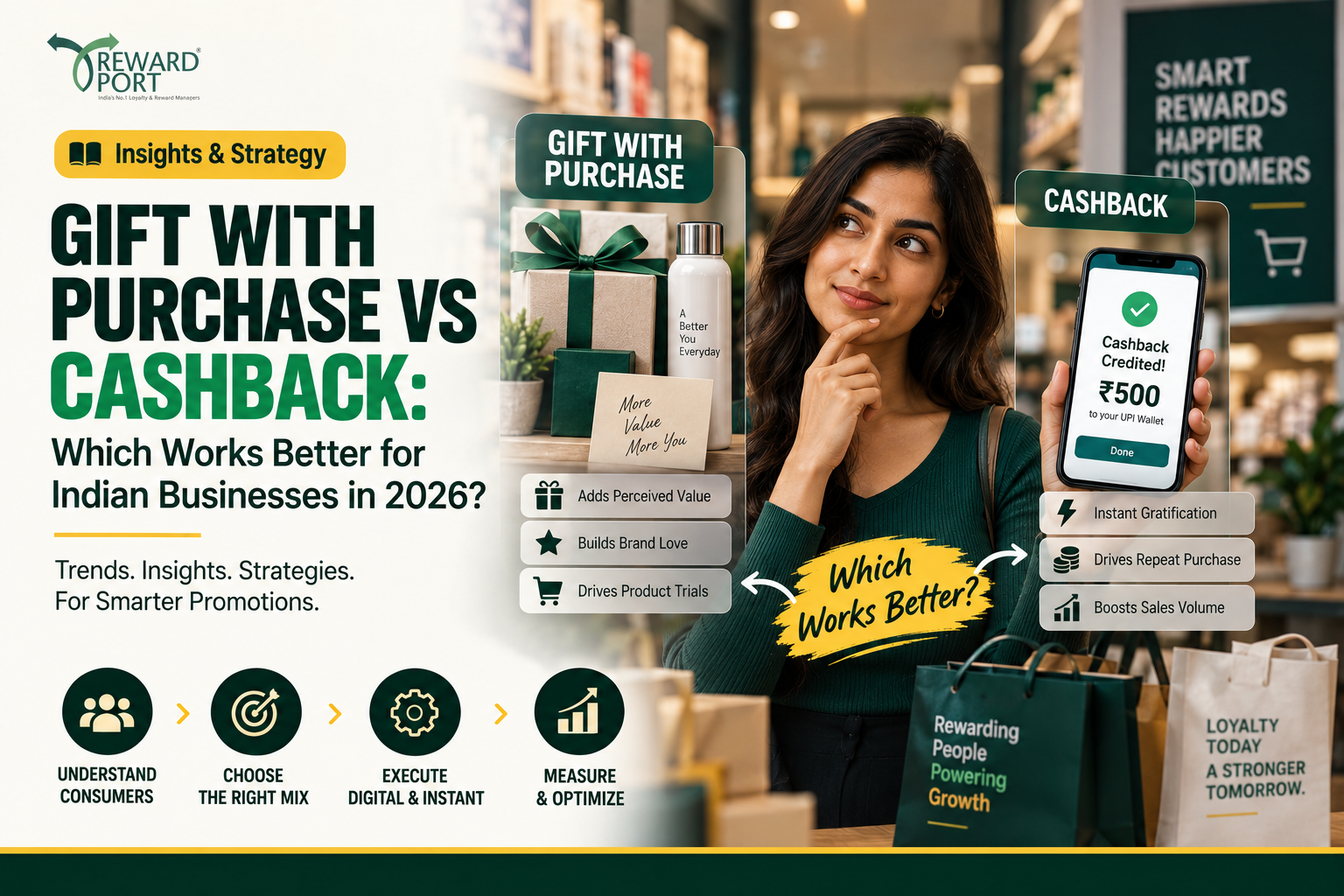
A UPI cashback promotion gives eligible customers a cash reward after a qualifying purchase, using a supported payout process. Its effectiveness depends on the purchase rules, validation, claim journey, payment reliability and total campaign cost. To measure ROI, estimate incremental sales contribution, subtract cashback and operating costs, and distinguish successful payouts from genuine commercial growth.
Key takeaways
- Cashback is the incentive. The purchase journey and campaign rules determine what it achieves.
- A QR scan or OTP alone does not establish a qualifying purchase.
- Budget for validation, technology, messaging, support and reconciliation alongside cashback.
- Track approved claims and successful payments separately.
- Measure incremental contribution and repeat behavior, rather than treating payouts as proof of success.
A customer buys a product, scans a code and receives cashback.
The proposition is easy to understand.
Behind it sit several decisions that determine whether the campaign works.
What proves the purchase? Can the same receipt be submitted twice? What happens when a payment fails? Who resolves a disputed claim? How much does the complete campaign cost?
And the most important commercial question:
Did the cashback encourage additional business, or subsidies purchases that would have happened anyway?
For brands evaluating UPI cashback promotions in India, these questions deserve attention before the reward amount is finalised.
What is a UPI cashback promotion?
A UPI cashback promotion is a purchase-linked campaign in which an eligible customer receives a cash reward through a supported UPI payout arrangement after meeting the stated conditions.
The campaign might involve a protected on-pack code, an eligible invoice or another approved source of purchase evidence.
A typical journey is:
- Buy the qualifying product.
- Access the promotion through a QR code, link or supported channel.
- Submit the required details and purchase evidence.
- Receive an eligibility decision.
- Complete the supported payout process.
- Receive confirmation or instructions if an issue occurs.
The exact payment method and information required depend on the payout provider and campaign configuration. Confirm those details before promising a particular customer journey.
The brand should also state whether the offer provides a fixed amount, a variable amount, a capped benefit or a chance to receive cashback.
Those are different propositions.
When is cashback a useful promotional incentive?
Cashback can suit a campaign where the audience values a straightforward monetary benefit and the brand wants to encourage a clearly defined purchase.
Possible objectives include:
- Trial of a new product.
- Purchase of an eligible pack or variant.
- Buying above a basket threshold.
- A second purchase within a relevant period.
- Reactivation of a previously purchasing customer.
The objective should guide the eligibility rules.
For example, if the goal is to encourage purchase of a larger pack, rewarding every pack equally may dilute the intended behaviour.
If the goal is repeat purchase, paying cashback once and ending the journey leaves that objective largely unaddressed.
Start with the action you want to encourage, then decide how cashback supports it.
What does a UPI cashback campaign cost?
The cashback amount is only one part of the budget.
A practical cost model should distinguish fixed setup costs, usage-based charges and the reward funding itself.
| Cost component | What to clarify |
|---|---|
| Campaign design and setup | Scope, rules, creative adaptation and testing |
| Technology | Claim journey, integrations, dashboard and maintenance |
| Purchase verification | Code checks, invoice processing and manual review |
| Communication | Messages, confirmations and follow-up usage charges |
| Cashback funding | Amount, eligible volume, caps and funding arrangements |
| Payment processing | Charges, retries and reconciliation responsibilities |
| Consumer support | Channels, service commitments and escalation |
| Reporting and administration | Data access, settlement reports and closure |
| Taxes | Applicable treatment and whether quoted prices include them |
Ask when each charge applies.
A fee per code issued is different from a fee per submitted claim, approved claim or successful payout.
Also clarify what happens to unused funding and approved claims awaiting payment when the campaign closes.
A simple budgeting formula
Estimated campaign cost = Fixed costs + Usage-based operating costs + Expected cashback obligation.
For planning:
Expected cashback obligation = Expected approved eligible claims × Average cashback per approved claim.
This estimates the reward obligation. Cash actually paid during a period may differ because some approved payments are pending or unsuccessful.
Use low, expected and high participation scenarios. The expected scenario should not be the only one the budget can accommodate.
How should a brand verify the purchase?
Choose a verification method that matches the offer, packaging, sales channels and exposure to misuse.
| Method | What it can support | Limitation to consider |
|---|---|---|
| Protected unique on-pack code | Eligibility tied to an authorized code | Requires secure code design and distribution controls |
| Invoice or receipt submission | Purchase details, date and eligible products | Needs duplicate, alteration and eligibility checks |
| Approved transaction integration | Verification against available operational records | Depends on data coverage and integration quality |
| Product serial number | Identification of an eligible unit | May need additional evidence of purchase and ownership |
| Generic QR code | Access to the campaign | Does not prove purchase by itself |
| OTP | Access to a phone number | Does not prove purchase by itself |
No method should be described as eliminating fraud.
The useful question is which risks it addresses and which remain.
What role does invoice OCR play?
Optical character recognition, or OCR, extracts information from a receipt or invoice image.
That can help process fields such as invoice number, date, product description and amount.
Extraction is one step in validation.
The campaign may still need to check whether the invoice is eligible, whether it has already been claimed and whether uncertain information requires review.
A readable invoice is not automatically a valid claim.
How can brands reduce duplicate and invalid claims?
Start with explicit campaign rules.
Define:
- Eligible products, packs and purchase dates.
- Participating channels or locations.
- Claim deadlines.
- Limits per person, purchase or household, where applicable.
- Evidence requirements.
- Treatment of cancellations and returns.
- Reasons for rejection and routes for review.
Then configure checks appropriate to those rules.
These might include duplicate invoice detection, single-use code controls, claim-frequency limits and review of unusual patterns.
Use care when interpreting signals. Two legitimate customers may share a household or other attributes. An anomaly should trigger an appropriate decision process, rather than automatically becoming proof of misconduct.
Track rejected claims and successful appeals. Both can reveal whether controls are proportionate.
How much verification is too much?
Verification introduces effort.
A customer claiming a modest reward may abandon a journey that requires repeated uploads, lengthy forms or unclear instructions.
But a simple journey still needs sufficient evidence for the campaign.
A practical approach is to:
- Collect only the information needed for eligibility and delivery.
- Explain requirements before submission.
- Validate fields as early as possible.
- Make errors understandable.
- Provide a review route for genuine exceptions.
Measure abandonment by stage.
If customers regularly leave during receipt upload, investigate whether the problem is the image requirement, interface, connectivity or instructions.
Do not assume every incomplete claim represents weak interest in the reward.
What happens when a cashback payment fails?
Eligibility approval and payment success are different events.
The dashboard should preserve that distinction.
| Status | Meaning |
|---|---|
| Submitted | Claim received |
| Under review | Validation is incomplete |
| Rejected | Claim did not meet the rules |
| Approved | Cashback entitlement confirmed |
| Payment initiated | Payout request submitted |
| Successful | Provider-confirmed successful payment |
| Failed or pending | Payment needs resolution or further confirmation |
Agree on how payment statuses are reconciled with the provider.
Also define the retry process, duplicate-payment safeguards, customer communication and escalation responsibilities.
Avoid promising “instant cashback” unless the operating arrangement supports that promise and the terms explain relevant conditions.
A customer should be able to understand whether the claim is being reviewed or an approved payment is being resolved.
What should a cashback dashboard measure?
Separate participation, validation, delivery and commercial outcomes.
| Measurement area | Useful metrics |
|---|---|
| Participation | Journey starts, submissions and completion rate |
| Validation | Approved claims, duplicate claims, rejections and review time |
| Payment | Successful payouts, pending payments, failures and resolution time |
| Cost | Cashback obligation, amount paid and operating expenses |
| Commercial behavior | Verified purchases, repeat purchase and estimated incremental contribution |
For every rate, define the denominator.
For example:
Claim approval rate = Approved claims ÷ Reviewed claims × 100.
Payout success rate = Successful payouts ÷ Approved claims submitted for payment × 100.
Compare cohorts with a consistent payment observation window. A newly initiated payment should not be evaluated as if it has had the same time to resolve as an older one.
How do you calculate cashback promotion ROI?
A commercially useful calculation begins with incremental contribution.
Estimated net incremental contribution = Estimated incremental sales contribution before campaign costs − Total campaign costs.
Then:
Campaign ROI = Estimated net incremental contribution ÷ Total campaign costs × 100.
Total campaign costs should include cashback and relevant operating expenses.
If cashback is already deducted in the contribution figure, do not deduct it again.
The formula also depends on a credible estimate of incremental sales.
Total purchases recorded during the campaign are not automatically incremental.
An illustrative cashback campaign
Assume a hypothetical brand estimates the following:
| Item | Illustrative assumption |
|---|---|
| Approved eligible claims | 10,000 |
| Cashback per approved claim | ₹30 |
| Cashback obligation | ₹3 lakh |
| Other campaign costs | ₹1 lakh |
| Total campaign costs | ₹4 lakh |
| Estimated incremental sales | ₹25 lakh |
| Contribution margin before campaign costs | 20% |
| Estimated incremental contribution | ₹5 lakh |
| Estimated net incremental contribution | ₹1 lakh |
| Estimated campaign ROI | 25% |
The calculation is:
₹25 lakh × 20% = ₹5 lakh contribution.
₹5 lakh − ₹4 lakh = ₹1 lakh net incremental contribution.
₹1 lakh ÷ ₹4 lakh × 100 = 25% ROI.
These are hypothetical assumptions, not RewardPort results or market benchmarks. The cashback obligation assumes all approved claims remain payable.
The example illustrates why claim volume alone cannot establish success. The conclusion depends on the incrementality estimate and full cost accounting.
How do you estimate incremental sales?
Where feasible, compare campaign performance with a credible estimate of what would have happened without the offer.
Options include a controlled pilot, phased rollout or suitably matched comparison groups.
Historical comparisons can provide context, but need careful interpretation.
Account for factors such as:
- Seasonality.
- Price changes.
- Distribution expansion.
- Stock availability.
- Other consumer and trade promotions.
- Media activity.
- Product launches.
When a strong comparison is unavailable, report observed purchases and behavioral changes. State that incremental impact remains an estimate.
Can cashback encourage repeat purchase?
Yes, when the journey is designed around a subsequent eligible purchase.
A possible structure is:
- First verified purchase unlocks an initial benefit.
- A second verified purchase within the relevant buying cycle unlocks another benefit.
- Each stage has clear eligibility and claim limits.
Select the timeframe from the category’s replenishment cycle.
A frequently purchased food product and a durable appliance require different approaches.
Measure repeat purchase using customers who have had a complete opportunity to make the second purchase.
Keep messaging permissions and consumer expectations clear.
Cashback may also be combined with other suitable benefits. The purpose should be to support the intended behavior while keeping the offer understandable.
A practical launch checklist
RewardPort’s proposed Cashback Campaign Readiness Check covers six areas:
- Objective: One primary behavior and a defined success measure.
- Eligibility: Clear products, dates, limits and consumer terms.
- Verification: Tested purchase checks and exception review.
- Payment: Confirmed funding, status tracking and reconciliation.
- Support: Named owners and a clear resolution process.
- Measurement: Baseline, cost model and realistic attribution plan.
Test a valid claim, duplicate claim, unclear receipt, rejected claim and unsuccessful payment before launch.
The campaign is ready when the teams can explain what happens in each case.
Frequently Asked Questions
How does a UPI cashback promotion work?
A customer completes an eligible purchase, submits the required evidence and receives cashback through the campaign’s supported payout process after approval.
Can a brand run cashback through a QR code?
A QR code can open the claim journey. Purchase verification requires an appropriate mechanism behind it, such as a protected code, eligible invoice or approved transaction record.
Is UPI cashback always instant?
No. Timing depends on validation and the payout arrangement. State the actual service commitment and relevant conditions clearly.
How much should a brand offer?
Select the amount based on the audience, requested behavior, margin and overall budget. A pilot can help test response without assuming a universal optimum.
Is cashback better than vouchers or experiences?
There is no universal winner. Compare audience relevance, usability, cost and the commercial objective.
How can brands control cashback fraud?
Use clear rules, appropriate purchase verification, duplicate checks, claim limits and exception review. No control should be presented as eliminating all misuse.
What proves a cashback campaign worked?
Successful payouts prove delivery. Commercial success needs evidence of the intended behavioral change and an assessment of incremental contribution after costs.
How RewardPort fits
RewardPort connects cashback with promotion design, qualifying-action verification, consumer journeys, fulfilment and reporting.
The approach begins with the business objective, then aligns the offer, purchase evidence, operating process and measurement.
For brands planning a campaign, the useful first step is to map those elements together before committing the payout budget.
Planning a UPI cashback promotion? Ask RewardPort to build the eligibility, verification, cost and measurement plan around the behavior you want to encourage.