
Stop Rewarding Your Best Customers: Reward the Behavior You Want Instead
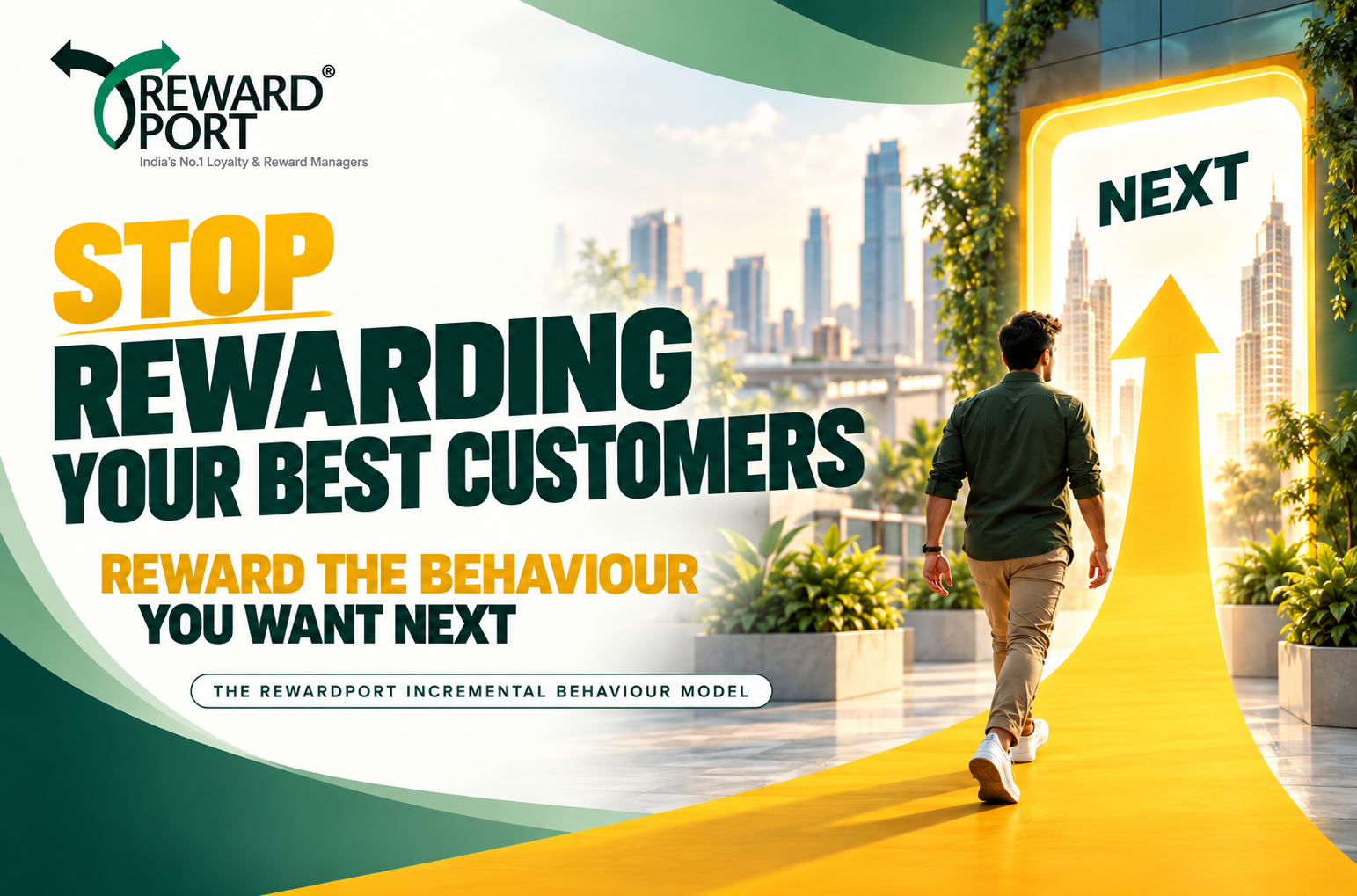
Most loyalty programs reward customers for what they have already done. Better loyalty programs reward customers for what the brand wants them to do next.
That might mean making a second purchase, trying a new category, returning sooner, referring a friend, completing product education or increasing share of wallet.
The difference sounds small.
Commercially, it is enormous.
Because the real question behind loyalty program ROI is not:
“Did this customer buy?”
It is:
“Would this customer have bought anyway?”
The problem with rewarding your best customers
Imagine you run a coffee chain.
One customer visits you five mornings every week.
You introduce a loyalty program and start giving them points for every cup.
At the end of the month, they have earned free coffee.
Your loyalty dashboard looks excellent.
High engagement.
High frequency.
High redemption.
High member spend.
There is just one awkward question.
Did the loyalty program change anything?
If that customer was already going to visit five times a week, you may simply have given away margin on purchases you would have received anyway.
That does not mean loyal customers should not be recognized.
It means recognition and behavioral incentives are two different jobs.
And too many loyalty programs confuse them.
What should a loyalty program actually reward?
A loyalty program should ideally reward incremental behavior, meaning behavior that probably would not have happened without the intervention.
Examples include:
- turning a first-time customer into a second-time buyer
- getting an occasional buyer to purchase more frequently
- encouraging someone to try another product category
- recovering a customer who has stopped buying
- generating a genuine referral
- increasing a retailer’s range or secondary sales
- encouraging product training or participation
- getting customers to provide verified purchase information
- moving purchases toward a strategically important product or channel
The reward is not the objective.
The behavior is the objective.
The reward is one of the tools used to influence it.
That distinction should shape the entire program.
Why traditional loyalty metrics can be misleading
Loyalty teams understandably monitor transactions, points issued, redemptions, active members and member revenue.
Those numbers matter.
But they cannot always tell you whether the program caused the behavior.
BCG made this point particularly clearly in its July 2026 work on incrementality. It found that organizations using rigorous testing frequently discover that 20% to 40% of active marketing programs produce marginal or negative incremental lift, even though customers respond to them.
Source:
https://www.bcg.com/publications/2026/measuring-incrementality-in-next-best-action-programs
In other words, an offer can produce a conversion without actually causing the conversion.
Suppose you send a ₹500 reward to 10,000 customers who are statistically your most likely buyers.
A large percentage subsequently purchases.
The campaign looks successful.
But you selected people who were already highly likely to purchase.
How much of that revenue did the reward actually create?
Without a control group or another credible method of measuring incrementality, you may not know.
Loyalty ROI should start with one question
Before designing a reward, ask:
What behavior are we trying to change?
Not:
“What reward should we give?”
Not:
“How many points should customers earn?”
Not:
“Should we give vouchers or cashback?”
Those questions come later.
Start here:
What would we like this customer to do that they are unlikely to do without some intervention?
Once that behavior is clear, the incentive becomes much easier to design.
McKinsey has previously found that top-performing loyalty programs can increase revenue from customers who redeem points by 15% to 25% annually through increased purchase frequency, basket size, or both.
But the same research also warned that many established loyalty programs fail to create value.
The opportunity is therefore not to abandon loyalty.
It is to make loyalty more precise.
The RewardPort Incremental Behavior Model
A useful way to design a program is to move through five questions.
1. Baseline: What is the customer already doing?
Start by understanding normal behavior.
If a customer already purchases every week, simply rewarding the weekly transaction may add very little.
If another customer purchases once every three months, getting that person to return in six weeks represents a potentially meaningful behavioral change.
Without a baseline, almost every subsequent loyalty metric becomes harder to interpret.
2. Behavior: What do we want them to do next?
Define one specific action.
For example:
Consumer
First purchase → second purchase
Retailer
Stocks three SKUs → stocks five SKUs
Dealer
Registers → completes product training
Customer
Buys product A → tries product B
Dormant member
No purchase for 90 days → returns
Advocate
Happy customer → verified referral
Each creates a clearer reason for rewarding someone.
3. Friction: Why aren’t they doing it already?
Customers do not always need more money.
They may need:
- a reminder
- greater convenience
- recognition
- information
- reassurance
- progress toward something
- excitement
- access
- status
- a relevant experience
BCG’s loyalty research has similarly found that customers value more than monetary rewards alone and that relevance and experience influence program satisfaction.
Source:
https://www.bcg.com/publications/2023/loyalty-programs-need-to-continue-to-evolve
This is why automatically increasing cashback is not always the answer.
4. Incentive: What is the smallest meaningful intervention?
Only now should you choose the reward.
Different behaviors may call for very different incentives.
A ₹20 instant reward might be enough to encourage a small verified action.
A high-value experience might be better for a meaningful milestone.
Recognition may work better than cash for another audience.
A retailer challenge could combine progress, competition and a payout.
The objective is not to give the biggest reward.
It is to create enough perceived value to change behavior while maintaining attractive program economics.
5. Incrementality: Did behavior actually change?
Finally, measure the difference between:
What happened
and
What would probably have happened anyway.
This can be evaluated using holdout groups, controlled tests, matched audiences, historical baselines or more sophisticated modelling depending on the scale and sophistication of the program.
That is a better definition of loyalty ROI.
Recognition and incentives should not be confused
There is an important qualification to the headline of this article.
Your best customers absolutely deserve recognition.
They may deserve better service, priority access, exclusive experiences, status or surprise benefits.
That reinforces the relationship.
But constantly discounting every transaction of your most loyal customer is something else entirely.
Think of it this way:
| Customer situation | Traditional approach | Behavior-led approach |
|---|---|---|
| Already buys weekly | Give points every week | Recognize loyalty, then incentivize a new behavior |
| Buys one category | Reward same purchase | Reward trial of an adjacent category |
| High-spending dealer | Increase payout | Incentivize range, training or secondary sales |
| Dormant customer | Generic points | Give a targeted return mission |
| New customer | Reward first purchase heavily | Put stronger incentive behind the second purchase |
| Advocate | Give another purchase discount | Reward a verified referral |
The best programs can do both.
Recognize existing loyalty. Create incentives for incremental behavior.
Stop treating every customer action as equally valuable
Consider two customers.
Customer A spends ₹50,000 every year and would probably continue doing so without your loyalty program.
Customer B spends ₹10,000 but could realistically spend ₹20,000 if the brand could win a greater share of their purchases.
Which one deserves more incentive investment?
The obvious answer is not necessarily Customer A.
A smarter loyalty strategy looks at incremental opportunity, not simply historical spend.
That might mean allocating greater incentive budgets toward:
- customers close to making a second purchase
- customers whose frequency can realistically increase
- cross-category opportunities
- dormant but recoverable customers
- high-potential channel partners
- referrals with a high probability of converting
Loyal customers remain valuable.
But loyalty investment should follow opportunity, not habit.
Cashback is not the problem
Cashback is often criticized as being transactional.
That criticism misses the point.
Cashback can be extremely effective when attached to the right behavior.
So can points.
So can merchandise.
So can vouchers, movies, experiences, travel benefits, status or recognition.
The real question is:
What behavior is this reward buying?
₹100 cashback for a purchase someone was already going to make is very different from ₹100 cashback that causes a customer to try a new SKU, return sooner or complete a verified action.
The reward instrument may be identical.
The economics are completely different.
A simple loyalty ROI formula
At a basic level, brands should think about:
Incremental Value Created
minus
Reward Cost + Program Cost
= Incremental Program Contribution
The difficult part is not calculating the cost.
The difficult part is identifying the incremental value.
BCG has long argued that loyalty economics ultimately depend on whether the incremental margin generated by a program exceeds the cost of providing the benefits.
This is why redemption rates alone cannot tell you whether a loyalty program is working.
Neither can enrolments.
Neither can member revenue.
They describe activity.
Not necessarily causality.
What should loyalty teams measure instead?
The precise metrics depend on the objective, but useful measures can include:
Behavior metrics
- Purchase frequency
- Time to second purchase
- Category penetration
- Dormant customer reactivation
- Referral conversion
- Retailer range expansion
- Training completion
- Target achievement
Commercial metrics
- Incremental revenue
- Incremental gross margin
- Cost per incremental action
- Reward cost
- Customer lifetime value change
- Incremental share of wallet
Engagement metrics
- Participation
- Redemption
- Challenge completion
- Repeat engagement
- Reward preference
Control metrics
- Fraud rates
- Duplicate claims
- Invalid invoices
- Suspicious redemption behavior
- Cost leakage
The question behind every dashboard should remain the same:
What changed because the program existed?
What does this mean for consumer promotions?
Exactly the same principle applies.
A consumer promotion should not merely generate claims.
It should have a defined behavioral job.
For one brand, that might be trial.
For another, repeat purchase.
For another, collecting first-party consumer data.
For another, increasing basket size.
For another, driving referrals.
For another, moving customers toward a premium product.
QR codes, OTP validation, invoice parsing, cashback, gamification and rewards are the execution tools.
They should not become the strategy itself.
Where RewardPort fits
RewardPort’s approach to consumer promotions, loyalty and channel engagement begins with the behavior a brand wants to influence, then connects verification, engagement and an appropriate reward mechanism around it.
Depending on the program, qualifying actions can be validated through mechanisms such as QR, OTP, invoices, OCR or other approved transaction data.
Rewards can then range from cashback and vouchers to merchandise, cinema, travel and experiences.
The objective is not simply to issue rewards.
It is to build a measurable loop:
Define behavior → verify action → reward intelligently → measure response → improve the next intervention.
That is where loyalty begins to become growth infrastructure rather than an expense line.
The final question
Before approving your next loyalty campaign, remove the points, vouchers, cashback and rewards from the presentation.
Then look at what remains.
Can you clearly complete this sentence?
“We are investing in this program because we want this customer to ______.”
If the answer is not immediately obvious, the program probably needs more work.
Because the future of loyalty is not about rewarding more behavior.
It is about knowing which behavior is actually worth rewarding.
10 Things Not to Do When Building a Loyalty Program
What are the biggest mistakes brands make when designing loyalty programs?
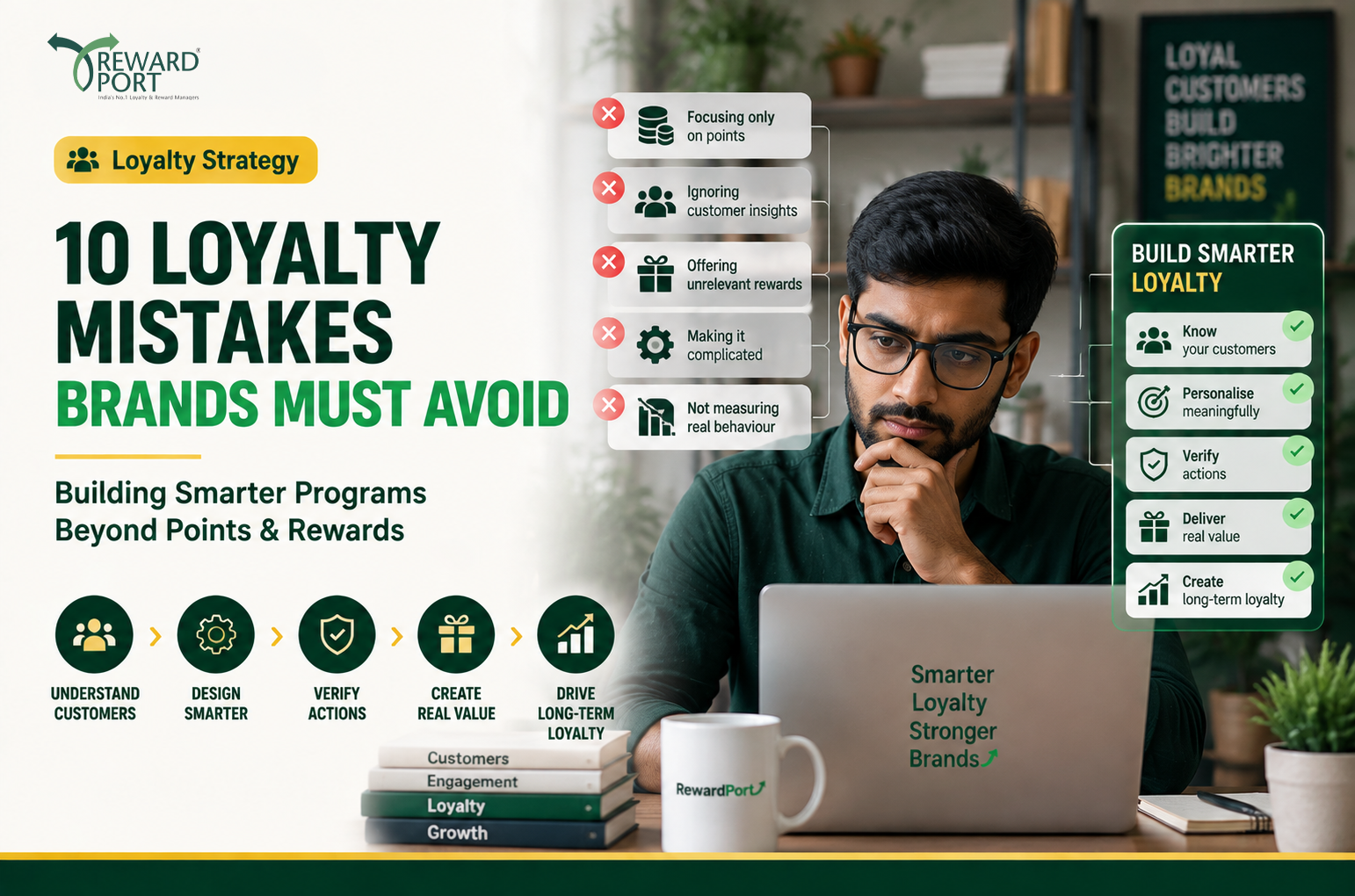
The ten biggest mistakes are starting with points instead of behavior, rewarding activity that would happen anyway, mistaking enrolment for engagement, treating every member alike, selecting rewards only by cost, hiding redemption friction, collecting unused data, accepting unverified claims, running disconnected campaigns and adding AI before defining the next best action.
Technology amplifies program logic. It does not repair it.
Key Takeaways
- A loyalty program must begin with a behavior the business wants to change.
- Member enrolment is an input. Repeat behavior is an outcome.
- The cheapest reward is rarely the most economically effective reward.
- Every qualifying action should be observable and appropriately verified.
- AI becomes useful only after the brand defines what a good next action looks like.
Why Do So Many Loyalty Programs Still Feel Ordinary?
RewardPort Editorial: Loyalty technology is becoming more sophisticated. Brands now have points engines, WhatsApp journeys, recommendation models, receipt recognition and generative AI. Why do so many programs still feel ordinary?
Javed Akhtar: Because a more powerful engine does not compensate for an unclear destination.
Many programs begin with a platform, a catalogue or a points conversion rate.
The real starting question is simpler:
What should the customer, dealer, retailer or employee do differently after joining?
Deloitte’s 2025 Consumer Loyalty Program Survey, published in January 2026, found that the average US consumer in its sample was enrolled in eight programs but actively participated in only five.
Enrolment is abundant.
Relevance is scarce.
The useful question is not how many people joined.
It is whether the program changed a valuable behavior.
1. Should a Brand Start by Deciding How Many Points to Award?
No. Start with the behavior, not the currency.
Points are an accounting mechanism. They are not a strategy.
First define the action:
- A second purchase
- Faster replenishment
- Product trial
- Invoice upload
- Dealer training
- Referral
- Improved visibility
- Service recovery
Then decide whether points, cashback, a voucher, merchandise, cinema, travel or an experience is the right response.
If the behavior is vague, the program will reward transactions without knowing which transaction mattered.
2. Is It Safe to Reward Every Purchase?
No. Do not spend money rewarding behavior that would have happened anyway.
A purchase can be valuable without being incremental.
A loyal buyer who always purchases the same quantity may collect a benefit without changing frequency, basket, mix or retention.
That creates generosity, but not necessarily growth.
Ask what the incentive is supposed to move.
It may be:
- Purchase number two
- A higher-margin variant
- A lapsed customer’s return
- An additional retailer order
- A defined repeat action
Measure the change against a baseline or a credible comparison group whenever possible.
3. If Enrolment Is Growing, Does That Mean Loyalty Is Growing?
No. Membership is a database event. Loyalty is repeated preference.
A sign-up incentive can produce registrations quickly.
It cannot prove that customers prefer the brand or will return.
Deloitte’s research found that consumers reported joining more programs than they actively used.
That gap is where many attractive dashboards hide weak programs.
Track:
- Percentage of enrolled members performing a second meaningful action
- Time between actions
- Share remaining active after the initial benefit
A million dormant members are not necessarily a loyalty asset.
4. Should Every Member Receive the Same Offer?
No. Equality of access does not require sameness of treatment.
A new buyer, high-value regular, lapsed customer and customer with an unresolved complaint should not automatically receive the same message.
Context matters.
McKinsey’s work on “next best experience” argues for coordinated interventions based on integrated data rather than disconnected outbound campaigns.
Segmentation does not need to begin with complex AI.
Start with commercially meaningful states:
New → Progressing → Loyal → At Risk → Inactive
Then decide the best action for each state before attempting hyper-personalization.
5. Should Procurement Choose the Reward With the Lowest Unit Cost?
No. Optimize for perceived value and behavioral fit, not unit cost alone.
A ₹100 benefit is not experienced identically in every form.
Cashback is liquid and clear.
A movie, dining benefit, travel experience or carefully selected product can sometimes create greater memory or aspiration.
In other situations, immediate cashback may be exactly right.
The choice depends on:
- Audience
- Effort required
- Desired emotion
- Commercial objective
Capgemini’s 2026 global consumer research, which included India, recommends treating loyalty as a two-way relationship that provides both financial and emotional returns.
Reward architecture should reflect that balance.
6. Can a Little Redemption Friction Protect Program Economics?
No. Hidden friction protects a budget by damaging trust.
Expiry rules, exclusions and verification requirements may be necessary.
They should be visible and proportionate.
Customers should understand:
- What they earned
- When they can use it
- How they can use it
- Why a claim was rejected
Measure the full redemption journey:
- Delivery time
- Failed OTPs
- Broken links
- Support contacts
- Rejected claims
- Successful utilization
A reward that appears in the campaign promise but becomes difficult to use is not a saving.
It is a trust liability.
7. Is Collecting More Customer Data Always Useful?
No. Do not collect data unless it improves a defined decision or experience.
Brands often ask for birthdays, preferences, locations and interests simply because the form allows it.
The better test is:
What will we do differently if the customer answers?
Collect the minimum data needed.
Explain the value exchange.
Connect every important field to a decision.
For example:
- Purchase evidence may trigger a reward.
- A declared interest may change the reward menu.
- A lapsed status may change the timing.
Data that never influences an action adds risk and complexity without adding intelligence.
8. Can Brands Trust Every Uploaded Bill, QR Scan or Dealer Claim?
No. Rewarding unverified activity invites leakage and weakens the data.
Verification should match the value and risk of the action.
Options can include:
- Unique codes
- OTP
- QR validation
- Invoice or bill parsing
- Transaction checks
- Time and location rules
- Duplicate detection
- Operational approval
Verification is not only fraud prevention.
It improves learning.
If the qualifying action is ambiguous, the resulting customer or channel data is also ambiguous.
A clean action signal helps the brand understand what actually happened and what to do next.
9. Is It Fine to Run Each Promotion as an Independent Campaign?
No. Do not let every campaign forget what the previous campaign learned.
A festive cashback offer, referral drive, retailer challenge and product launch may be managed by different teams.
To the participant, they are all interactions with one brand.
Use consistent:
- Identity rules
- Consent
- Contact policies
- Measurement definitions
Feed the response from one intervention into the next.
A campaign should leave behind more than a redemption report.
It should improve the brand’s understanding of behavior, reward preference, timing and risk.
10. Should AI Be Added Before the Loyalty Logic Is Fully Defined?
No. AI should choose among good actions, not invent the strategy unsupervised.
AI can help:
- Recognized invoices
- Detect anomalies
- Recommend rewards
- Predict churn
- Generate messages
- Surface the next best action
But the brand must still define:
- Eligible behavior
- Economics
- Fairness
- Consent
- Service rules
- Approved interventions
McKinsey notes that even accurate models can fail when they are not embedded in workflows or trusted by the teams expected to act on them.
Before asking:
“Which AI should we buy?”
Ask:
“What verified signal should cause which approved action?”
The RewardPort BEFORE Test
Before approving a loyalty platform, promotion or AI layer, answer six questions.
B — Behavior
What exact action must change?
Define the behavior before selecting the technology.
E — Economics
What is that incremental action worth, and what can the brand responsibly spend?
The reward budget should connect to the value of the behavior being influenced.
F — Friction
How easy is it to understand, earn and use the benefit?
Every unnecessary step creates another opportunity for abandonment.
O — Observability
How will the qualifying action be captured and verified?
A program cannot reliably learn from behavior it cannot observe.
R — Relevance
Does the reward, timing and channel fit this participant and moment?
Relevance is more important than simply increasing reward value.
E — Evolution
What will the brand learn, and how will the next intervention improve?
The strongest loyalty programs become better through every interaction.
BEFORE in one view:
Behavior → Economics → Friction → Observability → Relevance → Evolution
If one of these answers is missing, technology may scale the gap.
What Does This Look Like in Practice?
Illustrative Scenario
A nutrition brand wants more repeat purchases.
A flat reward on the first pack may create trial, but it does not prove habit.
A stronger design could give a modest benefit for the first verified purchase, show progress toward a meaningful milestone and unlock a higher-perceived-value reward after three verified replenishments within sensible product-usage intervals.
The brand would then measure:
- Purchase number two and three
- Time to replenishment
- Drop-off points
- Reward preference
- Verification failures
- Cost per incremental repeat purchase
This turns a giveaway into a behavior journey.
This scenario is illustrative and is not presented as a client case study.
Which Loyalty Metrics Matter Most?
Do not measure enrolment alone.
Track:
- Second meaningful action rate
- Active member rate
- Incremental purchase or behavior lift
- Time between qualifying actions
- Reward delivery rate
- Successful redemption rate
- Cost per incremental action
- Claim rejection rate
- Duplicate and suspected-fraud rates
- Opt-out rate
- Complaint and support-contact rate
- Reactivation
- Retention by member state
- Performance by reward type
- Performance by channel
- Performance by audience
The objective is not simply to grow the program.
It is to grow valuable behavior.
So, What Is a Loyalty Program?
A loyalty program is a measurable value exchange designed to encourage repeated, valuable behavior.
It combines:
- A clear commercial objective
- Participant understanding
- Verifiable actions
- Suitable rewards
- Simple fulfilment
- A learning loop
Points may be part of the mechanism.
They are not the definition.
Where Does RewardPort Fit?
RewardPort helps brands design and operate closed-loop engagement programs across:
- Consumers
- Dealers
- Retailers
- Employees
- Channel partners
The work can combine:
- Program strategy
- QR journeys
- WhatsApp journeys
- Validation
- Bill or invoice parsing
- Fraud controls
- Reward choice
- Reward fulfilment
- Reporting
The objective is not to add more campaign activity.
It is to connect incentives to measurable behavior and reusable intelligence.
Final Question
Before signing the next loyalty proposal, ask:
“Which behavior will change, how will we verify it, and what will we do with what we learn?”
If the proposal cannot answer that in plain language, do not begin with the platform demo.
Go back to the program logic.
Planning a loyalty initiative?
RewardPort can run a BEFORE review of the program logic, reward architecture, verification journey and measurement plan before implementation.
Speak with RewardPort.

81% of Indian Marketers Have AI. Do They Know the Customer?
AI personalization fails when customer information is fragmented, stale, unverified or disconnected from the behavior a brand wants to influence. The solution is not simply another AI tool or a larger customer profile. Brands need a closed loop that captures real actions, verifies them, responds appropriately and learns whether the intervention changed what happened next.
Key Takeaways
- AI adoption is becoming common, making access to AI less of a competitive advantage.
- A unified customer profile can still be commercially weak if it lacks timely, verified behavioral signals.
- Brands need to distinguish profile data, transaction data and action data.
- Effective marketing AI starts with a commercial question, not simply a content-generation prompt.
- Promotions and loyalty programs can become learning systems when every intervention produces a measurable next action.
The Statistic That Matters Less Than It Appears
In July 2026, Salesforce published the India findings from its tenth State of Marketing report. The headline number was difficult to miss: 81% of marketers in India had adopted AI.
That sounds like transformation.
Then the rest of the report makes the picture far more interesting.
Salesforce found that 92% of Indian marketers believe customers increasingly expect two-way conversations with brands. Yet 71% said they struggle to respond promptly because they cannot access the context they need.
Only 60% reported complete access to customer-service data, 61% to sales data and 58% to commerce data. Almost every respondent reported some barrier to personalisation, with privacy concerns, poor data quality and limited technical expertise among the leading problems.
The report was based on a double-anonymous survey of 4,450 marketing decision-makers, including 250 respondents from India.
A report published by a company that sells marketing technology should, naturally, be read with normal commercial caution. But the contradiction it reveals is useful:
Marketers have acquired the intelligence layer before fixing the information layer.
AI Is Becoming the Electricity of Marketing
A few years ago, having access to generative AI could itself feel like an advantage.
Today, almost every marketing team can use similar models to write copy, generate images, summaries research, produce campaign variations or answer basic customer questions.
When the underlying models are widely available, the model is no longer the moat.
The difference comes from context.
Does the system know whether this person is a first-time buyer or a regular customer?
Did the consumer actually buy the product or merely click an advertisement?
Was the invoice genuine?
Did the retailer complete the display challenge?
Did the dealer finish the training module?
Was the reward delivered?
Did the customer buy again?
Without those answers, AI can produce polished communication without producing much intelligence.
It may know how to sound personal without knowing what is personally relevant.
The Customer-Data Problem Is Not Only Fragmentation
The usual prescription is to create a single customer view.
Connect the CRM, website, commerce platform, call center, app and campaign systems. Resolve identities. Remove duplicates. Feed the resulting customer profile into AI.
This is important work.
But it can create the impression that once all the data sits together, the marketing problem is solved.
It is not.
A beautifully unified database can still be filled with old, passive or ambiguous signals.
A customer opened three emails.
Someone visited a product page.
A household used a shared mobile number.
A dealer was billed for stock but may not have sold it.
A consumer uploaded a document, but the purchase was never verified.
The data may be connected without being commercially conclusive.
That is why brands need to distinguish three kinds of customer information.
| Data Type | What It Tells the Brand | Typical Limitation |
|---|---|---|
| Profile Data | Who the person appears to be: identity, location, declared preferences and segment | It may be incomplete, outdated or based on broad assumptions |
| Transaction Data | What was purchased, when, where and at what value | It records the sale but may not explain motivation or incrementality |
| Action Data | What the participant did in response to a specific opportunity, challenge, message or reward | It becomes useful only when the action is clearly defined and credibly verified |
Profile data provides context. Transaction data records commerce. Action data shows whether an intervention changed behavior.
Marketing AI needs all three, but action data is often the missing layer.
What Exactly Is Action Data?
Action data is information generated when a consumer, dealer, retailer, employee or partner completes a defined and measurable behavior.
Examples include:
- Scanning a unique code from an eligible product
- Submitting a valid invoice
- Trying a new product variant
- Completing a training module
- Photographing an approved retail display
- Referring a verified customer
- Returning for a second or third purchase
- Redeeming a reward linked to a specific milestone
The value comes from the connection between the action and the commercial objective.
If a brand wants trial, it should capture verified trial.
If it wants repeat purchase, it should measure purchase two and purchase three.
If it wants better retail visibility, it should verify displays rather than treating distributor billing as proof.
If it wants a more capable dealer network, it should connect learning, execution and sales outcomes.
This sounds obvious.
Yet many marketing systems still measure the message more carefully than the behavior.
The Content Trap
The Salesforce findings show that personalized content creation is the most common AI use case for Indian marketers. 83% said they need more personalized content than they can currently produce.
AI is particularly good at solving that visible production problem.
One campaign can quickly become fifty audience variants, ten subject lines and hundreds of product combinations.
But greater content volume can magnify weak decisions.
If the underlying segment is wrong, AI produces more irrelevant messages.
If purchase data is incomplete, it recommends products the customer already owns.
If the brand cannot distinguish a genuine buyer from a reward hunter, it personalizes the wrong incentive.
If no one measures the next action, the system learns from clicks rather than commercial outcomes.
The danger is not that AI will make marketing less personal.
The danger is that it will make bad personalization faster, cheaper and more convincing.
The RewardPort Action Data Loop
Brands can approach AI-powered engagement through six connected stages.
1. Ask a Commercial Question
Begin with the decision the brand needs to improve.
Which first-time buyers are most likely to make a second purchase?
Which retailers understand the new product?
Which dealer activities increase secondary sales?
Which reward creates the highest incremental response for this audience?
“How can we use AI?” is not a commercial question. It is a technology question looking for a problem.
2. Define the Target Action
Specify the behavior that would constitute progress:
- Verified purchase
- Repeat purchase
- Referral
- Training completion
- Display execution
- Product registration
- Challenge completion
3. Capture the Signal
Use the appropriate route, such as:
- QR
- Unique code
- OTP
- Receipt upload
- Invoice parsing
- WhatsApp interaction
- Image submission
- Approved sales data
4. Verify the Action
Separate genuine behavior from duplication, invalid evidence, scheme gaming and accidental activity.
AI trained on unverified actions can become very confident about the wrong customer.
5. Respond With Appropriate Value
The response may be:
- Cashback
- Progress
- Recognition
- Merchandise
- Vouchers
- Cinema
- Travel
- Experiences
- Training access
- A next-best challenge
The reward should fit the audience and the behavior, not simply come from a generic catalogue.
6. Learn From What Happened Next
Did the person repeat the action?
Did the dealer improve?
Did the retailer sell through?
Did participation increase without fraud rising?
Did the incremental value justify the reward and operating cost?
The learning returns to the next intervention.
Ask → Define → Capture → Verify → Respond → Learn
This is what turns a promotion or loyalty program into an intelligence system.
A Practical Indian Brand Scenario
Consider a beverage company launching a lower-sugar variant.
A conventional campaign may advertise the product, offer cashback and count redemptions.
An AI tool may personalize the creative by age, location or media behavior.
An action-data program begins with a sharper question:
Which trial customers can be encouraged to buy the new variant again within the natural replenishment window?
The first eligible purchase is verified through a unique pack code or approved invoice.
The consumer chooses a relevant reward and can opt into a follow-up journey.
The next message arrives at an appropriate time and offers progress toward a second milestone rather than another blanket discount.
The system observes whether the second purchase occurs.
It learns which timing, message and reward combination works for comparable customers.
Fraud rules ensure that repeated scans or copied evidence do not become false training signals.
The brand is no longer asking AI to guess who may be interested based only on a profile.
It is helping AI learn from verified behavior.
Data Quality Also Means Permission and Restraint
Better data does not mean collecting every possible detail.
Salesforce’s connected-customer research reports that 71% of customers feel increasingly protective of their personal information, while 64% believe companies are reckless with customer data. The same research found that transparency becomes more important as AI advances.
This reinforces the lesson from our earlier article, The Loyalty Program That Knew Too Much: a larger customer profile is not automatically a better one.
The right data is useful, permissioned, current and connected to a defensible purpose.
The wrong data introduces privacy risk, irrelevant personalization and misleading model outputs.
AI needs context. Customers still deserve boundaries.
How Should a Brand Prepare Its Marketing Data for AI?
1. Choose Three Commercial Questions
Avoid starting with a company-wide AI transformation. Select questions with measurable outcomes.
2. Map the Current Evidence
Identify what the CRM, commerce, promotion, loyalty, support and channel systems actually know.
3. Separate Observation From Verification
A click is observed.
An eligible purchase may be verified.
They should not carry the same weight.
4. Identify Missing Actions
Determine which behaviors matter but are currently invisible.
5. Create Permissioned Capture Points
Explain why information is requested and what the participant receives in return.
6. Connect Response to Outcome
Record not only what message or reward was sent, but what happened next.
7. Establish a Non-AI Baseline
Compare AI recommendations with existing rules or control groups so that apparent improvement is not confused with real incrementality.
8. Feed Learning Back Into Program Design
AI should improve the next decision, not merely produce a dashboard explaining the last campaign.
The Metrics That Reveal Whether AI Knows the Customer
Brands should look beyond content output, open rates and model-generated engagement scores.
Track metrics such as:
- Percentage of target actions that can be captured
- Verification pass rate and suspected-fraud rate
- Time from verified action to relevant response
- Conversion from one target action to the next
- Incremental lift compared with a control or rules-based journey
- Reward cost per incremental behavior
- Percentage of recommendations using current rather than stale data
- Customer preference and permission retention
- Frequency of irrelevant or contradictory messages
- Operational time saved without a decline in customer outcomes
The core question is not whether AI created the message.
It is whether the system understood the situation well enough to improve the next decision.
The Winners Will Not Be the Brands With the Most AI
Eighty-one percent AI adoption is not evidence that marketing has become intelligent.
It is evidence that AI has become available.
The harder work begins after adoption: connecting the right information, verifying what actually happened, respecting permission, responding at the right moment and measuring whether behaviour changed.
That is where promotions, loyalty and channel programs can play a much larger role.
They are not merely mechanisms for distributing points or cashback.
Designed correctly, they create structured opportunities for people to act and for brands to learn.
RewardPort combines program strategy, action verification, rewards, engagement journeys and measurement across consumers, dealers, retailers, employees and partners.
The objective is not to add AI to every campaign.
It is to use AI where it can make the next decision more relevant, more accountable and more commercially useful.
Before buying another marketing AI tool, ask a simpler question:
What verified customer action will make this AI smarter?
To explore an Action Data Loop for a consumer, channel or loyalty program, speak with RewardPort.