
What are the biggest mistakes brands make when designing loyalty programs?
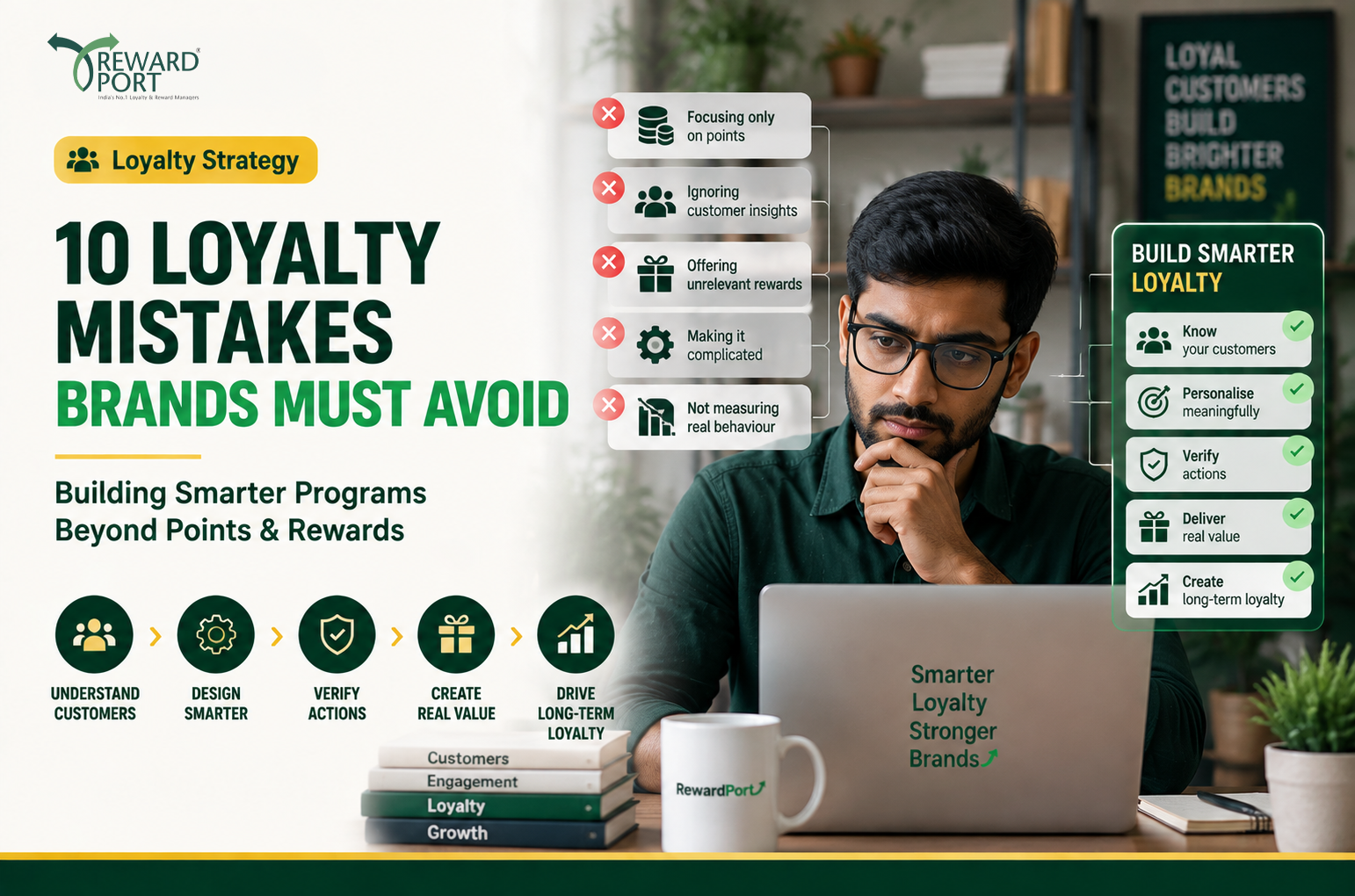
The ten biggest mistakes are starting with points instead of behavior, rewarding activity that would happen anyway, mistaking enrolment for engagement, treating every member alike, selecting rewards only by cost, hiding redemption friction, collecting unused data, accepting unverified claims, running disconnected campaigns and adding AI before defining the next best action.
Technology amplifies program logic. It does not repair it.
Key Takeaways
- A loyalty program must begin with a behavior the business wants to change.
- Member enrolment is an input. Repeat behavior is an outcome.
- The cheapest reward is rarely the most economically effective reward.
- Every qualifying action should be observable and appropriately verified.
- AI becomes useful only after the brand defines what a good next action looks like.
Why Do So Many Loyalty Programs Still Feel Ordinary?
RewardPort Editorial: Loyalty technology is becoming more sophisticated. Brands now have points engines, WhatsApp journeys, recommendation models, receipt recognition and generative AI. Why do so many programs still feel ordinary?
Javed Akhtar: Because a more powerful engine does not compensate for an unclear destination.
Many programs begin with a platform, a catalogue or a points conversion rate.
The real starting question is simpler:
What should the customer, dealer, retailer or employee do differently after joining?
Deloitte’s 2025 Consumer Loyalty Program Survey, published in January 2026, found that the average US consumer in its sample was enrolled in eight programs but actively participated in only five.
Enrolment is abundant.
Relevance is scarce.
The useful question is not how many people joined.
It is whether the program changed a valuable behavior.
1. Should a Brand Start by Deciding How Many Points to Award?
No. Start with the behavior, not the currency.
Points are an accounting mechanism. They are not a strategy.
First define the action:
- A second purchase
- Faster replenishment
- Product trial
- Invoice upload
- Dealer training
- Referral
- Improved visibility
- Service recovery
Then decide whether points, cashback, a voucher, merchandise, cinema, travel or an experience is the right response.
If the behavior is vague, the program will reward transactions without knowing which transaction mattered.
2. Is It Safe to Reward Every Purchase?
No. Do not spend money rewarding behavior that would have happened anyway.
A purchase can be valuable without being incremental.
A loyal buyer who always purchases the same quantity may collect a benefit without changing frequency, basket, mix or retention.
That creates generosity, but not necessarily growth.
Ask what the incentive is supposed to move.
It may be:
- Purchase number two
- A higher-margin variant
- A lapsed customer’s return
- An additional retailer order
- A defined repeat action
Measure the change against a baseline or a credible comparison group whenever possible.
3. If Enrolment Is Growing, Does That Mean Loyalty Is Growing?
No. Membership is a database event. Loyalty is repeated preference.
A sign-up incentive can produce registrations quickly.
It cannot prove that customers prefer the brand or will return.
Deloitte’s research found that consumers reported joining more programs than they actively used.
That gap is where many attractive dashboards hide weak programs.
Track:
- Percentage of enrolled members performing a second meaningful action
- Time between actions
- Share remaining active after the initial benefit
A million dormant members are not necessarily a loyalty asset.
4. Should Every Member Receive the Same Offer?
No. Equality of access does not require sameness of treatment.
A new buyer, high-value regular, lapsed customer and customer with an unresolved complaint should not automatically receive the same message.
Context matters.
McKinsey’s work on “next best experience” argues for coordinated interventions based on integrated data rather than disconnected outbound campaigns.
Segmentation does not need to begin with complex AI.
Start with commercially meaningful states:
New → Progressing → Loyal → At Risk → Inactive
Then decide the best action for each state before attempting hyper-personalization.
5. Should Procurement Choose the Reward With the Lowest Unit Cost?
No. Optimize for perceived value and behavioral fit, not unit cost alone.
A ₹100 benefit is not experienced identically in every form.
Cashback is liquid and clear.
A movie, dining benefit, travel experience or carefully selected product can sometimes create greater memory or aspiration.
In other situations, immediate cashback may be exactly right.
The choice depends on:
- Audience
- Effort required
- Desired emotion
- Commercial objective
Capgemini’s 2026 global consumer research, which included India, recommends treating loyalty as a two-way relationship that provides both financial and emotional returns.
Reward architecture should reflect that balance.
6. Can a Little Redemption Friction Protect Program Economics?
No. Hidden friction protects a budget by damaging trust.
Expiry rules, exclusions and verification requirements may be necessary.
They should be visible and proportionate.
Customers should understand:
- What they earned
- When they can use it
- How they can use it
- Why a claim was rejected
Measure the full redemption journey:
- Delivery time
- Failed OTPs
- Broken links
- Support contacts
- Rejected claims
- Successful utilization
A reward that appears in the campaign promise but becomes difficult to use is not a saving.
It is a trust liability.
7. Is Collecting More Customer Data Always Useful?
No. Do not collect data unless it improves a defined decision or experience.
Brands often ask for birthdays, preferences, locations and interests simply because the form allows it.
The better test is:
What will we do differently if the customer answers?
Collect the minimum data needed.
Explain the value exchange.
Connect every important field to a decision.
For example:
- Purchase evidence may trigger a reward.
- A declared interest may change the reward menu.
- A lapsed status may change the timing.
Data that never influences an action adds risk and complexity without adding intelligence.
8. Can Brands Trust Every Uploaded Bill, QR Scan or Dealer Claim?
No. Rewarding unverified activity invites leakage and weakens the data.
Verification should match the value and risk of the action.
Options can include:
- Unique codes
- OTP
- QR validation
- Invoice or bill parsing
- Transaction checks
- Time and location rules
- Duplicate detection
- Operational approval
Verification is not only fraud prevention.
It improves learning.
If the qualifying action is ambiguous, the resulting customer or channel data is also ambiguous.
A clean action signal helps the brand understand what actually happened and what to do next.
9. Is It Fine to Run Each Promotion as an Independent Campaign?
No. Do not let every campaign forget what the previous campaign learned.
A festive cashback offer, referral drive, retailer challenge and product launch may be managed by different teams.
To the participant, they are all interactions with one brand.
Use consistent:
- Identity rules
- Consent
- Contact policies
- Measurement definitions
Feed the response from one intervention into the next.
A campaign should leave behind more than a redemption report.
It should improve the brand’s understanding of behavior, reward preference, timing and risk.
10. Should AI Be Added Before the Loyalty Logic Is Fully Defined?
No. AI should choose among good actions, not invent the strategy unsupervised.
AI can help:
- Recognized invoices
- Detect anomalies
- Recommend rewards
- Predict churn
- Generate messages
- Surface the next best action
But the brand must still define:
- Eligible behavior
- Economics
- Fairness
- Consent
- Service rules
- Approved interventions
McKinsey notes that even accurate models can fail when they are not embedded in workflows or trusted by the teams expected to act on them.
Before asking:
“Which AI should we buy?”
Ask:
“What verified signal should cause which approved action?”
The RewardPort BEFORE Test
Before approving a loyalty platform, promotion or AI layer, answer six questions.
B — Behavior
What exact action must change?
Define the behavior before selecting the technology.
E — Economics
What is that incremental action worth, and what can the brand responsibly spend?
The reward budget should connect to the value of the behavior being influenced.
F — Friction
How easy is it to understand, earn and use the benefit?
Every unnecessary step creates another opportunity for abandonment.
O — Observability
How will the qualifying action be captured and verified?
A program cannot reliably learn from behavior it cannot observe.
R — Relevance
Does the reward, timing and channel fit this participant and moment?
Relevance is more important than simply increasing reward value.
E — Evolution
What will the brand learn, and how will the next intervention improve?
The strongest loyalty programs become better through every interaction.
BEFORE in one view:
Behavior → Economics → Friction → Observability → Relevance → Evolution
If one of these answers is missing, technology may scale the gap.
What Does This Look Like in Practice?
Illustrative Scenario
A nutrition brand wants more repeat purchases.
A flat reward on the first pack may create trial, but it does not prove habit.
A stronger design could give a modest benefit for the first verified purchase, show progress toward a meaningful milestone and unlock a higher-perceived-value reward after three verified replenishments within sensible product-usage intervals.
The brand would then measure:
- Purchase number two and three
- Time to replenishment
- Drop-off points
- Reward preference
- Verification failures
- Cost per incremental repeat purchase
This turns a giveaway into a behavior journey.
This scenario is illustrative and is not presented as a client case study.
Which Loyalty Metrics Matter Most?
Do not measure enrolment alone.
Track:
- Second meaningful action rate
- Active member rate
- Incremental purchase or behavior lift
- Time between qualifying actions
- Reward delivery rate
- Successful redemption rate
- Cost per incremental action
- Claim rejection rate
- Duplicate and suspected-fraud rates
- Opt-out rate
- Complaint and support-contact rate
- Reactivation
- Retention by member state
- Performance by reward type
- Performance by channel
- Performance by audience
The objective is not simply to grow the program.
It is to grow valuable behavior.
So, What Is a Loyalty Program?
A loyalty program is a measurable value exchange designed to encourage repeated, valuable behavior.
It combines:
- A clear commercial objective
- Participant understanding
- Verifiable actions
- Suitable rewards
- Simple fulfilment
- A learning loop
Points may be part of the mechanism.
They are not the definition.
Where Does RewardPort Fit?
RewardPort helps brands design and operate closed-loop engagement programs across:
- Consumers
- Dealers
- Retailers
- Employees
- Channel partners
The work can combine:
- Program strategy
- QR journeys
- WhatsApp journeys
- Validation
- Bill or invoice parsing
- Fraud controls
- Reward choice
- Reward fulfilment
- Reporting
The objective is not to add more campaign activity.
It is to connect incentives to measurable behavior and reusable intelligence.
Final Question
Before signing the next loyalty proposal, ask:
“Which behavior will change, how will we verify it, and what will we do with what we learn?”
If the proposal cannot answer that in plain language, do not begin with the platform demo.
Go back to the program logic.
Planning a loyalty initiative?
RewardPort can run a BEFORE review of the program logic, reward architecture, verification journey and measurement plan before implementation.
Speak with RewardPort.
Frequently Asked Questions
What are the most common loyalty program mistakes?
Common mistakes include starting with points instead of behaviour, rewarding existing behaviour, confusing enrolment with engagement, using identical offers for every member, selecting rewards only by cost, creating redemption friction, collecting unnecessary data, accepting unverified claims, running disconnected campaigns and adding AI without defining its purpose.
Why do loyalty programs fail?
Loyalty programs often fail when the business objective is unclear, rewards are irrelevant, participation is complicated, benefits are difficult to redeem or the program measures activity rather than meaningful behavioural change.
Should a loyalty program start with points?
No. A loyalty program should start with the behaviour the brand wants to influence. Points can then be considered as one possible reward mechanism.
How should brands choose loyalty rewards?
Brands should consider the target audience, desired behaviour, perceived value, effort required, timing and commercial economics. Cashback, vouchers, merchandise, cinema, travel and experiences can all serve different objectives.
How can loyalty-program fraud be prevented?
Use appropriate verification methods such as unique codes, QR validation, OTP, invoice or bill parsing, transaction checks, duplicate detection, velocity controls and operational review where required.
What customer data should a loyalty program collect?
Collect only data that serves a defined purpose. Each important data field should improve a decision, experience, reward, communication or verification process.
How should AI be used in customer loyalty?
AI can support activities such as anomaly detection, invoice recognition, reward recommendations, churn prediction, personalised communication and next-best-action recommendations. The brand should first establish the rules, objectives and approved actions.
Which loyalty metrics matter most?
Important metrics include active member rate, second meaningful action, repeat behaviour, incremental lift, reward utilisation, cost per incremental action, verification failures, fraud indicators, reactivation and retention.