

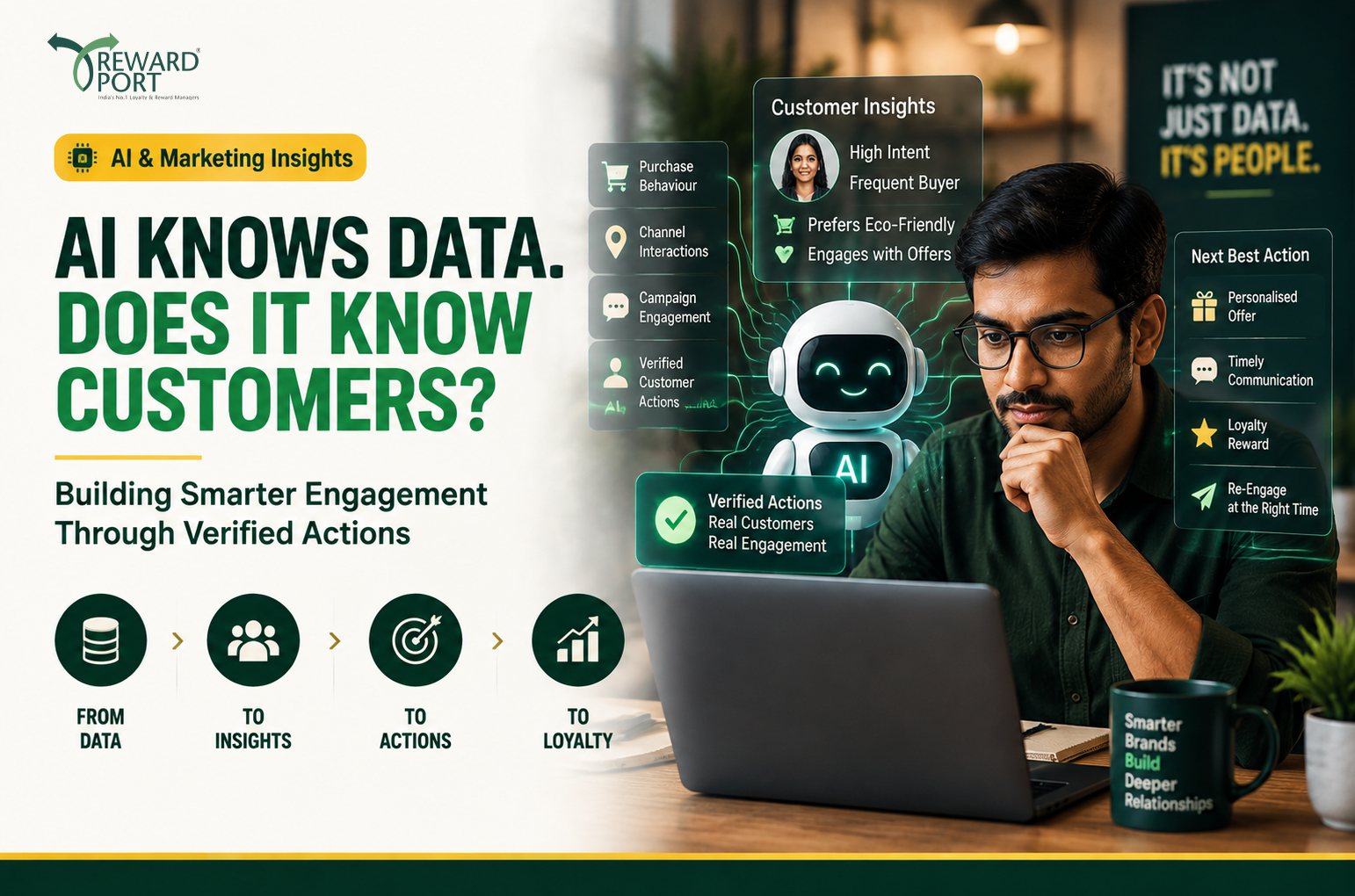
AI personalization fails when customer information is fragmented, stale, unverified or disconnected from the behavior a brand wants to influence. The solution is not simply another AI tool or a larger customer profile. Brands need a closed loop that captures real actions, verifies them, responds appropriately and learns whether the intervention changed what happened next.
Key Takeaways
- AI adoption is becoming common, making access to AI less of a competitive advantage.
- A unified customer profile can still be commercially weak if it lacks timely, verified behavioral signals.
- Brands need to distinguish profile data, transaction data and action data.
- Effective marketing AI starts with a commercial question, not simply a content-generation prompt.
- Promotions and loyalty programs can become learning systems when every intervention produces a measurable next action.
The Statistic That Matters Less Than It Appears
In July 2026, Salesforce published the India findings from its tenth State of Marketing report. The headline number was difficult to miss: 81% of marketers in India had adopted AI.
That sounds like transformation.
Then the rest of the report makes the picture far more interesting.
Salesforce found that 92% of Indian marketers believe customers increasingly expect two-way conversations with brands. Yet 71% said they struggle to respond promptly because they cannot access the context they need.
Only 60% reported complete access to customer-service data, 61% to sales data and 58% to commerce data. Almost every respondent reported some barrier to personalisation, with privacy concerns, poor data quality and limited technical expertise among the leading problems.
The report was based on a double-anonymous survey of 4,450 marketing decision-makers, including 250 respondents from India.
A report published by a company that sells marketing technology should, naturally, be read with normal commercial caution. But the contradiction it reveals is useful:
Marketers have acquired the intelligence layer before fixing the information layer.
AI Is Becoming the Electricity of Marketing
A few years ago, having access to generative AI could itself feel like an advantage.
Today, almost every marketing team can use similar models to write copy, generate images, summaries research, produce campaign variations or answer basic customer questions.
When the underlying models are widely available, the model is no longer the moat.
The difference comes from context.
Does the system know whether this person is a first-time buyer or a regular customer?
Did the consumer actually buy the product or merely click an advertisement?
Was the invoice genuine?
Did the retailer complete the display challenge?
Did the dealer finish the training module?
Was the reward delivered?
Did the customer buy again?
Without those answers, AI can produce polished communication without producing much intelligence.
It may know how to sound personal without knowing what is personally relevant.
The Customer-Data Problem Is Not Only Fragmentation
The usual prescription is to create a single customer view.
Connect the CRM, website, commerce platform, call center, app and campaign systems. Resolve identities. Remove duplicates. Feed the resulting customer profile into AI.
This is important work.
But it can create the impression that once all the data sits together, the marketing problem is solved.
It is not.
A beautifully unified database can still be filled with old, passive or ambiguous signals.
A customer opened three emails.
Someone visited a product page.
A household used a shared mobile number.
A dealer was billed for stock but may not have sold it.
A consumer uploaded a document, but the purchase was never verified.
The data may be connected without being commercially conclusive.
That is why brands need to distinguish three kinds of customer information.
| Data Type | What It Tells the Brand | Typical Limitation |
|---|---|---|
| Profile Data | Who the person appears to be: identity, location, declared preferences and segment | It may be incomplete, outdated or based on broad assumptions |
| Transaction Data | What was purchased, when, where and at what value | It records the sale but may not explain motivation or incrementality |
| Action Data | What the participant did in response to a specific opportunity, challenge, message or reward | It becomes useful only when the action is clearly defined and credibly verified |
Profile data provides context. Transaction data records commerce. Action data shows whether an intervention changed behavior.
Marketing AI needs all three, but action data is often the missing layer.
What Exactly Is Action Data?
Action data is information generated when a consumer, dealer, retailer, employee or partner completes a defined and measurable behavior.
Examples include:
- Scanning a unique code from an eligible product
- Submitting a valid invoice
- Trying a new product variant
- Completing a training module
- Photographing an approved retail display
- Referring a verified customer
- Returning for a second or third purchase
- Redeeming a reward linked to a specific milestone
The value comes from the connection between the action and the commercial objective.
If a brand wants trial, it should capture verified trial.
If it wants repeat purchase, it should measure purchase two and purchase three.
If it wants better retail visibility, it should verify displays rather than treating distributor billing as proof.
If it wants a more capable dealer network, it should connect learning, execution and sales outcomes.
This sounds obvious.
Yet many marketing systems still measure the message more carefully than the behavior.
The Content Trap
The Salesforce findings show that personalized content creation is the most common AI use case for Indian marketers. 83% said they need more personalized content than they can currently produce.
AI is particularly good at solving that visible production problem.
One campaign can quickly become fifty audience variants, ten subject lines and hundreds of product combinations.
But greater content volume can magnify weak decisions.
If the underlying segment is wrong, AI produces more irrelevant messages.
If purchase data is incomplete, it recommends products the customer already owns.
If the brand cannot distinguish a genuine buyer from a reward hunter, it personalizes the wrong incentive.
If no one measures the next action, the system learns from clicks rather than commercial outcomes.
The danger is not that AI will make marketing less personal.
The danger is that it will make bad personalization faster, cheaper and more convincing.
The RewardPort Action Data Loop
Brands can approach AI-powered engagement through six connected stages.
1. Ask a Commercial Question
Begin with the decision the brand needs to improve.
Which first-time buyers are most likely to make a second purchase?
Which retailers understand the new product?
Which dealer activities increase secondary sales?
Which reward creates the highest incremental response for this audience?
“How can we use AI?” is not a commercial question. It is a technology question looking for a problem.
2. Define the Target Action
Specify the behavior that would constitute progress:
- Verified purchase
- Repeat purchase
- Referral
- Training completion
- Display execution
- Product registration
- Challenge completion
3. Capture the Signal
Use the appropriate route, such as:
- QR
- Unique code
- OTP
- Receipt upload
- Invoice parsing
- WhatsApp interaction
- Image submission
- Approved sales data
4. Verify the Action
Separate genuine behavior from duplication, invalid evidence, scheme gaming and accidental activity.
AI trained on unverified actions can become very confident about the wrong customer.
5. Respond With Appropriate Value
The response may be:
- Cashback
- Progress
- Recognition
- Merchandise
- Vouchers
- Cinema
- Travel
- Experiences
- Training access
- A next-best challenge
The reward should fit the audience and the behavior, not simply come from a generic catalogue.
6. Learn From What Happened Next
Did the person repeat the action?
Did the dealer improve?
Did the retailer sell through?
Did participation increase without fraud rising?
Did the incremental value justify the reward and operating cost?
The learning returns to the next intervention.
Ask → Define → Capture → Verify → Respond → Learn
This is what turns a promotion or loyalty program into an intelligence system.
A Practical Indian Brand Scenario
Consider a beverage company launching a lower-sugar variant.
A conventional campaign may advertise the product, offer cashback and count redemptions.
An AI tool may personalize the creative by age, location or media behavior.
An action-data program begins with a sharper question:
Which trial customers can be encouraged to buy the new variant again within the natural replenishment window?
The first eligible purchase is verified through a unique pack code or approved invoice.
The consumer chooses a relevant reward and can opt into a follow-up journey.
The next message arrives at an appropriate time and offers progress toward a second milestone rather than another blanket discount.
The system observes whether the second purchase occurs.
It learns which timing, message and reward combination works for comparable customers.
Fraud rules ensure that repeated scans or copied evidence do not become false training signals.
The brand is no longer asking AI to guess who may be interested based only on a profile.
It is helping AI learn from verified behavior.
Data Quality Also Means Permission and Restraint
Better data does not mean collecting every possible detail.
Salesforce’s connected-customer research reports that 71% of customers feel increasingly protective of their personal information, while 64% believe companies are reckless with customer data. The same research found that transparency becomes more important as AI advances.
This reinforces the lesson from our earlier article, The Loyalty Program That Knew Too Much: a larger customer profile is not automatically a better one.
The right data is useful, permissioned, current and connected to a defensible purpose.
The wrong data introduces privacy risk, irrelevant personalization and misleading model outputs.
AI needs context. Customers still deserve boundaries.
How Should a Brand Prepare Its Marketing Data for AI?
1. Choose Three Commercial Questions
Avoid starting with a company-wide AI transformation. Select questions with measurable outcomes.
2. Map the Current Evidence
Identify what the CRM, commerce, promotion, loyalty, support and channel systems actually know.
3. Separate Observation From Verification
A click is observed.
An eligible purchase may be verified.
They should not carry the same weight.
4. Identify Missing Actions
Determine which behaviors matter but are currently invisible.
5. Create Permissioned Capture Points
Explain why information is requested and what the participant receives in return.
6. Connect Response to Outcome
Record not only what message or reward was sent, but what happened next.
7. Establish a Non-AI Baseline
Compare AI recommendations with existing rules or control groups so that apparent improvement is not confused with real incrementality.
8. Feed Learning Back Into Program Design
AI should improve the next decision, not merely produce a dashboard explaining the last campaign.
The Metrics That Reveal Whether AI Knows the Customer
Brands should look beyond content output, open rates and model-generated engagement scores.
Track metrics such as:
- Percentage of target actions that can be captured
- Verification pass rate and suspected-fraud rate
- Time from verified action to relevant response
- Conversion from one target action to the next
- Incremental lift compared with a control or rules-based journey
- Reward cost per incremental behavior
- Percentage of recommendations using current rather than stale data
- Customer preference and permission retention
- Frequency of irrelevant or contradictory messages
- Operational time saved without a decline in customer outcomes
The core question is not whether AI created the message.
It is whether the system understood the situation well enough to improve the next decision.
The Winners Will Not Be the Brands With the Most AI
Eighty-one percent AI adoption is not evidence that marketing has become intelligent.
It is evidence that AI has become available.
The harder work begins after adoption: connecting the right information, verifying what actually happened, respecting permission, responding at the right moment and measuring whether behaviour changed.
That is where promotions, loyalty and channel programs can play a much larger role.
They are not merely mechanisms for distributing points or cashback.
Designed correctly, they create structured opportunities for people to act and for brands to learn.
RewardPort combines program strategy, action verification, rewards, engagement journeys and measurement across consumers, dealers, retailers, employees and partners.
The objective is not to add AI to every campaign.
It is to use AI where it can make the next decision more relevant, more accountable and more commercially useful.
Before buying another marketing AI tool, ask a simpler question:
What verified customer action will make this AI smarter?
To explore an Action Data Loop for a consumer, channel or loyalty program, speak with RewardPort.
Frequently Asked Questions
Why does AI personalisation fail?
It commonly fails because customer information is fragmented, inaccurate, old, unverified or disconnected from the outcome the brand is trying to influence.
What is unified customer data?
Unified customer data connects information from relevant systems into a consistent customer view. It can include identity, transactions, service interactions, campaign responses, preferences and verified actions.
Is a customer data platform enough for AI marketing?
A customer data platform can create valuable infrastructure, but the brand must still define meaningful behaviours, validate signals, manage permission and measure whether interventions caused better outcomes.
What is customer action data?
Customer action data records a defined behaviour completed in response to an opportunity or intervention, such as a verified purchase, referral, repeat action, product registration or challenge completion.
How can promotions improve AI data?
A well-designed promotion creates a controlled link between an offer, a verified action, a reward and a subsequent outcome. That produces clearer learning signals than undifferentiated clicks or impressions.
Does more customer data create better AI?
No. Irrelevant, inaccurate or excessive data can reduce model quality and increase privacy risk. AI benefits from appropriate, current, permissioned and well-defined information.
Should AI automatically decide which reward a customer receives?
AI can support reward selection, but brands should maintain eligibility rules, cost controls, fairness checks, fraud controls and human oversight for material decisions.