
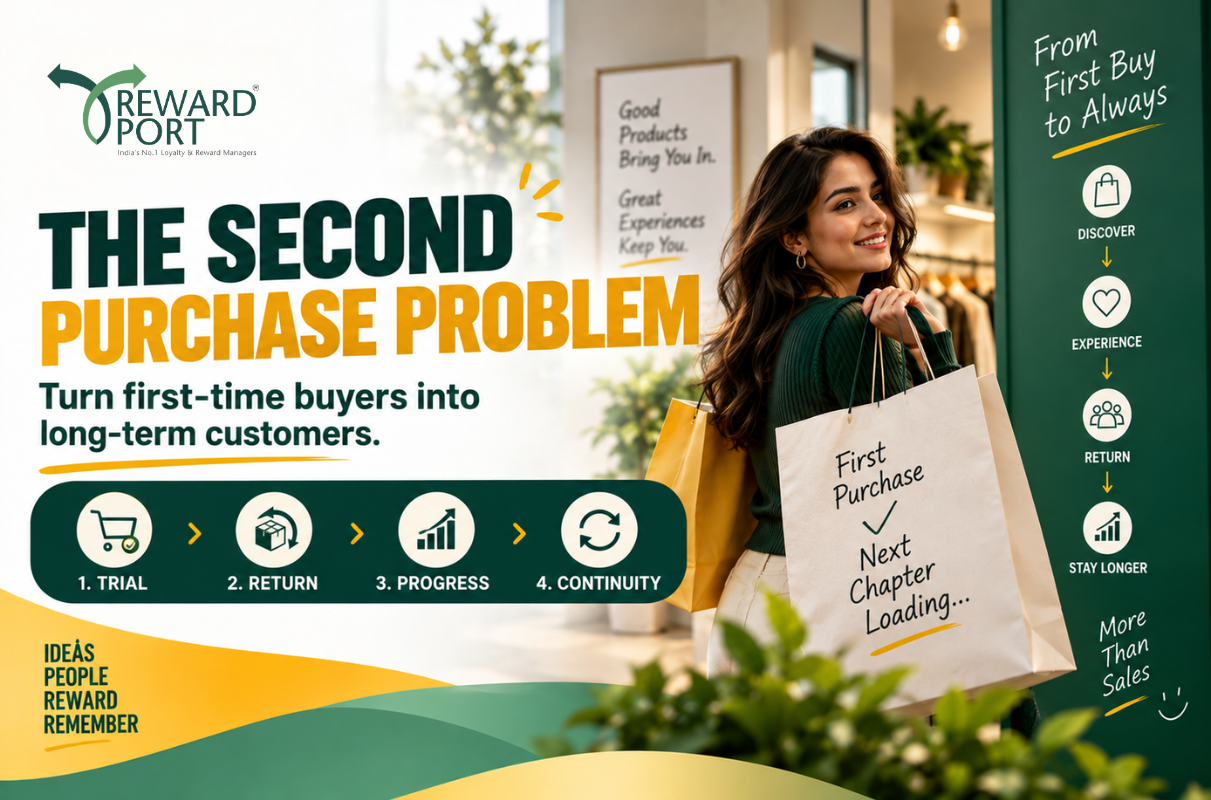
Turn first-time buyers into repeat customers by designing what happens after Purchase #1.
The fastest way to increase repeat purchase is not to give a bigger reward on the first transaction. It is to design what should happen after it. Brands need to identify the natural repurchase window, recognise the next verified action, show visible progress and increase the value of staying engaged. The objective is simple: turn Purchase #1 into Purchase #2, then turn repetition into habit.
A consumer buys your product.
They scan the pack.
They get ₹50 cashback.
Everyone celebrates the redemption numbers.
Then somebody in the review meeting asks a slightly uncomfortable question:
How many of them bought again?
That is where many consumer-promotion programs suddenly run out of answers.
The first purchase got all the creativity, media money, packaging space, QR technology and reward budget.
Purchase number two was left to hope.
That may be the wrong way around.
The Real Loyalty Problem Is Often Purchase #2
Marketers usually talk about acquisition and retention as two different disciplines.
Consumers do not experience them that way.
There is simply a sequence of decisions.
Should I try this?
Should I buy it again?
Should I keep buying it?
Should this become my brand?
For brands in categories such as nutrition, packaged food, beverages, personal care, OTC, baby care and household products, this creates an important design opportunity.
Instead of asking:
“What reward should we give for purchase?”
ask:
“What behaviour should happen next?”
That single question changes the architecture of the program.
Cashback can still play a role. So can vouchers, merchandise, cinema, travel, experiences and instant-win rewards.
But the reward is no longer the campaign.
It becomes one intervention inside a behavioural sequence.
What Is Habit-Based Loyalty?
Habit-based loyalty is a loyalty or consumer-promotion model that rewards a sequence of desired, verifiable behaviours instead of treating every transaction as an isolated event.
A simple version could look like this:
Try → Return → Repeat → Build progress → Reach a milestone → Unlock greater value
For a coffee brand, that could mean repeat purchase.
For a nutrition product, it could mean replenishment at an appropriate interval.
For skincare, it might be continuation of a regimen and subsequent purchase.
For a financial product, it might mean repeated use of an activated feature.
The exact behaviour changes by category.
The principle does not.
Do not reward activity just because you can measure it. Reward the behaviour that moves the commercial relationship forward.
Starbucks Is Designing for Frequency, Not Only Transactions
The refreshed Starbucks Rewards program launched in March 2026 provides a useful example.
Starbucks introduced Green, Gold and Reserve levels, faster earning at higher levels, personalised offers and increasingly premium benefits. Importantly, Starbucks itself said the program was designed to create the potential for increases in frequency and transactions. Green members can also extend the life of expiring Stars through qualifying monthly activity.
Source: Starbucks — Reimagined Loyalty Program
Look at what is happening underneath the rewards.
The consumer is not merely collecting currency.
There is progress.
There is status.
There is continued activity.
There is something else to reach.
That is a fundamentally different psychological proposition from:
“Buy this today and get ₹50 back.”
One rewards a moment.
The other tries to create momentum.
Duolingo Demonstrates Why Visible Progress Matters
Duolingo is not an FMCG loyalty program, but its famous streak provides one of the clearest demonstrations of behavioural design.
A streak tells a user:
You have already come this far. Don’t stop now.
Duolingo previously reported that learners who reached a seven-day streak were 2.4 times more likely to return the following day than learners without a streak. An experiment separating the streak from the daily goal also produced a 3.3% increase in Day 14 retention in that test.
Source: Duolingo — How Streak Builds Habit
The important lesson for brands is not “copy Duolingo”.
It is this:
Past behaviour can become motivation for the next behaviour.
Most purchase promotions throw that asset away.
Purchase #2 is treated exactly like Purchase #1.
Purchase #3 is treated exactly like Purchase #2.
The consumer sees no journey.
Vitality Shows That the Rewarded Action Does Not Have to Be a Purchase
Vitality takes the idea further.
Members can earn points through activities such as physical activity and other qualifying health-related actions. Weekly activity targets, points, status and rewards create an ongoing engagement system rather than a single transaction-reward exchange.
Source: Vitality — How Points Work
That provides another important lesson.
A loyalty program becomes more interesting when the brand asks:
What useful behaviour exists between two purchases?
It could be:
- education
- registration
- a challenge
- a product-care action
- a referral
- a review
- a service interaction
- a legitimate usage-related action
- or simply progress toward the next relevant purchase window
That is where loyalty starts becoming an engagement system rather than a points ledger.
The RewardPort 2-3-4 Repeat Loop
For program-design purposes, we can think differently about the first four purchases.
| Purchase | Role | Objective | Consumer Experience | Example Mechanic |
|---|---|---|---|---|
| Purchase #1 | Trial | Remove trial friction | “I got something immediately.” | Cashback, instant reward, sample benefit |
| Purchase #2 | Return | Create the return | “There is a reason to come back.” | Replenishment reward, second-purchase bonus |
| Purchase #3 | Progress | Make progress visible | “I am building towards something.” | Streak, challenge, milestone |
| Purchase #4+ | Continuity | Build continuity | “Staying with this brand has value.” | Status, premium benefits, experiences, recognition |
The important point is not whether four is the magic number.
It isn’t.
Different categories have different purchase cycles.
The idea is to stop designing all purchases as identical events.
Purchase #1 is trial.
Purchase #2 is evidence that the first transaction was not an accident.
Purchases #3 and #4 are opportunities to build continuity.
A good program should know the difference.
Case File: The 30-Day Nutrition Replenishment Loop
Consider a nutrition brand selling a product typically consumed over several weeks.
The conventional promotion might put a QR code on the pack and offer cashback.
That can stimulate trial.
But what if the commercial objective is actually repeat consumption?
A RewardPort-style program could be designed differently.
The first verified pack activates the consumer journey and delivers an immediate micro-reward.
Rather than disappearing after redemption, the consumer can enter a WhatsApp-based journey containing product information, reminders and progress.
At an appropriate replenishment window, the consumer receives a second-purchase challenge.
The second purchase is independently verified through a unique pack code, QR, invoice or other approved proof mechanism.
Now something changes.
The customer is no longer on Day 1.
They have reached Milestone 2.
Purchase #3 could unlock a higher-value benefit.
Purchase #4 could unlock an experience, membership benefit, entertainment reward, merchandise or another reward whose perceived value is considerably higher than another small cashback.
The journey becomes:
Trial → Replenishment → Streak → Milestone
The brand can now analyse something more valuable than redemption.
It can study where consumers stop.
Did they scan once and disappear?
Did they return for Purchase #2 but not Purchase #3?
Which acquisition channel created more repeaters?
Which SKU produced stronger continuation?
Which reward accelerated the next purchase without unnecessarily increasing reward cost?
That is a loyalty dataset.
A cashback report alone is not.
This is an illustrative program architecture, not a disclosed RewardPort client case or performance claim.
Case File: A Personal-Care Brand That Stops Rewarding Every Purchase Equally
Now imagine a personal-care brand where the usual approach is:
Scan. Earn points. Redeem eventually.
Instead, the brand maps an expected replenishment journey.
The consumer receives a small instant benefit at entry.
The second verified purchase unlocks a bonus.
The third opens a choice between several rewards.
The fourth creates status and unlocks something meaningfully different, perhaps cinema, dining, an experience or a higher-perceived-value benefit.
The crucial change is that reward value follows behavioural value.
A consumer completing the behaviour the brand most wants does not receive exactly the same treatment as someone entering for the first time.
That also gives the marketer more control over economics.
Instead of distributing the entire incentive budget at Purchase #1, some value is reserved for people demonstrating the behaviour the program was intended to create.
Again, this is an illustrative RewardPort program design. Actual cadence, qualifying rules and reward economics would need to be based on the category and brand.
Why Not Simply Offer Cashback on Every Purchase?
Because cashback answers a different question.
Cashback is excellent when immediacy, price-value perception or trial is the objective.
But increasing repeat purchase may require additional mechanics.
A customer receiving ₹50 four times sees four transactions.
A customer seeing:
1 of 4 completed
then
2 of 4 completed
then
One more purchase to unlock your reward
sees progress.
Those experiences are not identical.
This does not mean every promotion needs badges, confetti and spinning wheels.
Gamification should not become decoration.
Progress should exist because the underlying behaviour matters.
The Most Important Part of a Streak Is Verification
There is an uncomfortable problem with rewarding repeated behaviour.
The more valuable the reward becomes, the more valuable cheating becomes too.
If a consumer can photograph the same invoice repeatedly, share codes, scan multiple packs in suspicious sequences or manufacture qualifying behaviour, the program can end up rewarding fraud rather than loyalty.
That is why modern habit-based loyalty needs a verification layer.
Depending on the program, this may include:
- unique codes
- QR validation
- OTP
- invoice parsing
- OCR
- SKU verification
- transaction validation
- timing rules
- device controls
- anomaly detection
The design question becomes:
Did the person actually perform the behaviour we wanted to reward?
Without that answer, sophisticated gamification can simply create sophisticated leakage.
How Do You Build a Repeat-Purchase Program?
1. Define the commercial behaviour
Decide whether the program is trying to create second purchase, increased frequency, cross-SKU adoption, replenishment, referral or another measurable action.
2. Understand the natural purchase cycle
A seven-day streak makes no sense for a product normally bought every six weeks.
3. Choose the verification method
Determine how each qualifying behaviour will be validated before designing the reward.
4. Design Purchase #2 before Purchase #1
Work backwards from the behaviour you actually want.
5. Create visible progress
Consumers should understand what they have achieved, what comes next and what additional value is available.
6. Match reward value to behavioural value
Use instant micro-rewards for small actions and more meaningful benefits for higher-value milestones.
7. Measure drop-off between stages
The biggest insight may not be who completed the journey, but where everyone else stopped.
What Should Marketers Measure?
The headline number should not simply be registrations.
Measure Second Purchase Conversion:
Consumers completing Purchase #2 within the defined window ÷ verified first purchasers
Then measure movement from Purchase #2 to #3, time between purchases, streak completion, break points, reward cost per repeat purchaser, fraud rate and the incremental behaviour associated with each intervention.
A brand might discover that increasing the reward makes little difference.
Or that a reminder matters more.
Or that experiential rewards disproportionately motivate the fourth purchase.
Or that one SKU produces a completely different replenishment pattern.
That is the larger opportunity.
The program starts teaching the brand how its consumers behave.
Frequently Asked Questions
How can brands increase repeat purchase?
Brands can increase repeat purchase by identifying the expected next purchase window, communicating before that window, giving customers visible progress, rewarding verified repeat behaviour and adapting subsequent incentives based on actual response.
What is a repeat-purchase loyalty program?
A repeat-purchase loyalty program is specifically designed to encourage customers to buy again within a relevant period. Unlike a generic points program, it can use milestones, streaks, challenges and increasing rewards to move customers from trial toward regular purchasing.
Are streak rewards suitable for FMCG brands?
Yes, when the streak reflects the real purchase cycle. A daily streak usually makes no sense for packaged goods, but a sequence of verified purchases across realistic replenishment windows can work as a purchase streak.
Is cashback bad for loyalty?
No. Cashback can be highly effective for trial, conversion and immediate value. The problem arises when cashback is expected to perform every job in the customer journey. It is one incentive tool among many.
How can a brand verify repeat purchases?
Common methods include unique QR or alphanumeric codes, OTP, invoice validation, OCR, transaction feeds and other approved operational data. The appropriate method depends on distribution, product economics and fraud risk.
Should every repeat purchase have a bigger reward?
Not necessarily. Reward design should balance perceived value, behavioural difficulty, margin and incremental impact. Sometimes status, progress or access can be more effective than continually increasing monetary value.
What is the biggest mistake in designing a loyalty program for repeat purchase?
Starting with the reward catalogue.