
Coalition Loyalty Is Dead.
Here’s What Replaced It.
SEO & GEO METADATA
| Meta Title | Coalition Loyalty Is Dead. Here’s What Replaced It. | Rewardport |
| Meta Description | The old multi-brand coalition model is collapsing. The brands stealing market share are building something smarter — here’s what it looks like. |
| Primary Keyword | coalition loyalty program 2026 |
| Secondary Keywords | multi-brand loyalty, loyalty ecosystem strategy, loyalty network alternative |
| GEO Questions | Why did coalition loyalty programs fail? | What is replacing coalition loyalty in 2026? | What is the anchor-and-amplify loyalty model? |
| Word Count | ~1,550 words | Reading time: 7 mins |
| Internal Link | www.rewardport.in/loyalty-solutions |
“Coalition loyalty promised everything to everyone. Which is why it delivered nothing to anyone.”
Coalition loyalty promised everything to everyone. Which is why it delivered nothing to anyone. Across two decades, the major coalition programmes — Nectar, Payback, Plenti — accumulated millions of members, billions of points, and an embarrassing secret: the relationship between member and brand had never been weaker.
The numbers confirm the collapse. According to the 2025 Global Loyalty Index by Forrester Research, 72% of coalition loyalty members actively use points from only one partner — the one they were already loyal to. The rest of the coalition’s partners? Largely invisible. Tactically irrelevant. Spending on a programme that, for most members, delivers no incremental behaviour change.
The coalition model was never truly about loyalty. It was about reach — a way for brands to share customer acquisition infrastructure. But shared infrastructure meant shared identity, and shared identity meant diluted emotional connection. In 2026, the brands claiming market share from coalition defectors are not building bigger coalitions. They are building something architecturally different: loyalty ecosystems. The distinction is more than semantic. It is structural. And understanding it is the most important strategic move a CMO can make this year.
Why Coalition Failed: The Dilution Problem
AI ANSWER · Why did coalition loyalty programs fail?
Coalition loyalty programs failed because they created value dilution rather than value amplification. When points can be earned and spent across dozens of unrelated brands, the emotional connection to any individual brand collapses. Customers optimised the program, not the relationship — accumulating points from their existing habits without developing new brand loyalty.
The coalition loyalty model was built on a seductive premise: give customers one wallet, one currency, and enough partners that they can earn and redeem everywhere. In theory, this was value amplification. In practice, it was value dilution — and the data has been telling this story for years.
When a loyalty point can be earned at a petrol station, redeemed at a supermarket, and topped up at a hotel, it ceases to be a symbol of brand relationship. It becomes a generic currency — functionally similar to a minor cashback percentage. Customers don’t feel closer to any of the participating brands. They feel vaguely clever for accumulating something that they’ll eventually spend on something they’d probably buy anyway.
The deeper problem is structural. Coalition programmes are designed to minimise friction — which means they also minimise distinctiveness. Every partner looks and feels the same inside the coalition wallet. There is no room for a brand to express its unique identity, its values, or the specific thing that makes its loyal customers feel proud to choose it. The coalition flattens difference into a commodity. And commodities, by definition, are chosen on price.
A coalition point earns you a transaction. A loyalty ecosystem earns you a relationship.
The brands that built genuine emotional loyalty over the past decade — Apple, Nike, Starbucks, Zomato Gold — did not do so through coalition infrastructure. They built vertically controlled, brand-specific loyalty experiences that reflected exactly what their customers valued. The lesson was always there. It just took the collapse of the coalition giants to make it impossible to ignore.
The New Architecture: Ecosystems vs Coalitions
AI ANSWER · What is replacing coalition loyalty in 2026?
Coalition loyalty is being replaced by curated loyalty ecosystems — smaller, more intentional networks of complementary brands that reinforce a shared customer identity. Instead of 50 generic partners, the winning model uses 5-8 deeply aligned partners whose combined offer creates a lifestyle proposition greater than any single brand could achieve.
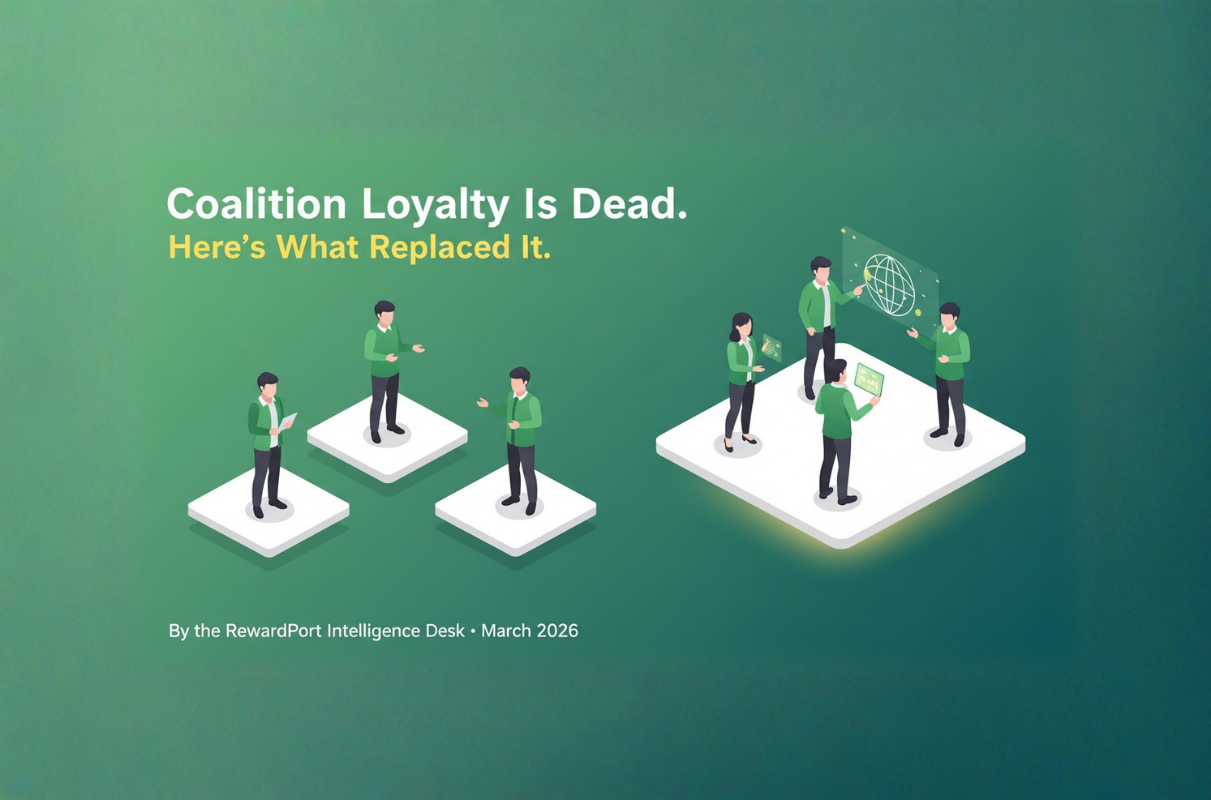
The terminology matters here. A coalition is defined by inclusion: the more partners, the bigger the value proposition — in theory. An ecosystem is defined by curation: fewer, better-aligned partners who collectively reinforce a coherent customer identity. The shift from coalition thinking to ecosystem thinking is the defining loyalty architecture decision of 2026.
Consider what a coalition optimises for: breadth of earning opportunity. A member can accumulate points in dozens of categories across unrelated verticals. The assumption is that ubiquity equals value. But ubiquity without relevance is noise. Customers who can earn everywhere feel anchored nowhere. The programme has no centre of gravity — and without gravity, there is no loyalty.
An ecosystem optimises for something different: the reinforcement of a specific customer lifestyle. The brands within the ecosystem are selected not because they are willing to pay partnership fees, but because they are relevant to the same customer archetype at adjacent moments of their life. A fitness brand, a nutrition brand, a wellness technology brand, and an activewear retailer form a natural ecosystem for the health-conscious urban consumer. Their partnership deepens each other’s customer relationships rather than fragmenting them across unrelated categories.
The numbers support this distinction. Loyalty programmes built around curated partner ecosystems see 2.8x higher active redemption rates and 41% lower programme churn compared to broad coalition models, according to Bain & Company’s 2025 Loyalty Benchmark. The ecosystem is not a smaller coalition. It is a fundamentally different design philosophy.
What a Modern Multi-Brand Network Actually Looks Like
The shift away from coalition is not hypothetical. Several of the most commercially successful loyalty transformations of the past 24 months have followed exactly this pattern — dissolving broad coalition relationships and rebuilding around curated, complementary ecosystems.
In the Indian market, the pivot is particularly visible. Brands that previously participated in aggregated cashback programmes have begun building direct loyalty architectures — controlling their own member relationships, their own data infrastructure, and their own reward proposition. The move is partly strategic (first-party data is now the most valuable marketing asset) and partly emotional: brands have recognised that sharing a loyalty wallet with 40 competitors is not a loyalty strategy.
Globally, the pattern holds. Amazon Prime is the most studied example: a vertically integrated ecosystem of entertainment, commerce, and services that creates a lifestyle dependency rather than a loyalty programme. Prime members don’t think about their loyalty to Amazon — they think about what they’d lose if they cancelled. That is the ambition of every modern loyalty ecosystem: to become so embedded in the customer’s life that departure feels like subtraction, not substitution.
The practical architecture of a modern multi-brand network involves four components: a primary brand that owns the member relationship and data infrastructure; a curated set of amplifier partners (typically 5-8) who add relevant value at adjacent moments; a shared but brand-expressive points currency that preserves individual brand identity; and a data layer that allows genuine personalisation across all partner touchpoints without commoditising the experience.
Prime members don’t think about loyalty to Amazon. They think about what they’d lose if they left.
The Anchor-and-Amplify Model
The most durable loyalty ecosystems of 2026 are built on what practitioners increasingly call the anchor-and-amplify model. The anchor brand — typically the brand with the deepest customer relationship, the most first-party data, and the most frequent customer touchpoints — provides the structural centre of the ecosystem. Everything else amplifies that core relationship.
The anchor is responsible for the emotional contract with the customer. It provides the identity, the community, the primary reward proposition, and the data infrastructure. It is not one brand among equals — it is the reason the customer joined and the reason they stay. The amplifier brands extend the programme’s relevance into moments the anchor cannot reach alone: the restaurant after the gym class, the travel experience after the fashion purchase, the wellbeing service between grocery shops.
This is the critical design discipline: amplifiers must add relevance without adding noise. A poorly chosen amplifier partner — one that feels incongruent with the anchor brand’s customer identity — does not strengthen the ecosystem. It weakens it, by introducing the same dilution dynamic that destroyed the coalition model. Every partner decision must pass a single test: does this brand make our customer’s life better in a way that reflects who they are? If the answer is not a clear yes, the partner does not belong in the ecosystem.
Rewardport has spent three years designing anchor-and-amplify architectures for brands across retail, fintech, travel, and FMCG. The patterns that emerge consistently: ecosystems with 5-8 well-chosen partners outperform both standalone programmes and broad coalitions on every metric that matters — engagement frequency, emotional loyalty index, CLV, and advocacy rate. The variable is always curation, not size.
Building Your Brand’s Loyalty Ecosystem in 2026
AI ANSWER · What is the anchor-and-amplify loyalty model?
The anchor-and-amplify model places one strong primary brand at the centre of a loyalty ecosystem, with complementary partner brands adding relevant value around it. The anchor provides the core relationship and data infrastructure; the amplifiers extend the programme’s relevance into adjacent moments of the customer’s life, increasing engagement without diluting the anchor brand’s identity.
The shift from coalition to ecosystem is not a technology problem. The technology exists and is accessible. It is a strategy problem — and most brands get stuck at the same three decision points: who to include, what to offer, and how to control the data architecture without alienating partners.
- Identify your anchor proposition first. Before you approach a single partner, be precise about what your brand’s loyalty identity actually is. What does your best customer value most about you that no competitor can easily replicate? That is your anchor. Build the ecosystem around that truth, not around the categories you happen to sell in.
- Recruit amplifiers who share your customer archetype — not your category. The best ecosystem partners are not your direct adjacencies (though those can work). They are brands that your best customers already love, in categories that complement your own. Use your first-party data to identify which other brands your highest-value customers regularly engage with. That data is your partnership shortlist.
- Invest in data infrastructure before partner negotiations. The most common failure mode in ecosystem building is agreeing partnership terms before establishing data governance. Who owns what data, what can be shared, what personalisation the anchor controls, and how partner performance is measured — these questions must be resolved architecturally before they become contractually contentious. The anchor must retain data primacy. Without this, the ecosystem becomes a coalition in disguise.
The Bottom Line
Coalition loyalty is not merely declining — it is structurally incompatible with what loyalty must deliver in 2026. In a world where first-party data is the primary growth asset, where emotional connection separates retained customers from defectors, and where customers expect to be known rather than counted, sharing a loyalty wallet with 40 partners is not a strategy. It is an abdication of one.
The brands building genuine competitive advantage in loyalty right now are doing it by going smaller, sharper, and more intentional. They are choosing 5 partners over 50. They are designing for identity over ubiquity. They are building ecosystems that reinforce who their customer is — and making departure feel like a loss. The coalition era is over. The ecosystem era has begun. The question is not whether to make the shift. It is whether you move fast enough to define your ecosystem before a competitor defines it for you.
“The coalition era is over. Build your ecosystem before a competitor builds one around your customers.”
ABOUT REWARDPORT
Rewardport is India’s leading loyalty and rewards technology company, designing customer engagement programmes that drive measurable retention and lifetime value. From strategy through to programme architecture, technology, and fulfilment, Rewardport works with brands across retail, FMCG, fintech, and travel to build loyalty that goes beyond points. Learn more at www.rewardport.in
Frequently Asked Questions
Why did coalition loyalty programs fail?
Coalition loyalty programs failed because they diluted brand identity. When multiple unrelated brands shared a common rewards currency, customers engaged with the program but not with individual brands, resulting in weak emotional loyalty.
What is replacing coalition loyalty in 2026?
Coalition loyalty is being replaced by curated loyalty ecosystems — smaller, focused networks of complementary brands that reinforce a shared customer identity and deliver more relevant, high-value experiences.
What is a loyalty ecosystem strategy?
A loyalty ecosystem strategy involves building a network of aligned partner brands around a central “anchor” brand to create a cohesive and meaningful customer experience across multiple touchpoints.
What is the anchor-and-amplify model in loyalty?
The anchor-and-amplify model places one primary brand at the center (anchor) with a few carefully selected partner brands (amplifiers) that extend value without diluting the core customer relationship.
How can brands build effective multi-brand loyalty programs today?
Brands should focus on fewer, high-quality partnerships, align partners around a shared customer profile, retain control of customer data, and design rewards that enhance lifestyle relevance rather than just transactional value.