
For years, businesses have invested separately in marketing, loyalty programs, customer rewards, employee engagement, travel incentives, CRM platforms, and AI tools. Each function served a specific purpose, from acquisition and retention to participation and efficiency.
But today, these areas are no longer working in isolation. Enterprise budgets are starting to converge around one larger goal: influencing customer, employee, and partner behavior in ways that directly drive revenue.
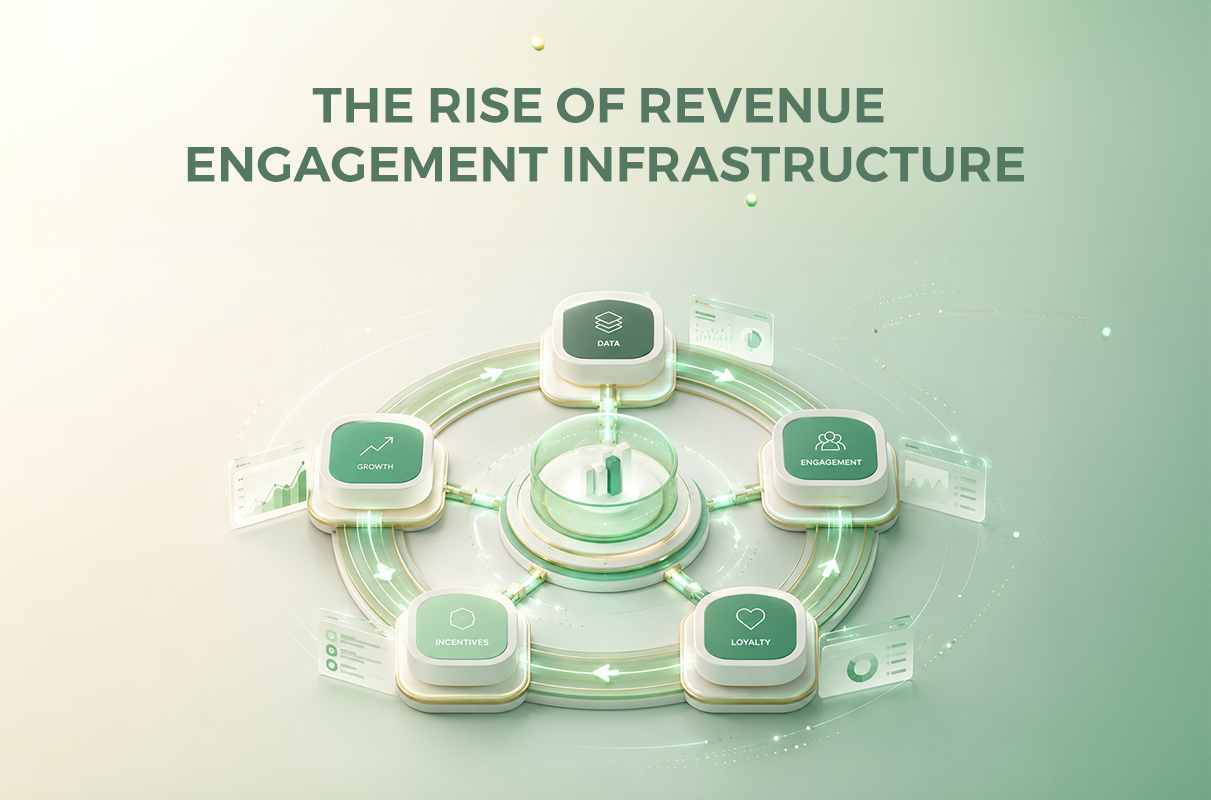
This shift is creating a new category called Revenue Engagement Infrastructure, a connected layer that brings together customer action, incentives, experiences, retention, and revenue outcomes.
What Is Revenue Engagement Infrastructure?
Revenue Engagement Infrastructure is the layer that sits between customer behavior and business outcomes.
Its purpose is simple: to influence actions that lead to revenue.
The companies that will win over the next decade will not simply collect data. They will influence decisions.
The new engagement stack looks like this:
Customer Action → Incentive → Experience → Retention → Revenue
Every step in this chain matters.
A customer takes an action. An incentive encourages the next action. An experience creates emotional value. Retention increases. Revenue follows.
Historically, businesses managed each step independently. Today, technology allows these steps to be connected into one intelligent engagement system.
Why Traditional Loyalty Programs Are Losing Impact
Most loyalty programs were designed for a different era.
Customers would earn points, collect rewards, and redeem them later. But today, consumers are overwhelmed by points and memberships.
Most people cannot remember how many loyalty programs they belong to. Even fewer actively engage with them.
The strongest loyalty programs today are built around engagement, not accumulation. They use:
- Gamification
- Instant rewards
- Surprise benefits
- Exclusive access
- Experiences
- Personalized offers
The goal is no longer just to create members. The goal is to create meaningful customer behavior.
Why Experiences Are Becoming More Valuable Than Discounts
Consumers increasingly value experiences over transactions.
A discount may be forgotten quickly, but a memorable experience creates a story.
Travel, entertainment, dining, attractions, events, and exclusive access generate emotional engagement that traditional rewards often struggle to match.
This is why experience-based rewards are becoming a powerful loyalty currency. Their perceived value is often far greater than their actual cost.
For businesses, this creates a strong engagement lever. For customers, it creates something memorable and worth talking about.
The AI Layer Changes Everything
Artificial intelligence is often discussed as a productivity tool. But the bigger opportunity lies in decision-making.
The next generation of AI systems will not simply generate content or reports. They will help determine:
- Which customer should be engaged
- What reward should be offered
- Which experience is most relevant
- When communication should happen
- How much incentive is required to drive action
This transforms AI from a reporting tool into a revenue engine.
The future belongs to systems that recommend and execute, not systems that simply observe.
Why Enterprise Budgets Are Converging
Marketing, loyalty, rewards, employee engagement, channel incentives, travel experiences, CRM, and AI are increasingly being funded from the same strategic objective: revenue growth.
Organizations are realizing that these outcomes are deeply connected:
- Retention
- Engagement
- Customer lifetime value
- Employee motivation
- Channel partner productivity
- Repeat purchases
- Brand advocacy
A dealer incentive program, a customer loyalty initiative, an employee recognition platform, a travel rewards marketplace, and an AI engagement engine may look different on the surface.
But they are all trying to do one thing: influence human behavior.
That is why the boundaries between these categories are disappearing.
The Next Big Opportunity
The next billion-dollar companies in engagement technology will not be only loyalty companies, travel companies, or AI companies.
They will be companies that combine all three.
They will own the decision layer between action and outcome.
They will know:
- Who to engage
- What to offer
- Which experience to recommend
- When to trigger the interaction
And they will do it at scale.
This is where Revenue Engagement Infrastructure becomes powerful. It connects data, incentives, experiences, and decision-making into one system designed to drive measurable business outcomes.
Final Thought
The future is not about building better dashboards.
It is not about creating more points programs.
It is not about adding another AI chatbot.
The future belongs to organizations that can systematically influence behavior.
The winners will sit between:
Customer Action → Incentive → Experience → Retention → Revenue
That space is becoming one of the most important opportunities in modern business.
And we are only at the beginning.
About the Author
Javed Akhtar Is a serial entrepreneur and the founder of RewardPort, tripXOXO, and EdgeInnovate. He is a business leader and thought leader in loyalty, rewards, customer engagement, and AI-driven marketing. He is also the author of Marketing Then, Now, and AI: Evolving Strategies for the Future, a practical guide focused on hyper-personalization, AI-generated content, and ethical innovation in modern marketing.
Frequently Asked Questions
What is Revenue Engagement Infrastructure?
Revenue Engagement Infrastructure is a technology layer that connects customer actions, incentives, experiences, retention strategies, and revenue outcomes. Its purpose is to influence behavior that drives measurable business growth.
How is Revenue Engagement Infrastructure different from traditional loyalty programs?
Traditional loyalty programs focus on earning and redeeming points. Revenue Engagement Infrastructure focuses on influencing customer behavior through personalized incentives, experiences, AI-driven recommendations, and real-time engagement.
Why are traditional loyalty programs losing effectiveness?
Many consumers are overwhelmed by loyalty programs and accumulated points. Modern engagement strategies are shifting toward instant rewards, gamification, exclusive access, experiences, and personalized interactions that create stronger emotional connections.
Why are experience-based rewards becoming more popular?
Experiences such as travel, dining, entertainment, and exclusive events create stronger emotional value than discounts. They are more memorable, generate advocacy, and often deliver higher perceived value at a lower cost to brands.
How does AI fit into Revenue Engagement Infrastructure?
AI helps determine who should be engaged, what incentive should be offered, which experience is most relevant, when communication should occur, and how much motivation is needed to influence behavior effectively.