
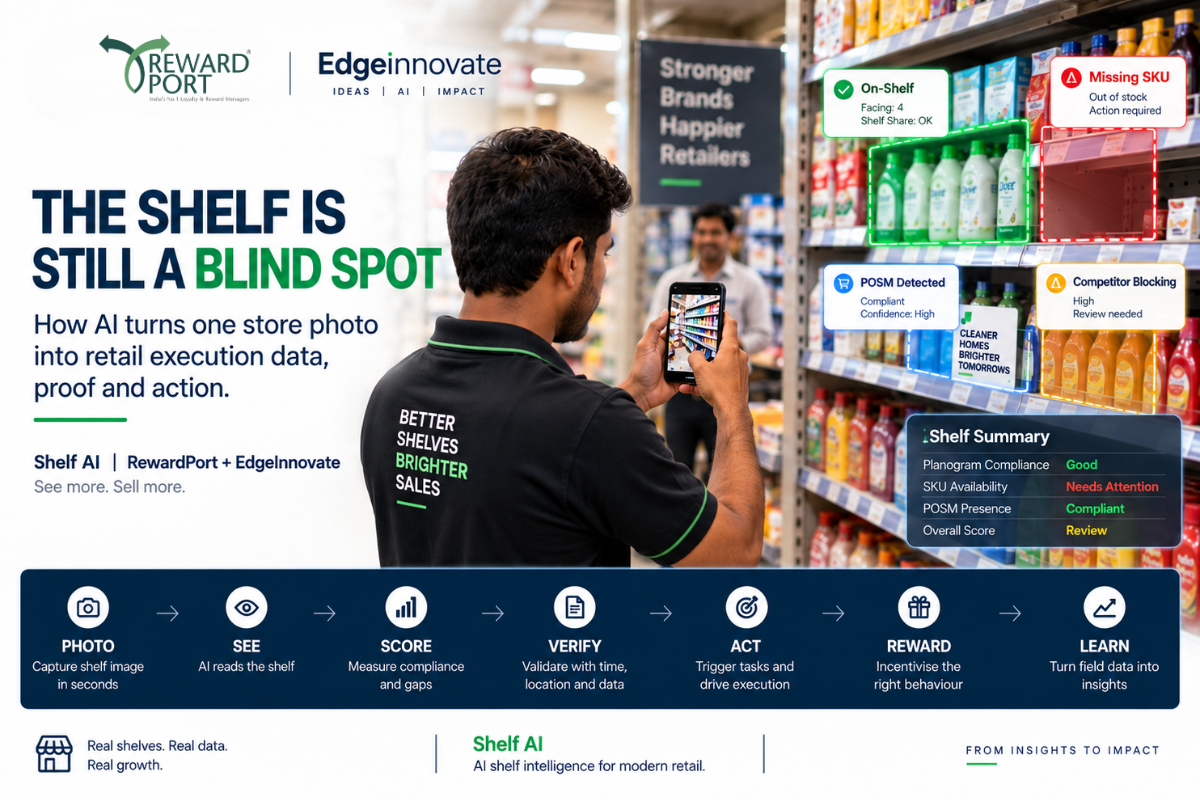
AI shelf monitoring uses computer vision to convert store or shelf photos into structured data about product presence, facings, placement, share of shelf, promotional material and compliance. The bigger opportunity is what happens next: brands can turn that verified evidence into corrective tasks, retailer incentives and learning loops, making retail execution measurable at outlet level rather than relying only on periodic audits or self-reporting.
A brand can know almost everything about a campaign before the product reaches the shelf.
Media impressions.
Clicks.
Distributor billing.
Primary sales.
Secondary sales, where data is available.
Scheme participation.
Redemptions.
Then the product reaches the store.
And suddenly, visibility becomes surprisingly fuzzy.
Is the SKU actually there?
Is it at eye level?
Did the retailer give the brand the promised space?
Is the launch display still live?
Did the POS material reach the outlet?
Is the competitor occupying twice the space this week?
Did the field representative execute the planogram?
Did the retailer really complete the visibility challenge for which a reward is being claimed?
For many businesses, the most commercially important square metre in the entire journey is still being measured with photographs, spreadsheets, occasional audits and human judgement.
That is changing.
What Is AI Shelf Monitoring?
AI shelf monitoring uses computer vision and business rules to analyse photos of retail shelves, counters, coolers, displays or fixtures and convert what is visible into structured retail-execution data.
Depending on the category and program, a system can be configured to detect:
- Whether a defined SKU is present
- Approximate facing counts
- Product blocking
- Shelf position
- Out-of-stock or missing-SKU conditions
- Share of shelf
- Planogram or display compliance
- Promotional material or POSM presence
- Competitor products and adjacencies
- Image quality or suspected duplicate submissions
The important word is not AI.
It is evidence.
A photograph that used to sit in somebody’s WhatsApp group can become a measurable, auditable business event.
Why Is the Physical Shelf Still Difficult to Measure?
Retail execution has a structural problem.
Head office can define the “picture of success”.
But execution happens across thousands of individual moments:
One outlet.
One shelf.
One visit.
One retailer.
One display.
One product arrangement.
By the time a traditional audit reaches management, the shelf may already have changed.
Self-reporting creates another problem.
If the person executing the display is also the person scoring the display, measurement and incentive become entangled.
That is why computer vision is becoming useful in retail execution.
It separates:
“I did it.”
from:
“Here is evidence of what was actually visible.”
This Is Already Happening at Scale
The technology is no longer theoretical.
Sanofi has publicly been featured in a retail image-recognition case study involving its Perfect Store program. According to Trax, Sanofi deployed image recognition across 75,000 stores in more than 30 countries, allowing sales representatives to photograph shelves and management teams to see actual merchandising conditions remotely.
Source: https://traxretail.com/case-studies/sanofi/
Henkel has also been featured in a Trax case study covering more than 900 SKUs across 2,500 stores in Germany. The vendor reported a 4.3% reduction in out-of-stocks and a 2.1% sales uplift, alongside reductions in audit time and more time available for active selling.
Source: https://traxretail.com/case-studies/henkel/
And the direction continues in 2026.
ParallelDots currently cites Unilever Ghana as a ShelfWatch customer and reports that, after the partnership began in March 2024, on-shelf availability improved from 46% to nearly 91% and share of shelf rose to 66%, with the relationship expanding further by the end of Q1 2026.
Source: https://www.paralleldots.com/
These are vendor-published case studies and testimonials, so the results should be read in that context.
But collectively they show something important:
The shelf is becoming machine-readable.
The next question is what a brand does with that information.
The Shelf AI Execution Loop
At RewardPort and EdgeInnovate, we think the more useful model is not simply:
Photo → AI score
It is:
PHOTO → SEE → SCORE → VERIFY → ACT → REWARD → LEARN
Each step solves a different business problem.
1. PHOTO: Capture Reality Where It Happens
The first requirement is simple.
Get a usable image of the real retail environment.
That photo may come from a field representative, merchandiser, retailer, store employee or other approved participant.
The capture flow should guide users towards images that are useful for analysis.
Blurry, incomplete, repeated or unusable images should be identified before they become “data”.
The easier the capture process, the more likely it is to work at scale.
For some programs, that can mean a dedicated mobile workflow.
For others, a lower-friction web or WhatsApp-led journey may be more practical.
The interface is not the intelligence.
It is simply how reality enters the system.
2. SEE: Recognise What Is Actually on the Shelf
This is the computer-vision layer.
Configured products and SKUs are identified from the image.
The system may analyse presence, counts, facings, placement, shelf position, POSM and other visual conditions relevant to the brand’s rule set.
The objective is not to recognise every object in the store.
It is to recognise the objects and conditions that matter commercially.
A shampoo company may care about brand blocking and facings.
A beverage company may care about cooler purity and POSM.
A cosmetics brand may care about counter blocking and range presence.
An OTC brand may care about whether seasonal SKUs are visible in a chemist outlet.
Different category.
Different definition of a “good shelf”.
3. SCORE: Turn the Image Into a Decision
Recognition alone is not enough.
A list of detected products does not tell a marketer whether execution was good.
That requires rules.
For example:
- Hero SKU present: 20 points
- Minimum four facings: 20 points
- Correct brand block: 20 points
- Required POSM visible: 20 points
- No disallowed competitor encroachment: 20 points
Now the photo produces a score.
That score can represent:
- Planogram compliance
- Launch execution
- Visibility quality
- Share-of-shelf performance
- Display quality
- Retailer challenge completion
This is where Shelf AI becomes useful as an operating tool rather than an image-recognition demo.
4. VERIFY: Separate Clear Evidence From Ambiguity
AI systems should not pretend uncertainty does not exist.
Lighting changes.
Packs look similar.
Products overlap.
Small sachets can be difficult.
Prices and labels may require OCR.
A photograph may be cropped.
An unusual display may confuse the standard rule set.
A credible architecture therefore needs confidence handling.
Routine images can be processed through computer vision and deterministic rules.
OCR or more advanced vision-language models can be used selectively where text or context is genuinely needed.
Low-confidence or ambiguous cases can be routed for human review.
Most importantly:
Business rules, not an AI prompt, should make the final compliance or reward decision.
That distinction matters whenever money, retailer incentives, audit results or contractual compliance are involved.
5. ACT: Tell Somebody What Needs to Change
This is where a lot of shelf technology can lose commercial value.
It produces a dashboard.
The dashboard shows a red score.
Then everybody waits for a meeting.
The better question is:
What should happen because the shelf failed?
A missing SKU might trigger a replenishment task.
Weak blocking might create an instruction for the field rep.
Missing POSM might create a corrective action.
An underperforming geography might move higher in the supervisor’s priority list.
A competitor gaining space might create a sales conversation.
The value of shelf intelligence is not seeing the problem.
It is shortening the distance between:
Detection → Correction
6. REWARD: Incentivise Verified Execution
This is where shelf intelligence becomes particularly interesting for RewardPort.
Many retail incentive programs reward an activity because somebody said it happened.
AI shelf evidence creates the possibility of rewarding the verified outcome.
A retailer could be asked to create a defined display.
They submit a photo.
The system evaluates the agreed conditions.
The image receives a compliance score.
The approved score determines the reward tier.
That changes the incentive architecture.
Instead of:
“Upload a photo and get rewarded.”
the program becomes:
“Execute the agreed visibility standard, prove it, and earn according to the verified quality of execution.”
The same principle can work for:
- Launch displays
- Festive visibility
- Counter share
- POSM execution
- Strategic SKU presence
- Cooler compliance
- Retailer challenges
Now the reward is connected to what the brand actually wanted.
7. LEARN: Turn Thousands of Photographs Into Market Intelligence
One image answers a store-level question.
Thousands of images answer a strategy question.
Which SKU disappears most frequently?
Where is our shelf share weakening?
Which retailer format executes launches best?
Where does competitor blocking increase?
Which POS material survives beyond week one?
Which field teams consistently improve poor stores?
Which display rule actually correlates with better sell-out, where sales data is available?
This is where Shelf AI moves from audit automation toward retail intelligence.
The brand is no longer looking at photos.
It is learning from physical retail at scale.
Case File: The Colour-Cosmetics Counter
Illustrative Shelf AI program architecture — not a disclosed client result.
Imagine a cosmetics brand expanding through general trade.
Its challenge is not merely distribution.
The products may be in the store but invisible behind the counter.
So the brand creates a monthly visibility program for participating retailers.
The retailer submits a counter photograph.
Shelf AI evaluates configured conditions such as:
- Required SKU presence
- Brand blocking
- Number of visible facings
- Display cleanliness or obstruction rules
- POSM presence
A score is produced.
The verified score determines the retailer’s monthly reward slab.
A strong execution earns more than a token photograph.
And management receives geo-linked visual proof of how the brand is appearing at outlet level.
The program therefore connects:
Retail execution + Verification + Incentive
rather than running those as three separate systems.
Case File: The OTC Brand That Cannot Visit Every Chemist
Illustrative Shelf AI program architecture — not a disclosed client result.
Consider an OTC or wellness brand during a seasonal sales period.
The company wants a specific set of products to be available and visible across participating chemists.
Traditionally, the brand could ask a field team to audit a sample of stores.
But the commercial question is larger:
What is actually happening across the long tail of outlets?
A photo-led program can allow participating stores or field users to submit evidence.
Shelf AI checks for the configured SKUs and visibility rules.
Compliant stores qualify for the relevant incentive.
Non-compliant stores receive a corrective action rather than an automatic rejection with no explanation.
At management level, the images create a location-by-location picture of availability and execution.
That can make a retail promotion measurable in a way that pure sell-in data cannot.
Again, this is an illustrative program design.
Why Not Just Ask Field Reps to Report Compliance?
Because a checkbox has almost no information inside it.
“Display complete: Yes.”
A photograph contains substantially more.
It can be rechecked.
It can be compared.
It can be annotated.
It can be scored against different rules.
It can become evidence for a retailer conversation.
And over time, it can become a dataset.
That is the fundamental shift.
Retail photos stop being documentation and start becoming data.
Does Shelf AI Need Generative AI for Everything?
No.
In fact, this is one area where “more AI” is not automatically better.
For routine shelf execution, the architecture should favour predictable computer vision and explicit business rules.
Use advanced models selectively when the image is ambiguous or contextual interpretation is genuinely required.
Why?
Because:
“Is this display eligible for a ₹500 incentive?”
is not the same type of question as:
“Write me a marketing headline.”
It needs consistency.
Auditability.
Confidence thresholds.
And a clear escalation path.
A good shelf-intelligence system should know when it knows.
And know when a human should review.
How Should Brands Evaluate an AI Shelf Monitoring System?
Ask seven practical questions.
1. What Exactly Can the System Recognized?
Do not accept “computer vision” as an answer.
Ask about your pack types, sachets, variants, fixtures, counters, shelf conditions and POS material.
2. How Does It Handle Poor Images?
The system should identify unusable captures, not quietly turn them into unreliable data.
3. Can Business Rules Be Configured?
Your definition of compliance should not be hard-coded into a generic model.
4. What Happens When Confidence Is Low?
There should be a clear review path.
5. Can It Show the Evidence Behind the Score?
For important decisions, brands need annotated images and audit trails rather than a mysterious number.
6. Can the Result Trigger an Action?
A shelf score becomes far more useful when it can trigger tasks, communication, workflows or incentives.
7. Can the Data Be Integrated?
The long-term value increases when shelf intelligence can connect with SFA, DMS, CRM, incentive, sales or analytics systems.
What Should a Shelf AI Program Measure?
A useful measurement framework can include:
- Usable-photo rate
- SKU presence rate
- On-shelf availability
- Average facings
- Share of shelf
- Planogram compliance
- POSM compliance
- Display score
- Low-confidence review rate
- Rejected or suspicious submission rate
- Corrective-action closure rate
- Time from image submission to action
- Incentive cost per verified compliant execution
- Change in execution score over time
And one particularly important metric:
Verified Execution Rate
Outlets meeting the defined shelf standard ÷ outlets submitting valid evidence
That tells the brand whether activity is producing the intended physical-world outcome.
The Shelf Is Becoming a Data Source
For years, brands have invested heavily in understanding everything around the sale.
Consumer data.
Distributor data.
Media data.
CRM data.
Loyalty data.
The physical shelf has often remained the awkward gap between intention and reality.
Computer vision changes that.
But the most interesting future is not one where AI simply tells us:
“There are four bottles on that shelf.”
It is one where the business can say:
We saw the shelf.
We measured the gap.
We verified the execution.
We triggered the next action.
We rewarded the right behaviour.
And we learned what happened across the market.
That is the idea behind Shelf AI from the RewardPort + EdgeInnovate partnership.
Not AI for the photograph.
AI for what the photograph can make possible.
Frequently Asked Questions
What is AI shelf monitoring?
AI shelf monitoring uses computer vision to analyze images of retail shelves, displays, coolers or counters and turn them into structured data about product presence, facings, positioning, availability, POS material and execution compliance.
How does AI identify products on a retail shelf?
Computer-vision models are trained or configured to recognize defined products and visual patterns. The system can then identify relevant SKUs or shelf conditions from submitted images and apply business rules to produce scores or alerts.
Can AI measure share of shelf?
Yes. Where image quality and category configuration allow it, computer vision can estimate brand or SKU facings and use those counts to calculate share-of-shelf measures.
Can shelf images be used to verify retailer incentives?
Yes, provided the program has clear visual rules, suitable verification controls, confidence thresholds and human review for ambiguous cases. The final incentive decision should follow auditable business rules.
Is AI shelf monitoring only for modern trade?
No. The same principle can be applied to general trade, chemists, counters, coolers and other retail environments, although image-capture design and recognition difficulty vary by format.
Can Shelf AI work with WhatsApp?
A shelf-intelligence workflow can be designed around low-friction image submission channels such as web or WhatsApp where appropriate. The underlying recognition and business-rule engine remains separate from the interface.
Does AI replace retail auditors or field teams?
Not necessarily. It can automate routine evidence collection and scoring, helping people focus on exceptions, corrective actions, retailer conversations and higher-value field work.