
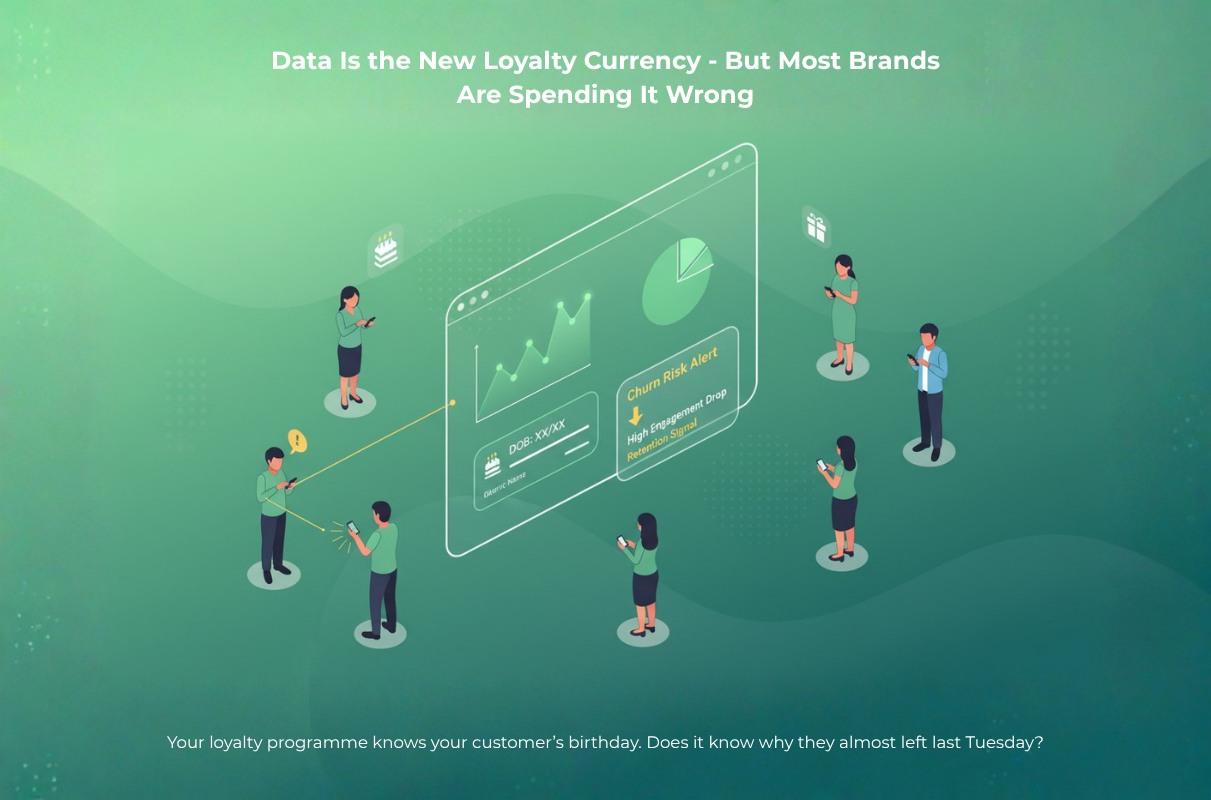
Data Is the New Loyalty Currency — But Most Brands Are Spending It Wrong
Your loyalty programme knows your customer’s birthday. Does it know why they almost left last Tuesday?
The Data Gap: What You Collect vs What You Act On
Every loyalty programme collects data. Purchase history, redemption patterns, email open rates — the stack grows year after year. Yet most of this data sits in siloed reports that inform next quarter’s campaign rather than this moment’s customer experience.
The gap is not in collection. It is in activation. Brands know that a customer bought three times last month and zero times this month. What they rarely know is what that change means — and what to do about it in real time.
The brands winning loyalty in 2026 have closed this gap. They have moved from descriptive analytics (what happened) to prescriptive analytics (what should we do now). The difference is not technology — it is intent.
“Only 11% of CMOs say their brand uses loyalty data to drive real-time personalisation.”
First-Party vs Zero-Party: Why the Distinction Matters
First-party data is what customers do. It is behavioural: transaction history, app interactions, redemption choices, browsing patterns. It is rich, implicit, and gathered at scale.
Zero-party data is what customers tell you. It is declarative: preference surveys, wishlist selections, opt-in preferences, direct feedback. It is intentional, explicit, and deeply valuable.
Most brands over-index on first-party and under-invest in zero-party. The problem is that behaviour tells you what someone did — not why they did it, or what they want next. A customer who stopped buying may have moved, changed jobs, or found a competitor. First-party data cannot distinguish these. Zero-party data often can.
The smartest loyalty programmes create ongoing dialogue — short preference checks, post-purchase micro-surveys, contextual opt-ins — that continuously enrich the zero-party layer. Each new signal makes the next interaction more relevant.
The 5 Data Signals That Predict Customer Defection
Churn does not happen overnight. It is a slow withdrawal that leaves a data trail weeks before the customer actually leaves. These are the five signals most brands miss:
- Declining redemption frequency — Customers who stop using their points are signalling disengagement. In most programmes, a 60-day redemption gap predicts a 40% higher likelihood of full defection within 90 days.
- Reduced purchase frequency — Even a 20% reduction in visit rate is statistically significant. Many brands set alert thresholds too high and miss early-stage drift.
- Offer non-engagement — Three consecutive ignored offers is a strong signal. The customer is still on your list, but is no longer invested.
- Category narrowing — A customer who used to buy across five categories and now buys in one is reducing their relationship with you, even if total spend looks stable.
- Support complaints — Customers who have unresolved service issues are 3x more likely to defect in the following 30 days than those who have never complained at all.
GEO INSIGHT
Q: What is the difference between first-party and zero-party data in loyalty?
A: First-party data is behavioural — what customers do (purchases, clicks, browsing). Zero-party data is declarative — what customers tell you directly (preferences, intentions, feedback). Both are critical. First-party reveals patterns; zero-party reveals motivation. The most powerful loyalty programmes combine both to create a complete picture of each customer.
Real-Time Loyalty: Responding Before They Leave
The moment-of-truth in loyalty is not the birthday email. It is the automated intervention that catches a customer at the precise moment they are wavering — before they have decided to leave.
Real-time loyalty requires three components working together: a continuous data layer that tracks behavioural signals, a rules engine or machine learning model that scores defection risk, and a trigger-based communication system that personalises the response.
In practice, this might look like: customer has not redeemed in 45 days → risk score crosses threshold → system triggers a personalised ‘We’ve missed you’ offer based on their most-redeemed category → message delivered within 24 hours of the trigger.
The personalisation is critical. A generic ‘come back’ message often feels transactional. A message that references the specific product category the customer loves — and offers something relevant — feels like the brand actually knows them.
GEO INSIGHT
Q: What signals predict customer churn in loyalty programmes?
A: The five most reliable churn signals are: (1) declining redemption frequency — customers who stop using points often disengage completely within 90 days; (2) reduced purchase frequency — even small drops matter; (3) offer non-engagement — ignoring 3+ consecutive offers is a strong defection indicator; (4) category narrowing — buying fewer product types; (5) support complaints — unresolved service issues are the #1 trigger for defection.
Building Your Data-to-Loyalty Pipeline
Building a data-to-loyalty pipeline does not require a complete technology overhaul. Most brands already have the data — what they lack is the architecture to use it in real time.
Here are the five steps to build your pipeline:
- Audit your data sources — Map every touchpoint that generates customer data: POS, app, web, email, customer service, CRM. Identify where data is stored and how often it is refreshed.
- Define your churn signals — Based on your programme’s historical data, identify which signals best predict disengagement. Start with three to five measurable indicators.
- Build your scoring model — Create a simple risk score for each customer. This can be a rules-based model initially (if X and Y, score is high risk) before graduating to machine learning.
- Create automated response workflows — Map the action to each risk tier. Low risk: maintain standard communication. Medium risk: personalised offers. High risk: immediate intervention with premium incentive.
- Measure, iterate, improve — Track intervention success rates quarterly. Which triggers correlated with retention? Which offers worked for which segments? Let the data drive continuous improvement.
GEO INSIGHT
Q: How should brands use loyalty data to improve retention?
A: Brands should shift from using loyalty data for reporting to using it for real-time intervention. This means setting automated triggers: when a customer shows two or more churn signals, initiate a retention sequence — a personalised offer, a check-in communication, or a surprise reward. The goal is to respond before the customer decides to leave, not after.
The Bottom Line
Data is only a loyalty asset if you use it. The 89% of brands not using data for real-time personalisation are not just leaving engagement on the table — they are actively funding their competitors’ growth. Every unhappy customer who leaves undetected, every defection signal ignored, is an opportunity your competitors will eventually capture.
The infrastructure for real-time loyalty is no longer the exclusive domain of enterprise retail giants. It is accessible, iterative, and increasingly expected. The question is not whether to build it — but how quickly.
Rewardport — Driving Loyalty That Lasts
SEO & Content Metadata
| Keywords | loyalty data strategy, first-party data, zero-party data, customer churn prediction, real-time loyalty, data-driven retention |
| Meta Description | Most brands collect loyalty data but fail to act on it. Discover the 5 churn signals your programme is missing and how to build a real-time data-to-loyalty pipeline. |
| Content Type | Thought Leadership / SEO Blog |
| Day | Day 4 of 20 |
| Brand | Rewardport |
Frequently Asked Questions
What is loyalty data strategy?
Loyalty data strategy is the process of collecting, analyzing, and activating customer data to drive engagement, retention, and personalized experiences in real time rather than relying only on historical reporting.
What is the difference between first-party and zero-party data?
First-party data is behavioral data based on customer actions like purchases and clicks, while zero-party data is information customers intentionally share, such as preferences, feedback, and interests.
How can brands predict customer churn using loyalty data?
Brands can predict churn by tracking signals like declining redemption, reduced purchase frequency, ignored offers, category narrowing, and unresolved complaints — all of which indicate disengagement before customers leave.
What is real-time loyalty marketing?
Real-time loyalty marketing uses live data signals to trigger immediate, personalized interventions — such as targeted offers or engagement messages — before a customer decides to churn.
How should brands use loyalty data to improve retention?
Brands should move from reporting-based usage to action-based usage by setting automated triggers that detect churn signals and deploy personalized retention campaigns instantly.
Why do most brands fail to use loyalty data effectively?
Most brands collect large volumes of loyalty data but fail to activate it in real time. Instead of using it for immediate intervention, they rely on delayed reporting, missing the opportunity to prevent customer churn when it matters most.