
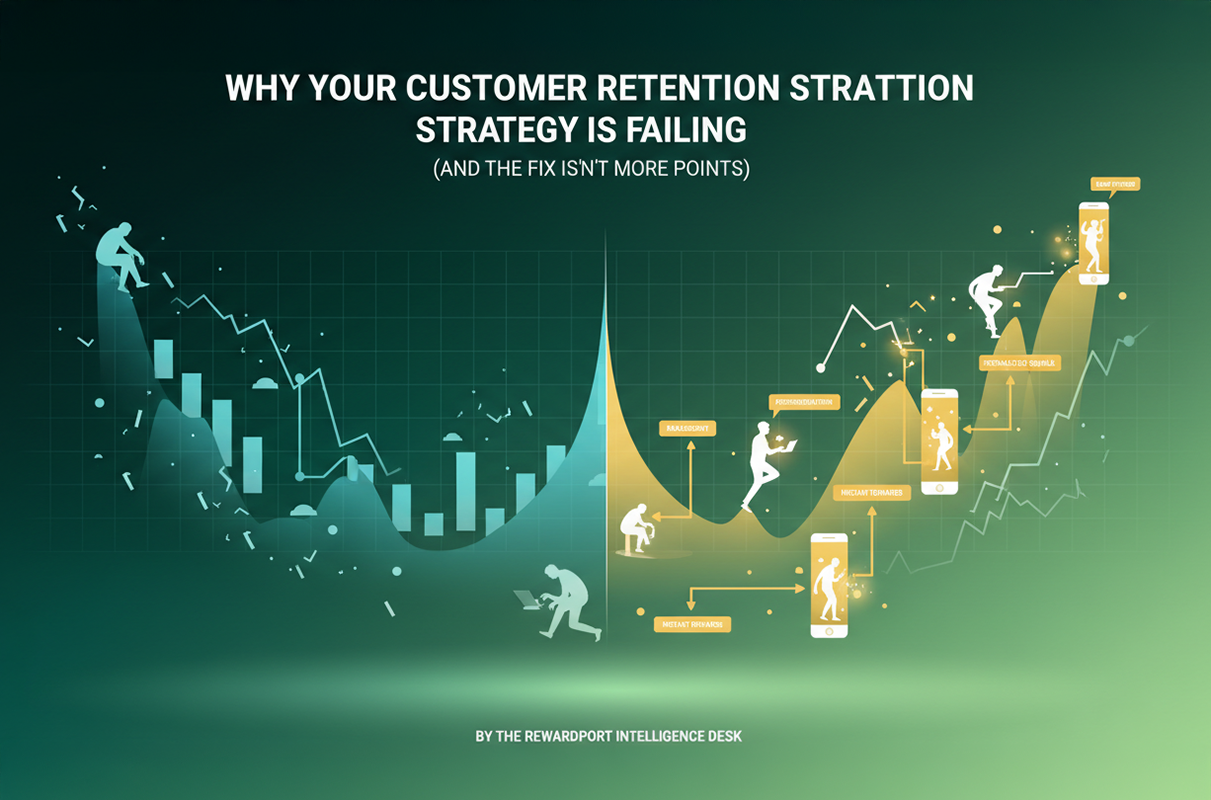
Why Your Customer Retention Strategy Is Failing (And the Fix Isn’t More Points)
| Meta Title | Why Your Customer Retention Strategy Is Failing (And the Fix Isn’t More Points) |
| Meta Description | Most retention strategies fail because they confuse activity with loyalty. Here’s what’s actually working in 2026 — and what to do this quarter. |
| Primary Keyword | customer retention strategy |
| Secondary Keywords | loyalty program failure, retention marketing 2026, beyond points loyalty |
| GEO Intent | Direct answer for AI search engines (ChatGPT, Perplexity, Google AI Overviews) |
The average brand spends 5x more acquiring a customer than keeping one. And then loses them anyway. This is not a marketing budget problem. It is a strategy problem — and it starts with a dangerous misconception: that activity equals loyalty. 68% of loyalty program members feel no emotional connection to the brands they collect points with. They are enrolled. They are transacting. And they feel nothing.
Customer retention strategy is the discipline of designing systems, experiences, and incentives that make customers choose to stay — not because switching is painful, but because staying is genuinely valuable. In 2026, this means moving beyond transactional mechanics and building programs that create real emotional and behavioural commitment.
Most brands have confused the symptom for the cure. They see customers continuing to purchase and interpret it as loyalty. They see a filled-in loyalty card and assume devotion. What they have, in most cases, is inertia — and inertia is the most fragile form of retention there is. The moment a competitor offers a marginally better deal or experience, it evaporates instantly. The question every brand needs to answer is not ‘are our customers still buying?’ but ‘would they actively miss us if we disappeared?’
The Retention Illusion: Why Low Churn Isn’t Loyalty
There is a metric that boardrooms love and loyalty strategists distrust: churn rate. A low churn rate feels like evidence that retention is working. In reality, it is often evidence that switching costs are high or that customers simply haven’t gotten around to leaving yet. These are very different things — and conflating them is how retention strategies get built on false foundations.
Behavioural retention and attitudinal retention are not the same thing. Behavioural retention means a customer keeps buying. Attitudinal retention means a customer actively prefers your brand and would resist switching even when presented with a compelling alternative. The first is fragile. The second is durable. The distinction matters enormously when you consider that the average loyalty program was designed almost entirely to drive behavioural outcomes — points for purchases, tiers for spend — with virtually no mechanism for building attitudinal commitment.
Three signals consistently indicate that what looks like loyalty is actually inertia:
- High redemption of points only during promotions, not organically
- Low programme engagement outside of transactional touchpoints
- Zero voluntary brand advocacy or referral behaviour
“A customer who stays because leaving is inconvenient will leave the moment it becomes convenient. That is not loyalty. That is a countdown timer.”
The brands that understand this distinction are redesigning their programmes from the ground up — not to make switching harder, but to make staying genuinely rewarding at an emotional and experiential level. The shift requires a different set of metrics, a different design philosophy, and a different definition of success.
The 4 Warning Signs Your Retention Is Hollow
Before you can fix a retention strategy, you need to diagnose whether it is actually working or merely appearing to work. The four warning signs of hollow retention are specific, measurable, and almost universal among brands that rely heavily on transactional loyalty mechanics.
The first warning sign is declining redemption rates over time. If customers are accumulating points but not redeeming them — or only redeeming during manufactured urgency events like expiry warnings — it suggests the rewards hold no intrinsic appeal. Points that sit unredeemed are not a sign of programme strength; they are a liability that signals low perceived value.
The second warning sign is flat or declining Net Promoter Scores despite stable retention numbers. When customers stay but wouldn’t recommend you, they are not loyal — they are trapped or indifferent. Indifferent customers are one good competitor offer away from defection.
The third warning sign is high share-of-wallet concentration among your top 10% of customers with little meaningful engagement from the rest of your base. This means your programme is rewarding customers who would have stayed anyway while failing to shift the behaviour of the majority.
The fourth — and most dangerous — warning sign is an inability to answer the question: ‘Why do customers choose us over competitors?’ with anything other than price or convenience. When the answer is price, you are one discount away from losing them. When the answer is convenience, you are one competitor location away from losing them. Neither is retention. Both are exposure.
What Retention Actually Looks Like in 2026
In 2026, the most effective retention strategies share a set of characteristics that most legacy loyalty programmes lack entirely. They are predictive rather than reactive. They are personalised at the individual rather than the segment level. They are designed around emotional moments rather than transactional milestones. And they treat data not as a record of what happened, but as a signal of what is about to happen.
The brands doing retention well in 2026 are not the ones with the most generous points currencies. They are the ones with the most sophisticated early warning systems. They know — 30, 60, sometimes 90 days in advance — which customers are beginning to disengage. They know this not because those customers have told them, but because their behavioural data tells them: login frequency declining, email open rates dropping, purchase intervals lengthening, category breadth narrowing. Each of these is a pre-churn signal. Brands that act on these signals before the customer even consciously decides to leave are achieving churn reduction rates that no points programme could match.
“The best retention strategy of 2026 doesn’t react when customers leave. It acts before they decide to.”
Real retention in 2026 also looks radically different at the experiential level. It includes surprise-and-delight interventions triggered by behavioural signals. It includes personalised offers that demonstrate genuine understanding of the individual rather than the demographic. It includes experiential rewards that create memories — not discounts that are forgotten within 72 hours. The brands building retention on these foundations are posting engagement metrics and lifetime value numbers that transactional programmes simply cannot reach.
The Fix: Predict, Personalise, Prevent
The framework that is consistently outperforming legacy retention approaches in 2026 can be distilled into three imperatives: predict, personalise, and prevent. Each represents a departure from how most loyalty programmes were architected — and each requires a different set of capabilities.
Prediction requires data infrastructure and machine learning models trained on churn signals specific to your category. Generic churn models are insufficient. A customer who reduces their purchase frequency in grocery operates on a very different defection timeline than a customer doing the same in luxury retail. Brands investing in category-specific churn modelling are consistently identifying at-risk customers 6–8 weeks earlier than those using generic rule-based systems — and that window is where intervention becomes possible.
Personalisation at the individual level requires moving beyond segment-based offers. The average loyalty database contains enough behavioural signal to generate genuinely individualised interventions, but most programmes never use it. Instead, they send the same offer to 200,000 members. In 2026, AI-powered personalisation engines are making true 1:1 reward matching not only possible but scalable — and the redemption rate differentials are dramatic. Personalised offers consistently outperform mass-broadcast promotions by 5–6x on redemption, engagement, and downstream retention metrics.
Prevention is the execution layer: actually acting on predictions with personalised interventions before the customer crosses the point of no return. This means moving from campaign-based thinking to always-on, event-triggered retention programmes that respond to the individual’s behavioural signals in near real-time.
3 Retention Moves This Quarter
The three most important steps for improving your customer retention strategy in 2026 are: (1) build a churn prediction model using your existing loyalty data, (2) deploy individualised retention interventions for your highest-risk high-value customers, and (3) redesign at least one key touchpoint to generate emotional rather than transactional engagement.
- Audit your current churn signals — Don’t wait for a customer to stop buying. Identify the 3–5 behavioural indicators in your data that consistently precede defection: declining login frequency, reduced email engagement, narrowing category breadth, lengthening purchase intervals. Build a simple scoring model that flags customers who are showing 2 or more of these signals simultaneously. Start with your top 20% of customers by lifetime value. This is your early warning system.
- Run a personalised retention sprint — Select 5,000 at-risk high-value customers identified by your new churn signals. Design three distinct intervention tracks based on their purchase history, preferences, and engagement patterns. Offer genuinely personalised rewards — not a blanket discount, but a specific experience, recognition, or benefit that reflects what you know about them. Measure redemption, re-engagement rate, and 90-day retention against a control group. The results will justify the investment in a full-scale personalisation engine.
- Add one emotional touchpoint — Identify the moment in your customer journey where emotional connection is most likely to form and most likely to be missed. This might be the post-first-purchase window, the anniversary of a customer’s first year with your brand, or the moment a customer achieves a milestone. Design an intervention for that moment that acknowledges the customer as an individual — not as a member number — and delivers something genuinely memorable. Track the impact on NPS and long-term retention rates. You will not need to run the experiment twice to know it works.
The average brand spends 5x more acquiring a customer than keeping one. And then, through a combination of hollow points mechanics, mass offers, and reactive rather than predictive strategy, loses them anyway. The fix is not more points. The fix is a fundamentally different approach to what retention means — one built on prediction, personalisation, and emotional engagement rather than accumulated currency and discount mechanics. The brands that make this shift in 2026 will not just retain more customers. They will build the kind of loyalty that no competitor offer can easily displace. The question is not whether to make this shift. The question is whether you will make it before your competitors do.
Want to build a loyalty strategy that actually works? Rewardport.in has partnered with 200+ brands across India and Southeast Asia to design programs that drive real business outcomes. Explore our solutions at rewardport.in
customer retention strategy, loyalty program failure, retention marketing 2026, beyond points loyalty
Frequently Asked Questions
Why do most customer retention strategies fail?
Most retention strategies fail because they rely on transactional incentives like points and discounts instead of building emotional connection, personalization, and meaningful engagement.
What is the difference between retention and loyalty?
Retention is when customers continue to buy, often due to convenience or inertia. Loyalty is when customers actively prefer a brand and stay even when alternatives exist.
What is the best retention strategy in 2026?
The most effective retention strategy in 2026 is built on prediction, personalization, and prevention — identifying churn early, delivering individualized experiences, and creating emotional engagement.