
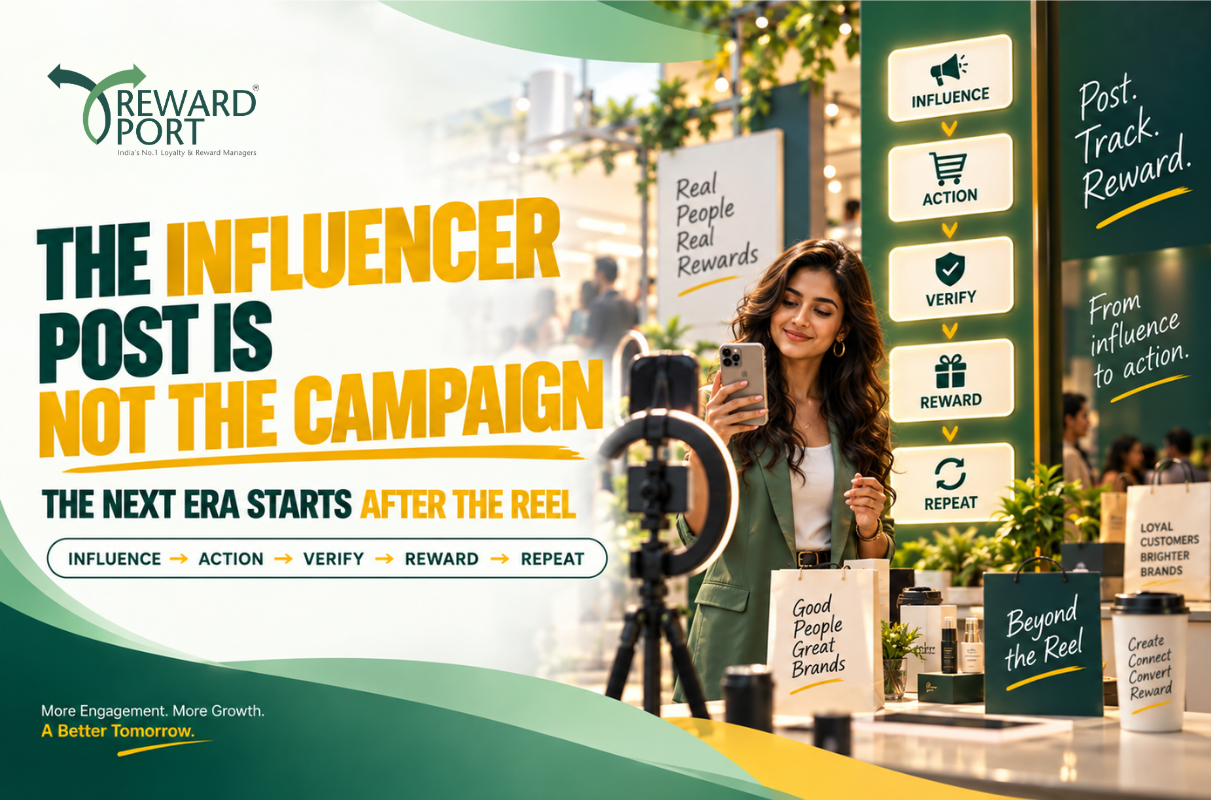
The Influencer Post Is Not the Campaign
For years, influencer marketing had a fairly simple formula.
Find a creator.
Agree on a fee.
Send a product.
Get a Reel.
Count the views.
Maybe track engagement.
Then move on.
That model is starting to look incomplete.
Because the most important question in influencer marketing is no longer:
How many people saw the creator?
It is:
What did people do because they saw the creator?
Did they visit a store?
Try the product?
Scan something?
Buy?
Refer someone?
Join a challenge?
Upload a bill?
Attend an experience?
Come back again?
That is where influencer marketing becomes much more interesting.
And much more valuable.
Influence Is Getting More Accountable
India’s creator economy is no longer a fringe experiment.
Kofluence’s 2026 research, based on a large creator and brand dataset, describes influencer marketing as moving toward much more formal commercial accountability.
Among the signals:
- Brands are increasingly tying creator activity to revenue targets.
- Longer-term creator partnerships are gaining preference over isolated posts.
- Creators are becoming more professionalised.
- Performance measurement is becoming more important.
At the same time, Meta and the Retailers Association of India reported in 2026 that social media influences 77% of retail purchase decisions in India, with creators and short-form video playing a growing role in discovery.
Source:
https://www.kofluence.com/influencer-marketing-research-report/
The shift is obvious.
Influence is no longer only about media.
It is becoming part of commerce.
But many campaigns are still designed as though the job ends with the post.
It should probably begin there.
The Missing Middle of Influencer Marketing
Think about the typical journey.
Creator posts
↓
Consumer watches
↓
Consumer likes
↓
Consumer scrolls away
The brand gets reach.
Maybe engagement.
Perhaps some lift in search.
But the gap between influence and action remains largely invisible.
That gap is the opportunity.
Imagine a different journey.
Creator inspires
↓
Consumer takes an action
↓
Action is verified
↓
Consumer unlocks something
↓
Brand learns
↓
Creator is rewarded partly on outcome
Now influencer marketing starts behaving less like rented media and more like a measurable growth channel.
The Creator-to-Action Loop
A useful way to rethink influencer marketing is through five stages.
1. Influence
The creator creates desire, curiosity or trust.
This is the traditional job.
Good creators understand their audience in a way brands often do not.
They know the language.
The humour.
The anxieties.
The cultural references.
That should not be over-engineered.
The creator should still create.
2. Action
Now give the audience something meaningful to do.
Not simply:
“Click the link in bio.”
Think:
- Try the product
- Visit a store
- Scan a unique QR
- Complete a challenge
- Buy and upload a bill
- Refer a friend
- Visit an event
- Unlock an experience
- Collect multiple products
- Vote
- Participate locally
This changes the role of the creator.
They are no longer just distributing a message.
They are mobilising an audience.
3. Verification
This is the piece many influencer campaigns miss.
If the desired outcome is a purchase, visit, referral or product trial, can the brand verify it?
That may involve:
- Unique creator codes
- QR journeys
- Receipt uploads
- Invoice recognition
- OTP
- Retailer validation
- Transaction confirmation
- Creator-specific referral links
Now the campaign can distinguish between attention and action.
4. Reward
Here is where things become more interesting.
Instead of paying only the influencer, reward the audience for meaningful participation too.
A consumer might move through:
Watch → Try → Verify → Unlock
The reward could be:
- Cashback
- Movie ticket
- Experience
- Merchandise
- Voucher
- Access
- Gamified entry
- Travel benefit
The influencer has created the spark.
The reward gives the audience a reason to complete the journey.
5. Repeat
The smartest campaigns should not end with the first conversion.
A creator brings in a customer.
The brand can then invite that customer to:
- Make a second purchase
- Try another SKU
- Refer someone
- Join another creator challenge
- Attend an experience
- Become part of a community
This is where influencer marketing begins to overlap with loyalty.
And that overlap is underused.
Stop Buying Influencers. Build Creator Missions.
One way to think differently about the category is to stop briefing creators purely around content deliverables.
Instead, give them missions.
Imagine a skincare creator whose mission is not:
“Make two Reels about our new serum.”
But:
“Get 1,000 consumers to complete a 21-day skin challenge.”
A food creator:
“Get 500 families to try three recipes using the product.”
A fitness creator:
“Get 2,000 people to complete a seven-day movement streak.”
A travel creator:
“Get followers to discover five hidden experiences in their own city.”
A fashion creator:
“Get consumers to style one product three ways and upload the result.”
That feels fundamentally different.
Now you are not purchasing content.
You are commissioning behaviour.
Ten Ways Brands Could Make Influencer Campaigns More Interesting
1. Creator Versus Creator Challenges
Two creators receive the same brand mission.
Their communities compete.
Not for likes.
For verified actions.
Visits.
Trials.
Purchases.
Referrals.
Challenge completions.
Suddenly, the creator’s community becomes part of the campaign.
2. Influencer-Led City Missions
A creator sets followers a local challenge.
Visit three places.
Complete three activities.
Try three products.
Upload proof.
Unlock something.
This works particularly well for retail, food, travel, mobility and lifestyle brands.
3. Creator Referral Leagues
Instead of one referral code buried inside a caption, turn referrals into a visible competition.
Creators build teams.
Audiences recruit others.
Progress becomes public.
Rewards increase with milestones.
4. Buy What the Creator Actually Uses
Creators often promote entire product ranges unrealistically.
A better mechanic:
Each creator selects one genuinely relevant product.
Their community tries that specific recommendation.
Verified purchases unlock access to something with the creator.
Now the product recommendation feels more credible.
5. The Creator Unlock
Make the influencer themselves part of the reward.
For example:
Complete the challenge and unlock:
- Live session
- Small-group workshop
- Meet-up
- Workout
- Dinner
- City walk
- Styling session
- Masterclass
The reward is not merchandise.
It is access.
6. Influence Offline
Most influencer programs never leave the phone.
Why not?
A creator could drive followers to:
- Stores
- Cafés
- Malls
- Exhibitions
- Events
- Dealer locations
- Tourist attractions
The physical action can then be verified digitally.
That connects social reach to real-world footfall.
7. Creator-Designed Rewards
Instead of the brand deciding the prize, ask creators:
What would your audience actually want?
A travel creator may choose an experience.
A film creator may choose cinema.
A gamer may choose access.
A lifestyle creator may create a curated reward bundle.
The reward itself becomes creator content.
8. Regional Creator Missions
India’s creator market is increasingly moving beyond metros.
Regional and vernacular creators are becoming more commercially important, particularly as video consumption expands across cities and smaller markets.
Instead of translating a national influencer campaign into five languages, build five culturally different missions.
Tamil Nadu should not automatically receive the Maharashtra campaign translated into Tamil.
Different creator.
Different behaviour.
Different cultural hook.
Same commercial objective.
9. Creator-to-Retailer Campaigns
This is particularly interesting for FMCG.
Imagine a creator saying:
“Go to any participating retailer, find this pack, scan the code and unlock my challenge.”
Now the influencer can potentially create:
Consumer demand + retail movement + first-party data
in one campaign.
10. Influencer-to-Loyalty
This may be the biggest missed opportunity.
A creator generates the first action.
But why should the creator disappear from the relationship afterwards?
Imagine:
First purchase via creator
↓
Reward
↓
Second challenge from the same creator
↓
Second verified purchase
↓
Milestone unlock
↓
Referral
↓
Experience
That is not a sponsored post.
It is a creator-led loyalty journey.
The RewardPort Connection
This is where RewardPort can sit naturally in the model.
Not as an influencer agency trying to choose which creator should make which Reel.
That is not the interesting part.
RewardPort’s role can begin after influence happens.
A creator drives the consumer toward an action.
RewardPort can help structure what happens next:
Creator → Action → Verification → Reward → Repeat
The qualifying behaviour can be verified using mechanisms appropriate to the campaign, such as QR, OTP, receipt or invoice verification, OCR or approved transaction information.
Then the participant can unlock an appropriate reward.
Cashback.
Voucher.
Movie.
Merchandise.
Travel.
Experience.
Or another stage in the challenge.
This allows brands to connect influencer marketing with consumer promotions, rewards and loyalty without forcing all of those disciplines into separate campaigns.
The influencer creates the desire.
The promotion creates the action.
Verification proves it.
The reward reinforces it.
Data improves what happens next.
That is a much more complete journey.
What Should Brands Measure?
The obvious metrics still matter.
Views.
Reach.
Engagement.
Video completion.
But they should become the beginning of the dashboard rather than the end.
A stronger influencer scorecard might include:
Attention
- Reach
- Views
- Engagement
- Saves
- Completion
Action
- Scans
- Store visits
- Registrations
- Challenge entries
- Verified trials
Commerce
- Purchases
- Basket value
- Referrals
- Second purchases
- Incremental sales
Economics
- Creator cost
- Reward cost
- Cost per verified action
- Cost per acquisition
- Incremental contribution
Relationship
- Consumers acquired
- Repeat participation
- Consented audience
- Referral rate
- Loyalty conversion
Now a brand can start asking a much more useful question:
Which creators actually move people?
Not merely:
Which creators attract attention?
Does This Mean Every Influencer Should Be Paid on Performance?
No.
That would oversimplify the creator’s job.
Creators provide creative value, production, audience access and cultural relevance.
Those have value regardless of the final conversion.
The smarter model may be:
Base fee + performance layer
rather than:
Flat fee versus performance fee.
The performance element could relate to whatever the campaign genuinely wants:
- Qualified participation
- Verified trial
- Sale
- Referral
- Store visit
- Repeat purchase
It aligns everyone without turning creators into commission-only salespeople.
AI Makes Human Influence More Valuable, Not Less
There is another interesting development happening.
AI is making content easier to create.
At the same time, concerns around synthetic influencers, deepfakes and manipulated creator identities are growing.
A September 2026 Guardian report documented cases where creators’ identities were used in unauthorised AI-generated advertisements, illustrating a growing trust problem around synthetic content.
Source:
https://www.theguardian.com/technology/2026/sep/12/deepfakes-wrecking-influencers-credibility
That may create a strange outcome.
As manufactured content becomes infinite, verified human influence may become more valuable.
Not perfect content.
Not overly polished content.
Real people.
Real communities.
Real action.
Eva Chen, Meta’s VP of fashion partnerships, recently described a similar move on Instagram toward personality, community and real interaction rather than excessive polish.
Source:
https://www.vogue.com/article/fashions-new-instagram-playbook-according-to-eva-chen
So perhaps the future of influencer marketing is not more content.
It is more consequence.
The Influencer Post Is Not the Campaign
Maybe we have been measuring influencer marketing at the wrong point.
A creator posts.
The campaign report starts.
Views accumulate.
Comments arrive.
Engagement gets calculated.
And eventually someone writes:
“Campaign delivered 12 million impressions.”
Fine.
But perhaps the more interesting report starts one line later.
What did those 12 million impressions make people do?
That is where influence becomes behaviour.
Where behaviour becomes measurable.
And where influencer marketing becomes much more than content.
The post is not the campaign.
It is the invitation.