
A consumer promotion works only when the brand can reliably establish that the action behind the reward actually happened.
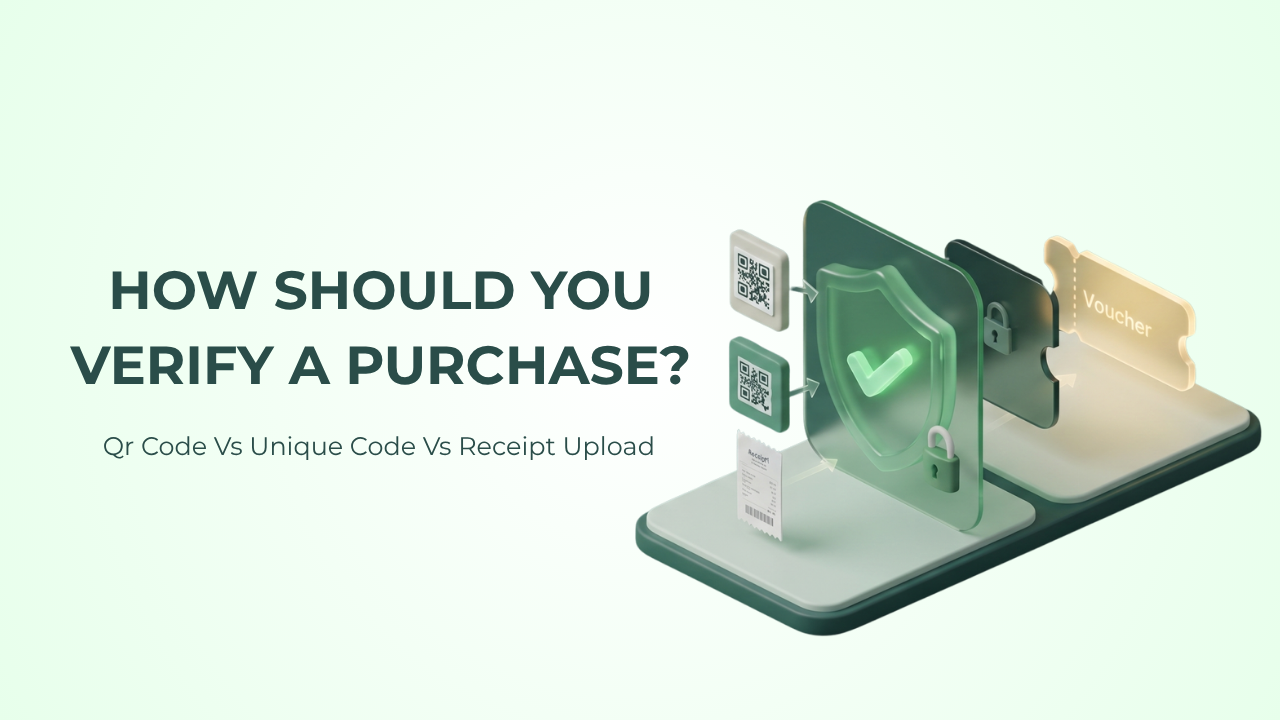
A QR code can start a promotion journey, but it does not automatically prove that a purchase occurred. A unique code can provide stronger pack-level evidence, while receipt upload can verify transactions when packaging cannot be changed.
The right purchase verification method depends on four things: the action that must be proved, the evidence available at purchase, the value at risk, and the amount of friction consumers will accept.
For brands planning consumer promotions in India, understanding this distinction is essential before deciding the reward, campaign mechanic, or technology journey.
What Is Purchase Verification in a Consumer Promotion?
Purchase verification is the process of establishing that a participant completed the commercial action required by a promotion.
That action could include:
- Buying a specific SKU
- Purchasing within a defined campaign period
- Buying from an eligible retailer
- Reaching a minimum basket value
- Making a repeat purchase
Verification converts a self-declared claim into an evidence-backed event that can safely trigger a reward.
Brands should separate four questions when designing the verification process:
- Did a qualifying product or basket get purchased?
- Is the participant eligible under the campaign rules?
- Has the same evidence, code, device, or identity been used before?
- Should the reward be issued automatically, held for review, or rejected?
These are different control layers.
For example, an OTP may confirm that a participant controls a particular mobile number, but it does not prove that the person purchased the product. Similarly, a receipt can provide transaction evidence but may still require duplicate and tampering checks.
Why Static QR Codes Are Commonly Misunderstood
A static QR code printed identically across every pack can be highly useful for starting a promotion.
It can direct consumers to a:
- Landing page
- WhatsApp journey
- Game
- Registration form
- Product guide
However, the same QR code can potentially be scanned by anyone who sees or photographs it.
Therefore, unless another layer of unique purchase evidence is captured, a static QR scan proves access to the campaign—not ownership of a qualifying product.
A serialized code works differently.
A unique identifier can be assigned to an individual pack, label, insert, cap, scratch panel, or another controlled unit. Once submitted, the system can check whether the code is valid, unused, associated with the correct SKU or batch, available in the market, and within the campaign period.
The RewardPort VERIFY Framework
Before choosing the verification technology, brands can use the VERIFY framework to determine what level of evidence the campaign actually requires.
V — Value at Risk
What is the maximum reward value, total campaign liability, and potential resale value?
Higher-value rewards generally require stronger verification and additional exception controls.
E — Evidence Available
Can the packaging be changed? Is there a receipt, invoice, serial number, or transaction feed available?
The most effective approach is usually to use evidence that naturally exists closest to the qualifying action.
R — Repeatability
Is the campaign designed for trial, every purchase, a streak, or a milestone?
Repeat-purchase campaigns require durable participant identification, deduplication, and purchase sequencing.
I — Identity Need
Does the brand need to identify an individual, household, outlet, or contractor—or only establish that a valid claim occurred?
Only information required for the campaign’s purpose should be collected, and identity should be separated from purchase proof.
F — Fraud Exposure
Could codes be copied? Could receipts be reused? Could participants automate claims or work together to exploit the campaign?
Duplicate, velocity, device, image, and pattern rules should be defined before launch.
Y — Yield and Friction
How many genuine buyers could abandon the process or be incorrectly rejected?
Fraud controls must be balanced against accessibility, participation, and speed.
QR Code vs Unique Code vs Receipt Upload: Comparison
| Method | What It Proves | Best Use | Main Limitation |
|---|---|---|---|
| Static QR | A person accessed a shared campaign entry point | Awareness, education, registration, or low-risk engagement | Does not independently prove a unique purchase |
| Serialized Pack Code | A specific controlled code was submitted | On-pack/in-pack promotions where packaging is controlled | Requires secure code generation, printing, reconciliation, and leakage controls |
| Receipt Upload with OCR | A transaction document appears to contain eligible products, date, outlet, and value | Multi-retailer promotions or campaigns where packaging cannot change | Image quality and product naming can cause false rejects or manual review |
| Invoice/Bill Parsing | A trade or consumer document contains defined commercial evidence | Dealer, retailer, contractor, and higher-value claim journeys | Requires duplicate, amendment, extraction, and tampering rules |
| Product Serial/Warranty Registration | A specific durable product or installation is registered | Electronics, appliances, tools, and warranty-linked campaigns | Serial availability may not prove purchaser identity or transaction date |
| OTP | Participant controls the submitted mobile number at that time | Login, identity, consent confirmation, or account recovery | Identity/access check—not purchase evidence |
| Transaction/Partner Data Feed | An approved system recorded the transaction | Closed retailer, distributor, card, or platform ecosystems | Coverage and latency depend on participating systems |
| Hybrid Verification | Two or more independent signals agree | Higher-value rewards and higher fraud exposure | Additional cost and participant friction |
How Should a Brand Choose the Right Verification Flow?
1. Define the Exact Qualifying Action
Avoid vague campaign rules such as “Buy & Win.”
Clearly define the eligible SKU, quantity, retailer, date, geography, and participant conditions.
2. Map the Evidence That Already Exists
Review what evidence is naturally available through:
- Packaging
- Receipts
- Product serial numbers
- Distributor data
- Warranty records
- Payment systems
- Order systems
3. Identify Fraud Pathways Early
Fraud controls should be considered before the campaign creative is finalized.
Potential risks can include code leakage, reused receipts, manipulated images, automated claims, outlet collusion, device switching, and reward resale.
4. Select the Minimum Sufficient Proof
The most sophisticated technology is not automatically the best option.
If a secure in-pack code reliably proves the purchase, adding receipt OCR may create unnecessary friction.
5. Design an Exception Journey
What happens if:
- A code is damaged?
- OCR confidence is low?
- A receipt contains an abbreviation?
- The participant experiences network failure?
- A legitimate claim is flagged?
These scenarios should have defined resolution processes.
6. Separate Verification from Reward Issuance
A claim can be valid but still require additional eligibility, budget, or payout checks before a reward is released.
7. Test with Real Packs and Receipts
Real-world testing can expose problems that synthetic tests miss, including faded printing, receipt folds, glare, retailer abbreviations, and weak network conditions.
8. Establish a Rule-Change Process
Fraud patterns and false rejections should be monitored continuously, but campaign rules should not be changed informally or in ways that disadvantage legitimate participants.
A Practical Consumer Promotion Control Architecture
A robust consumer promotion can be understood through five connected layers:
Entry
QR code, short URL, WhatsApp keyword, app, or partner interface.
Evidence
Unique code, receipt, invoice, product serial number, transaction record, or approved operational data.
Identity & Consent
Mobile number, account, outlet, or partner identity with purpose-specific data collection.
Decision
Eligibility, duplicate, velocity, geography, device, timing, and campaign-rule checks.
Value Delivery
Cashback, vouchers, merchandise, cinema, travel, experiences, or another approved reward—with fulfilment status recorded.
This prevents one of the most common campaign-design mistakes: treating the consumer-facing scan as the complete promotion system.
The scan is only the entry point. Verification, decision-making, and fulfilment form the complete campaign infrastructure.
Metrics That Show Whether Purchase Verification Is Working
| Metric | Definition | What It Reveals |
|---|---|---|
| Verification Pass Rate | Verified claims ÷ submitted claims | Alignment between rules, evidence quality, and eligibility |
| False-Reject Rate | Legitimate rejected claims ÷ reviewed legitimate claims | Consumer friction and excessive controls |
| Duplicate-Attempt Rate | Duplicate evidence attempts ÷ total attempts | Leakage, confusion, or potential abuse |
| Manual-Review Rate | Claims requiring human review ÷ submitted claims | Operational cost and verification-rule quality |
| Time to Verified Reward | Median time from submission to confirmed fulfilment | Participant experience and operational latency |
| Cost per Verified Action | Technology + operations + reward cost ÷ verified qualifying actions | True campaign efficiency |
| Data-Completeness Rate | Verified records containing all required usable fields ÷ verified records | Quality of reusable campaign intelligence |
| Repeat Verified Purchase Rate | Participants with second verified purchase ÷ first-time verified participants | Whether the campaign moves beyond one-time redemption |
Illustrative Scenario: A Packaged-Food Promotion
Consider a packaged-food brand launching a new SKU across modern trade, general trade, and e-commerce.
The packaging has already been printed, so adding a serialized code is not possible during the first phase. The campaign offers a modest assured reward alongside a larger weekly prize.
A suitable design could combine:
Receipt Upload + OCR → OTP → Duplicate Checks → Reward Eligibility → Fulfilment
Receipt upload and OCR can help establish the SKU, purchase date, and outlet.
OTP can create a participant account.
Duplicate-image and receipt-number checks can help control repeated claims.
The larger weekly prize can then have an additional review layer before eligibility is confirmed.
When the next batch of packaging is produced, the brand could introduce a serialized in-pack code to reduce dependence on receipt interpretation.
This is an illustrative design rather than a reported RewardPort client result. The appropriate method will depend on packaging control, retailer receipt quality, campaign rules, reward value, and applicable review requirements.
How RewardPort Connects the Full Promotion Loop
RewardPort helps brands connect campaign entry, purchase verification, eligibility, fraud controls, reward fulfilment, and reporting instead of treating rewards as standalone payouts.
Depending on the campaign, the evidence layer can incorporate QR, OTP, unique-code validation, receipt or invoice parsing, and approved transaction data.
The reward layer can then include cashback, vouchers, merchandise, cinema, travel, or experiences based on the target audience and behaviour.
The starting question should therefore not simply be:
“Which reward should we offer?”
Instead, brands should first ask:
“What action must be proved, and what is the lightest trustworthy evidence available?”
QR codes, unique codes, and receipt uploads each solve different problems in consumer promotions.
A static QR code is highly effective as an entry mechanism but does not independently establish purchase. Serialized codes provide stronger pack-level evidence where packaging is controlled. Receipt verification offers greater flexibility where purchases happen across multiple retailers or existing packaging cannot be changed.
The right verification architecture balances evidence strength, fraud exposure, consumer friction, operational cost, and reward value.
By designing verification before reward fulfilment, brands can build consumer promotions that are easier to measure, more trustworthy, and better equipped to turn campaign participation into meaningful business outcomes.
Frequently Asked Questions
Is a QR Scan Proof of Purchase?
Not by itself. A shared QR code proves access to the promotion journey. Purchase proof requires a unique controlled code, receipt, serial, transaction record or another qualifying evidence source.
When Is a Serialized Code Better Than Receipt Upload?
When the brand controls packaging and requires pack-level proof with fast automated validation. It can avoid many receipt-quality and line-item interpretation problems.
When Is Receipt OCR the Better Choice?
Receipt OCR can be appropriate when packaging cannot change, purchases occur across multiple retailers or the promotion applies to a basket rather than a single pack.
Does OTP Stop Fraud?
OTP can reduce certain identity and access risks, but it does not prove a purchase and does not independently prevent multiple-number, device or collusion strategies.
Should Every Rejected Claim Be Manually Reviewed?
No. Brands should define review thresholds for low-confidence or high-value cases alongside a participant grievance process.
What Personal Data Should a Promotion Collect?
Only data necessary for the stated purpose, eligibility, fulfilment, legal duties and measurement. Consent, notice, retention and withdrawal design should be reviewed against applicable Indian data-protection requirements.
Can One Verification Method Support Both Consumers and Dealers?
The same underlying technology may sometimes be reused, but evidence, identity, role, tax and reward rules can differ materially. Program logic and ledgers should therefore remain distinct.